How Generative AI Transforms Employee Training & Learning?
Written by Pravena K
- The Limitations of Traditional Employee Training
- The Growing Need for Continuous Skill Development
- What is Generative AI in Learning and Development?
- Two Key Drivers: Personalization and Automation
- Personalization: Tailoring Learning to Individual Needs
- AI as a Continuous Learning Assistant
- Automation in Learning and Development
- The Shift Toward Agile Training Workflows
- Responsible Use of AI in Training
- Build Expertise in Autonomous AI with GSDC’s Certified Agentic AI Professional certification
- The Future of Employee Training
- Conclusion
The way organizations train their employees is undergoing a major transformation. Traditional corporate training models, often built around classroom-style workshops and standardized learning materials, are increasingly struggling to keep pace with the rapid evolution of modern workplaces. As businesses adopt digital tools, AI automation, and AI-driven systems, employees must continuously upgrade their skills to remain effective.
This is where Generative AI is creating a powerful shift in learning and development. Instead of relying on static training programs that treat every employee the same, organizations are now exploring AI for employee training and AI-powered learning systems that personalize training experiences and automate repetitive learning processes.
By combining human expertise with AI capabilities, companies can design training programs that are more adaptive, scalable, and aligned with real workplace needs. This blog explores how generative AI is transforming employee training through personalization, automation, and continuous learning support.
In many organizations today, learning and development teams are already experimenting with generative AI software and AI training tools as practical training design assistants. Instead of spending weeks creating learning materials from scratch, trainers can generate draft modules, workplace simulations, and assessment questions using AI tools and then refine them with their expertise. This approach allows organizations to accelerate training development while keeping learning closely aligned with real operational challenges.
The Limitations of Traditional Employee Training
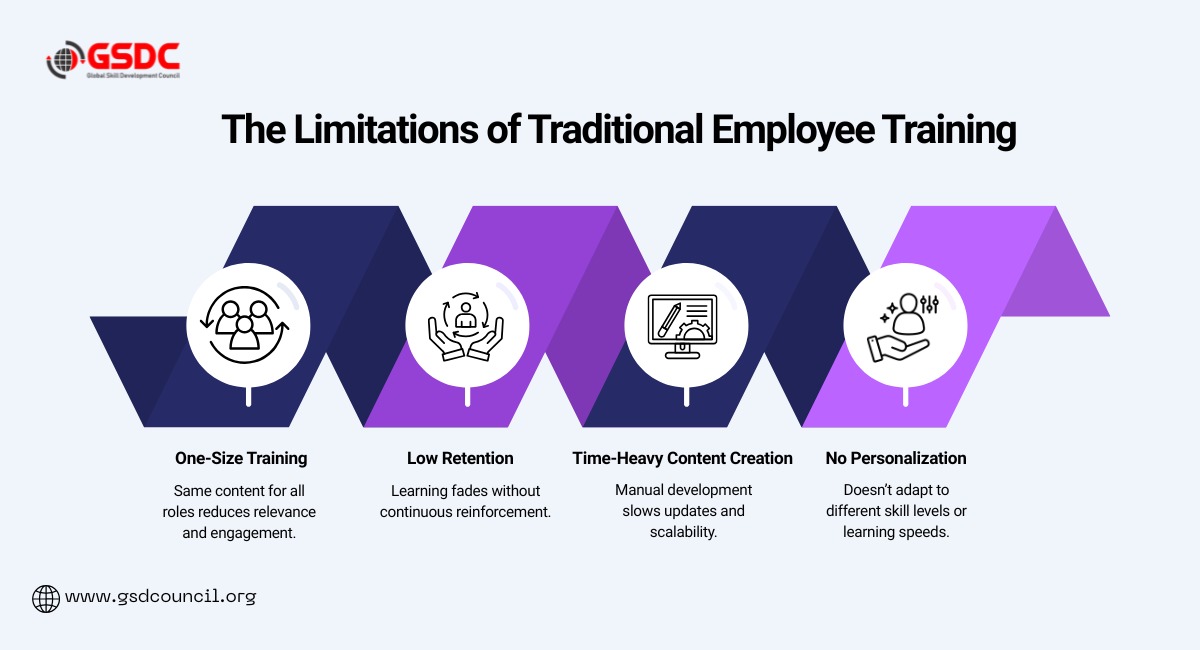
For many years, corporate training programs followed a similar format: a trainer prepared slides, delivered a workshop, and employees attended the session regardless of their role or experience level.
While this approach worked in slower, more stable work environments, it presents several challenges today, especially as organizations embrace generative AI for enterprise and digital transformation initiatives.
1. One-Size-Fits-All Training
Traditional training programs often deliver identical content to employees with vastly different responsibilities and levels of experience. For example, a communication workshop might include new hires, mid-level employees, and department managers in the same session.
However, their learning needs are very different. A new employee may need basic workplace communication skills, while a manager may need training on conflict resolution and leadership communication.
When training does not match the learner’s context, engagement and effectiveness decrease. This is why many organizations are adopting AI for training to create more personalized learning experiences.
2. Low Knowledge Retention
Employees often understand concepts during training sessions but struggle to apply them later in their work. Without continuous reinforcement, much of the learning fades quickly.
This is especially common when training is delivered as a single event rather than an ongoing learning process. Modern generative AI training solutions can help reinforce learning through continuous support and personalized recommendations.
3. Manual and Time-Consuming Content Development
Learning and development teams spend significant time creating training materials such as slides, case studies, assessments, and documentation.
Updating these materials becomes even more challenging when company processes, tools, or policies change frequently. As a result, training programs may become outdated or slow to adapt. Organizations are increasingly using generative AI software and AI-powered automation to streamline content creation and updates.
4. Lack of Individual Learning Adaptation
Every employee learns at a different pace. Some may already possess advanced knowledge, while others need foundational support. Traditional training rarely adapts to these differences.
This can lead to frustration for advanced learners and confusion for beginners. By leveraging AI-driven automation and intelligent learning systems, organizations can better tailor training to individual employee needs.
The Growing Need for Continuous Skill Development
The modern workplace is evolving faster than ever before. Technologies such as AI, automation, cloud platforms, and digital collaboration tools are changing how employees perform daily tasks. This ongoing generative AI revolution is reshaping how organizations operate, learn, and innovate.
As a result, the lifecycle of skills is becoming shorter. Tools update frequently, processes evolve, and job roles change rapidly. The increasing adoption of AI employees, intelligent assistants, and automated systems is further accelerating workplace transformation.
Organizations can no longer rely on occasional training programs. Instead, employees must continuously reskill and upskill to remain effective in their roles. To keep pace with these changes, many companies are investing in AI for employee training and modern learning technologies that support continuous development.
Companies that invest in modern learning strategies are better positioned to support workforce transformation and maintain competitiveness in a technology-driven environment. Additionally, professionals who pursue a Generative AI Certification can gain the skills needed to leverage emerging AI technologies and contribute effectively to organizational growth.
What is Generative AI in Learning and Development?
Generative AI refers to AI systems capable of producing new content, such as text, images, presentations, quizzes, or simulations, based on user prompts.
In the context of learning and development, generative AI can assist trainers and organizations in several ways:
- Creating training materials and course modules
- Summarizing long policy documents or training manuals
- Designing quizzes, assessments, and surveys
- Generating role-play simulations for workplace scenarios
Instead of starting from scratch, trainers can use AI-generated drafts and then refine them with their expertise and organizational context.
This approach significantly reduces preparation time while maintaining training quality.
Two Key Drivers: Personalization and Automation
The transformation of AI-driven training can largely be understood through two core capabilities: personalization and automation.
These two elements work together to create more effective and scalable learning systems.
Personalization: Tailoring Learning to Individual Needs
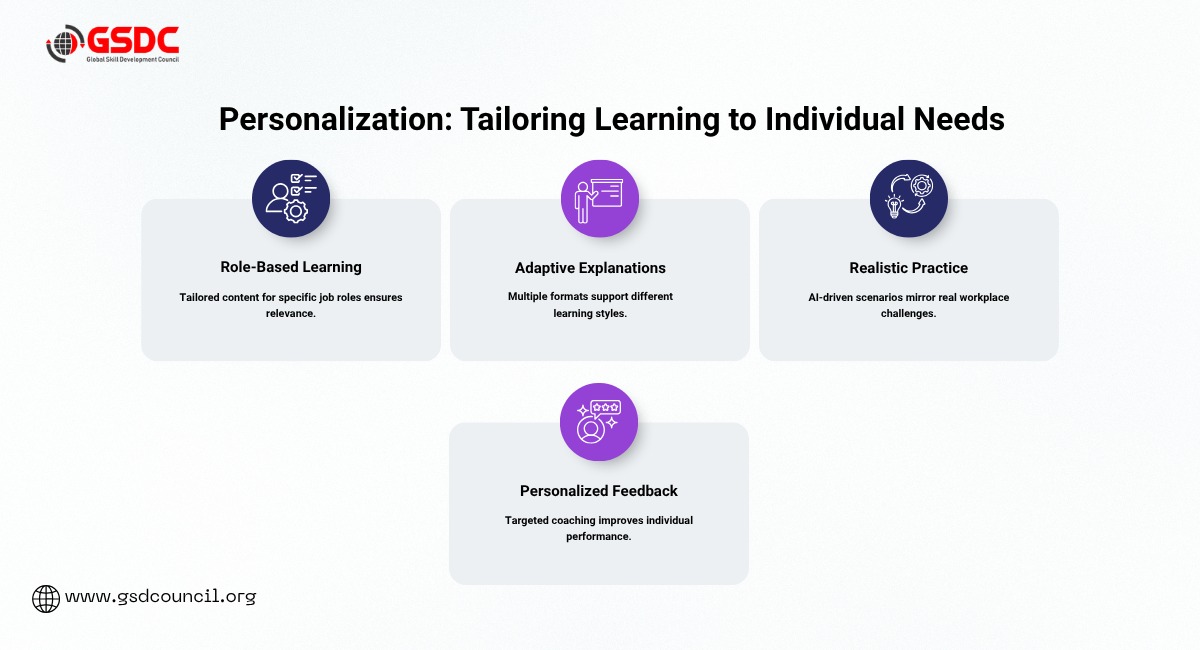
Personalization is one of the most powerful benefits of generative AI in training. Rather than delivering identical content to every employee, AI can help customize learning experiences based on roles, experience levels, and job responsibilities.
Role-Based Learning Paths
AI systems can generate training materials tailored to specific job functions.
For example:
- Customer service employees may receive training focused on handling customer interactions.
- Team leaders may receive training on feedback, performance management, and conflict resolution.
- Executives may focus on stakeholder communication and crisis management.
This ensures that training content is directly relevant to employees’ real responsibilities.
Adaptive Explanations
Employees learn in different ways. Some prefer simple explanations with examples, while others prefer deeper theoretical insights.
Generative AI can produce multiple versions of the same concept, allowing trainers to support diverse learning styles within the same organization.
Realistic Practice Scenarios
Another advantage of AI-powered learning is the ability to generate job-specific simulations and role-play scenarios.
Instead of generic case studies, employees can practice situations that closely reflect their daily work challenges. This improves engagement and makes learning more practical.
For example, in leadership and workplace communication training, generative AI can simulate conversations such as giving feedback to an underperforming team member, managing internal team conflict, or responding to difficult stakeholder questions. Learners can practice these scenarios in a safe environment before applying the skills in real workplace situations.
Personalized Coaching and Feedback
AI systems can also assist trainers by generating feedback or coaching suggestions for individual learners. This enables more targeted support and improves skill development over time.
AI as a Continuous Learning Assistant
One of the biggest shifts introduced by generative AI is that learning no longer ends when the training session finishes.
In traditional training models, employees attend workshops and receive materials, but follow-up learning often disappears. With AI for training and modern generative AI software, organizations can provide ongoing learning support long after formal training has ended.
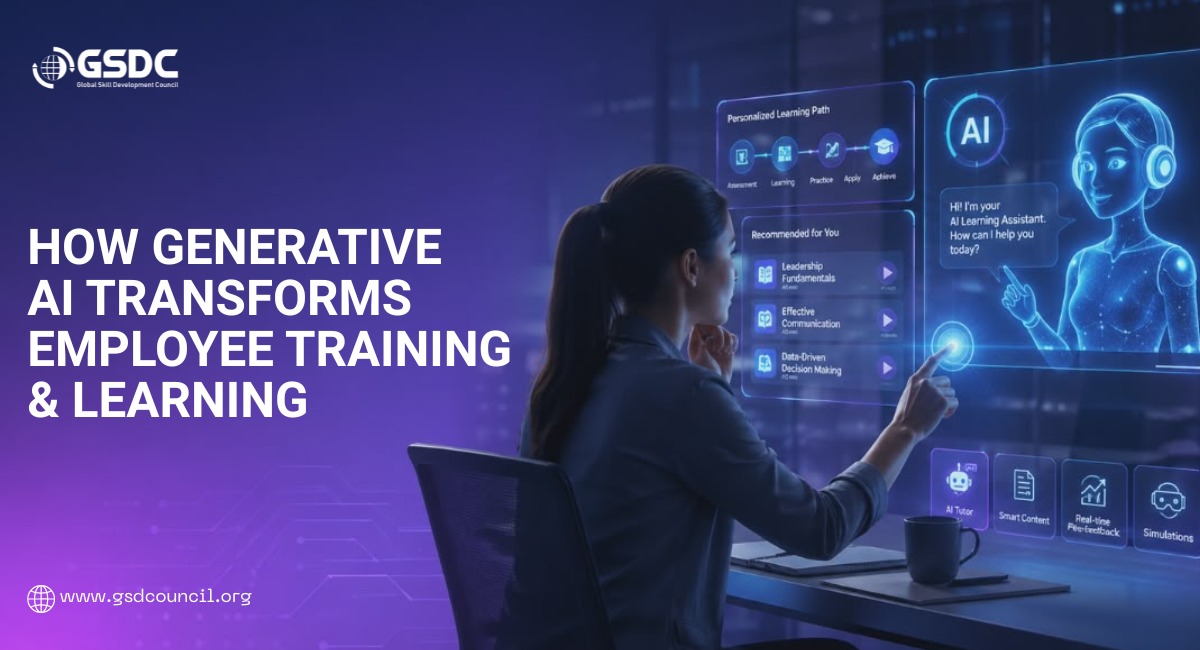
AI tools can extend learning beyond the classroom by acting as:
Learning Assistants
Employees can ask AI tools questions related to training content and receive quick explanations or reminders of key concepts.
Practice Partners
AI can simulate workplace scenarios, allowing employees to practice decision-making, communication, or problem-solving without real-world risks.
Explanation Tools
AI systems can simplify complex documents such as SOPs or policy manuals, helping employees quickly understand important information.
Feedback Generators
Some AI systems can analyze written responses or exercises and provide suggestions for improvement through AI-powered automation.
These capabilities turn training into a continuous learning experience rather than a one-time event. As organizations expand their use of generative AI training solutions, employees gain access to personalized support whenever they need it.
Automation in Learning and Development
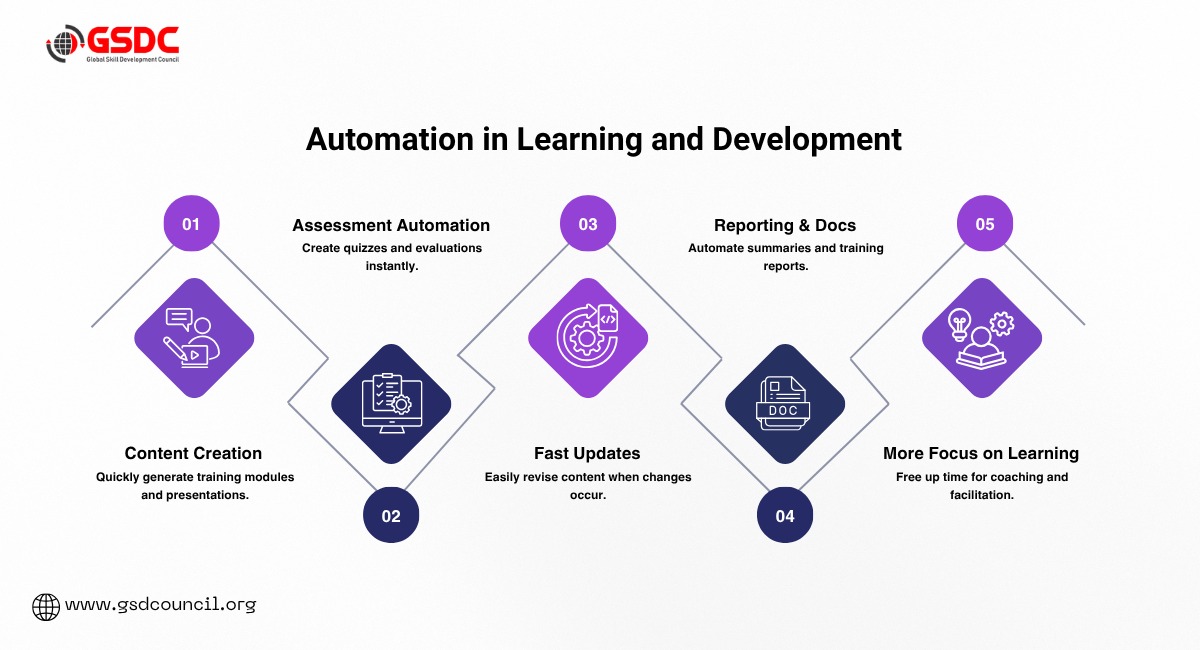
While personalization focuses on improving learning outcomes, automation focuses on improving efficiency.
Many tasks performed by learning and development teams are repetitive and time-consuming. Generative AI can automate several of these processes through AI-driven automation and intelligent content generation capabilities.
In practice, many trainers are beginning to use generative AI as a co-creation partner in course development. AI can help draft training outlines, generate discussion prompts, design role-play scenarios, and propose learning exercises. Trainers can then focus more on facilitation, contextual guidance, and coaching learners based on the organization’s real workplace dynamics. This growing use of generative AI for enterprise is helping organizations scale learning initiatives more effectively.
Content Generation
AI can quickly generate training outlines, modules, and presentations based on prompts provided by trainers using advanced generative AI software.
Assessment Creation
Trainers can generate quizzes, surveys, and evaluation forms automatically, saving significant preparation time through AI-powered automation.
Training Updates
When company policies or tools change, AI can help update training materials faster by modifying existing content.
Documentation and Reporting
AI tools can summarize training sessions, create reports, and produce learning documentation more efficiently.
By automating these tasks, trainers can focus more on coaching, facilitation, and improving the learning experience. The combination of AI automation and human expertise enables learning teams to deliver training faster while maintaining quality and relevance.
The Shift Toward Agile Training Workflows
Generative AI is also changing the structure of training workflows.
Traditional training processes typically follow a linear model:
Design → Develop → Deliver → Update
This approach can be slow and inflexible.
With AI-enabled systems, the workflow becomes more dynamic:
Design → Generate → Refine → Deliver → Improve Continuously
AI assists in generating content quickly, while trainers refine and contextualize the materials. Continuous feedback from learners can then be used to improve future training.
This agile approach allows organizations to update training programs faster and adapt to evolving workforce needs.
Responsible Use of AI in Training
While generative AI offers many benefits, organizations must use it responsibly. Effective AI adoption requires strong governance and human oversight, particularly when implementing generative AI for enterprise learning initiatives.
Key considerations include:
Accuracy
AI-generated content should always be reviewed before being used in training programs. Generative AI software can produce drafts quickly, but trainers must ensure the information aligns with company policies and real workflows.
Bias Awareness
AI models learn from large datasets that may contain biases. Trainers must review examples and scenarios to ensure training materials remain inclusive and balanced.
Data Privacy
Sensitive company data should not be uploaded to public AI platforms. Organizations should follow strict data governance policies when using AI training tools and other AI-powered systems.
Human Oversight
AI should support training processes, not replace human expertise. Trainers remain responsible for ensuring that learning objectives, accuracy, and quality standards are met. Even as organizations adopt AI-powered automation, human judgment remains essential.
Balancing human judgment with AI capabilities is essential for successful AI-driven learning systems. This approach ensures that AI for employee training enhances learning outcomes while maintaining trust, quality, and compliance.
Build Expertise in Autonomous AI with GSDC’s Certified Agentic AI Professional certification
The rapid growth of intelligent and autonomous systems is transforming how organizations operate, making AI agent expertise a valuable skill for modern professionals. GSDC’s Certified Agentic AI Professional Certification provides a comprehensive understanding of AI agent frameworks, autonomous decision-making, multi-agent collaboration, AI orchestration, and practical implementation approaches.
Designed for professionals looking to stay ahead in the AI era, the Certified Agentic AI Professional certification enables learners to leverage AI agents for workflow automation, operational optimization, and business transformation. By earning this credential, professionals can demonstrate their ability to work with advanced agentic AI technologies and strengthen their readiness for emerging roles in AI-driven organizations.
The Future of Employee Training
Generative AI is not simply a technological trend. It represents a fundamental shift in how organizations build skills and develop talent.
By combining personalized learning experiences with automated training processes, companies can create more adaptive and scalable learning environments.
In the future, employee training will likely become:
- More personalized
- More continuous
- More integrated with daily work tools
- More data-driven and responsive to feedback
Organizations that embrace this transformation will be better equipped to support workforce development in a rapidly evolving digital economy.
Conclusion
Generative AI is revolutionizing employee training by enabling organizations to move beyond traditional one-size-fits-all learning models. As part of the broader generative AI revolution, businesses are increasingly leveraging AI technologies to create more effective and scalable learning experiences.
Through personalization, AI allows training programs to adapt to individual roles, learning styles, and experience levels. Through AI automation, it reduces the time and effort required to create and maintain training materials.
However, successful implementation requires responsible AI practices, human oversight, and thoughtful integration into existing learning strategies. Organizations adopting generative AI for enterprise must ensure that AI solutions align with business goals, compliance requirements, and workforce needs.

Related Certifications
Frequently Asked Questions
Stay up-to-date with the latest news, trends, and resources in GSDC
If you like this read then make sure to check out our previous blogs: Cracking Onboarding Challenges: Fresher Success Unveiled
Not sure which certification to pursue? Our advisors will help you decide!