Zero-Shot, One-Shot, Few-Shot-Teaching AI Your Company Voice
Written by Emily Hilton
- Understanding AI Prompting
- What Is Zero-Shot Prompting?
- What Is One-Shot Prompting?
- What Is Few-Shot Prompting?
- Teaching AI Your Company Voice
- The Power of Role Prompting
- Why Clear Instructions Matter
- Chain of Thought Prompting
- Prompt Chaining for Learning Design
- Creating an HR Prompt Templates Library
- Using AI Self-Critique for Better Results
- Enhancing Learning Content with RAG
- AI Agents and HR Onboarding
- Measuring Success: AI ROI in Learning and Development
- Responsible AI and Regulatory Considerations
- Developing AI Skills for HR and L&D Professionals
- Conclusion
The rise of generative AI in HR has transformed how organizations create learning content, employee communications, onboarding materials, performance support resources, and talent development programs. From drafting policies to designing training modules, AI tools are helping HR and Learning & Development teams work faster than ever before.
However, many organizations quickly discover a challenge: while AI can generate content instantly, it often lacks the company's unique voice. The tone may be too formal, too generic, or inconsistent with established communication standards.
This is where prompting techniques become essential.
Just as a new employee needs guidance to understand organizational culture and communication expectations, AI models also require direction. Techniques such as Zero-Shot, One-Shot, and Few-Shot Prompting help organizations teach AI how to communicate in their unique voice.
In this article, we'll explore these foundational prompting methods, understand how they work, and examine their role in modern HR and L&D workflows.
Understanding AI Prompting
A prompt is the instruction given to an AI system to perform a task. The quality of the output often depends on the clarity and structure of the prompt.
As organizations adopt AI-powered workflows, prompt engineering is becoming a critical skill for HR professionals, instructional designers, trainers, and learning leaders.
Effective prompting helps organizations:
- Maintain consistent brand voice
- Improve content quality
- Reduce editing time
- Scale content creation
- Enhance employee learning experiences
Before diving into advanced techniques, let's understand the three foundational prompting approaches.
What Is Zero-Shot Prompting?
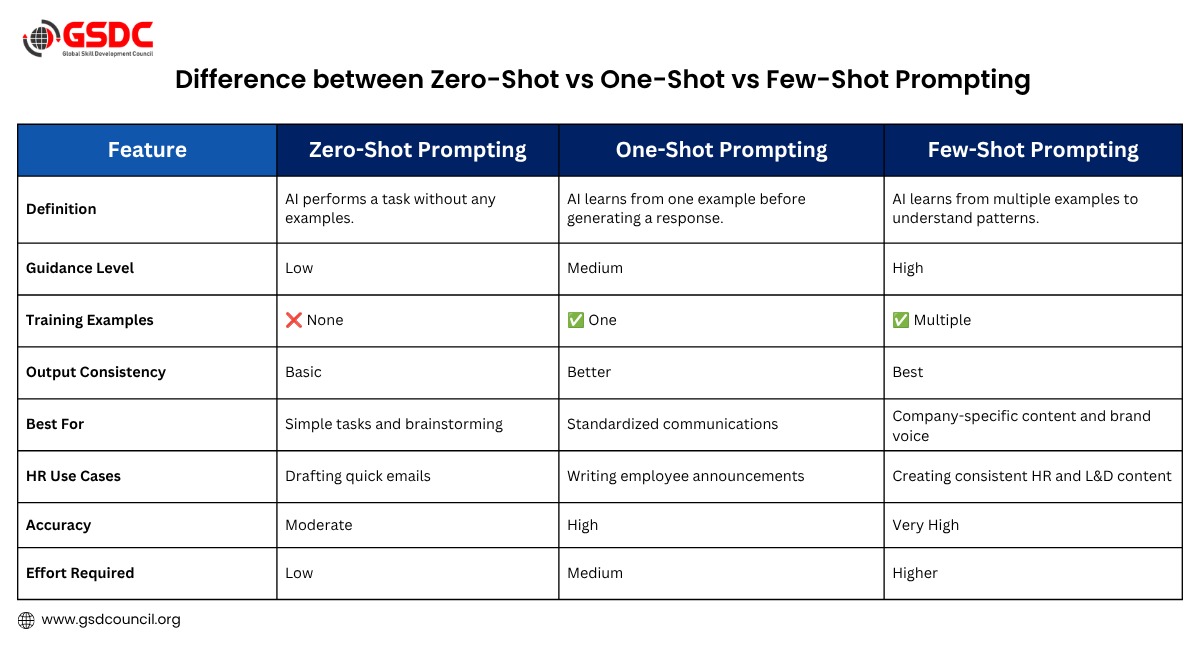
Zero-Shot Prompting refers to asking AI to complete a task without providing any examples.
The model relies entirely on its existing training and your instructions to generate a response.
Example
Prompt:
"Write an onboarding welcome email for a new employee joining the marketing team."
The AI generates content based on general knowledge of onboarding communications.
Benefits of Zero-Shot Prompting
- Fast and simple
- Minimal preparation required
- Useful for basic tasks
- Ideal for brainstorming
Limitations
- Output may be generic
- The company tone may not be reflected
- Inconsistent results across different prompts
For HR teams, Zero-Shot Prompting works well for initial drafts, idea generation, and routine communications. However, when consistency and organizational voice matter, additional guidance is often necessary.
What Is One-Shot Prompting?
One-Shot Prompting improves AI performance by providing a single example before requesting a new output.
The example demonstrates the expected format, style, tone, or structure.
Example
Prompt:
"Here is an example of our onboarding welcome message:
'Welcome to our team. We believe in collaboration, innovation, and continuous learning. We're excited to support your growth journey.'
Using the same tone, write a welcome message for a software engineer."
The AI uses the example to replicate the style.
Benefits of One-Shot Prompting
- Better alignment with company voice
- Improved consistency
- Faster than creating detailed instructions
- Useful for repetitive HR communications
HR Applications
One-Shot Prompting can be used for:
- Employee announcements
- Learning communications
- Internal newsletters
- Performance feedback templates
- Recruitment messages
This approach is similar to showing a new employee one example of the desired work before asking them to complete a task.
What Is Few-Shot Prompting?
Few-Shot Prompting takes the concept further by providing multiple examples.
Instead of learning from one sample, AI identifies patterns across several examples and applies them to new tasks.
Examples
An HR team may provide:
Example 1: Leadership training invitation
Example 2: Compliance training announcement
Example 3: Skills development workshop communication
Then ask:
"Create a new communication for a digital transformation training program using the same style."
The AI learns recurring patterns across all examples.
Why Few-Shot Prompting Works
Research shows that AI performs significantly better when given multiple examples because it can:
- Recognize tone patterns
- Understand preferred vocabulary
- Follow formatting conventions
- Replicate organizational writing styles
This makes few-shot prompting for HR one of the most valuable techniques for maintaining consistent employee communications.
HR Use Cases
Few-shot prompting can improve:
- Learning campaign communications
- Policy announcements
- Employee engagement messages
- Leadership communications
- Internal knowledge articles
Organizations seeking brand consistency often find Few-Shot Prompting to be the most practical approach for day-to-day HR content creation.
Teaching AI Your Company Voice
Every organization has a unique communication style.
Some companies prefer formal and professional language, while others adopt a conversational and employee-friendly tone.
Teaching AI your voice involves providing context, such as:
- Writing samples
- Brand guidelines
- Communication principles
- Audience expectations
- Organizational values
The more examples AI receives, the better it can mirror your communication standards.
This process helps transform AI from a generic content generator into a company-specific writing assistant.
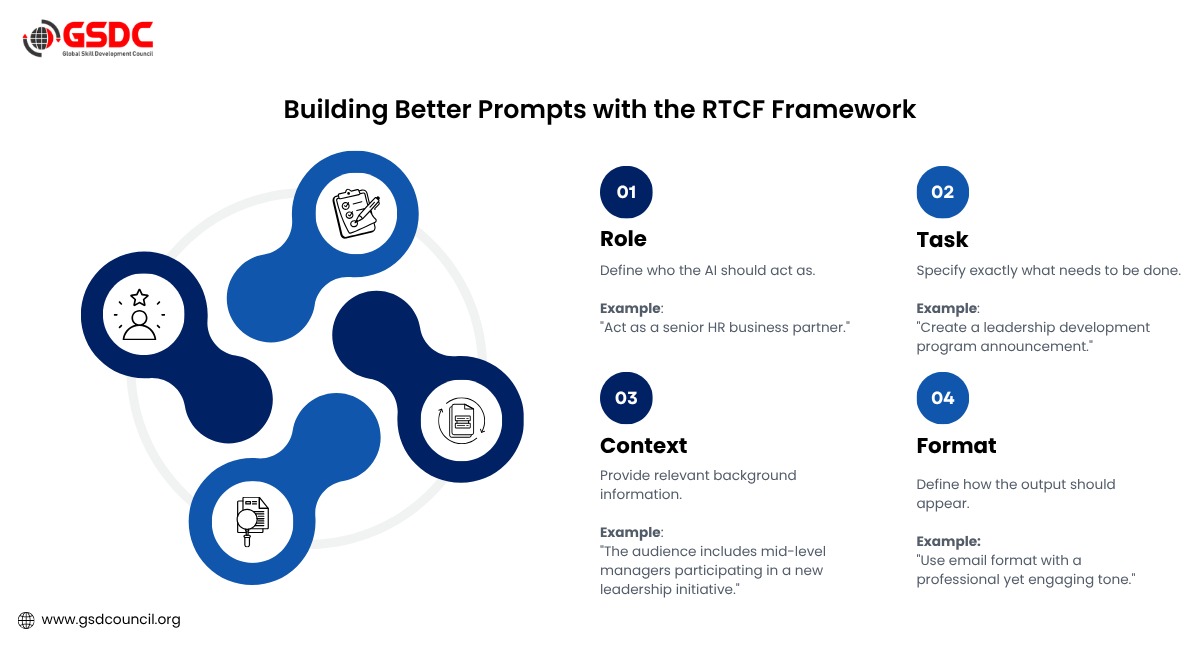
The Power of Role Prompting
One of the most effective ways to guide AI is through role prompting for L&D.
Instead of asking AI to create content generally, assign it a specific role.
Examples:
- Learning strategist
- Instructional designer
- HR manager
- Leadership coach
- Talent development consultant
When AI adopts a role, it can tailor language, recommendations, and perspectives more effectively.
Role prompting is particularly useful when designing learning journeys, competency frameworks, and leadership development initiatives.
Why Clear Instructions Matter
Many AI-related challenges stem from vague prompts.
Providing clear AI instructions HR teams can follow is critical for obtaining reliable outputs.
Instead of saying:
"Write a training communication."
Say:
"Write a 250-word training announcement for frontline employees using a supportive and encouraging tone. Include registration instructions and key learning outcomes."
Specificity leads to better results.
Organizations should establish prompt-writing guidelines to ensure consistent AI usage across teams.
Chain of Thought Prompting
Another useful technique is chain of thought prompting HR professionals can use when tackling complex tasks.
Instead of requesting a final answer immediately, the AI is encouraged to reason through the problem step by step.
Example:
"Identify onboarding challenges, analyze root causes, and then recommend solutions."
This approach improves:
- Problem-solving quality
- Decision-making support
- Strategic recommendations
- Training analysis
For workforce planning, skills assessments, and learning strategy development, Chain of Thought Prompting often produces more thoughtful outcomes.
Prompt Chaining for Learning Design
As AI adoption matures, organizations increasingly use prompt chaining course design techniques.
Prompt chaining involves connecting multiple prompts.
For example:
Prompt 1
Identify learning objectives.
Prompt 2
Create course modules based on objectives.
Prompt 3
Generate assessments for each module.
Prompt 4
Develop learner communications.
Each output becomes input for the next step.
This structured process helps instructional designers create complete learning experiences while maintaining consistency and quality.
Creating an HR Prompt Templates Library
Organizations can improve efficiency by developing an HR prompt templates library.
Rather than writing prompts from scratch every time, teams can maintain standardized templates for recurring tasks.
Examples include:
- Job descriptions
- Interview questions
- Learning communications
- Performance review summaries
- Policy explanations
- Onboarding content
Benefits include:
- Faster content creation
- Consistent outputs
- Reduced training requirements
- Improved governance
A prompt library becomes an organizational asset that scales AI adoption across HR functions.
Using AI Self-Critique for Better Results
One advanced technique is AI self-critique prompting HR teams can use to improve output quality.
After generating content, ask the AI to review its own work.
Example:
"Evaluate this onboarding communication for clarity, inclusivity, and engagement. Suggest improvements."
The AI acts as both creator and reviewer.
Benefits include:
- Improved accuracy
- Better readability
- Reduced bias
- Higher-quality content
Self-critique is particularly useful when creating employee-facing materials where clarity and inclusivity are important.
Enhancing Learning Content with RAG
As organizations build internal knowledge bases, RAG for L&D content is becoming increasingly important.
RAG stands for Retrieval-Augmented Generation.
Instead of relying only on general knowledge, AI retrieves information from trusted internal sources before generating responses.
Examples include:
- Company policies
- Learning repositories
- Standard operating procedures
- Knowledge management systems
Benefits include:
- Improved accuracy
- Reduced hallucinations
- Organization-specific outputs
- Better compliance
For L&D teams, RAG helps ensure learning materials reflect current organizational practices.
AI Agents and HR Onboarding
The next evolution of workplace AI involves AI agents for HR onboarding.
Unlike traditional chatbots, AI agents can perform multi-step tasks autonomously.
Examples include:
- Answering new hire questions
- Scheduling orientation sessions
- Recommending learning paths
- Tracking onboarding progress
- Delivering personalized resources
By combining prompting techniques with organizational knowledge, AI agents can create more engaging onboarding experiences while reducing administrative workload.
Measuring Success: AI ROI in Learning and Development
As AI adoption grows, leaders need ways to evaluate effectiveness.
Measuring AI ROI in L&D involves tracking both quantitative and qualitative outcomes.
Common metrics include:
Efficiency Metrics
- Content creation time
- Administrative workload reduction
- Faster course development
Learning Metrics
- Course completion rates
- Learner satisfaction
- Knowledge retention
Business Metrics
- Productivity improvements
- Reduced training costs
- Faster employee onboarding
Organizations that establish clear measurement frameworks are better positioned to scale AI initiatives successfully.
Responsible AI and Regulatory Considerations
While AI offers significant benefits, organizations must use it responsibly.
Topics such as fairness, transparency, privacy, and accountability are becoming increasingly important.
The conversation around responsible AI in HR / EU AI Act highlights the need for governance frameworks that ensure ethical AI deployment.
Key considerations include:
- Data privacy protection
- Bias mitigation
- Human oversight
- Explainability
- Regulatory compliance
HR leaders play a crucial role in balancing innovation with responsible implementation.
Developing AI Skills for HR and L&D Professionals
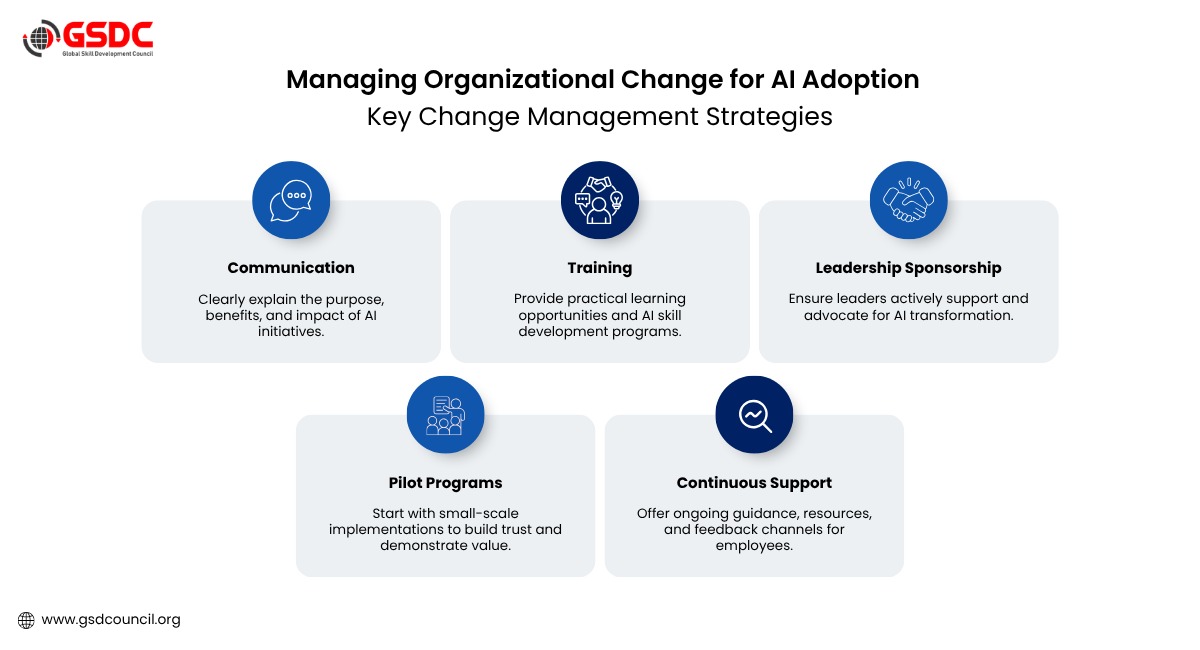
As AI becomes a core workplace capability, HR and L&D professionals need structured learning pathways.
Programs such as the GSDC GenAI L&D HR certification help professionals build foundational and practical skills in:
- Prompt engineering
- Generative AI applications
- Learning design
- AI governance
- HR transformation
Professional certifications can help teams develop confidence and competence while accelerating responsible AI adoption.

The GSDC Generative AI in HR & L&D Certification is designed for HR and Learning & Development professionals who want to integrate Generative AI into modern workplace practices. The program covers practical applications such as AI-powered recruitment, personalized learning experiences, content creation, workforce planning, prompt engineering, and process automation.
Conclusion
Zero-Shot, One-Shot, and Few-Shot Prompting are foundational techniques that help organizations teach AI their unique voice.
While Zero-Shot Prompting offers speed and simplicity, One-Shot and Few-Shot approaches provide greater consistency and alignment with organizational communication standards. Combined with techniques such as role prompting, prompt chaining, self-critique, RAG, and AI agents, these methods enable HR and L&D teams to unlock the full potential of generative AI.
As organizations continue expanding their use of generative AI in HR, success will depend not only on technology but also on the ability to guide AI effectively through structured prompts, governance frameworks, and continuous learning.
By mastering these foundational prompting techniques today, HR and L&D professionals can create more personalized learning experiences, improve operational efficiency, and build a future-ready workforce equipped for the AI-powered workplace.

Related Certifications
Stay up-to-date with the latest news, trends, and resources in GSDC
If you like this read then make sure to check out our previous blogs: Cracking Onboarding Challenges: Fresher Success Unveiled
Not sure which certification to pursue? Our advisors will help you decide!