Automating Learning with AI for Scalable, Personalized Training
Written by Ritwik Shete
- The Scalability Paradox in L&D
- Consistency Through Automation
- From Craftsmanship to Assembly Line: The L&D Transformation
- The L&D Tech Stack: Face, Engine, and Glue
- Human + Machine: The Future of L&D
- Implementation Strategy: Start Small, Scale Gradually
- Common Challenges and Pitfalls
- How L&D Certification Prepares Professionals for Modern Learning Leadership?
- Conclusion
People who enjoy their work day through performing tasks that involve copying email addresses from a spreadsheet to a web form probably view this blog as their personal website. Most of us got into learning and development because we wanted to teach, inspire, and help people grow, not because we dreamed of becoming professional schedulers or data-entry clerks.
The typical Learning and Development calendar shows what happens when organizations experience their regular operational times. The employees face a situation where they need to perform the same tasks multiple times through their manual work processes. Organizations need advanced ai in training and development because they need to train their workforce at all locations without adding extra resources.
Artificial intelligence technologies bring transformational changes to learning and development programs through their implementation. Organizations use these technologies as essential business tools that enable AI-powered employee training to execute repetitive tasks while decreasing administrative work and building valuable training programs. Organizations use contemporary AI-based learning platforms to deliver training programs that include standardized content and personalized learning experiences.
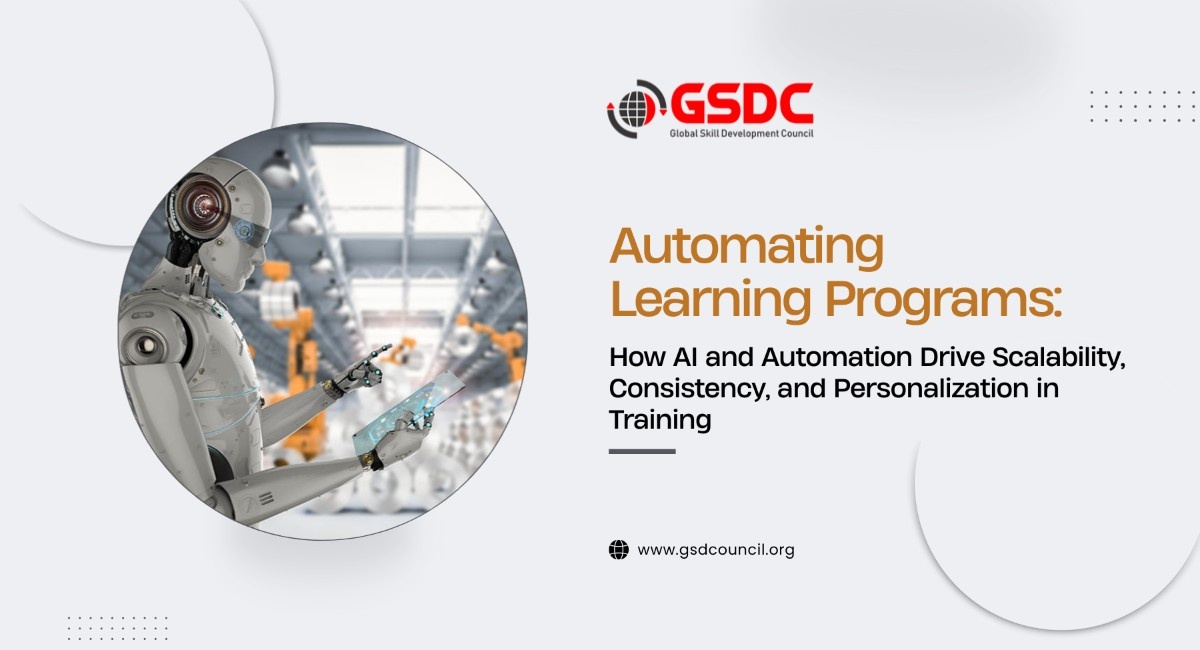
The blog post reveals the major findings from the webinar Automating Learning Programs: How AI and Automation Drive Scalability, Consistency, and Personalization in Training, which shows readers how to create better learning and development programs through new scaling and personalization methods.
The Scalability Paradox in L&D
Traditional learning programs require learning and development teams to complete administrative work, which prevents them from delivering educational content and developing their staff. The main difficulties organizations face include:
- The process requires workers to manually schedule and enroll students while they monitor progress through spreadsheets.
- The organization needs to train its workforce at a fast pace, but they lack additional support to achieve this goal.
Consistency Through Automation
The corporate training program uses manual delivery methods, which depend on repetitive tasks and coordination efforts, and the continuous monitoring of instructors. The fast-paced business environment needs standard process delivery because repetition helps develop skills but causes problems with communication and delivery of training programs, and creates hazardous conditions. This is where AI in training and development provides a smarter, more reliable approach.
The training development process at organizations becomes automated through AI tools for training and development, which distribute training materials to all remote locations throughout the world, including the cities of Mumbai, Munich, and Minneapolis. The training AI systems create an automated process that eliminates the need for human trainers to schedule and deliver training content.
Modern AI-powered learning platforms provide these essential functions:
- The platform distributes training content to multiple locations, which enables training to maintain consistent delivery across all sites.
- The system guarantees that all essential instructions and compliance documents reach every student without any content gaps.
- The system decreases mistakes which stem from human factors, including fatigue and mistakes and the normal range of human behavior.
- The system creates uniform learning paths that enable students to select their preferred learning methods.
AI improvements demonstrate their advantages in learning and development programs, which help organizations train employees effectively while achieving training standards that match their workforce's accuracy and delivery of consistent quality training.
From Craftsmanship to Assembly Line: The L&D Transformation
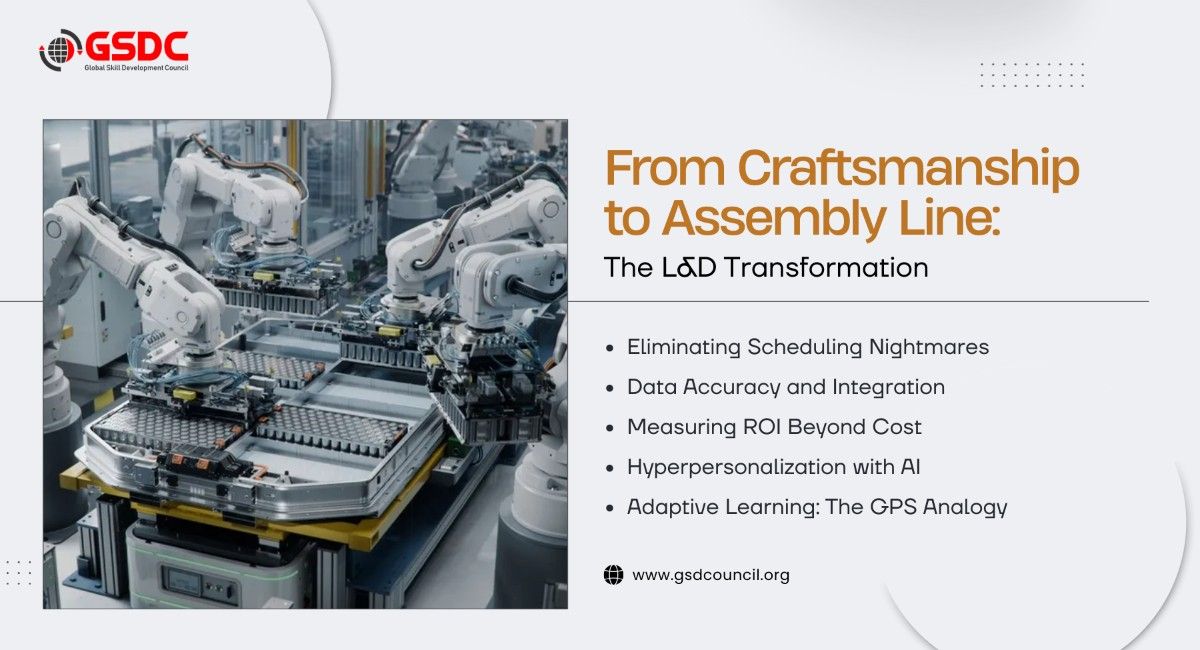
Large organizations require traditional L&D systems, which use customized training methods because these systems cannot operate efficiently at their major scale. The assembly-line method of operation appears through automation when organizations establish their first automated systems:
- The organization needs to create rules that apply to the entire organization, starting with their first rule, which requires all new sales hires to take the Negotiation 101 course.
- AI operates all automatic functions through scheduling and reporting, and content delivery systems.
- L&D professionals shift from factory workers to engineers designing high-value learning experiences instead of manually managing processes.
Eliminating Scheduling Nightmares
Scheduling live sessions for large groups is time-consuming and frustrating, especially across time zones and with last-minute changes. Automation tools integrate with calendars, manage waitlists, and find optimal slots, eliminating admin burden. L&D professionals can finally focus on teaching and facilitating learning rather than policing schedules.
Data Accuracy and Integration
Manual spreadsheets are prone to errors, risking compliance reporting mistakes. Automated systems create direct pipelines between HR and learning platforms, removing “human middleware” and ensuring accurate data. This saves hours of administrative work while maintaining consistency and reliability across learning programs.
Measuring ROI Beyond Cost
Automation isn’t just about saving money; it improves engagement and retention. Starbucks reduced barista turnover from 25% to 11% by automating scheduling and screening. Faster, smoother processes enhance the employee experience, demonstrating that ROI includes time efficiency, reduced turnover, and better overall learning outcomes, not just software costs.
Hyperpersonalization with AI
Employees expect personalized learning like their Netflix experience. AI analyzes roles, skill gaps, and peer behavior to recommend tailored content. For example, a coding expert struggling with public speaking might get targeted presentation training. This approach respects learners’ time, increases engagement, and improves knowledge retention across the organization.
Adaptive Learning: The GPS Analogy
Traditional training is like a bus stopping at every street; adaptive AI learning is like GPS, guiding employees based on current skills and objectives. Learners skip unnecessary basics, saving time. IBM’s Your Learning platform shows success: 98% quarterly usage and 60 hours of voluntary learning per year, proving AI personalization drives engagement.
The L&D Tech Stack: Face, Engine, and Glue
To fully leverage AI and automation, organizations need a holistic learning ecosystem.
- Face (LXP) – The user interface, akin to Netflix, which makes the learning experience visually appealing, intuitive, and engaging. A well-designed Learning Experience Platform (LXP) encourages exploration, tracks social learning, and creates a learner-centric experience.
- Engine (Generative AI) – The backend powerhouse that generates content, quizzes, and translations, freeing human trainers from repetitive creation tasks. Generative AI allows L&D professionals to focus on strategic content decisions rather than mechanics.
- Glue (APIs) – The invisible infrastructure connecting HR and learning systems. APIs automate administrative processes like enrollment, reporting, and data synchronization, eliminating human bottlenecks.
Together, these three components enable L&D departments to scale operations efficiently while maintaining quality and personalization.
Human + Machine: The Future of L&D
A common concern when discussing AI in L&D is job displacement. AI is not a replacement for human professionals but a powerful augmentation. AI can handle administrative tasks, generate quizzes, and schedule sessions, but it cannot understand company culture, facilitate emotional breakthroughs in leadership workshops, or make nuanced judgments.
By automating repetitive tasks, L&D professionals can shift from course administrators to performance architects, focusing on what content to teach and how best to facilitate employee growth. This “human with machine” approach ensures that employees benefit from both technological efficiency and human insight.
Implementation Strategy: Start Small, Scale Gradually
The webinar demonstrated its content through actual use cases. Organizations should use their most frequent, time-intensive, and valuable processes to begin automation work, which includes scheduling sessions for their corporate training program. AI tools enable teams to streamline their administrative tasks while they enhance their operational processes through training and development activities, which create immediate advantages for their organization.
AI training systems depend on pre-assessment processes to create personalized experiences. Organizations create personalized learning paths through the process of evaluating employee skill levels, which helps them develop programs that meet their specific needs. AI programs require different learning paths for developers because not all developers need basic knowledge, while some need advanced product integration methods. The targeted learning method supported by AI-powered learning platforms achieves efficient learning by eliminating duplicate content, which also saves time and meets actual business needs.
The success story of IBM demonstrates the effectiveness of this business model. The organization achieved high employee participation through its pre-assessment system, which identified suitable learning paths, leading to employees finishing their training. The demonstration of AI-enabled learning and development advantages shows its value when applied through strategic methods.
Common Challenges and Pitfalls
- Overestimating AI Accuracy – Large Language Models (LLMs) and other AI tools are not 100% accurate. Predictions and content recommendations need human oversight.
- Eliminating the Human in the Loop – Human involvement is essential for providing context, cultural nuance, and organizational insight. Removing this element can lead to irrelevant or misaligned learning programs.
- Premature Workforce Reduction – Some organizations assume automation allows for headcount reduction.
- Poor Data Quality – AI systems rely on accurate data. Pre-assessments, HR integrations, and consistent reporting are critical to ensure personalization and efficiency.
- Starting with Complexity – Jumping directly to full-scale AI-driven personalization without piloting incremental steps can overwhelm teams and reduce adoption.
How L&D Certification Prepares Professionals for Modern Learning Leadership?
The Learning & Development certification program from GSDC provides professionals with essential practical skills to design, implement, and expand effective learning programs for contemporary digital-first work environments.
The program connects traditional training methods with modern technology-based learning through its emphasis on instructional design, data-driven decision-making, and performance-based assessment.
The Learning & Development certification establishes professional credibility while it verifies international standard skills and trains L&D leaders to implement new methods, which include personalized learning, automated systems, and ongoing development practices.

Conclusion
What should we learn from this situation? Your current work methods require you to create each course from scratch, while you send messages that take a long time to reach others. AI and automation exist to help your work become more valuable because they do not exist to replace your employment.
You will achieve a life without scheduling problems that require you to create identical content and handle disorganized spreadsheets. You should dedicate your time to three essential tasks, which include creating actual educational activities, assessing employee requirements, and assisting their personal development through human connections. AI takes care of basic tasks while humans manage essential planning tasks.
Begin your project with small steps while you concentrate on your most important tasks. The result? The organization gains employees who participate voluntarily, and the training programs achieve seamless expansion while learning and development experts finally perform their actual duties, which involve establishing performance standards to facilitate growth and create enjoyable work experiences. You should adopt the assembly line system while maintaining your role as an engineer. The location functions as the site where everything becomes possible.

Related Certifications
Stay up-to-date with the latest news, trends, and resources in GSDC
If you like this read then make sure to check out our previous blogs: Cracking Onboarding Challenges: Fresher Success Unveiled
Not sure which certification to pursue? Our advisors will help you decide!