How the CLO Role Is Evolving in the Age of Skills, Data, and AI?
Written by Charity McDonald
- From Training Manager to Strategic Business Partner
- Why the Traditional CLO Model Is No Longer Enough
- The Impact of AI on Learning Leadership
- Governance, Ethics, and Human-Centered AI
- Skills, Education, and the Return of Balance
- New Titles, Same Mission
- Collaboration, Influence, and Change Leadership
- The Future of the CLO Role
- Conclusion
The role of the chief learning officer is undergoing one of the most significant transformations in its history. What was once a function centered on training delivery and compliance is now evolving into a strategic, data-driven, and AI-enabled leadership role that directly influences business outcomes. This evolving role reflects the growing strategic importance of learning leadership in modern enterprises.
As organizations navigate rapid technological change, workforce disruption, and evolving skill demands, learning leaders are being asked to step far beyond traditional learning and development. The modern CLO or its emerging equivalents is expected to shape workforce strategy, guide ethical AI adoption, and ensure that learning investments deliver measurable impact through AI in learning and development initiatives.
This shift is not incremental. It is a fundamental redefinition of what learning leadership means in the future of work, reshaping the CLO role and redefining what a Chief Learning Officer is in today’s business environment.
From Training Manager to Strategic Business Partner
Historically, the clo role focused on managing training programs, overseeing learning management systems, and ensuring compliance with regulatory requirements. Success was often measured through participation rates, course completion, and learner satisfaction surveys.
While these elements remain important, they are no longer sufficient.
Today’s organizations expect learning leaders to function as strategic partners deeply embedded in business planning and decision-making. Learning is no longer viewed as a support function; it is increasingly recognized as a lever for productivity, innovation, and competitive advantage, especially with the rise of AI and learning initiatives.
Modern enterprises are also integrating AI-driven automation and workforce AI strategies into development programs, redefining what is ai training in the context of business growth and employee enablement.
Instead of asking, “Did employees like the training?” leaders now ask:
- How did learning impact performance?
- Did it reduce costs or save time?
- Did it prepare the workforce for future demands?
The focus has shifted decisively from activity to outcomes.
Why the Traditional CLO Model Is No Longer Enough
Many enterprises, especially large, complex organizations, still do not have a dedicated chief learning officer. In practice, learning responsibilities are often absorbed by Chief People Officers, HR leaders, or talent development heads as only a fraction of their broader roles. In other cases, organizations rely on fractional or consulting CLOs, recognizing the value of learning leadership without committing to a full-time executive role.
This trend is accelerating as expectations rise.
The traditional clo role was largely reactive: identifying skill gaps after performance issues emerged and deploying training to address them. In a world where technology, AI, and market conditions evolve continuously, this reactive approach no longer works.
Organizations now need learning leaders who can anticipate skill needs before gaps appear, align learning strategy with enterprise goals, and guide the workforce through constant change. This evolving role is being further shaped by the adoption of ai in learning and development and workforce ai strategies across modern enterprises.
The Impact of AI on Learning Leadership
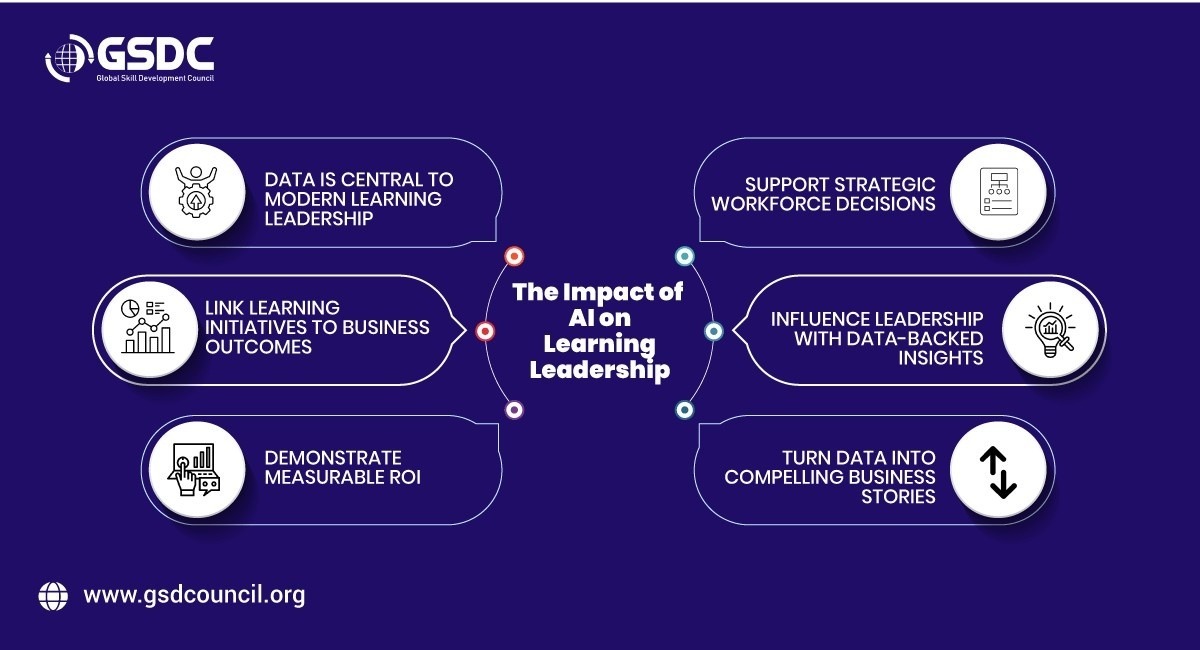
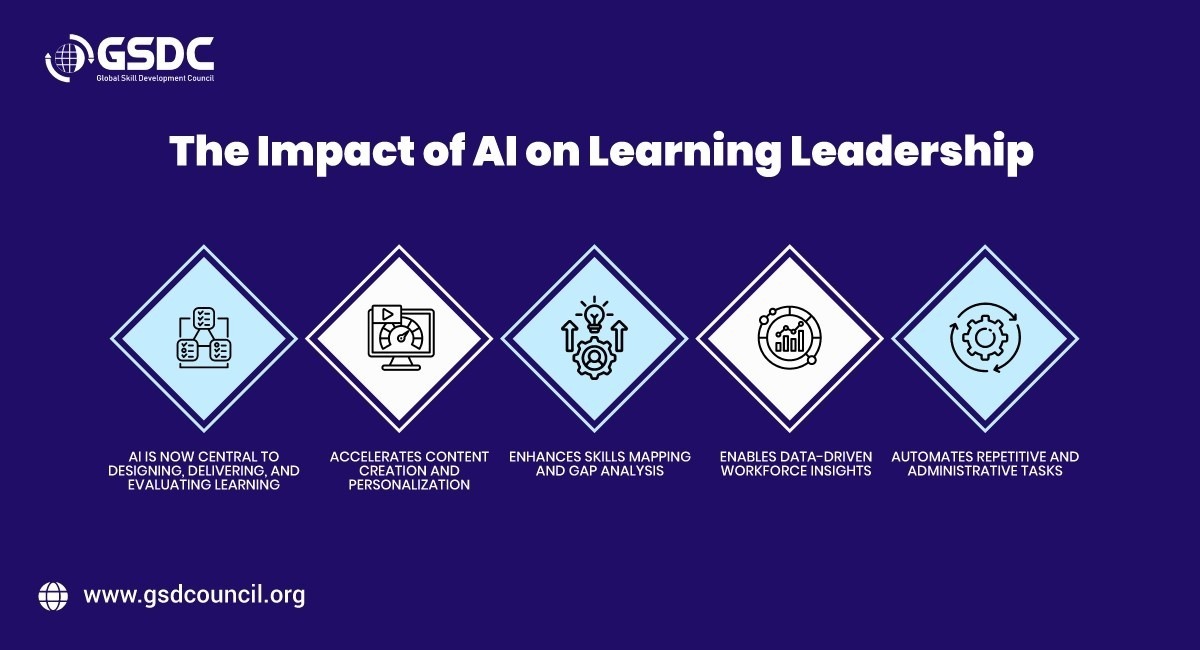
Artificial intelligence has become a defining force in the evolution of the CLO role. Importantly, AI is no longer a “nice-to-have” tool; it is becoming central to how learning strategies are designed, delivered, and evaluated.
However, this does not mean AI replaces learning leaders.
Instead, AI:
- Accelerates content creation and personalization
- Improves skills mapping and gap analysis
- Enables data-driven insights into workforce capability
- Automates administrative and repetitive learning tasks
What remains firmly human-led is strategy, judgment, influence, and ethics.
Modern learning leaders are expected to be AI-literate, not AI experts. AI literacy means understanding what AI can and cannot do, how it impacts workforce systems, and how to use it responsibly to support people rather than replace them.
Governance, Ethics, and Human-Centered AI
As AI becomes embedded in learning and talent systems, governance and ethics move to the forefront of the CLO agenda.
The future learning executive is responsible not just for deploying AI-powered tools, but for shaping the systems, policies, and guardrails around them. This includes:
- Ensuring transparency in AI-driven decisions
- Protecting data privacy
- Promoting fairness and inclusion
- Preventing bias in learning and talent processes
Compliance still matters, but it has expanded into AI governance. Learning leaders play a critical role in helping organizations adopt ethical, human-centered AI practices that align with organizational values and social responsibility.
Skills, Education, and the Return of Balance
In recent years, skills-based hiring and skills-driven learning have gained momentum, emphasizing what people can do over formal credentials. While this approach remains important, organizations are beginning to rebalance.
The emerging consensus is clear: skills alone are not enough.
Future-ready learning strategies combine:
- Skills development
- Formal education
- Continuous upskilling and reskilling
- Strategic workforce planning
The role of the CLO is to integrate these elements into a coherent learning ecosystem that supports both immediate performance and long-term growth.
New Titles, Same Mission
As the role evolves, so do job titles. Many organizations are rebranding learning leadership roles to reflect their expanded scope and AI focus. Titles such as:
- AI Learning Strategist
- Head of Learning Experience
- AI Transformation Lead
- Chief Talent Strategist
are increasingly common.
While the titles change, the core mission remains the same: enabling people and organizations to thrive through learning.
Collaboration, Influence, and Change Leadership
One of the defining characteristics of the modern CLO is collaborative leadership. This evolving role requires leaders to work across functions and drive enterprise-wide learning transformation.
Driving learning transformation requires influencing stakeholders across the enterprise, managing resistance to change, and building alliances that support innovation. This demands strong communication, resilience, and the ability to articulate vision and value clearly, qualities increasingly associated with AI leadership in modern organizations.
Change is inevitable. Learning leaders who can guide organizations through uncertainty while maintaining optimism and trust will be the ones who remain relevant and impactful, especially as the impact of artificial intelligence continues to reshape chief learning officer jobs across industries.
The Future of the CLO Role
The evolution of the CLO role reflects a broader truth about the future of work: learning is no longer optional, and leadership in learning is no longer transactional.
The modern CLO is:
- Proactive, not reactive
- Strategic, not operational
- Data-driven, not intuition-based
- AI-enabled, but human-led
- Focused on outcomes, not activities
As organizations look ahead, learning leaders who embrace this transformation will shape not just training programs but the future of their workforce.

As organizations look ahead, learning leaders who embrace this transformation will shape not just training programs but the future of their workforce.
To support this transformation, the Global Skill Development Council offers the Chief Learning Officer Certification, designed for forward-thinking learning leaders. This program equips professionals with the strategic, data-driven, and AI-enabled capabilities required to lead modern learning ecosystems.
Chief Learning Officer Certification focuses on aligning learning initiatives with business goals, leveraging analytics for decision-making, and integrating emerging technologies like AI into workforce development. Through this certification, CLOs can strengthen their leadership impact, drive measurable outcomes, and future-proof their organizations ensuring learning becomes a core pillar of innovation, performance, and long-term growth.
Conclusion
The evolution of the chief learning officer role reflects a much larger shift in how organizations view learning, talent, and leadership. In an age defined by rapid skills disruption, data-driven decision-making, and widespread AI adoption, learning leaders can no longer operate on the sidelines. They are now central to business strategy, workforce resilience, and long-term growth.
The modern CLO or its emerging equivalents moves beyond training delivery to become a proactive architect of workforce capability. By combining AI literacy with ethical governance, data insights with human judgment, and learning strategy with measurable business outcomes, learning leaders ensure that organizations remain competitive and future-ready, highlighting the impact of artificial intelligence on workforce development.
As the future of work continues to unfold, one thing is clear: organizations that invest in evolved learning leadership will not only keep pace with change, but they will lead it, reinforcing the evolving role of learning executives in modern business.

Related Certifications
Frequently Asked Questions
Stay up-to-date with the latest news, trends, and resources in GSDC
If you like this read then make sure to check out our previous blogs: Cracking Onboarding Challenges: Fresher Success Unveiled
Not sure which certification to pursue? Our advisors will help you decide!