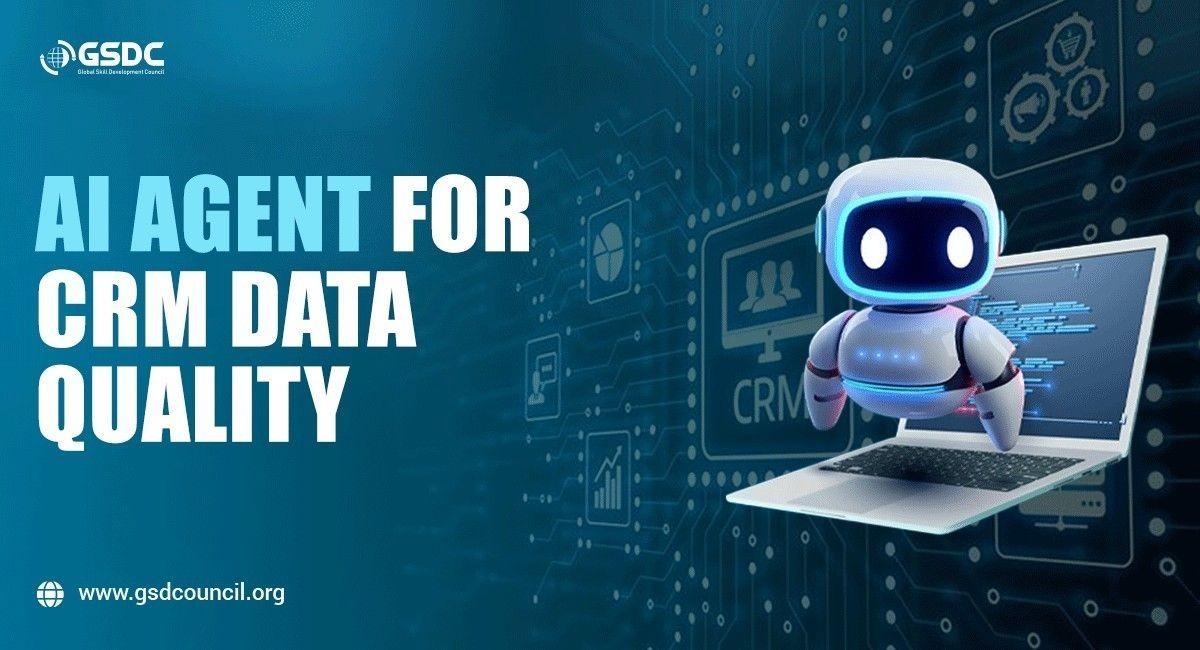
AI Agent for CRM Data Quality
Written by Mansi Kapoor
- Why CRM Data Quality Matters
- The Challenge of “Dirty” CRM Data
- Introducing AI Agents for CRM Data Quality
- Architecture of an AI-Powered CRM Data Quality Agent
- Key Capabilities of AI CRM Data Quality Agents
- Implementation Roadmap
- Agentic AI Professional: Driving Autonomous, Goal-Oriented AI for Smarter Business Outcomes
- Conclusion
Customer Relationship Management (CRM) systems are the backbone of modern sales, marketing, and customer engagement strategies. Organizations rely heavily on CRM platforms to track leads, manage customer interactions, forecast sales pipelines, and drive strategic decisions. However, the effectiveness of these systems depends entirely on the quality of the data stored within them. In today’s evolving landscape, concepts like AI in CRM, AI data management, and understanding what is a CRM database are becoming essential for organizations aiming to stay competitive.
Unfortunately, many organizations struggle with poor CRM data quality. Duplicate records, missing information, outdated contact details, and inconsistent formatting can severely impact operational efficiency and business outcomes. According to industry estimates, poor data quality costs organizations millions of dollars annually, affecting productivity, decision-making, and revenue growth. This is where AI for CRM, AI CRM software, and CRM AI solutions play a critical role in transforming how data is managed and utilized.
In a recent webinar titled “AI Agent for CRM Data Quality,” data engineering expert Mansi Kapoor discussed how artificial intelligence can help organizations address these challenges. By deploying AI-powered agents within CRM ecosystems, companies can automate data cleansing, enrichment, and validation processes on a large scale.
This blog delves into the insights shared during the webinar and explains how AI agents can significantly enhance CRM data quality.
Why CRM Data Quality Matters
CRM platforms such as Salesforce, HubSpot, and Microsoft Dynamics 365 store critical customer and sales information. These systems support activities such as:
- Lead management
- Sales forecasting
- Customer support operations
- Marketing campaign targeting
When CRM data is inaccurate or incomplete, these processes become inefficient.
Research shows that:
- 10–30% of CRM records are duplicates
- Customer data decays at nearly 30% per year
- Sales representatives lose up to 550 hours annually due to poor data quality
Duplicate contacts, outdated email addresses, or incorrect phone numbers can lead to missed opportunities, inaccurate forecasts, and wasted sales effort.CRM data verification helps identify these unwanted contacts in real-time as they enter the CRM, helping businesses maintain accurate and reliable customer records.
The Challenge of “Dirty” CRM Data
Many organizations accumulate “dirty data” over time due to several reasons, making it important to understand what is CRM management, the role of data quality automation, and why data quality is important in modern business environments powered by AI powered CRM solutions:
Duplicate Records
Duplicate records occur when the same contact or company is entered multiple times in the system. This leads to confusion in reporting and may result in multiple sales representatives contacting the same customer.
Missing or Incomplete Data
CRM entries often lack important information such as job titles, industry classification, or contact details. Missing fields reduce the effectiveness of marketing segmentation and lead scoring.
Invalid or Placeholder Data
In many systems, placeholder values such as “N/A,” “Unknown,” or “To Be Decided” appear in fields where accurate information should exist.
Data Decay
Customer information changes frequently due to job changes, company restructuring, or updated contact details. Without regular updates, CRM databases quickly become outdated.
These challenges make manual data cleaning extremely time-consuming, reinforcing the need for intelligent and automated approaches to maintain high-quality CRM data.
Introducing AI Agents for CRM Data Quality
AI agents provide a proactive solution to CRM data management challenges.
An AI-powered CRM data quality agent automatically detects, analyzes, and resolves data issues in real time. Instead of relying on periodic manual reviews, organizations can maintain continuous data quality monitoring.
These agents can be built using platforms such as GitHub Copilot and Microsoft Copilot Studio.
The AI agent operates as an intelligent layer on top of CRM systems, performing tasks such as:
- Detecting duplicate contacts
- Enriching missing data
- Validating data formats
- Monitoring CRM health scores
- Suggesting corrective actions
By automating these tasks, organizations can dramatically improve data accuracy while reducing manual effort.
Architecture of an AI-Powered CRM Data Quality Agent
The architecture of an AI CRM data quality agent typically includes several key components.
1. CRM Data Sources
The agent connects to existing CRM data sources such as:
- Salesforce
- HubSpot
- Microsoft Dynamics 365
- Excel or CSV datasets
- APIs and databases
These systems serve as the primary data inputs for analysis.
2. AI Agent Layer
The AI agent layer manages orchestration and automation.
Within platforms like Microsoft Copilot Studio, developers can configure:
- Triggers for data health checks
- Business rules for validation
- Data connectors and workflows
- Automated alerts and notifications
This layer coordinates how the AI agent interacts with CRM data.
3. AI Reasoning Engine
The reasoning engine uses machine learning and natural language processing to analyze CRM data patterns.
For example, GPT‑4.1 can evaluate records and detect inconsistencies using contextual understanding rather than simple rule-based checks.
The AI model assigns confidence scores to potential matches or anomalies, helping determine whether records should be merged automatically or flagged for human review.
4. Automated Actions and Outputs
Once issues are detected, the AI agent can take actions such as:
- Automatically merging duplicate contacts
- Updating missing information
- Flagging suspicious records
- Generating alerts and dashboards
- Logging audit trails for compliance
This automation ensures continuous CRM data optimization.
Key Capabilities of AI CRM Data Quality Agents
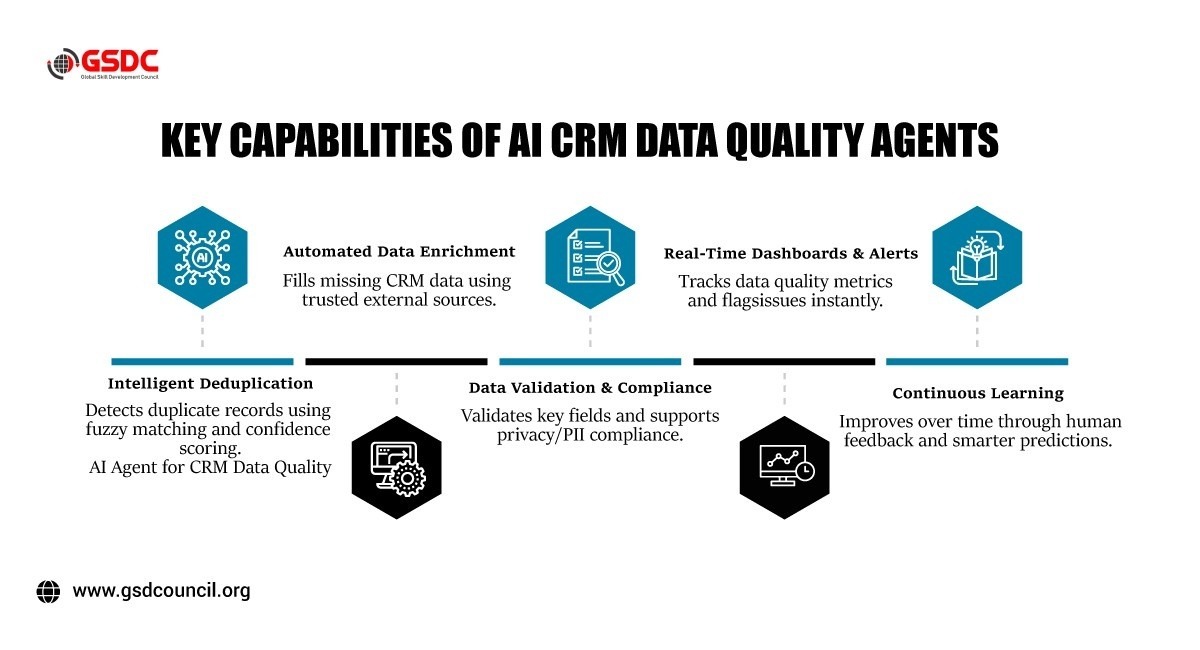
AI-powered CRM agents provide several advanced capabilities that significantly enhance data governance.
Intelligent Deduplication
AI agents use fuzzy logic matching to identify duplicate records based on attributes such as:
- Name
- Email address
- Phone number
- Company name
Machine learning algorithms then assign a confidence score to determine whether records should be merged or reviewed.
Automated Data Enrichment
AI agents can integrate external sources to enrich CRM records.
For example, they can retrieve missing information from professional platforms like LinkedIn to update job titles, company sizes, or industry classifications.
This ensures CRM records remain complete and current.
Data Validation and Compliance
AI agents can enforce validation rules for fields such as:
- Email format verification
- Phone number formatting
- Mandatory CRM fields
They can also support compliance with privacy regulations like the General Data Protection Regulation by identifying sensitive data fields and ensuring proper handling of personally identifiable information (PII).
Real-Time Dashboards and Alerts
Organizations can monitor CRM health through AI-generated dashboards.
These dashboards display metrics such as:
- Data quality scores
- Duplicate record counts
- Missing field percentages
- Trend analysis over time
Alerts notify administrators whenever data quality thresholds fall below acceptable levels.
Continuous Learning
AI agents improve over time through feedback loops.
When human reviewers approve or reject suggested actions, the AI model learns from those decisions and refines its future predictions.
This continuous learning ensures higher accuracy in detecting data anomalies.
Human-in-the-Loop Governance
Despite automation, AI systems should not operate entirely without oversight.
The webinar emphasized the importance of human-in-the-loop governance. In this model:
- AI detects and recommends actions
- Humans review high-risk cases
- Final decisions remain under human control
For example:
- Records with a confidence score above 90% may be automatically merged
- Scores between 70% and 90% require human approval
- Scores below 70% trigger manual review
This approach balances efficiency with accuracy.
Business Impact and ROI
Implementing AI-powered CRM data quality agents delivers measurable benefits.
Organizations can achieve:
- Reduced duplicate records
- Improved sales forecasting accuracy
- Faster lead qualification
- Better customer segmentation
- Increased sales productivity
Industry estimates suggest that poor data quality costs organizations around $15 million annually. By implementing AI-driven data management systems, companies can save millions while improving operational performance.
Additionally, automation reduces manual data cleansing time from several hours per week to just minutes.
Implementation Roadmap
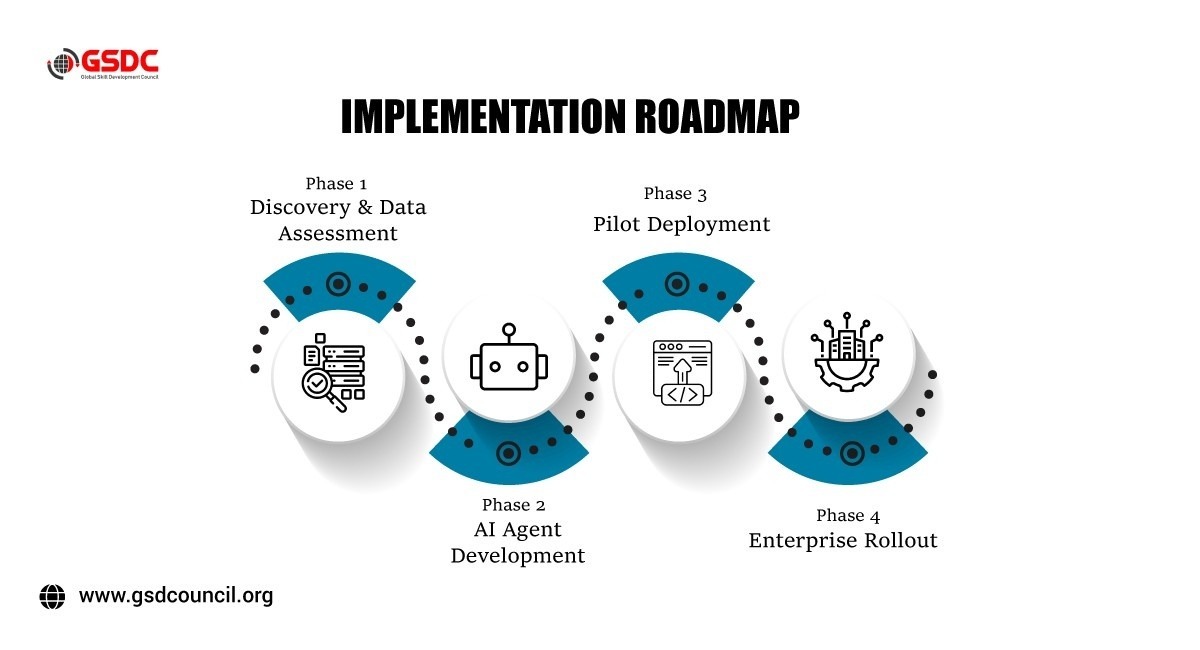
Organizations can implement AI CRM agents through a structured approach.
Phase 1: Discovery and Data Assessment
This stage involves auditing CRM databases to identify:
- Duplicate records
- Missing data fields
- Data quality benchmarks
Stakeholders define rules for deduplication and validation.
Phase 2: AI Agent Development
During this phase, teams build the AI agent using tools like GitHub Copilot and Microsoft Copilot Studio.
Developers configure:
- Data connectors
- AI models
- Business logic and workflows
Phase 3: Pilot Deployment
Organizations deploy the agent within a specific department or business unit.
Testing focuses on validating:
- Deduplication accuracy
- Data enrichment success rates
- Integration performance
Phase 4: Enterprise Rollout
After successful testing, the AI agent is deployed across the entire CRM system.
Continuous monitoring and feedback loops ensure ongoing improvements.
Agentic AI Professional: Driving Autonomous, Goal-Oriented AI for Smarter Business Outcomes
An Agentic AI Professional Certification from GSDC specializes in designing, deploying, and managing AI systems that can act autonomously, make decisions, and achieve defined goals with minimal human intervention. These professionals focus on building intelligent agents that can adapt, learn, and execute complex workflows across business functions.
Why it’s beneficial:
GSDC’s Agentic AI certification enhances efficiency by automating decision-making processes, reduces operational costs, and enables organizations to scale faster with intelligent, self-improving systems. It also improves accuracy, responsiveness, and innovation by allowing AI to handle dynamic, real-time tasks.
Conclusion
As organizations increasingly rely on CRM platforms to drive business decisions, maintaining high-quality customer data has become essential. In this context, understanding AI in CRM, AI data management, and what is a CRM database is crucial for building efficient and reliable systems. Poor data quality leads to operational inefficiencies, lost sales opportunities, and inaccurate analytics.
AI-powered CRM data quality agents provide a scalable solution to these challenges. Leveraging AI for CRM, advanced AI CRM software, and CRM AI capabilities, these agents automate tasks such as deduplication, enrichment, validation, and monitoring, helping organizations maintain accurate and trustworthy customer databases.
As highlighted by Mansi Kapoor, the future of CRM management lies in combining artificial intelligence with human oversight to create intelligent, self-improving data ecosystems.
Organizations that adopt AI-driven data governance today will gain a significant competitive advantage in tomorrow’s data-driven economy.

Related Certifications
Frequently Asked Questions
Stay up-to-date with the latest news, trends, and resources in GSDC
If you like this read then make sure to check out our previous blogs: Cracking Onboarding Challenges: Fresher Success Unveiled
Not sure which certification to pursue? Our advisors will help you decide!