How AI Teams Work in 2026: Roles, Skills, and Career Paths
Written by Matthew Hale
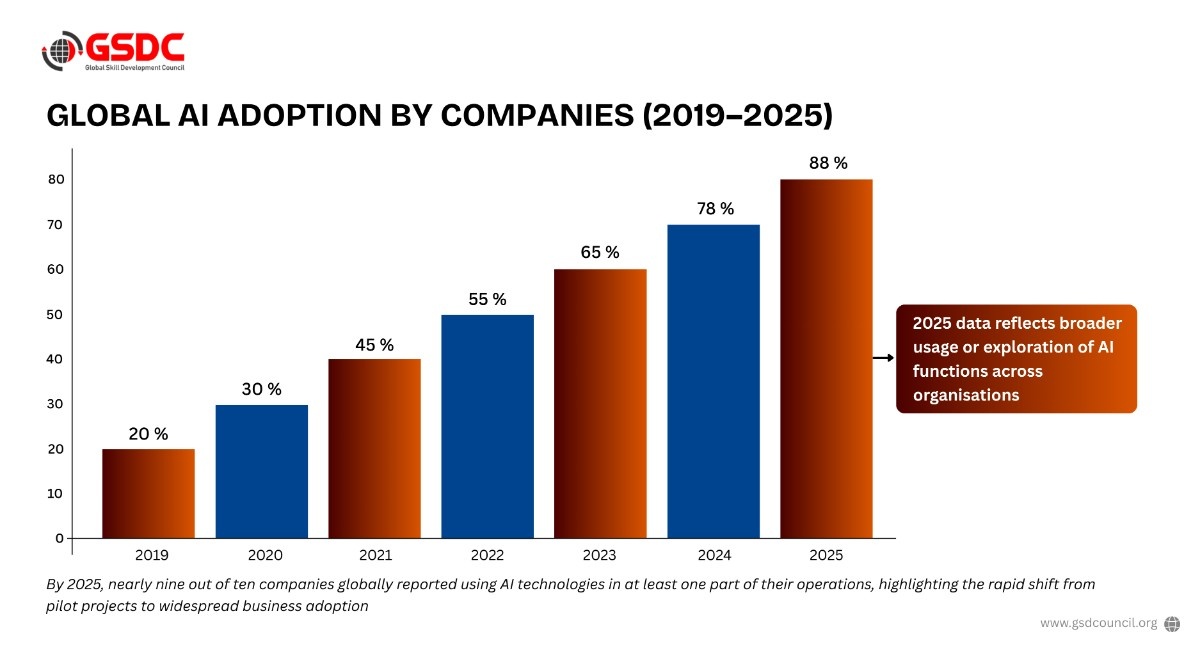
Thinking about a future in artificial intelligence, but unsure where you fit in? You are not alone. Today, AI is no longer an experimental technology - it is already shaping business operations worldwide, with nearly 8 out of 10 organisations using AI in at least one part of their operations.
This surge in adoption shows why companies are investing in specialised AI teams and clearly defined AI roles to turn innovation into measurable business value. If you are wondering what are AI skills are, exploring AI career paths, or trying to understand how to learn AI skills and build long-term AI career pathways, this article will guide you through how modern AI teams are structured and how different roles come together to create real-world AI products - helping you find where you truly fit in this growing field.
Why Companies Invest in AI Teams
As artificial intelligence becomes a core business capability, organisations are investing in dedicated AI teams to turn technology into real, measurable outcomes.
1. AI delivers measurable business value
AI can analyse data, learn patterns, and make predictions at scale. That is why leaders often ask how much is AI worth - organisations that use AI effectively report clear improvements in revenue growth, operational efficiency, and decision-making quality.
2. AI helps generate new revenue streams
The largest corporations apply AI to substitute human work in repetitive tasks, prevent human errors, and enhance logistics efficiency. Such changes will be beyond just cost-saving: they will allow the creation of new digital services, more intelligent pricing models, and customer experiences at the individual level, which will have a direct impact on revenues.
3. AI empowers Competitive Advantage
Companies that embed AI into products and decision-making processes are considerably quicker than their competition, relying on manual analysis. AI underpins data-led strategies, enabling leaders to act on insight rather than instinct.
4. Success with AI requires people, not just technology
All of the above benefits can be achieved only through the successful structuring of AI teams with clearly identified AI roles in the business functions, data, and engineering areas.
Organisations that align skills with structured learning frameworks from bodies like the Global Skill Development Council (GSDC) are better positioned to develop capable AI teams and future-ready professionals.
Key AI Roles Inside Modern AI Teams
A successful artificial intelligence initiative depends on specialised roles working together - each bringing unique expertise to solve complex business problems. Here are the most important roles you’ll find in high-performing AI teams:
1. Executive Sponsor
Offers vision, funding, and business alignment. AI projects are aligned with the company's strategic visions, and funding for their success is provided by this senior individual.
2. AI Product Manager
Defines outcomes, use cases, and success metrics. This role connects business strategy with technical execution and prioritises work that delivers measurable value.
3. Data Engineers
Set up and maintain the data pipes that provide the data to the machine learning models, organised. Data engineers provide the quality, accessibility, and scalability of data, an aspect necessary since quality data is the leading cause of failures in AI development.
4. Data Scientists & Machine Learning Engineers
These constitute the technical core of an AI team:
- Data Scientists examine the data and develop early-stage models. Business queries are answered as analysis responses through the operation of Data Scientists.
- Machine Learning Engineers optimise, scale, and productionize these models so that they can be used for real-world problems.
5. Software Engineers
Implement AI models inside apps and systems such as: Mobile apps, Internal Dashboards. These ensure the safe execution of AI models and operations with efficiency and effectiveness.
6. UX Designers
Make the AI tools intuitive, understandable, and credible to the end-users. Designing for AI applications is even more critical as it is necessary that the end-users trust the system and make decisions upon the results available from the system.
7. AI Ethicists / Responsible AI Leads
As organisations increasingly adopt AI, roles focused on fairness, transparency, and compliance are emerging. These professionals help teams avoid bias, meet ethical standards, and comply with regulations - a growing organisational priority.
Together, these professionals form high-performing AI teams with the skills needed to turn data into insight, insight into action, and action into business value - making artificial intelligence a dependable part of the organisation
Typical 2026 Global Salary Ranges for Key AI Roles
To understand why these roles are in such high demand, it helps to look at earning potential. Recent industry projections for 2026 show that professionals working in core AI team roles continue to earn some of the highest salaries in the global tech market.
- Machine Learning / AI Engineer: approximately USD 127,000 – 199,000 per year
- AI Product Manager: around USD 120,000 to 200,000 yearly
- Data Scientist: about 65,000 to 110,000+ dollars each year, based on experience.
- AI Architect/Senior Roles in AI Research: The salary range tends to be approximately USD 120,000 – 200,000+
The above statistics show the reason why many professionals are now focused on acquiring skills and developing a lifelong plan for an AI career.
Download the checklist for the following benefits:
What Are AI Skills and Why Do They Matter?
Many newbies would ask, what are AI skills? Simply put, AI skills encompass technical knowledge together with the ability to solve a business problem.
1. Understanding data and analytics
AI begins with data. The skills needed for reading, processing, and interpreting data give one the ability to see patterns and make intelligent decisions.
2. Basics of machine learning models
You don’t have to be a data scientist yourself, but having some understanding of the learning process from data will bring clarity on how predictions are made by AI systems.
3. Business use-case design
Being able to relate AI to real-world organisational problems could be one of the most important things that an individual could learn in AI.
4. Model deployment fundamentals
Impact kicks in with AI only when it is deployed. Knowing how the models/systems learn to traverse the journey from development to real-life applications helps gain an understanding of how the value addition with AI happens at a mass-scale level.
5. Ethical and responsible AI thinking
Today’s AI needs to be fair, transparent, and trustworthy. It is important to be aware of how bias can be detected and how ethical foundations can be applied.
To build AI programming skills, start with strong fundamentals through programs like the Certified Artificial Intelligence Foundation.
AI career pathways
|
Career Pathway Type |
Entry-Level Role |
Mid-Level Role |
Senior / Leadership Role |
Key Responsibilities |
Core AI Skills to Develop |
|
Data-Focused Pathway |
Data Analyst |
Data Scientist |
Senior Data Scientist |
Collecting and cleaning data, building predictive models, analysing trends, guiding analytics strategy, mentoring junior analysts |
Data analytics, Python/R basics, statistics, machine learning fundamentals, data storytelling |
|
Engineering-Focused Pathway |
Software Engineer |
ML Engineer |
AI Architect |
Developing and deploying machine learning systems, building scalable pipelines, managing model performance, designing full AI ecosystems |
Programming, model deployment, MLOps basics, cloud platforms, system architecture |
|
Business-Focused Pathway |
Business Analyst |
AI Product Manager |
Head of AI Strategy |
Identifying business use cases, translating needs into AI solutions, leading cross-functional teams, driving AI adoption at enterprise level |
Business problem-solving, AI fundamentals, stakeholder management, product strategy, decision-making |
|
Ethics & Governance Pathway |
AI Compliance Associate |
Responsible AI Lead |
Chief AI Governance Officer |
Monitoring fairness and bias, ensuring ethical AI usage, aligning systems with regulations, building trust in AI solutions |
AI ethics, risk management, policy understanding, transparency frameworks, compliance skills |
This table helps readers clearly visualise AI career paths, understand what each role does, and identify the AI skills to learn at every stage of their journey.
How to Build and Advance Your AI Career
A common question is what is career pathways in the context of artificial intelligence. Career pathways describe how your role grows and evolves over time as your skills, responsibilities, and influence increase.
Most professionals move through recognised levels - from beginner to expert and leadership roles - gaining deeper technical knowledge or broader strategic ownership as they progress.
1. Data-focused pathway
Data Analyst → Data Scientist → Senior Data Scientist
This path is ideal for those who enjoy working with data, patterns, and insights. As professionals grow, they often move into specialised roles that involve advanced modelling, research, and guiding analytics strategy across teams.
2. Engineering-focused pathway
Software Engineer → ML Engineer → AI Architect
This pathway suits professionals who like building scalable systems and deploying AI models in production environments. At higher levels, engineers design full AI ecosystems and mentor teams working on complex machine learning solutions.
3. Business-focused pathway
Business Analyst → AI Product Manager → Head of AI Strategy
This route is perfect for those who prefer working at the intersection of technology and business decision-making. Senior roles focus on defining organisational AI vision, aligning products with business goals, and leading cross-functional AI teams.
These structured AI career pathways make it easier to understand different AI career paths and plan how to have a career in AI, even for professionals who do not come from a traditional coding background.
Start Your Journey with GSDC’s Certified Artificial Intelligence Foundation
The Certified Artificial Intelligence Foundation by the Global Skill Development Council (GSDC) is designed for professionals who are beginning their journey in artificial intelligence and want a clear, structured starting point.
What this program helps you understand
-
How real-world AI teams operate
Learn how different AI roles work together to turn ideas into business solutions.
-
Roles of AIs that matter most to organisations
Enhanced understanding of available career paths, including those emphasising data, engineering, and those emphasising the business side
-
The exact AI skills to learn for long-term growth
Build the foundation needed in data thinking, machine learning basics, and responsible AI practices.
-
How Certifications Accelerate AI Career Pathways
Understand how an industry-recognised artificial intelligence certification could validate your learning and help you progress in your career much quicker.
This program provides much-needed clarity for learners who are unsure how to learn AI skills or which AI career path best suits their goals.

Conclusion
AI is not built by machines alone - it is built by people. By understanding how AI teams function, recognising the most important AI roles, and developing the right AI skills, you can confidently navigate your own path in artificial intelligence.
Whether you are exploring AI career paths for the first time or planning long-term AI career pathways, a strong foundation makes all the difference. With the support of an industry-recognised artificial intelligence certification, your journey into AI becomes not just possible - but sustainable and future-ready.

Related Certifications
Stay up-to-date with the latest news, trends, and resources in GSDC
If you like this read then make sure to check out our previous blogs: Cracking Onboarding Challenges: Fresher Success Unveiled
Not sure which certification to pursue? Our advisors will help you decide!