Software Development Life Cycle: Key Skills and Responsibilities
Written by Emily Hilton
- What is SDLC and Why Does It Matter?
- The Seven Stages of the Software Development Life Cycle
- Essential Skills for SDLC Professionals
- Roles and Responsibilities in SDLC
- Common SDLC Models in the Industry
- SDLC Best Practices
- How GSDC Supports Software Development Professionals?
- Transform Your Career in Software Development with SDLC Skills
- Final Thoughts
Imagine a situation where you utilize a mobile application for sending money, verifying balances, or making payments. What is hidden from you is that the entire transaction, which is supposed to be quick and effortless with your mobile, is actually a procedure that ensures the reliability of the software.
This procedure is the Software Development Life Cycle (SDLC), an organized framework that outlines all the steps from software conception to its servicing. Companies that strictly follow the SDLC process can result in a reduction of the failure rate of their projects by 35%, yet there is a research report indicating only 39% of projects succeed.
This difference emphasizes the need for a systematic software development process to deliver quality software on time. It is also the first step in career building for beginners who first want to know what the best project management software is and the SDLC process.
What is SDLC and Why Does It Matter?
The core basis of modern software development is the Software Development Life Cycle (SDLC). It is the main idea that every phase - requirement gathering to maintenance - must be implemented effectively. When putting an SDLC framework into practice, teams can minimize mistakes, use resources efficiently, and produce software that meets user and business needs.
The main advantages are:
- Increased Visibility: Each stage’s information is known by all, thus confusion is minimized, and teams can work in coordination.
- Efficient Planning: Resources, timelines, and budgets are allocated properly, which avoids both delays and excessive spending.
- Better Risk Management: The teams will have time to resolve the issues because they can find the sources of problems at a very early stage of work.
- Systematic Delivery: Software is provided following the same quality and reliability standards, but in a systematic way.
- Improved Collaboration: The fact that roles are clearly defined makes the communication and collaboration between developers, testers, designers, and project managers the easiest and most efficient.
- Enhanced Customer Satisfaction: The result of implementing sdlc best practices is software that closest matches users’ needs and expectations.
- Scalability and Maintainability: The stepwise plan allows for the change of software into a new, better, and still more suitable version for business-oriented changes.
The Seven Stages of the Software Development Life Cycle
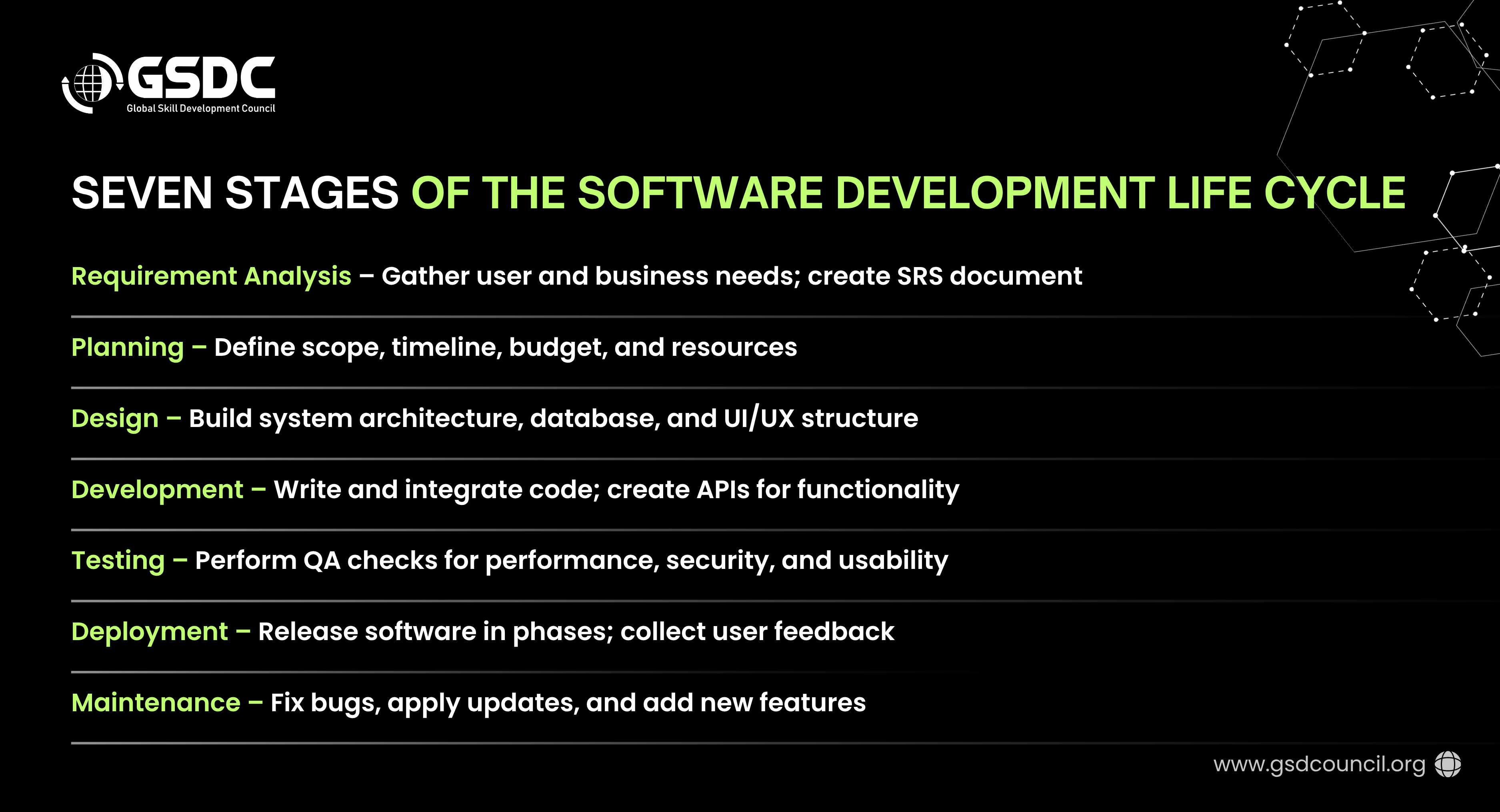
The software development life cycle breaks down development into seven structured stages. By understanding these stages, teams can manage to deliver certified-level software by the due date, while beginners get a straightforward view of how concepts become real-world applications.
- Requirement Analysis: Every project starts with gathering requirements from users, stakeholders, and market research. A Software Requirement Specification (SRS) document is prepared to guide development.
- Planning: Teams define the project’s scope, budget, resources, and timeline. Effective planning helps anticipate risks and set milestones.
- Design: Requirements are translated into technical solutions, including system architecture, database schemas, and user interfaces. Designers ensure feasibility and usability.
- Development: Developers write code using languages like Python, Java, or C# and implement required features. APIs are created for smooth module communication.
- Testing: QA engineers verify software stability and functionality. Functional, performance, security, and usability tests ensure a bug-free product.
- Deployment: Software is released to users, often in phases or beta versions. Feedback is monitored to address issues and improve performance.
- Maintenance: Post-deployment, software is updated, bugs are fixed, and security patches are applied. New features are added to maintain efficiency.
Essential Skills for SDLC Professionals
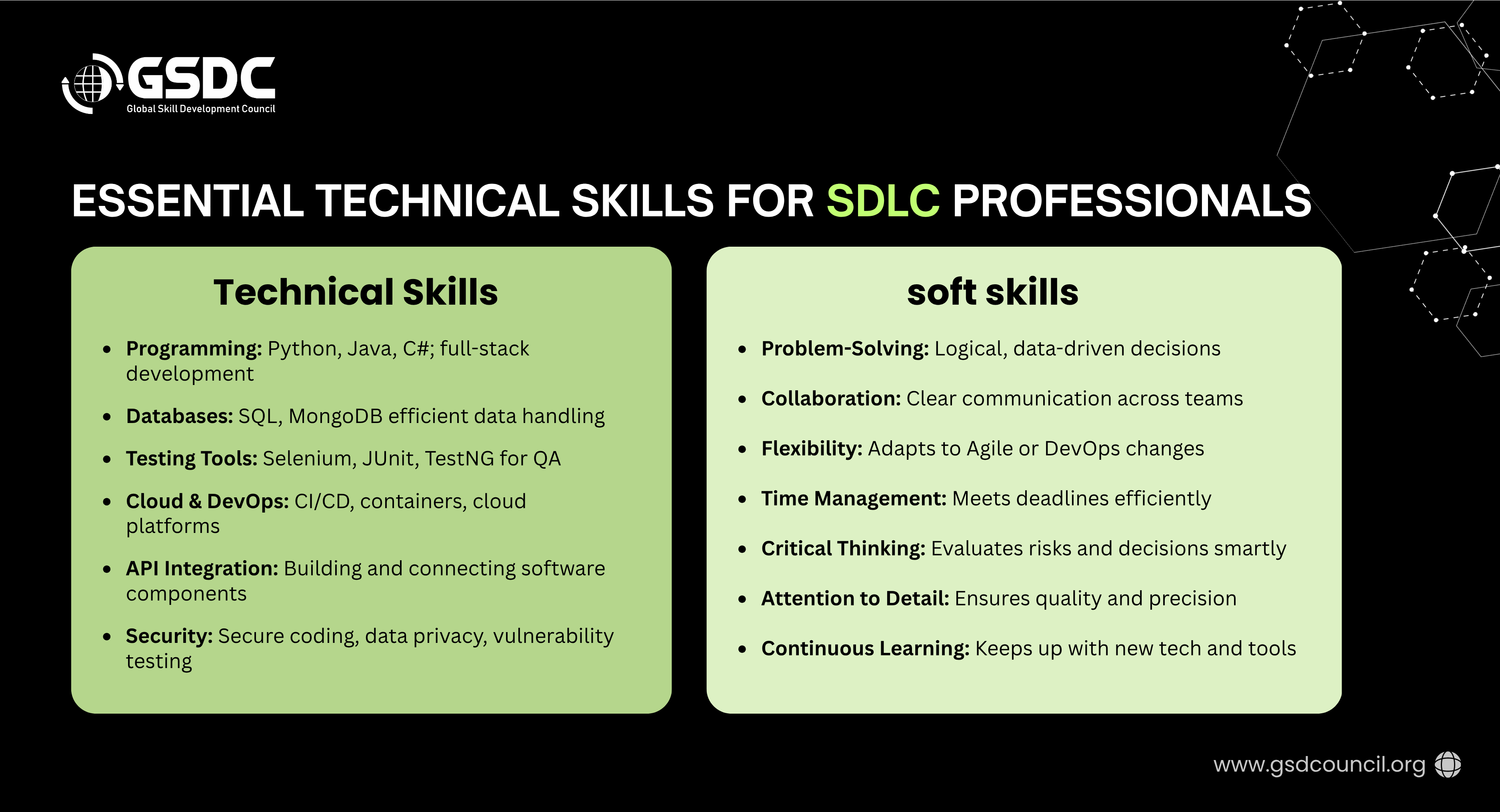
Among the essential soft and technical skills software developers have to equip themselves with, professionals who come up with a master plan are more likely to achieve success. These people will be the best to tackle the SDLC process and direct the project to succeed.
Technical Skills:
Programming Proficiency: Developers' familiarity with languages like Python, Java, or C# will allow them to produce clean, efficient, and maintainable code for almost any kind of software, while Full-stack development skills, if one is competent in both front-end and back-end operations, are especially beneficial.
- Database Knowledge: Skilled personnel trained in SQL, MongoDB, etc., can design data storage, data retrieval methods that are both efficient and are also integrable with software solutions.
- Testing Tools: Understanding of software testing frameworks such as Selenium, JUnit, or TestNG is equally valuable as the implementation of quality assurance by automation or manual testing routines.
- Cloud and DevOps Basics: An expert who knows cloud platforms, containers, CI/CD process, and infrastructure-as-code will be able to perform a software release without any complications and make subsequent changes easily.
- API Integration: A person who knows how to create and integrate APIs into the software won’t have any problem with the communication of the components.
- Security Fundamentals: In the software development cycle, the incorporation of secure coding, data privacy, and vulnerability testing will form a product that is resistant to cyberattacks.
Soft Skills:
- Logical Thinking & Problem-Solving: Required at every stage of the SDLC to troubleshoot issues and make data-driven decisions quickly.
- Collaboration & Communication: Essential for interacting with cross-functional teams, clarifying requirements, and ensuring smooth workflow in software projects.
- Flexibility: Being adaptable, like in Agile or DevOps environments, allows professionals to handle changing requirements and unexpected challenges efficiently.
- Time Management & Organization: Helps meet deadlines, prioritize tasks effectively, and maintain a smooth flow in complex software development projects.
- Critical Thinking: Ability to analyze situations from multiple perspectives, foresee potential risks, and make informed choices during planning and implementation.
- Attention to Detail: Ensures accurate documentation, proper testing, and reliable coding, which reduces errors and improves overall software quality.
- Continuous Learning: Staying updated with new technologies, frameworks, and best practices ensures long-term career growth in a rapidly evolving field.
Roles and Responsibilities in SDLC
Software development cannot be done single-handedly. All the roles perform their duties distinctively in the software development life cycle, thus ensuring that projects are completed on time and are within the required budget and quality standards.
- Software Developer: The software developer implements, tests, and maintains the code; takes care of features and assures scalability.
- Quality Assurance (QA) Engineer: The QA engineer spots errors in software by testing, resolves security vulnerabilities, and keeps pace with performance.
- System / Business Analyst: The system/business analyst connects the stakeholder and the technical teams; collects requirements and checks if they are aligned with the business goals.
- Project Manager: The project manager oversees the schedules, budgets, and resources; Furthermore, he/she also manages the teams and does the risk management.
- DevOps Engineer: The devops engineer takes care of the infrastructure, the release management process, and the continuous integration/continuous delivery (CI/CD).
- UI/UX Designer: With the appealing and functionally designed UI/UX designers ensure that user-centricness and ease of use take place...
- Technical Lead: The Technical Lead performs architectural design, technical standards, and, moreover, takes care of developers' training.
SDLC roles and responsibilities are carried out in repeated cycles, which ensure a smooth change between stages. Proper communication and cooperation between different departments improve software quality and increase the growth of the team.
📘 Download the SDLC Career Growth Toolkit
Common SDLC Models in the Industry
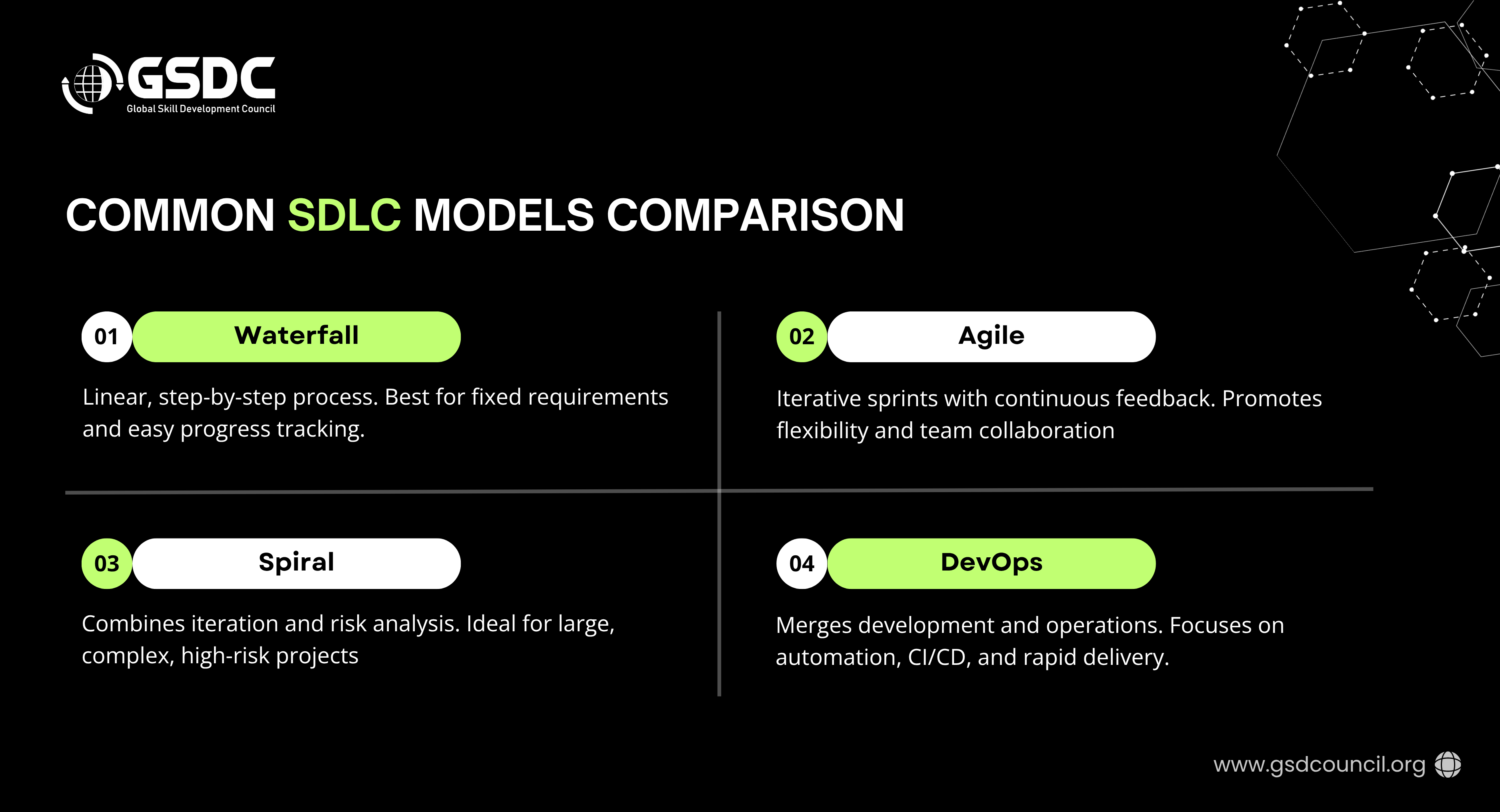
Various SDLC models help teams move efficiently from concept to product launch while managing projects, deadlines, and resources:
- Waterfall: A step-by-step approach ideal for projects with well-defined requirements. Progress is easy to monitor, but less flexible for mid-project changes.
- Agile: Uses iterative sprints and regular feedback to deliver software incrementally. Encourages collaboration, adaptability, and faster releases in modern software development.
- Spiral: Combines iterative development with risk assessment, suitable for large, complex projects requiring innovation and early problem detection.
- DevOps: Integrates development and operations for faster, reliable delivery. Focuses on automation, continuous integration (CI), and continuous delivery (CD), enhancing both technical and collaborative skills for DevOps jobs.
Why It Matters:
“By a thorough grasp of these models and the adept implementation of sdlc best practices the teams become capable of selecting the most appropriate approach based on project complexity, size, and business needs. The real-world experience with these SDLC skills results in streamlined workflows, reduced mistakes, and superior outputs. It also makes professionals capable of keeping up with technological changes, optimizing processes, and adding value to software project management.”SDLC Best Practices
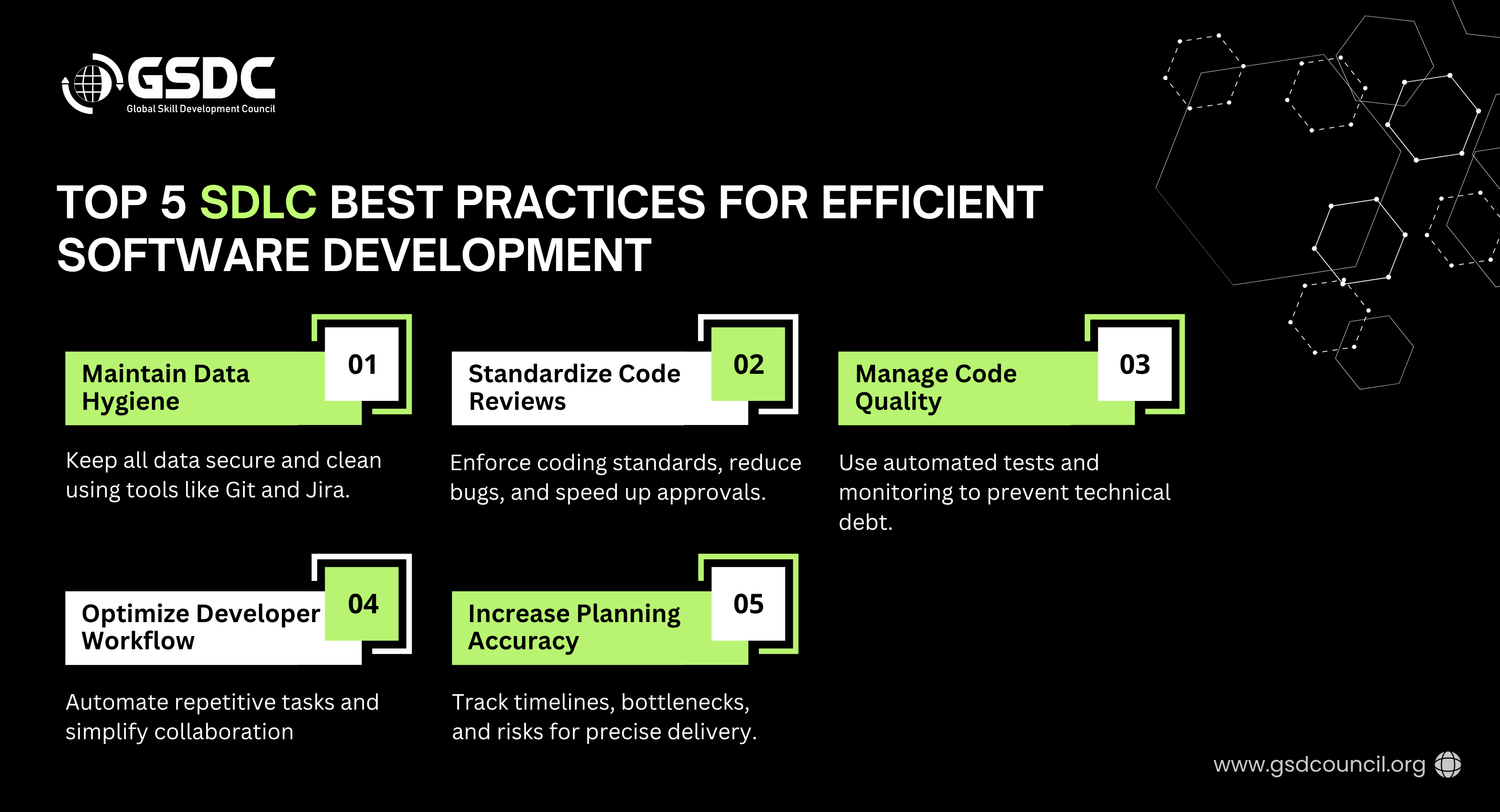
- Maintain Data Hygiene: Keeping data, whether customer, application, or workflow data, clean and secure is essential. Tools like Git and Jira help track metrics and eliminate hidden “shadow work,” ensuring transparency and efficiency in the software project management process.
- Standardize Code Reviews: Code reviews improve software quality by enforcing coding standards and preventing bugs. Reducing pull request sizes, following review protocols, and automating reminders help teams review code faster and maintain high-quality output.
- Manage Code Quality: Low-quality code creates technical debt, slows delivery, and increases maintenance. Using integration tests, automated checks, and continuous monitoring ensures reliable software and prepares teams for DevOps jobs.
- Optimize Developer Workflow: Developers are more productive when repetitive tasks are automated and context switching is minimized. Tools integrated with chat programs or issue trackers simplify workflows, allowing teams to focus on building features efficiently.
- Increase Planning Accuracy: Accurate planning ensures teams deliver what they commit to, aligning with stakeholders and improving customer satisfaction. Tracking cycle times, bottlenecks, and delays helps identify problem areas and make more precise project estimates.
Good planning skills are a very important part of SDLC best practices, which, as a result, enable teams to meet deadlines with confidence, minimize risks to a minimum, and ensure projects run smoothly.
How GSDC Supports Software Development Professionals?
Learning by doing is a must in today's fast and ever-changing world of technology. The Global Skill Development Council (GSDC) empowers learners worldwide with more than 250,000 certified professionals in over 100 countries.
Certified Software Development Life Cycle (SDLC) Professional certification validates your expertise in managing the complete software development process from planning and design to deployment and maintenance. It equips professionals with the skills to ensure quality, efficiency, and alignment with business goals at every stage of development.
The certification emphasizes best practices, agile methodologies, and process optimization. It’s ideal for developers, project managers, and QA professionals aiming to enhance their career in software engineering.
Benefits of GSDC Certifications:
- Hands-on learning through practical projects
- Career growth and global credibility
- Recognition by Fortune 500 companies
- Skill validation for real-world roles
Transform Your Career in Software Development with SDLC Skills
Experts who have knowledge of the Software Development Life Cycle (SDLC) can easily switch from one role to another, for example, from development to project management or DevOps. Besides technical knowledge, mastering SDLC also gives one intuitive thinking, problem resolution, and leadership skills.
As every industry is driven by software, earning an SDLC certification not only makes one more employable but also helps one to grow their career in software development and become a leader of the upcoming complex projects, as well as innovation.Final Thoughts

Mastering the Software Development Life Cycle (SDLC) is more than just understanding a process it’s about building a foundation for successful, high-quality software delivery. With the right technical and soft skills, professionals can move seamlessly across roles such as developer, project manager, or DevOps engineer.
Implementing SDLC best practices ensures efficiency, collaboration, and continuous improvement in every project. By earning a GSDC Certified SDLC Professional certification, you not only validate your expertise but also strengthen your career in the ever-evolving world of software development.
Related Certifications
Stay up-to-date with the latest news, trends, and resources in GSDC
If you like this read then make sure to check out our previous blogs: Cracking Onboarding Challenges: Fresher Success Unveiled
Not sure which certification to pursue? Our advisors will help you decide!