Top Skills to Learn in 2026 for High Salary Growth
Written by Emily Hilton
- What Are Technical Skills?
- 1. AI Skills for Career Growth
- 2. Data Analytics and Data Literacy
- 3. Cybersecurity and Cloud Computing
- 4. Programming and Automation
- 5. What Tech Skills Are Valuable for Marketers?
- 6. Strategic Thinking and Problem-Solving
- 7. Soft Skills for Career Growth
- 8. Most In-Demand Skills for the Future
- 9. How to Choose the Right Skills for Career Growth
- 10. How to Turn Skills Into Earning Potential
- Final Thoughts
The workplace is changing quickly. AI is transforming how people work, automation is taking over repetitive tasks, and employers increasingly value professionals who can combine technical knowledge with strong human skills.
But does that mean you need to learn everything?
Not at all.
The smarter approach is to build a skill stack a combination of technical, AI, business, and soft skills that makes you more valuable in your role.
The World Economic Forum’s Future of Jobs Report 2025 identifies AI and big data, technological literacy, creative thinking, resilience, flexibility, and curiosity among the skills becoming increasingly important for the future of work.
So, whether you're looking to boost your career, increase your earning potential, or prepare for future opportunities, knowing which skills to develop can give you a real advantage.
Let's explore the skills worth investing in.
What Are Technical Skills?
So, what are technical skills?
Technical skills are practical abilities that help you perform specific tasks using tools, technologies, systems, or professional methods.
Examples include:
- Programming
- Data analysis
- Cybersecurity
- Cloud computing
- SEO
- Digital marketing
- AI tools
- Data visualization
- Automation
Technical skills are usually easier to demonstrate through projects, certifications, portfolios, or work experience.
However, technical knowledge is only part of the equation. The professionals who stand out are often those who combine technical expertise with communication, creativity, strategic thinking, and problem-solving.
1. AI Skills for Career Growth
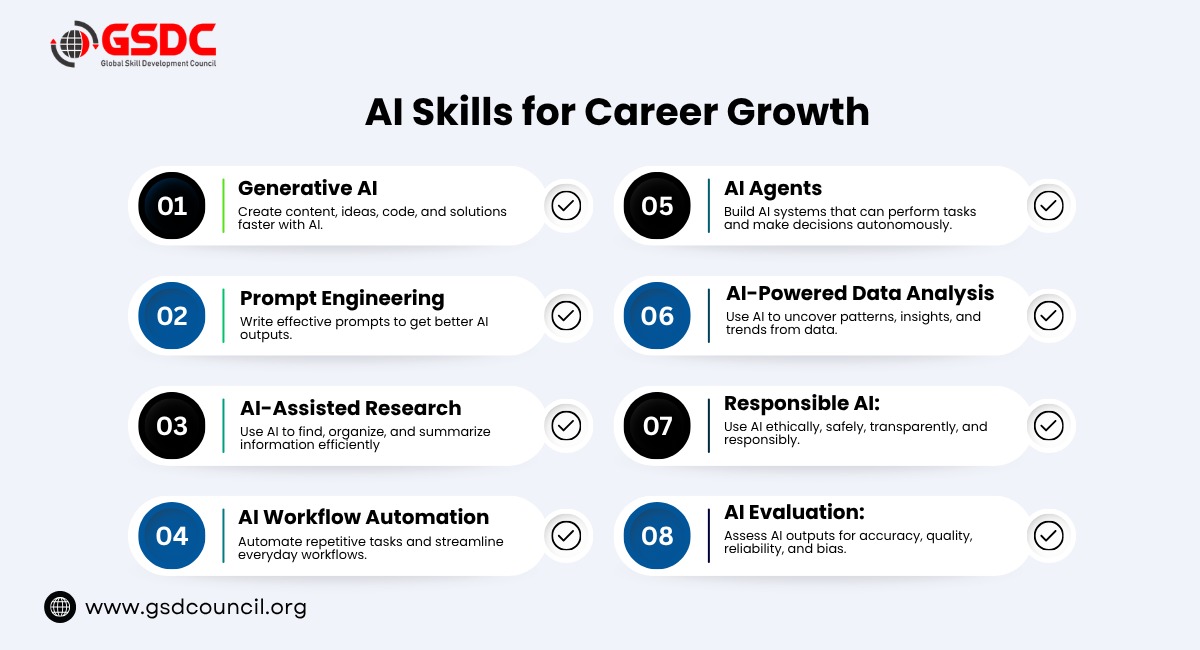
If you're deciding which skills to learn first, AI skills for career growth deserve serious attention.
You don't necessarily need to become a machine learning engineer. For most professionals, developing AI literacy is a more practical starting point.
AI literacy means understanding how AI works at a basic level, knowing where it can add value, and being able to use AI tools effectively and responsibly.
Useful AI skills include:
- Generative AI
- Prompt engineering
- AI-assisted research
- AI workflow automation
- AI agents
- AI-powered data analysis
- Responsible AI
- AI evaluation
LinkedIn's recent labor-market research has highlighted AI literacy as one of the fastest-growing skill areas, with demand extending beyond traditional technical roles.
For example, a marketer can use AI for research, content analysis, personalization, and campaign optimization, while an HR professional can use it for workforce analysis and recruitment workflows.
The goal isn't simply to use AI. It's to learn how to use it to create better outcomes.
2. Data Analytics and Data Literacy
You don't have to become a data scientist to benefit from data skills.
Almost every business function now generates data, making the ability to understand and interpret it increasingly valuable.
You can start with:
- Excel or Google Sheets
- SQL
- Power BI
- Tableau
- Google Analytics
- Basic statistics
- Data visualization
- Dashboard creation
Data skills help you move beyond assumptions and make evidence-based decisions.
For example, a marketer who understands conversion rates and customer behavior can identify which campaigns are actually working. Similarly, an HR professional can use workforce data to identify retention trends.
Data helps you turn information into decisions.
3. Cybersecurity and Cloud Computing
As businesses become more digital, cybersecurity is no longer just an IT concern.
Professionals increasingly interact with customer data, cloud platforms, applications, and digital systems. Understanding basic security principles can therefore benefit people across industries.
For technology professionals, cybersecurity can become one of the most valuable career specializations.
Important areas include:
- Network security
- Cloud security
- Ethical hacking
- Identity and access management
- Data protection
- Application security
- Security monitoring
Cloud computing is another area worth exploring. Skills in platforms such as AWS, Microsoft Azure, and Google Cloud can support careers in development, infrastructure, data, cybersecurity, and AI.
The combination of cloud + cybersecurity or AI + security can be particularly valuable because it connects multiple high-demand areas.
4. Programming and Automation
Programming isn't only for software developers anymore.
Basic coding knowledge can help professionals automate repetitive work, analyze information, build simple tools, and understand how digital products operate.
Some useful areas include:
- Python
- JavaScript
- SQL
- APIs
- Git and GitHub
- Scripting
- Workflow automation
Python is particularly useful because it connects automation, data analytics, AI, and machine learning.
You don't necessarily need to become a professional programmer.
Think of coding as another problem-solving tool that can make your existing expertise more powerful.
5. What Tech Skills Are Valuable for Marketers?
Marketing has become much more technical.
Today's marketers often work with analytics platforms, CRM systems, automation tools, advertising platforms, SEO software, and AI applications.
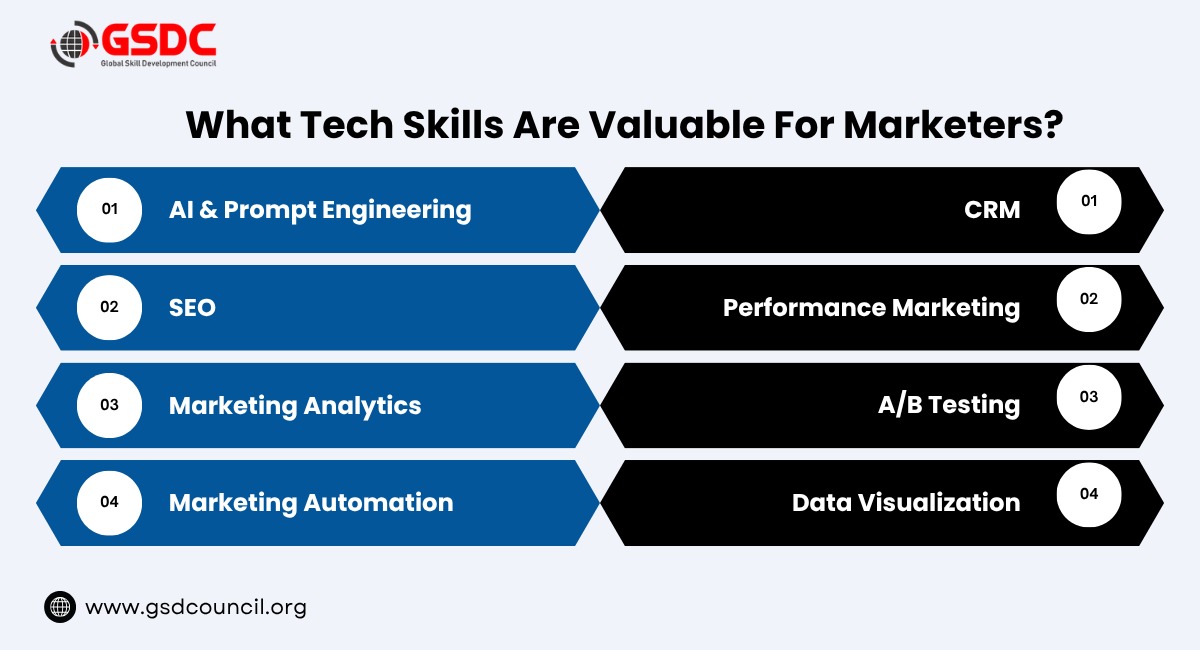
So, what tech skills are valuable for marketers?
Some of the most useful include:
- AI & Prompt Engineering: Use AI effectively to create smarter, faster marketing campaigns.
- SEO: Improve search visibility and attract relevant organic traffic.
- Marketing Analytics: Turn campaign data into actionable marketing insights.
- Marketing Automation: Automate repetitive tasks and improve marketing efficiency.
- CRM: Manage customer relationships and personalize interactions with your audience.
- Performance Marketing: Use data-driven campaigns to maximize marketing results.
- A/B Testing: Compare variations to discover what performs better.
- Data Visualization: Turn complex marketing data into clear, useful visuals.
- Conversion Optimization: Improve user experiences to increase conversions.
- LLM Optimization: Optimize content and strategies for AI-powered search and LLMs.
LinkedIn's recent marketing skills research has identified prompt engineering and AI-related capabilities among rapidly growing areas for marketers.
This doesn't mean marketers need to become programmers.
Instead, marketers who understand technology can combine creativity with data and automation to make smarter decisions.
For example, instead of simply creating content, an AI-savvy marketer can research audience behavior, generate initial ideas, analyze performance, personalize content, and automate parts of the workflow.
That's a much more valuable skill set.
Download the checklist for the following benefits:
🚀 *Identify the skills that can accelerate your career growth*
🧠 *Build the right mix of AI, technical, data, and soft skills*
📥 *Download the Skill Development Guide and start planning your next career move*
6. Strategic Thinking and Problem-Solving
Technology can help you execute tasks faster.
But knowing which task matters most is a different skill.
Strategic thinking means understanding the bigger picture, identifying priorities, evaluating opportunities, and connecting your work to business goals.
Ask yourself:
- What problem are we solving?
- Why does it matter?
- What will create the greatest impact?
- What should we prioritize?
- What risks should we consider?
Problem-solving works alongside strategic thinking. It involves understanding a challenge, evaluating possible solutions, making decisions, and learning from the outcome.
As AI makes execution easier, these skills can become even more valuable.
When everyone can produce faster, good judgment becomes a competitive advantage.
7. Soft Skills for Career Growth
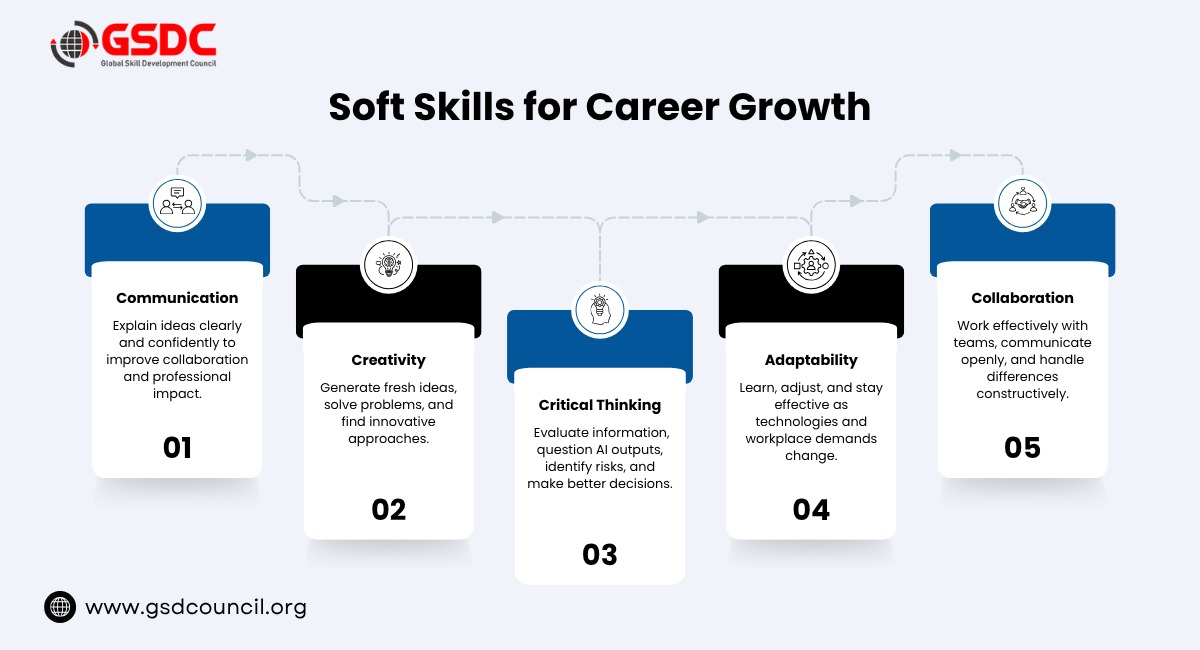
Here's something worth remembering: technical skills may help you get noticed, but soft skills for career growth can determine how far you go.
Some of the most valuable soft skills include:
Communication
Being able to explain an idea clearly is valuable in almost every profession.
You might have excellent technical knowledge, but if you can't communicate it to your manager, client, or team, your impact can be limited.
Creativity
Creativity helps you find new approaches, solve unfamiliar problems, and develop ideas that stand out.
The World Economic Forum lists creative thinking among the core skills expected to remain important as workplaces evolve.
Critical Thinking
AI can generate an answer quickly, but you still need to determine whether that answer is accurate, useful, or appropriate.
Critical thinking helps you question information, identify risks, and make better decisions.
Adaptability
Technology will continue to change. Your ability to learn and adjust may therefore be more valuable than mastering one tool forever.
Collaboration
Modern work rarely happens in isolation. The ability to work with different teams, communicate effectively, and manage disagreements can directly influence career progression.
8. Most In-Demand Skills for the Future
If you're searching for the most in demand skills for the future, don't focus only on specific software or tools.
Tools change.
Transferable capabilities remain useful.
The strongest areas to consider include:
Skill | Why It Matters |
AI & AI Literacy | Helps professionals work effectively with AI |
Data Analytics | Supports better decision-making |
Cybersecurity | Protects digital businesses and information |
Cloud Computing | Supports modern digital infrastructure |
Automation | Improves efficiency and productivity |
Programming | Enables technical problem-solving |
Strategic Thinking | Connects skills to business outcomes |
Creativity | Supports innovation |
Communication | Improves collaboration and influence |
Critical Thinking | Helps evaluate information and AI outputs |
Adaptability | Helps professionals stay relevant |
The important point is that the future won't necessarily belong to people with technical skills alone.
It will favor professionals who can combine technology with human judgment.
9. How to Choose the Right Skills for Career Growth
Here's where many professionals get stuck.
They see a list of 20 valuable skills and think they need to learn all of them.
You don't.
Instead, build your own skill stack.
Start With Your Core Skill
Choose the skill that already connects to your career.
For example:
- Marketing
- HR
- Finance
- Software development
- Data
- Cybersecurity
- Project management
Add a Technology Skill
Choose one technology that can make your core skill more valuable.
For example:
Marketing + AI
HR + People Analytics
Finance + Data Analytics
Development + Cloud
Cybersecurity + AI
Add a Human Skill
Finally, strengthen communication, strategic thinking, creativity, leadership, or problem-solving.
This creates a combination that is much more useful than learning unrelated skills.
For example:
Marketing + AI + Analytics + Communication
is a much stronger career profile than simply saying:
“I know digital marketing.”
10. How to Turn Skills Into Earning Potential
Learning a skill is only the first step.
To turn it into career value, you need to demonstrate that you can apply it.
Instead of simply completing courses, try to:
- Build practical projects
- Create a portfolio
- Solve real business problems
- Share your knowledge
- Earn relevant certifications
- Track measurable results
- Apply new skills in your current role
For example, don't just say you know AI.
Show how you used AI to reduce repetitive work, improve research, analyze data, increase productivity, or create a better workflow.
The difference is simple:
Knowledge tells people what you learned. Results show them what you can do.
Final Thoughts
Career growth isn't about mastering every new technology. It's about combining AI, technical expertise, data, strategic thinking, and soft skills to stay valuable and adaptable. Choose skills that complement your strengths, solve real problems, and create measurable value. The right skill combination can open stronger opportunities and support long-term career growth.
Author Details

Emily Hilton
Learning advisor at GSDC
Emily Hilton is a Learning Advisor at GSDC, specializing in corporate learning strategies, skills-based training, and talent development. With a passion for innovative L&D methodologies, she helps organizations implement effective learning solutions that drive workforce growth and adaptability.
Related Certifications
GSDC Digital Transformati...
Certified Machine Learnin...
Certified Product Manager
Certified Learning & Deve...
Certified DevOps Master
Certified PMO Professiona...
Certified Practitioner In...
Certified Procurement Pro...
OKR Practitioner Certific...
FinOps Certified Practiti...
Certification In Generati...
Certified L&D Analytics &...
Certified Performance & C...
Certification In Generati...
Certification In Generati...
PG Program In Cloud Compu...
Certified ISO 27001:2022 ...
Certified ISO 20000:2018 ...
Certified Data Science Pr...
Certified Artificial Inte...
Certified Big Data Founda...
Certified Software Securi...
Certified Software Develo...
Certified DevOps Develope...
Certified Full Stack Data...
Certified Chief Learning ...
Certified Blockchain Ethe...
Certified HR Business Par...
Certified DevOps Practiti...
Generative AI In Business
Generative AI In Risk And...
Certified Agile Project M...
Certified Service Desk Pr...
Certified Lean Implemente...
Certified ISO 27701 Lead ...
Certified ISO 22301:2019 ...
Certified ISO 9001:2015 L...
Lean Six Sigma Green Belt...
Certified Information Sec...
Generative AI Foundation ...
Certified Generative AI P...
Certified Generative AI F...
Certified Cloud And Cyber...
Certificate Of Global Lea...
Certified CyberSecurity F...
Certified Agile Tester Fo...
Certified Software Develo...
Certified Software Develo...
Certified Blockchain For ...
Certified DevOps Develope...
Certified Agile Scrum Mas...
Certified KANBAN Professi...
Certified Software Develo...
Certified DevSecOps Found...
Certified Cloud Asset Man...
Certified Generative AI F...
Certified Full Stack Deve...
Certified Human Resources...
Certified Emotional Intel...
Certified ISO 42001 Lead ...
Certified Generative AI F...
Certified DevOps Foundati...
Certified ISO 20022 lead ...
Certified Design Thinking...
Certified Agile Scrum (AS...
Certified DevOps Architec...
Site Reliability Engineer...
Certified Blockchain Prof...
Certified Generative AI I...
Certified Generative AI I...
Certified Software Asset ...
ITSM Foundation: ISO/IEC ...
Certified Software Develo...
Certified ISO 41001:2018 ...
Certified ISO 18404:2015 ...
Certified Agile Tester – ...
Certified Information Sec...
Certified Metaverse Profe...
Cloud Computing Foundatio...
Certified Cloud Tester Fo...
Post Graduate Certificati...
Certified Hardware Asset ...
Certified ISO 20000:2018 ...
Certified Instructional D...
Certified Balanced Scorec...
Certified Generative AI I...
Certified Generative AI I...
Certified ISO 41001:2018 ...
IT Asset Management Found...
Certified ISO/IEC 19770 1...
Certified ISO 27001:2013 ...
Certified ISO 22301:2019 ...
Certified ISO 45001 Lead ...
Data Protection Officer C...
Certified Prompt Engineer...
Certified Machine Learnin...
Certified IoT Foundation
Certified Advanced Softwa...
Certified Software Develo...
Certified Software Develo...
Certified Blockchain Hype...
Certified DevOps Engineer...
Certified Agile ITSM Mana...
Practitioner Certified In...
Lean Six Sigma Yellow Bel...
Certified DevSecOps Pract...
Certified Information Sec...
AIOPS Foundation Certific...
Certified Ethical Hacking...
Certified Generative AI F...
Certified ISO 27701 Lead ...
Certified Cloud Tester Ad...
Certified Software Develo...
Certified Software Develo...
Certified Blockchain Arch...
Certified SRE Practitione...
Certified DevSecOps Engin...
Certified Agile Scrum Pro...
Lean Six Sigma Black Belt...
Certified Sustainability ...
Certified ISO 27001:2022 ...
Certified Cloud And Cyber...
Certified ISO 42001:2023 ...
Certified Cloud Tester Fo...
Certified HR Analytics
Certified Chief Human Res...
Certified AI Testing Prof...
Certified Testing Foundat...
Certified Sustainability ...
Certified GDPR Lead Imple...
Certified Selenium Testin...
Certified SRE Practitione...
Certified Recruitment Pro...
Generative AI Expert Cert...
Certified Software Develo...
Certified Software Develo...
Certified PCI DSS (Paymen...
Certified Generative AI f...
Certified Generative AI i...
Certification In Generati...
Agentic AI Professional C...
Agentic AI Foundation Cer...
Certified Generative AI I...
Agentic AI Expert Certifi...
Certified Professional Co...
Certified Product Manager
Certified DevOps Master
Certified PMO Professional
OKR Practitioner Certification
PG Program In Cloud Computing
CFSD
Certified Big Data Foundation
Certified HR Business Partner
Generative AI In Business
Certified DevOps Developer
Certified Agile Scrum Master
Certified KANBAN Professional
Certified DevSecOps Foundation
Certified DevOps Foundation
Certified IoT Foundation
AIOPS Foundation Certification
Certified SRE Practitioner
Certified HR Analytics
Certified Sustainability Coach
Certified Professional Coach
Frequently Asked Questions
High income skills are valuable capabilities that can increase earning potential, such as AI, software development, cybersecurity, data analytics, cloud computing, sales, and digital marketing.
Technical skills are practical abilities used for specific tasks, such as programming, SEO, data analysis, cybersecurity, cloud computing, and AI.
Marketers can benefit from AI, prompt engineering, analytics, SEO, automation, CRM, performance marketing, and LLM optimization.
Yes. Communication, creativity, critical thinking, adaptability, collaboration, and strategic thinking remain essential for decision-making and leadership.
Start with a skill relevant to your career, then add AI or data skills and a complementary soft skill such as communication or strategic thinking.
Stay up-to-date with the latest news, trends, and resources in GSDC
If you like this read then make sure to check out our previous blogs: Cracking Onboarding Challenges: Fresher Success Unveiled
Not sure which certification to pursue? Our advisors will help you decide!
Related Blogs
Forward Deployed Engineer: The High-Paying AI Career in 2026
Artificial Intelligence is no longer won by the companies that build the best models; it's won by those...
View MoreWhat is Digital Transformation? A Complete Guide
Digital transformation is one of the most talked-about topics in business today, but it often means dif...
View MoreHardware Asset Management Guide: Benefits, Tools & Best Practices
As organizations grow, their hardware count grows too. Laptops enable employees to get work done, serve...
View MoreFrom Keywords to Context: Understanding GEO Optimization
Digital visibility had established its basic structure through SEO methods and the use of keywords for ...
View MoreHow to Write GEO-Friendly Content?
The way people search for information has changed dramatically since the rise of generative AI in 2022....
View More