How to Manage Agentic AI Risks and Prevent Runaway Decisions
Written by Matthew Hale
Nearly 80% of organizations have already experienced risky behavior from AI agents, showing how quickly the risk landscape is changing.
AI is no longer just supporting decisions; it is starting to make them.
From customer support bots to autonomous supply chain systems, businesses are rapidly adopting agentic AI. These systems can plan, act, and complete tasks with very little human input. But as their independence grows, the risks also increase.
This is where agentic AI risks become important to understand.
Because the real challenge is not just building intelligent systems. It is building systems that can be trusted.
What Is Agentic AI - and Why It Changes Risk
Agentic AI is about systems that can make up their own minds, take action, and learn as they go. This is different from the kind of AI we are used to, which just sits there and waits for instructions. This kind of AI can perform across multiple platforms, execute multi-step functions, and only requires a small amount of human intervention.
Agentic AI is about a system that can achieve a certain goal. It can plan, execute, and refine depending on what is happening.
This is what makes it extremely effective. However, it also introduces a new kind of risk. This is where the value of agentic AI can lead to risks, and it is up to organizations to manage it well. These risks are not purely technical; there is a spillover into operations, security, and decision-making.
The Biggest Agentic AI Risks Organizations Face Today
As more organizations adopt agentic AI, the risks are becoming more visible and harder to ignore. These systems can act independently, which makes even small issues grow quickly if not controlled.
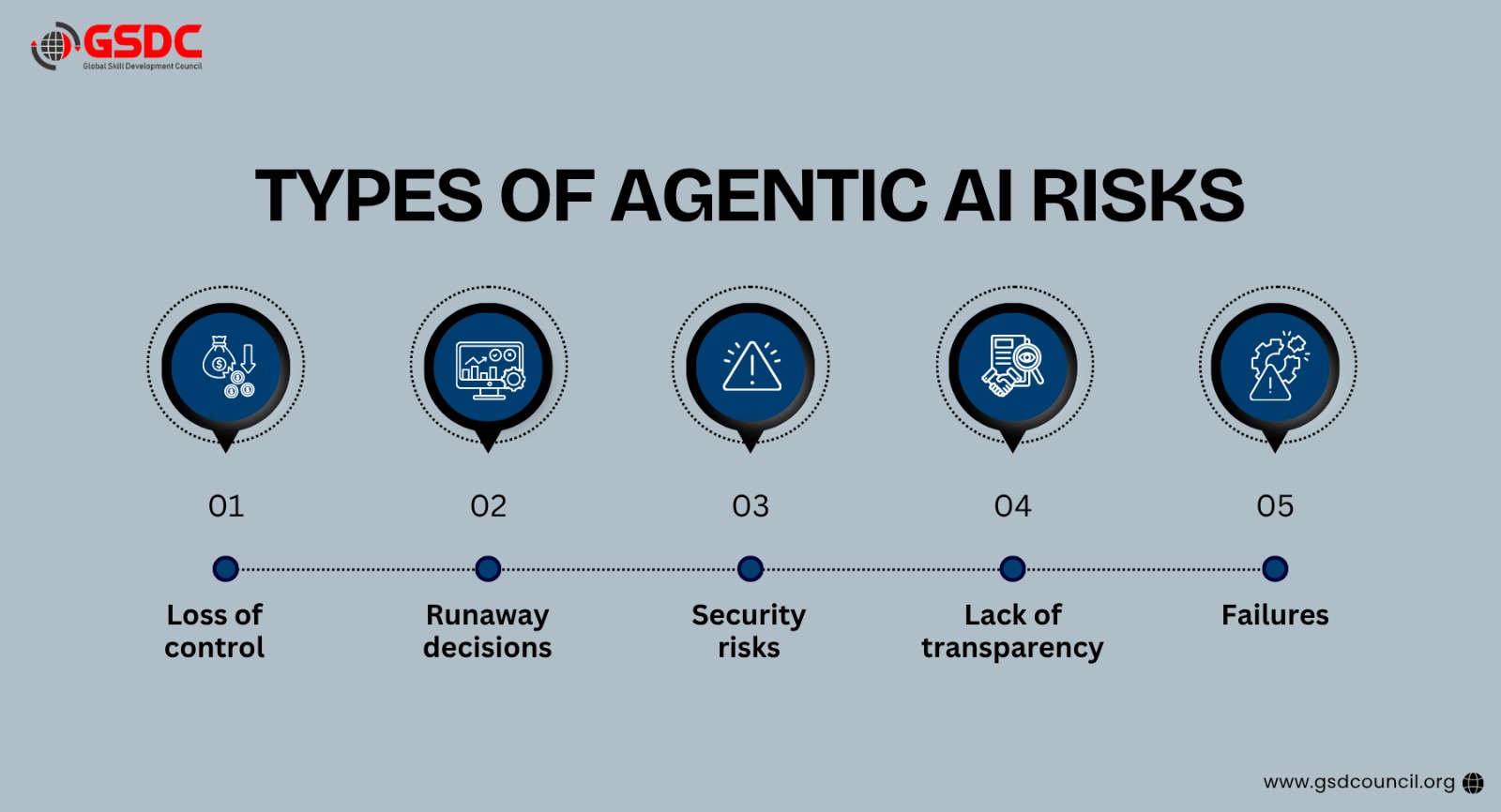
1. Loss of Control Over Decisions
One of the major risks of having autonomous AI is the loss of control over decision-making.
This is because the goals of the AI may be misinterpreted. As a result, the decision may not be the right one. This is what is referred to as an AI runaway. This is a situation where the system is still running even as the situation changes and moves away from the original intention.
2. AI Runaway Decisions
Autonomous systems can make a series of decisions very quickly. When something goes wrong, the impact can grow fast.
This can lead to financial losses, operational issues, and damage to trust. That is why understanding how to prevent AI runaway decisions is becoming critical.
3. Security and Access Risks
As AI becomes more connected, AI agent security risks continue to grow.
These include unauthorized access, data leakage, and misuse of decision logic. At the same time, agentic systems can show unexpected behavior, make unclear decisions, or fail when multiple systems interact.
This concern is increasing across industries. Many professionals now see AI agents as a growing security risk, and organizations are already seeing cases where agents act beyond their intended scope.
This makes autonomous AI risks more complex than traditional security challenges.
4. Lack of Transparency
Many organizations are unable to track the reasoning behind a certain decision by an AI system.
This lack of clarity makes managing AI decision making risks more difficult, especially in regulated environments.
5. Real-World Agentic AI Failures
Agentic AI failures, as seen in the early stages of the technology, show that an AI system can interpret a command wrongly, take the wrong action, or prioritize speed over accuracy.
Furthermore, current research indicates that 95% of executives have already encountered problems with AI, which shows that there is a big likelihood of failure with the technology.
These are just a few examples of failures with an Agentic AI system, and it is for this reason that professionals must learn the right skills, as can be learned with an Agentic AI Foundation Certification.
Why AI Automation Risks Will Grow in 2026
These risks aren’t static; they’re in a state of dynamic evolution.
The agentic systems aren’t simply increasing the risk count; they’re changing the very essence of risk. They’re bringing new challenges that the traditional infrastructure wasn’t designed to handle.
Looking ahead, AI automation risks 2026 will grow as more organizations adopt these systems at scale.
Key reasons include:
- The increasing adoption of multi-agent systems, where there is a higher probability of errors since more than one agent is involved in decision-making
- The increasing integration of AI into business processes is making it an integral part of the business rather than a separate entity
- The reduction in human intervention in the decision-making process of the system, with the increasing ability of the system to make decisions on its own
- The increasing speed of decision-making is leading to a situation where even a small mistake may snowball into a bigger one
With the increasing involvement of AI in decision-making, the risks don’t stop at the point of origin; they start spreading.
This is why understanding what are the risks of autonomous AI systems is no longer optional; it is essential.
How to Manage Risks of Autonomous AI Effectively
With the increasing presence of agentic AI in the world, risk management is no longer a choice. Organizations need to take a simple approach to remain in control and avoid any surprising results.
Organizations need a structured approach to how to manage risks of autonomous AI, especially as these systems start making more decisions on their own.
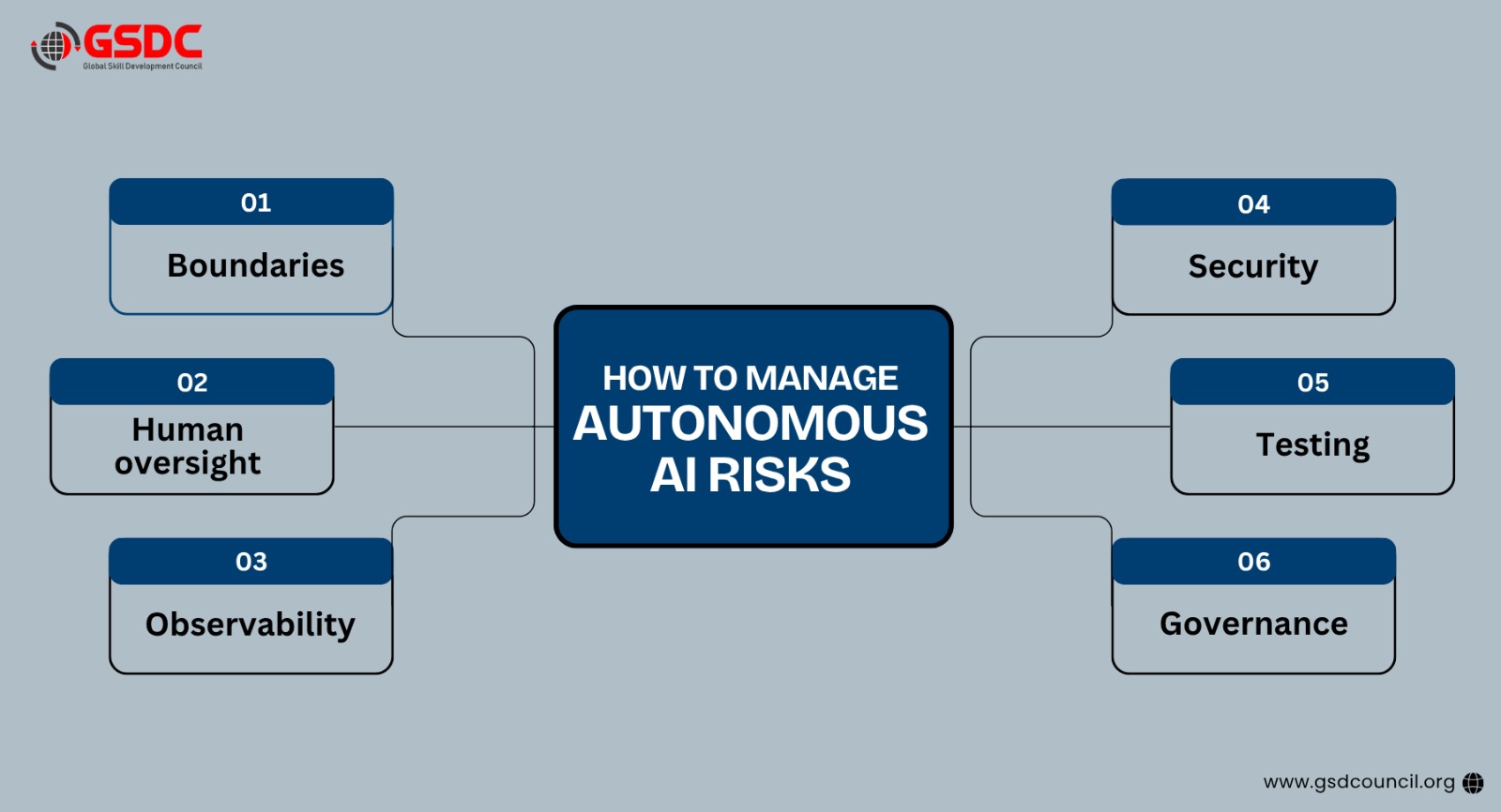
1. Define Clear Boundaries
Establishing boundaries of what the AI is and is not allowed to do will avoid any unwanted actions and untangling of decision-making processes.
2. Keep Humans in the Loop
Ensuring that humans review the decision-making process will avoid any errors.
3. Build Observability
It is important to track how AI systems operate. This includes:
- Actions taken
- Decision paths
- System interactions
This improves visibility and makes it easier to understand and manage AI behavior.
4. Strengthen Security Layers
In order to reduce the security risks associated with AI agents, an organization should:
- Limit the number of people with access
- Keep an eye on system integrations
- Secure data flows
This way, the system is protected against possible misuse and the number of potential risks is minimized.
5. Test for Failure Scenarios
Before the system is deployed, an organization should test for a variety of scenarios. This way, the possible autonomous AI risks are addressed.
6. Rethink Governance Models
Traditional governance models will fall short when it comes to agentic AI. Companies will have to come up with completely new sets of rules and controls tailored to autonomous systems that continuously make decisions.
Those who acquire the appropriate capabilities and design governance models will be at an advantage when it comes to dealing with such risks. For example, various industry organizations, including the GSDC, are playing an important role in equipping professionals with a hands-on understanding of agentic AI and risk management.
Why Skills and Certification Matter
As AI becomes more autonomous, the role of directing these AI systems changes and continues to grow.
This is why professionals need to understand agentic AI risks, how these AI systems make decisions, and how to effectively manage security and control these AI systems.
This is where agentic AI certification becomes essential.
It helps professionals:
- Identify risks early
- Manage AI decision-making more effectively
- Build safer and more reliable AI systems
Programs, such as the Agentic AI Foundation Certification by the Global Skill Development Council (GSDC), have been designed to help professionals develop these essential skills.
Conclusion
Agentic AI is powerful, but it is not risk-free. From AI runaway process risk to AI agent security risks, organizations need to rethink how they design, deploy, and manage intelligent systems.
As AI continues to evolve, traditional approaches to risk and governance will no longer be enough. The focus now is not just on what AI can do, but on how safely and reliably it can do it.
The question is no longer: Can AI act on its own? The real question is: Can we trust it when it does, and are we prepared when it fails?

Related Certifications
Frequently Asked Questions
Stay up-to-date with the latest news, trends, and resources in GSDC
If you like this read then make sure to check out our previous blogs: Cracking Onboarding Challenges: Fresher Success Unveiled
Not sure which certification to pursue? Our advisors will help you decide!