Autonomous Decision-Making in AI: How Agentic AI Is Transforming Enterprises
Written by Matthew Hale
- What Is Autonomous Decision-Making in AI?
- Agentic AI vs Generative AI: Decision Support vs Decision Ownership
- How Autonomous Decisions Are Made
- Why Autonomous Decision-Making Matters for Enterprises
- Business-Ready Use Cases of Autonomous Decision-Making
- What These Examples Reveal
- Developing Skills for Autonomous AI Systems
- Conclusion: The Strategic Shift Ahead
For decades, enterprise decision-making followed a familiar model: humans analyzed data, made judgments, and executed actions - while technology played a supporting role. This traditional model of ai in decision making positioned AI mainly as an assistive tool rather than a decision authority.
That model is now changing. A new class of systems is emerging - often referred to as autonomous enterprise AI. These platforms no longer simply recommend actions; they assume real decision authority. This shift toward outcome-driven systems is redefining how organizations operate, compete, and scale, reflecting broader AI transformations taking place across industries.
As leaders think about the future of AI in business, they are discovering that modern AI must now operate as part of structured autonomous decision systems rather than as isolated tools, marking a fundamental agent transformation in how enterprises design intelligent systems.
What Is Autonomous Decision-Making in AI?
Autonomous decision-making describes AI systems that can evaluate information, select actions, and execute outcomes independently within predefined business boundaries. In simple terms, this explains what is decision making in AI when AI moves beyond recommendations into action.
Humans are the ones who set the goals, the ethics, and the boundaries. However, the day-to-day operations are being handed over to machines gradually by means of a human-in-the-loop AI model, where people oversee rather than get involved in every step. This evolution of ai in decision making allows organizations to scale operations without overloading human teams.
This change is not about getting rid of the need to be accountable. It is about making it possible for AI to be in charge of decisions in a way that is both safe and scalable.
Agentic AI vs Generative AI: Decision Support vs Decision Ownership
|
Aspect |
Generative AI |
Agentic AI |
|
Primary Purpose |
Creates content and insights |
Achieves goals and outcomes |
|
Core Function |
Generates text, images, code, or summaries |
Plans, decides, executes, and adapts |
|
Interaction Model |
Prompt-driven and reactive |
Goal-driven and proactive |
|
Decision Role |
Supports human decision-making |
Makes and acts on decisions autonomously |
|
Workflow Scope |
Single-step or limited tasks |
Multi-step, end-to-end workflows |
|
Level of Autonomy |
Low to moderate |
High |
|
Human Involvement |
Human-in-the-loop |
Human-on-the-loop (oversight) |
Generative AI creates intelligence. Agentic AI makes decisions operational.Generative models are great for producing content or insight, but agentic systems are the ones that can achieve goals end, to, end. They plan, act, adapt, and learn, embedding governance directly into execution. This is where agentic AI frameworks become critical, enabling structured agent transformation and scalable ai transformations across enterprises.
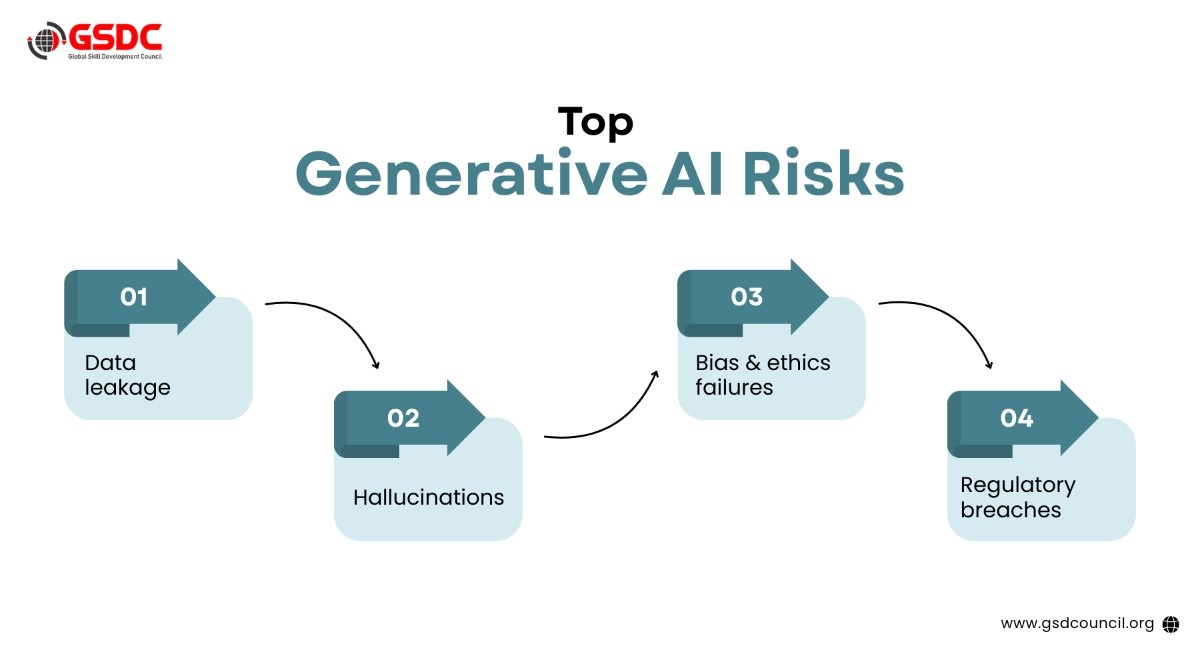
This is where the conversation moves beyond automation and into practical agentic AI risk management, ensuring that autonomy is paired with control.
How Autonomous Decisions Are Made
An autonomous decision does not mean a random choice or that control is lost. Agentic systems instead function through a structured, continuous decision loop that is analogous to human reasoning, but at machine speed.
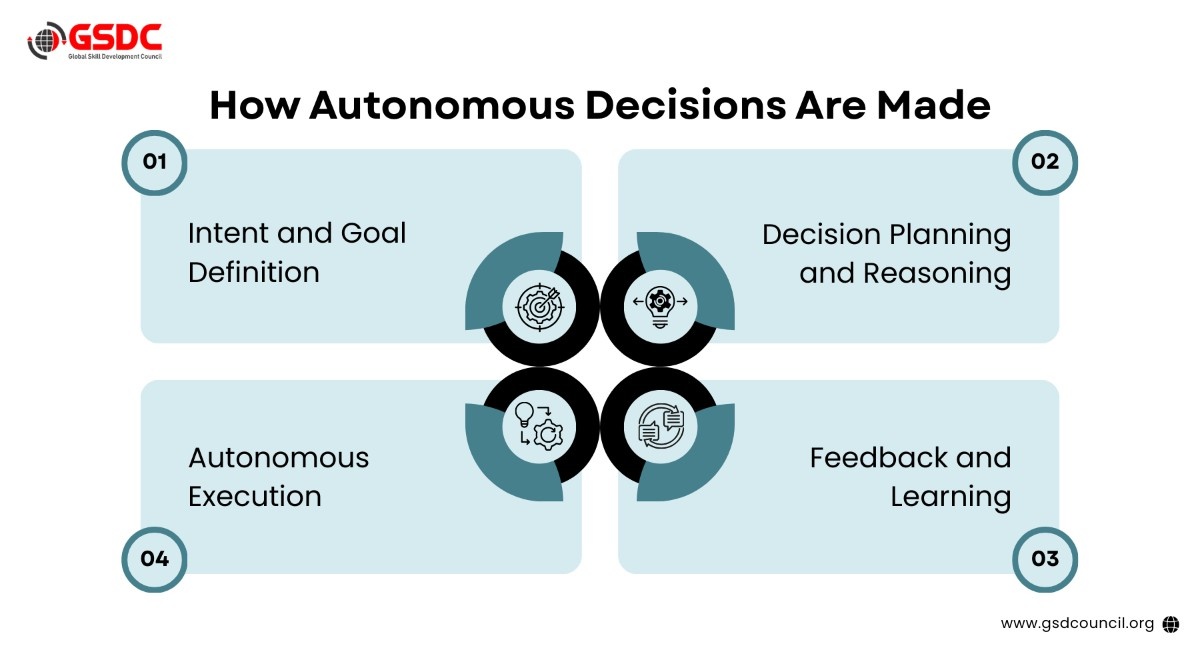
- Intent and Goal Definition: Intent is the foundation for every autonomous decision. A system receives a single, unambiguous business objective, such as reducing fraud, speeding up response times, or saving resources by allocating them efficiently.
- Decision Planning and Reasoning: The agent thinks through the possibilities, constraints, and trade-offs to decompose the objective into decision paths that can be executed.
- Autonomous Execution: An agentic system, unlike a traditional AI that stops at recommendations, directly executes the decisions, thus it can trigger workflows, change parameters, call tools, or coordinate with other systems.
- Feedback and Learning: The results are measured in real time. The system learns from success or failure and adjusts future decisions, thus creating a self-improving loop. This is what really autonomous decision-making is all about, rather than just automation.
When decisions are interpretable, executable, and refinable without human intervention, the effect is not just efficiency; it fundamentally changes the way enterprises operate at scale.
Together, these loops form the operational core of modern autonomous enterprise AI environments. Many organizations are now using programs like the Agentic AI Foundation Certification to create the necessary skills across their AI, risk, and operations teams in order to effectively design and manage these loops.
Why Autonomous Decision-Making Matters for Enterprises
Enterprises of the future are pushing the boundaries of traditional models, whose decisions are led by humans. The latter shows many limitations under the conditions where modern enterprises are functioning.
- High decision volumes: Enterprises are asked to make operational decisions in various areas such as finance, operations, customer experience, supply chain, and IT daily. These decisions are taken at times in the thousands, if not in the millions. A human-driven decision process cannot be scaled to this volume without delays, inconsistency, or increased costs.
- Compressed response windows: Market conditions, customer demands, and risk situations are changing so fast that times are even in seconds. Decisions that were allowed hours or days for review have to be made immediately. There is almost no space left for manual analysis or approval chains.
- Rapidly changing environments: Companies face extreme variability caused by fluctuating demand, supply interruptions, cyber threats, or regulatory changes. The pace of such a high level of dynamism is too fast for static rules and periodic reviews to keep up with.
Fortifying enterprise preparedness for AI ethics and AI, assisted compliance challenges across global operations.
Autonomous decision-making systems are designed to address these challenges directly:
- Reducing decision latency from hours to seconds: Autonomous systems execute all facets of a decision cycle using the data at hand within a few seconds. A human in the loop does not slow down the real-time reactions anymore to operational or market changes.
- Scaling decision logic across operations: Once the decision logic has been created and overseen, it can be essentially used in different departments, branches, and systems, thus ensuring that decisions are made consistently at the enterprise level.
- Improving consistency and reliability: Automated decision-making solutions are a prime example of how logic is executed without deviation or error, thus contributing to the reduction of mistakes resulting from human fatigue, bias, or fragmented judgment.
- Evolve continuously through feedback loops: Humans are then freed to concentrate on judgment, ethics, and strategy. In this way, by assigning the AI the task of making repetitive and time-sensitive decisions, companies enable their leaders and experts to use their time for higher-level activities such as setting the overall goal, recognizing constraints, ensuring ethical standards, and evaluating long-term impacts.
The influence is not just a matter of a simple speeding up of automation processes. It is, in fact, a continuous, accountable decision execution whereby actions are carried out, decisions are supervised, and improvements are implemented at any moment throughout the enterprise.
Business-Ready Use Cases of Autonomous Decision-Making
Autonomous decision-making is a reality across enterprises, especially in areas that require decisions to be made at scale, in real-time, and with unambiguous results. Agentic AI further these systems by allowing decisions to be carried out independently within certain business and governance boundaries.
- Fraud Detection & Transaction Monitoring: Autonomous systems in financial services are capable of evaluating transactions within a few milliseconds and hence, deciding whether to approve, block, or escalate the activity for manual review.
For Example, Visa Advanced Authorization analyzes up to several thousand signals per transaction to independently compute fraud risk and take the approval decision instantly.
Stripe Radar employs machine learning models that enable the automatic granting or blocking of payments depending on the fraud patterns. They keep on getting smarter with each outcome.
These kinds of systems are examples of how decision authority can be transferred from post, transaction review to instant, autonomous risk decisions.
- Credit Scoring & Loan Approval: Credit decisions are increasingly made by autonomous decision engines that weigh speed, risk, and compliance.
For Example, FICO credit decision systems automatically evaluate creditworthiness based on predefined models and thresholds, thus executing the approval or decline of applications at large.
Upstart leverages AI-driven models that independently assess loan applications, decide on approval and pricing, and only if there are edge cases, human review is given.
Thus, autonomous decisions here lower the turnaround time while explaining ability and regulatory oversight are maintained.
- Dynamic Pricing: Pricing decisions exemplify the most advanced cases of autonomous decision-making, functioning around the clock without the need for human intervention.
For Example, Amazon's dynamic pricing mechanisms are self-sufficient in varying product prices according to factors such as demand, inventory, competitor behavior, and customer signals.
Uber's surge pricing recalculates fares automatically and instantly based on supply and demand conditions in different locations.
These mechanisms are examples of continuous decision loops, where pricing decisions are arrived at, implemented, and perfected instantaneously.
- Predictive Maintenance: Manufacturing environments depend heavily on autonomous decision-making systems to detect and prevent failure situations before they can materialize.
For Example, GE Predix processes industrial sensor data and determines on its own the time when equipment needs maintenance, thus initiating the intervention before a breakdown.
IBM Maximo employs AI-driven decision logic to plan maintenance operations by analyzing the health and performance data of assets.
Indeed, the system is so advanced in both scenarios that it is the one deciding as to when to intervene rather than only indicating potential failures.
- Supply Chain Routing & Inventory Optimization: Autonomous decisions enable enterprises to react immediately to disruptions and changes in demand.
For Example, Amazon's supply chain optimization systems are designed to automatically redistribute inventory and change fulfillment routes in local and international operations.
Blue Yonder equips AI decision engines that keep updating demand forecasts, inventory levels, and logistics plans in real-time.
Such examples point to the future of autonomous decision-making, where it can simultaneously extend across different systems and stakeholders.
- Customer Service Routing & Resolution: Customer operations have increasingly relied on autonomous decision-making as a tool to manage high volumes in a time-efficient manner.
For Example, Zendesk AI routing is an automatic process that determines how tickets are prioritized, routed, or even resolved based on the identification of the intent and the urgency of the query.
Salesforce Service Cloud Einstein takes the initiative to suggest or even perform the resolutions of the most frequent issues, while, in turn, complex cases are escalated to human agents.
In this instance, autonomy in decision-making helps to accelerate the responses while still keeping the human touch for those situations that require it the most.
As these use cases scale within enterprises, the frameworks provided by the Global Skill Development Council (GSDC) assist in the translation of Agentic AI into practical skills that incorporate generative AI risk management and AI compliance from the very beginning.
What These Examples Reveal
Across all these cases, the shift is clear: decisions are no longer queued for approval-they are executed autonomously within governed boundaries.
Human participation changes to a higher level, where instead of just approving single actions, humans define the decision logic, the constraints, and the supervision. This is the layer of operation that forms the basis of Agentic AI, which is essentially linking the different isolated decision engines to be able to work together, driven by the desired outcomes, at enterprise scale.
As decision authority shifts from humans to systems, one question becomes unavoidable: where should autonomy stop, and how should it be governed?
Governance: Defining the Boundaries of Autonomous Decisions
Autonomous decision-making does not remove human responsibility-it reframes it.
Enterprises must define:
- Which decisions can be autonomous
- What constraints and guardrails apply
- When human intervention is required
- How decisions are audited and explained
Regulatory frameworks and ethical considerations make explainability, accountability, and oversight essential to scaling autonomy responsibly. Governance alone, however, is not enough. Enterprises also need the right skills to design, manage, and trust autonomous decision systems.
Governance is now the front line of how to mitigate AI risks. Without embedded controls, organisations cannot sustain generative AI risk management or demonstrate real-world artificial intelligence compliance.
Developing Skills for Autonomous AI Systems
As most of the decision-making power is handed over to machines, companies need to build the right capabilities to be able to manage, govern, and trust autonomous systems. As skills become more emphasized, there is also a rising number of requests for generative AI certifications, as professionals look for formal recognition of their ability in managing AI compliance frameworks and understanding the development of generative AI risk management.
The increasing demand for globally aligned skills that are well-structured is the point at which the Agentic AI Foundation Certification from Global Skill Development Council (GSDC) comes in by creating competency frameworks that link the new AI paradigms with the practical side of the enterprises.
Conclusion: The Strategic Shift Ahead
Agentic AI is a change in the mode of support from decisions made with the help of a human to decisions delegated to the AI system. Companies that win will not be those that simply automate the most tasks, but those that effectively create, manage, and expand autonomous decision-making. As AI systems are given more power to make decisions, managers become people who, instead of approving actions, actually specify the goal, set limits, and assess results.
In an era where speed and adaptability define competitiveness, autonomous decision-making is no longer optional-it is strategic. Success with generative AI in the future will not be measured by the first movers but by those who manage AI the best. Those who integrate AI compliance into their operations, become proficient in risk mitigation, and implement generative AI risk management across the organization will be the ones to succeed.

Related Certifications
Stay up-to-date with the latest news, trends, and resources in GSDC
If you like this read then make sure to check out our previous blogs: Cracking Onboarding Challenges: Fresher Success Unveiled
Not sure which certification to pursue? Our advisors will help you decide!