Common Mistakes in Competency Development And How to Fix Them
Written by Matthew Hale
Competency development employee engagement is a key focus for organizations today - but many still struggle to get it right.
Mistakes in competency development often lead to skill gaps, low engagement, and inconsistent performance, showing why competencies are important in today’s workplace.
The problem is not the effort - it is the approach.
Competency development must be structured and continuous to deliver real results.
When done right, it improves both performance and competency development employee engagement.
What is Competency Development?
Competency development is the process of building the skills, knowledge, and behaviors employees need to perform effectively and achieve business goals.
It goes beyond basic training by focusing on continuous learning, real-world application, and clear performance and development goals.
Some common competency development examples include leadership training, mentoring, and skill development programs.
By focusing on structured competency development, organizations can improve performance, support employee development & engagement, and show why competencies are important in the workplace.
Why Competencies Are Important in the Workplace
To understand common mistakes, we first need to understand why competencies are important.
Competence combines skills, knowledge, behavior, and abilities that determine how employees execute their job responsibilities in a competent manner.
Competencies help:
Define clear expectations
Competences define the capability level required of the employee who is performing the work assignment. By providing the employee with clarity regarding the expectation of their level of performance, it will increase their level of understanding regarding role ambiguity.
Improve employee performance
By providing the employee with a set of knowledge, skills, and behaviors that define the expectation that they are to deliver will allow the employee to complete their job assignment.
Align skills with business goals
Competencies provide an evaluation system for measuring employee's skills and capabilities against the organization's overall goal.
Identify skill gaps
Identifying gaps in employee skills allows you to determine where an employee requires improvement or where a company's development efforts should focus.
Defined competencies will give an individual their specific direction and will inform them of how they can achieve success in their job.
This is why is competence important in the workplace - it creates clarity, fosters assurance, and provides consistent performance throughout the entire organization.
7 Common Mistakes In Competency Development
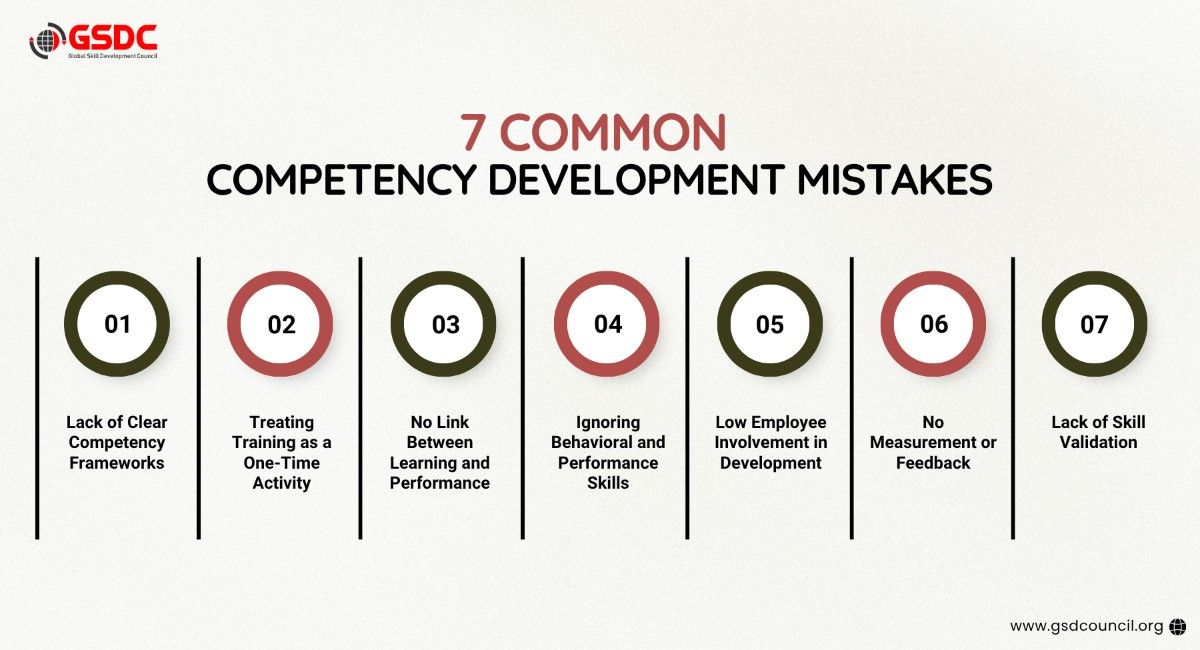
Competency development is essential for performance and growth, but many organizations get it wrong. Small gaps can lead to low engagement, unclear expectations, and poor results - showing why competencies are important and how the right approach improves competency development employee engagement.
1. Lack of Clear Competency Frameworks
The Mistake:
Often, organizations overlook the importance of precisely articulating the skills that each role requires. Such a scenario can be a breeding ground for misunderstandings, variability in performance, and ineffective developmental experiences.
How to Fix It:
- Develop well-organized and highly detailed competency frameworks
- Define clear performance competency examples
- Ensure the competencies reflect actual job responsibilities.
Having a well-laid-out framework is a key factor for employees to know what is expected of them and also serves as a pointer to more effective employee development & engagement.
2. Treating Training as a One-Time Activity
The Mistake:
Organizations frequently depend on one-off training sessions.
How to Fix It:
- Develop ongoing learning opportunities consistently
- Promote mentorship and coaching
- Create practical on-the-job opportunities for ongoing learning
Some effective competency development examples include:
- Leadership development programs
- Skill-based learning paths
- Hands-on project experience
These competency development examples ensure long-term improvement and sustained performance.
3. No Link Between Learning and Performance
The Mistake:
Learning and performance are often not integrated into a single program/event.
How to Fix It:
- Define performance and development goals clearly
- Link the learning process to identifiable outcomes
- Regularly evaluate improvement
When you have a link between learning and performance, employees remain engaged in their work.
4. Ignoring Behavioral and Performance Skills
The Mistake:
Most firms only give attention to technical abilities and not to behavioral and performance abilities.
How to Fix It:
Expand performance competence examples to include:
- Communication
- Teamwork
- Problem-solving
- Adaptability
These performance competencies examples are critical for overall workplace success.
5. Low Employee Involvement in Development
The Mistake:
Employees are not actively involved in their learning process.
How to Fix It:
- Encourage employee participation
- Personalize learning paths
- Strengthen employee engagement competency
This improves the connection between learning, competency development employee engagement.
6. No Measurement or Feedback
The Mistake:
Businesses presently do not have a way to determine how successful their development programs are.
How to Fix It:
- Measure skill enhancement
- Track performance outcomes
- Utilize feedback to improve programs
Through structured frameworks such as those supported by organizations such as GSDC, and global alignment of all skills, companies will be able to measure how effectively they develop their employees.
7. Lack of Skill Validation
The Mistake:
Employees are building skills, but they aren’t completing formal processes to verify that the skills meet an acceptable standard.
How to Fix It:
- Use structured assessments
- offer performance & competency certification
- Standardize skill evaluation
Competency framework designers/users can take advantage of certification programs, for example, the Certified Performance & Competency Developer program, which helps to implement more consistent and effective ways to assess competencies throughout their organizations.
Why Fixing These Mistakes Matters
Dealing with these problems results in:
- Improved Performance
- Employee Engagement Increased
- Stronger Employee Retention
- Skill Development Is More Consistent And Measurable
Developing competencies in a structured way aligned to organizational needs will help businesses fill skill gaps and enhance overall workforce capability.
This reinforces why competencies are important in building a capable, future-ready workforce and ensuring long-term success.
Taking a More Structured Approach to Competency Development
The increasing focus on structured and outcome-driven development for companies has led many to adopt globally aligned frameworks like those from the Global Skill Development Council (GSDC) to create a consistent, integrated system for developing employees' competencies.
On an individual basis, anyone responsible for developing or implementing a globally aligned competency development framework can develop their own professional development through targeted programs like the Certified Performance and Competency Developer program, which helps ensure that competency initiatives are realistic, measurable, and linked to the company's business objectives.

Conclusion
In conclusion, developing competencies involves more than training employees; it also requires competency development to deliver employee engagement through structured and ongoing development of the employee's competencies.
This is why developing competence in your workforce is very important, and how developing competence in your organisation can enhance the level of employee engagement.

Related Certifications
Frequently Asked Questions
Stay up-to-date with the latest news, trends, and resources in GSDC
If you like this read then make sure to check out our previous blogs: Cracking Onboarding Challenges: Fresher Success Unveiled
Not sure which certification to pursue? Our advisors will help you decide!