Agentic DevOps in Autonomous Cloud for App Modernization
Written by Akshay Mittal
- From Automation to Autonomy: The Great Shift
- The Latest Trends Defining Agentic DevOps (2025–2026)
- The Architecture of an Agentic System
- Real-World Example: The 2:00 AM API Spike, Reimagined
- Security Considerations: The New Frontier
- The Measurable Business Impact
- A 90-Day Roadmap to Implement Agentic DevOps
- The Future is Autonomous
- How the GSDC Agentic AI Professional Certificate Helps Professionals
Let’s face it: managing modern cloud infrastructure has become a superhuman task—and it’s exactly why agentic ai in devops is gaining so much attention today.
Picture this. It’s 2:00 AM. Your phone buzzes. An API in your multi-cloud environment is experiencing sudden latency spikes. As an on-call engineer, you drag yourself out of bed, log into three different observability dashboards, scroll through thousands of log lines, and cross-reference a recent deployment. Two hours later, you finally find the memory leak, roll back the deployment, and go back to sleep exhausted. It also highlights why is devops important in maintaining speed, reliability, and resilience across modern systems.
Cloud computing has undeniably transformed how we build and scale applications. However, as our environments have become increasingly complex, spanning AWS, Azure, Google Cloud, and hundreds of microservices, traditional DevOps practices are reaching a limit. From azure devops management challenges to the increasing reliance on azure devops agents, the sheer volume of telemetry data and the rapid pace of deployments have created cognitive overload that human teams simply cannot keep up with.
We don't just need more automation. We need autonomy.
This is where Agentic DevOps emerges as the next massive evolution. By combining artificial intelligence, autonomous agents, and advanced cloud architectures, Agentic DevOps moves us beyond simple script-based automation toward self-thinking, self-healing operational systems.
Welcome to the era of the Autonomous Cloud.
From Automation to Autonomy: The Great Shift
For the last decade, devops and automation has been largely deterministic. You write a script, and the system executes it. If X happens, do Y. But the moment the system encounters an unforeseen issue, an edge case not defined in the runbook, it stops and pages a human. This limitation is also one of the clearest answers to why is devops important in today’s complex digital environments.
In 2024 and 2025, we saw the rise of "Copilots" and AI assistants. They were great for suggesting code, improving workflows, and helping teams manage azure devops management tasks or write scripts faster. But in 2026, we have crossed the threshold from AI Assistants to AI Agents, including the emergence of azure devops ai capabilities and more intelligent azure devops agents.
Here is how the paradigm has shifted:
- Traditional AIOps (Reactive): Detects an anomaly -> Generates an alert -> Recommends a solution -> Waits for a human to act.
- Agentic DevOps (Autonomous): Observes system signals -> Analyzes the root cause -> Creates a multi-step remediation plan -> Executes the fix autonomously (within guardrails) -> Learns from the outcome.
This evolution is unlocking powerful devops use cases, from incident remediation and deployment rollback to infrastructure optimization and performance recovery.
In this new model, AI agents act like senior SREs who are always on duty. Humans transition from being overwhelmed operators to strategic supervisors of intelligent systems.
The Latest Trends Defining Agentic DevOps (2025–2026)
If you haven't looked at the Agentic DevOps landscape in the last 12 months, the ground has completely shifted beneath our feet. Here are the major trends currently redefining the space:
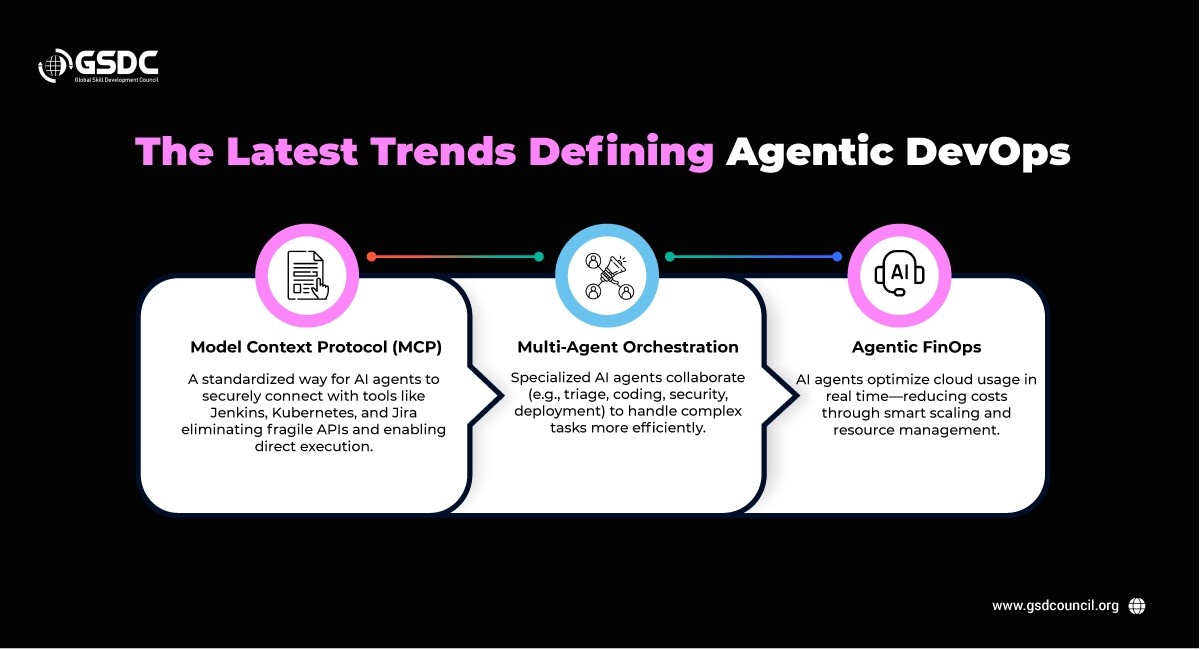
1. The "USB-C of AI": Model Context Protocol (MCP)
Perhaps the biggest breakthrough recently has been the widespread adoption of the Model Context Protocol (MCP). Introduced by Anthropic and widely adopted by Google, AWS, and DevOps platforms, MCP provides a secure, standardized way for AI models to connect directly to external tools (such as Jenkins, Kubernetes, Terraform, or Jira) without requiring custom, brittle API scripts. MCP allows agents to securely read your infrastructure state and execute commands natively, completely revolutionizing how agents interact with the real world.
2. Multi-Agent Orchestration
We are no longer relying on a single, general-purpose AI to do everything. Instead, 2026 is the year of the "microservices moment for AI." Frameworks like LangGraph, CrewAI, and AutoGen are powering teams of specialized agents. For example, a Triage Agent detects a bug, passes the context to a Coding Agent (such as a SWE-agent or OpenHands) to write a fix, which is then reviewed by a Security Agent, and finally deployed by an Infrastructure Agent.
3. Agentic FinOps
Cloud waste is a billion-dollar problem. We are now seeing the rise of dedicated FinOps agents that autonomously right-size cloud instances, orchestrate spot instances, and optimize compute loads in real-time, drastically reducing infrastructure spend without human intervention.
The Architecture of an Agentic System
To make AI agents trustworthy in production, modern Agentic DevOps relies on a strict, layered architecture:
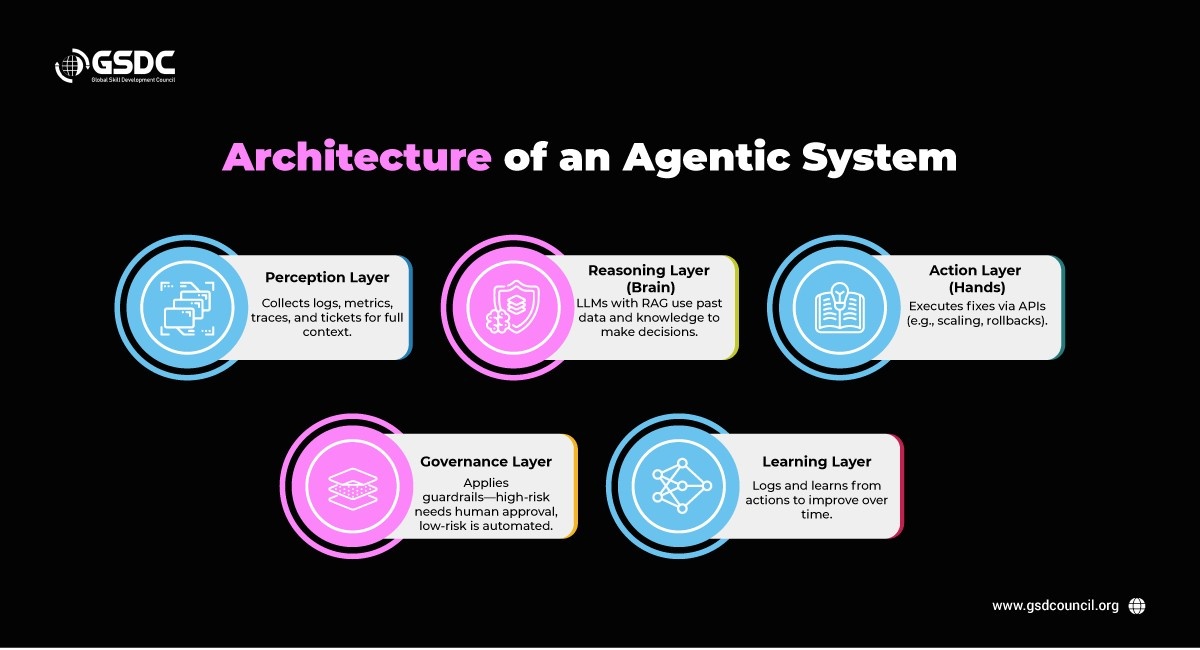
- The Perception Layer: The agent ingests multi-modal telemetry logs, metrics, application traces, user sentiment, and support tickets. This gives the AI the full operational context, not just an isolated metric, making agentic AI and cloud computing AI far more effective inside a modern devops environment.
- The Reasoning Layer (The Brain): Large Language Models (LLMs) act as the reasoning engine. Using Retrieval-Augmented Generation (RAG 2.0), the agent draws on your organization's specific knowledge graphs, past incident reports, and operational runbooks to generate hypotheses, strengthening automation intelligence, DevOps AI, and advanced Azure DevOps AI capabilities.
- The Action Layer (The Hands): Using standard protocols like MCP, the agent interacts with infrastructure APIs to execute a multi-step remediation plan (e.g., scaling resources, rolling back a pod), reflecting real-world cloud automation services, cloud automation software, and practical devops and automation workflows.
- The Governance Layer: Strict guardrails are applied. High-risk actions (such as dropping a database table) require a "Human-in-the-Loop" (HITL) approval, while low-risk actions (such as restarting a stalled container) are fully autonomous. This is also where AI in cloud security becomes essential and helps explain why intelligent automation matters in enterprise systems.
- The Learning Layer: Every action is logged, audited, and fed back into the model to improve future incident response, creating stronger generative agents, broader devops use cases, and shaping the future of devops.
Real-World Example: The 2:00 AM API Spike, Reimagined
Let’s revisit that 2:00 AM API latency spike, but this time, with Agentic DevOps in place.
- An observability agent detects abnormal latency and immediately correlates logs and metrics across the cluster.
- It identifies that a deployment from 4 hours ago introduced a memory leak.
- The agent autonomously scales up the affected Kubernetes pods to keep the app alive.
- It opens a Jira ticket, generates a pull request with the necessary code rollback, and pings the on-call engineer on Slack: "I detected an OOM error causing latency. I've scaled up the pods to mitigate impact and prepared a rollback PR. Reply 'Approve' to deploy."
What used to take hours of manual sleuthing is now mitigated and resolved in minutes, drastically reducing Mean Time to Resolution (MTTR) and letting engineers get back to sleep.
Security Considerations: The New Frontier
Handing the keys to the kingdom over to an AI agent sounds terrifying to any CISO. Security and governance are the most critical pillars of Agentic DevOps.
New risks involve shadow AI tools, non-human identities controlling infrastructure, and AI-generated vulnerabilities. To combat this, organizations are adopting:
- Identity-Based Security: Dedicated, tightly-scoped IAM roles specifically for AI agents.
- Auditability: Transparent, immutable logs of why an AI made a specific decision.
- The Kill Switch: Emergency mechanisms to instantly revoke an agent's access if anomalous behavior is detected.
The Measurable Business Impact
Organizations that have moved past the pilot phase of Agentic DevOps are seeing staggering numbers. Recent enterprise case studies from 2025 and early 2026 report:
- 85% faster incident resolution (MTTR)
- Up to 80% reduction in operational toil and manual tasks
- 45% reduction in deployment lead times
- Millions of dollars saved annually in both productivity gains and FinOps-driven cloud cost reductions.
A 90-Day Roadmap to Implement Agentic DevOps
You don't just "turn on" Agentic DevOps overnight. It requires a deliberate, phased approach:
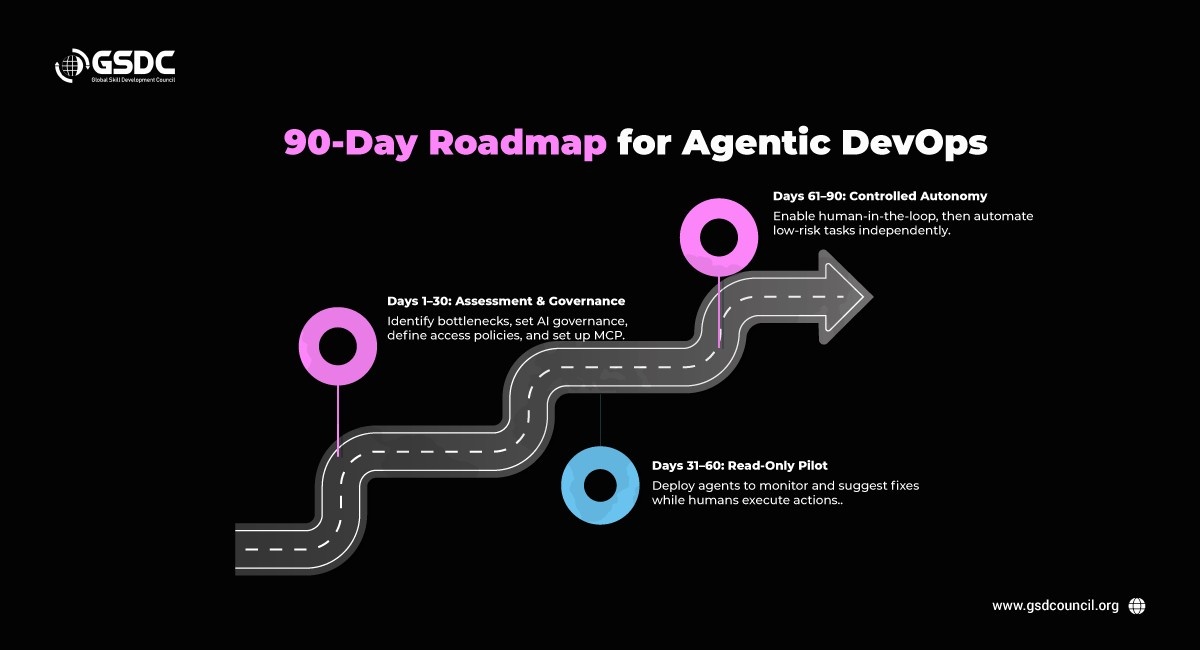
- Days 1–30: Assessment and Governance. Identify your biggest operational bottlenecks (e.g., CI/CD failures, L1 support tickets). Establish an AI governance framework, define identity access policies for non-human agents, and set up your initial Model Context Protocol (MCP) servers.
- Days 31–60: The "Read-Only" Pilot. Deploy AI agents in read-only/observability mode. Let them analyze incidents and suggest fixes, but require human engineers to actually execute the commands. Train your teams in AI supervision.
- Days 61–90: Controlled Autonomy. Enable "Human-in-the-Loop" execution for moderate tasks. Once trust is established, allow the agents to handle low-risk, repetitive tasks (like automated test generation or simple pod restarts) completely autonomously.
The Future is Autonomous
The next phase of DevOps will be defined by how well humans and specialized AI agents collaborate. Organizations that succeed in this new era will be those that view AI not just as a code-generation tool but as an autonomous teammate, especially as azure devops ai and azure devops agents become more central to modern delivery environments.
We are moving away from a culture of pure speed toward a culture of resilient, self-operating digital infrastructure powered by devops and automation. The future of DevOps isn't just automated, it is fully, securely, and intelligently autonomous, showing why is devops important for the next generation of enterprise operations.
How the GSDC Agentic AI Professional Certificate Helps Professionals
GSDC’s Agentic AI Professional Certificate equips professionals with practical knowledge of autonomous AI systems, intelligent agents, orchestration, governance, and enterprise use cases.
GSDC’s certificate helps professionals build future-ready skills to understand, design, and apply agentic AI in real-world business and technology environments, strengthening career growth across AI, DevOps, cloud, automation, and digital transformation roles.

Objectives:
- Understand the foundations of Agentic AI and autonomous systems
- Learn how intelligent agents operate, reason, and make decisions
- Explore real-world enterprise and business use cases
- Gain knowledge of AI governance, safety, and ethical deployment
- Build practical skills for implementing agentic AI strategies
- Strengthen career readiness for emerging AI-driven roles

Related Certifications
Frequently Asked Questions
Stay up-to-date with the latest news, trends, and resources in GSDC
If you like this read then make sure to check out our previous blogs: Cracking Onboarding Challenges: Fresher Success Unveiled
Not sure which certification to pursue? Our advisors will help you decide!