Agent Name Service (ANS) in Action – Building Trust, Governance, and Security for AI-Agent Workflows
Written by Akshay Mittal
- The Trust Challenge in Autonomous AI
- A Real-World Example of What Can Go Wrong
- What Is Agent Name Service (ANS)?
- How ANS Improves AI-Agent Collaboration
- How ANS Naming Works
- Strong Security Through Cryptographic Identity
- Proving Permissions Without Sharing Secrets
- AI Agents with True Zero Trust Security Model
- Real Benefits of Implementing ANS
- Preparing Teams for Secure and Governed Agentic AI
- Conclusion
Artificial Intelligence is rapidly moving beyond simple automation. Nowadays, organizations are deploying autonomous AI agents that can make decisions, interact with other systems, and take actions independently.
This shift to agentic AI opens up huge opportunities-but it also creates a serious challenge: How do we trust AI agents?
Without proper AI agent governance and AI agent identity management, autonomous agents can become unreliable and even risky. This is where Agent Name Service (ANS) becomes essential.
The Trust Challenge in Autonomous AI
Most AI systems, in their traditional sense, have had humans oversee the process and output to include the training of the model, approving the model, deploying the model, and reviewing how well the system performed.
Agentic AI changes this completely. Now we have AI agents that can:
- Automatically identify performance issues within themselves
- Retrain themselves without human involvement
- Deploy themselves directly to production environments
- Monitor themselves for performance and take corrective action if required
- Communicate and collaborate with other agents that have been created by AI
These systems are a core part of modern AI workflow automation and enterprise workflow automation strategies.
These agents are designed to operate independently. But when multiple agents interact, a critical question arises: How can one AI agent verify that another agent is legitimate and trustworthy?
If agents cannot securely authenticate each other, the entire AI workflow becomes vulnerable to errors, misuse, or attacks - directly impacting AI governance, AI data governance, and overall enterprise security.
A Real-World Example of What Can Go Wrong
Imagine a production environment with 50 AI agents working together. Each agent has a specific role: monitoring performance, retraining models, deploying updates, or sending alerts. They communicate using stored credentials and fixed configurations.
Now, imagine one agent gets compromised due to a simple misconfiguration.
Within minutes:
- The compromised agent pretends to be a trusted service
- Other agents accept its commands without verification
- Corrupted models get deployed into production
- Monitoring systems fail to detect the ai
The entire AI ecosystem collapses, not because the AI models were faulty, but because there was no reliable way for agents to verify identity and trust.
This example clearly shows why structured AI agent governance, strong AI agent identity management, and a trust layer like ANS are essential for secure AI for security and agent-based automation.
What Is Agent Name Service (ANS)?
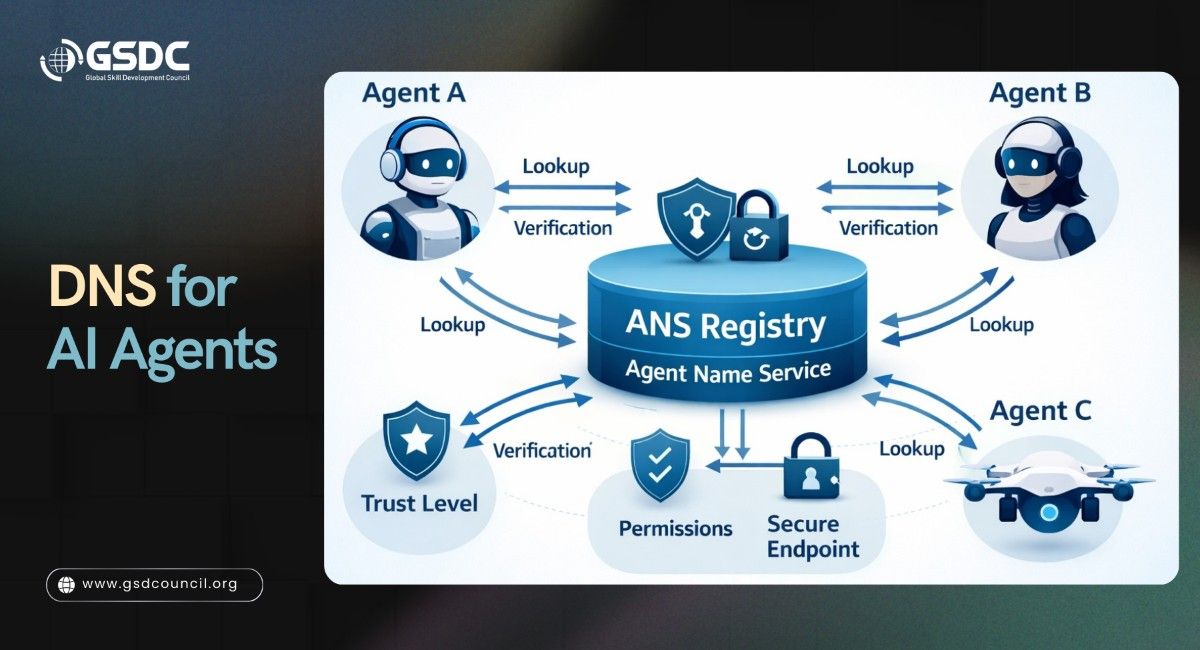
ANS can be understood as “DNS for AI agents.”
Just as DNS maps website names to IP addresses, ANS maps AI-agent names to critical trust and governance information. In modern AI governance software, this kind of structured identity layer is becoming foundational.
- Cryptographic Identities: ANS assigns every AI agent a unique, verifiable digital identity. This strengthens AI agent identity management and ensures that when agents communicate, they can prove who they are.
- Verified Capabilities: ANS allows agents to prove what they are authorized to do. Instead of blindly trusting another agent, systems can verify specific permissions - a core requirement for strong AI governance.
- Trust Levels: Each agent is associated with a trust score or level. This supports enterprise AI data governance and helps determine whether an agent is safe for sensitive workflows.
- Secure Endpoints: ANS provides authenticated and secure communication endpoints for agents, directly supporting AI for security and modern AI governance software frameworks.
How ANS Improves AI-Agent Collaboration
ANS goes far beyond traditional DNS by enabling secure, intelligent interactions.
- Secure Discovery: Agents can find other agents based on capabilities, not just location - a major upgrade for AI workflow automation.
- Cryptographic Authentication: Instead of using weak API keys, agents authenticate using strong cryptographic proofs. This makes impersonation and misuse extremely difficult.
- Capability Verification: Agents can verify exactly what another agent is allowed to do - strengthening AI agent governance.
- Policy Enforcement: ANS integrates with governance systems to ensure AI agents adhere to organizational rules and security policies at all times.
By combining discovery, identity, capability verification, and governance, ANS becomes the central trust foundation for scalable agent ecosystems - whether you are building internal tools, experimenting with open AI agents, or deploying enterprise-grade systems.
How ANS Naming Works
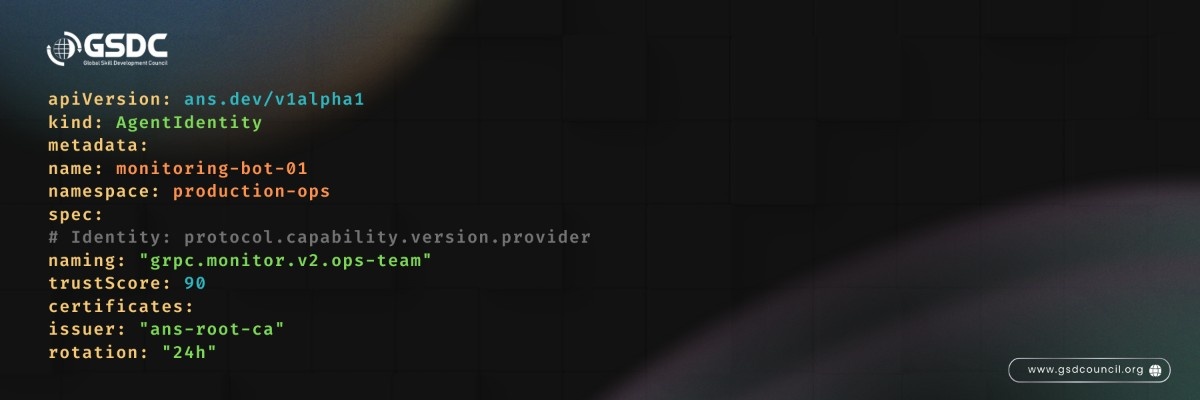
ANS uses a structured, self-describing naming system to clearly and securely identify agents.
A typical ANS name follows this format:
protocol. capability.provider.version.environment
For example:
a2a.security-monitoring.researchlab.v2.prod
This single name clearly explains:
- Communication Protocol: The first part of the name identifies how the agent communicates with others. This ensures compatibility between different agent systems.
- Agent Purpose: The capability section defines exactly what the agent is designed to do, such as monitoring, retraining, or validation.
- Provider Information: The provider segment tells which organization or team built the agent, enabling accountability.
- Version Control: Version details allow multiple versions of an agent to run simultaneously without confusion.
- Environment Context: The final part identifies whether the agent is running in production, testing, or development.
This removes hard-coded configurations and improves reliability across large-scale AI workflow automation environments.
Here is an example of how an agent identity is defined in the ANS manifest:
Strong Security Through Cryptographic Identity
At the core of ANS is a modern cryptographic security model.
Every AI agent is given:
- A unique decentralized identity
- Verifiable credentials
- Secure digital certificates
This approach directly answers key enterprise questions like what is AI security and how modern systems should protect autonomous systems.
By removing passwords and static tokens, ANS improves:
- Exposed Secrets: Traditional systems store passwords and tokens in configuration files. ANS removes this dependency entirely.
- Weak Authentication: Basic credentials can be stolen or reused. Cryptographic identity eliminates this risk.
- Manual Credential Management: With ANS, identities and certificates are managed automatically, reducing human error.
This is foundational for organizations using AI tools at scale.
Proving Permissions Without Sharing Secrets
One of the most powerful features of ANS is the use of Zero-Knowledge Proofs (ZKPs).
In traditional systems, an agent often has to share credentials to prove it has access to a resource. This creates major security vulnerabilities.
With ANS, an agent can prove:
“I have permission to perform this action.”
-without revealing any passwords, keys, or internal details.
- Privacy Protection: Sensitive credentials remain private and are never exposed during verification.
- Stronger Security: Proofs cannot be stolen, copied, or reused by attackers.
- Safer Communication: Authentication becomes more reliable because secrets never leave the agent.
This strengthens privacy, improves security, and supports scalable AI governance and AI agent governance without creating new attack surfaces.
Built for Real Enterprise Environments
ANS is not just a research idea-it is designed for real-world deployment.
It integrates seamlessly with common enterprise tools such as:
- Kubernetes for infrastructure
- GitHub CI/CD pipelines
- Open Policy Agent (OPA) for governance
- Monitoring platforms like Prometheus and Grafana
This means organizations can adopt ANS without replacing their existing systems.
Security policies can be written as code, tested, and automatically enforced across all AI agents.
AI Agents with True Zero Trust Security Model
For the ANS, the true zero-trust security model applies strictly.
- No Default Trust: An agent is not trusted unless proven trustworthy, regardless of location in the network..
- Mandatory Authentication: All agents must cryptographically authenticate their connections with other agents.
- Limited Permissions: Agents receive only the least amount of privilege needed to perform their jobs.
- Instant Revocation: If an agent displays suspicious behavior, it will immediately be stripped or limited of its access rights.
This ensures that even if one agent is compromised, the rest of the system remains protected - a core principle of modern AI for security and enterprise AI governance.
ANS in Action – A Practical Scenario
Consider a simple real-world workflow.
At 2:00 a.m., a monitoring agent detects that a production model’s performance has dropped significantly.
With ANS in place:
- The monitoring agent discovers a retraining agent
- Both agents verify each other’s identities
- Permissions are checked automatically
- The model is retrained
- The updated model is deployed
- The team receives a notification
The entire process happens securely, automatically, and often in under 30 seconds, with full audit trails and governance.
This entire workflow demonstrates secure AI workflow automation in action.
Real Benefits of Implementing ANS
Organizations that adopt ANS see clear operational improvements:
- Faster and Safer Deployments: AI-agent workflows run with minimal manual intervention and reduced risk.
- Reduced Configuration Errors: Automated discovery and identity verification prevent common mistakes.
- No Hardcoded Secrets: Credentials are replaced with cryptographic proofs.
- Strong Authentication: Agents can securely prove identity and permissions.
- Complete Visibility: Every action is logged and traceable for audits and compliance.
Most importantly, ANS makes autonomous AI systems:
- Secure
- Reliable
- Scalable
- Fully governable
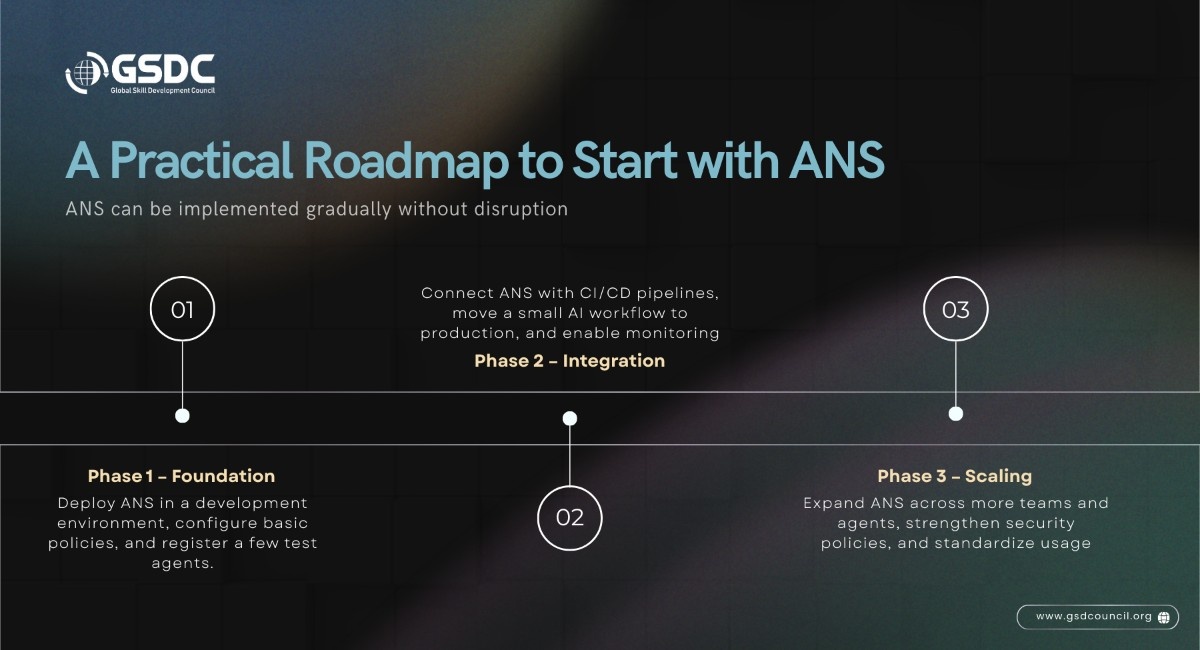
Preparing Teams for Secure and Governed Agentic AI
As businesses look at how to create an AI agent and develop scalability, they must ensure that teams understand identity, governance, and security as an essential foundation when adopting an agentic AI.
AI Learning and Certification programs that are industry aligned, such as those supported by Global Skill Development Council (GSDC), including the Agentic AI Professional Certification, allow professionals the opportunity to develop practical experience with the use of secure tools for AI, frameworks to govern AI, and how enterprise-level agentic AI workflows work.
When teams have this kind of practical exposure, it allows them to be ready for their organization to deploy agentic AI in a trustworthy way at scale with a trust framework like ANS.
Conclusion
The future of AI is autonomous and agent-driven. But autonomy without trust is dangerous.
ANS provides the foundation for secure, governed AI-agent ecosystems. It strengthens AI governance, improves AI agent identity management, and enables safe AI workflow automation at scale.
As organizations increasingly depend on agentic AI, ANS will become critical for secure and responsible adoption.
The question is not whether you will need ANS, but how soon you will start using it.
We believe in building in the public. We have released a live demonstration of the Agent Name Service that showcases the registration, discovery, and secure handshake flows described above.
Explore the code, fork the repository, and give it a star on GitHub:
👉 ANS live demo project on GitHub
We welcome issues and pull requests as we refine the standard for agentic trust.

Related Certifications
Stay up-to-date with the latest news, trends, and resources in GSDC
If you like this read then make sure to check out our previous blogs: Cracking Onboarding Challenges: Fresher Success Unveiled
Not sure which certification to pursue? Our advisors will help you decide!