AI Agent for Data Privacy & PII Detection
Written by Susmit Sen
- The Growing Complexity of Data Privacy
- The Rising Risk of Data Breaches
- What Is Personally Identifiable Information (PII)?
- Why Traditional Privacy Approaches Are No Longer Enough
- How AI Agents Improve Data Privacy and PII Detection
- The Five-Stage AI Privacy Architecture
- Key Technologies Used for Data Protection
- Privacy Challenges in Generative AI Systems
- The Role of Governance in AI-Driven Privacy
- Business Benefits of AI-Driven Data Privacy
- Building a Roadmap for AI-Driven Privacy
- The Future of Data Privacy with AI
- GSDC Certified Agentic AI Professional
- Conclusion
In the modern digital economy, data has become one of the most valuable assets for organizations. Companies rely heavily on data to drive analytics, build AI models, enhance customer experiences, and improve operational efficiency. However, with the rapid growth of data comes a major challenge: protecting sensitive information such as Personally Identifiable Information (PII).
Organizations today generate massive volumes of data daily, and much of it contains sensitive details such as names, addresses, social security numbers, financial information, and healthcare records. As regulatory requirements become stricter and cyber threats grow more sophisticated, ensuring data privacy has become a top priority for enterprises.
This is where AI agents for data privacy and PII detection are transforming the way organizations manage sensitive data. By leveraging artificial intelligence, automation, and intelligent data governance frameworks, businesses can detect, classify, protect, and govern sensitive information at scale.
This blog explores the growing importance of AI-powered privacy solutions, the challenges organizations face in managing PII, and how AI agents are helping businesses achieve stronger data protection and regulatory compliance.
The Growing Complexity of Data Privacy
Over the last decade, the global data privacy landscape has evolved rapidly. Today, more than 160 jurisdictions have implemented data privacy laws, and new regulations continue to emerge each year. These regulations require organizations to maintain strict control over how personal data is collected, stored, processed, and shared especially as businesses increasingly adopt AI agent software, experiment with AI agent frameworks, and deploy different types of AI agents in customer service, operations, analytics, and decision-making environments.
Some of the most well-known privacy regulations include:
- General Data Protection Regulation (GDPR)
- California Consumer Privacy Act (CCPA)
- Health Insurance Portability and Accountability Act (HIPAA)
- Digital Personal Data Protection Act (DPDP Act)
- European Union Artificial Intelligence Act (EU AI Act)
Compliance with these regulations is becoming increasingly complex, especially for multinational organizations that operate across multiple jurisdictions, manage cross-border data flows, and integrate intelligent systems such as AI agent software built on modern AI agent frameworks, which often process personal, behavioral, or sensitive enterprise data across various types of AI agents.
At the same time, enterprises are producing enormous volumes of data. Industry estimates suggest that organizations generate more than 2.5 quintillion bytes of data every day, and nearly 80% of it is unstructured [3]. Even more concerning is the fact that a large portion of this data remains unclassified and unmanaged, often referred to as “dark data.” Unstructured data volumes are growing by 55–65% annually [4], further amplifying the challenge.
This lack of visibility creates major privacy risks because sensitive information may exist in files, emails, cloud storage, collaboration platforms, and AI training datasets without proper monitoring or protection.
The Rising Risk of Data Breaches
The consequences of poor data privacy management can be severe. Data breaches not only expose confidential information but also result in financial losses, regulatory penalties, and reputational damage making data privacy AI and AI data security increasingly important for modern organizations.
Recent reports show that the global average cost of a data breach in 2025 is approximately $4.44 million. In specific industries, these costs are even more severe: healthcare data breaches average over $10.93 million per incident, and financial services average around $5.9 million.
Another major challenge is detection time. Without intelligent monitoring systems, it can take organizations an average of 241 to 277 days to identify and contain a data breach. During this extended period, attackers may have continuous access to sensitive data.
This is where AI-driven monitoring becomes critical. AI-powered detection systems can significantly reduce the time required to identify suspicious activity, strengthen AI data security, improve PII detection, and accelerate containment efforts. As more organizations explore what is an AI agent in the context of cybersecurity and compliance, AI-based privacy monitoring is becoming a key part of enterprise defense strategies.
What Is Personally Identifiable Information (PII)?
Personally Identifiable Information, or PII, refers to any data that can be used to identify an individual directly or indirectly.
Examples include:
- Full name
- Email address
- Phone number
- Government identification numbers
- Financial account details
- Medical records
- IP addresses or digital identifiers
PII is no longer limited to traditional databases. Today, it exists across multiple systems such as cloud platforms, SaaS applications, collaboration tools, and AI training datasets. This distributed nature of data makes manual monitoring nearly impossible.
Why Traditional Privacy Approaches Are No Longer Enough
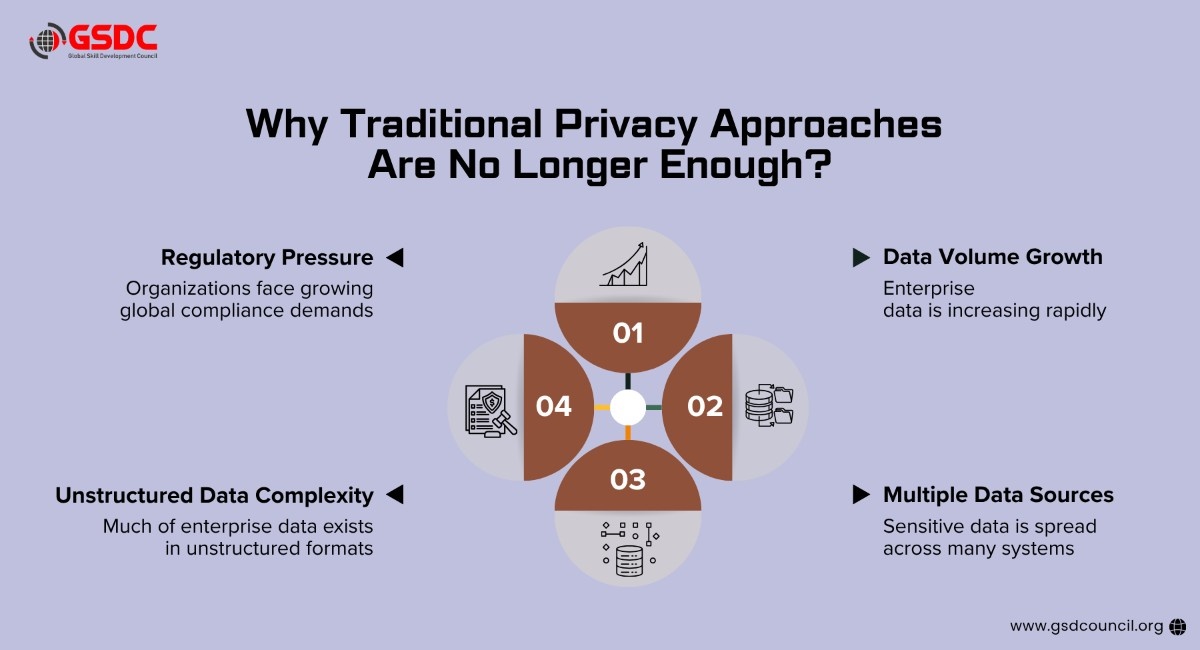
Traditional privacy management methods rely heavily on manual processes and rule-based systems. While these approaches worked in simpler IT environments, they struggle to keep up with modern data ecosystems.
Organizations now face several challenges:
- Data volume growth: The amount of data stored by enterprises has increased dramatically.
- Multiple data sources: Sensitive data is scattered across databases, cloud storage, messaging systems, and analytics platforms.
- Unstructured data complexity: A large percentage of enterprise data exists in emails, documents, images, and logs, growing rapidly every year.
- Regulatory pressure: Organizations must comply with multiple global privacy regulations simultaneously.
Because of these challenges, manual data discovery and classification methods cannot scale effectively. AI-powered privacy automation provides a more efficient solution.
How AI Agents Improve Data Privacy and PII Detection
AI agents are intelligent software systems that monitor data environments, analyze patterns, and automate privacy protection tasks. Unlike traditional tools, AI agents can continuously scan enterprise systems and identify sensitive information with high accuracy.
Their capabilities typically include:
- Automated Data Discovery
AI agents scan databases, cloud platforms, and enterprise applications to locate sensitive data automatically. This allows organizations to identify where PII is stored and eliminate blind spots in their data infrastructure.
- Intelligent Data Classification
Once discovered, AI models classify data into categories such as financial data, healthcare data, or personal identifiers. Advanced machine learning models can detect PII even in unstructured text documents.
3. Hybrid Detection Models
Modern AI privacy systems combine multiple techniques to improve accuracy, including:
- Pattern recognition (for structured data like ID numbers)
- Machine learning models
- Natural language processing
- Context-aware analysis
This hybrid approach helps reduce false positives and improves detection accuracy.
4. Automated Data Protection
After identifying sensitive data, AI agents can automatically trigger protective actions such as:
- Encryption
- Tokenization
- Access control enforcement
- Data masking and Redaction
These automated responses significantly reduce privacy risks.
5. Continuous Compliance Monitoring
AI systems also generate audit logs and compliance reports, helping organizations demonstrate adherence to privacy regulations.
The Five-Stage AI Privacy Architecture
Modern AI-driven privacy solutions typically operate through a structured pipeline that ensures privacy across the entire data lifecycle.
- 1. Discover: Scan all enterprise data sources to identify sensitive information.
- 2. Classify: Categorize detected data into different PII types.
- 3. Detect: Use advanced algorithms to confirm the presence of sensitive information.
- 4. Protect: Apply encryption, tokenization, redaction, or masking techniques.
- 5. Govern: Provide monitoring, compliance reporting, and audit capabilities.
This architecture enables organizations to embed privacy controls directly into their data ecosystems.
Key Technologies Used for Data Protection
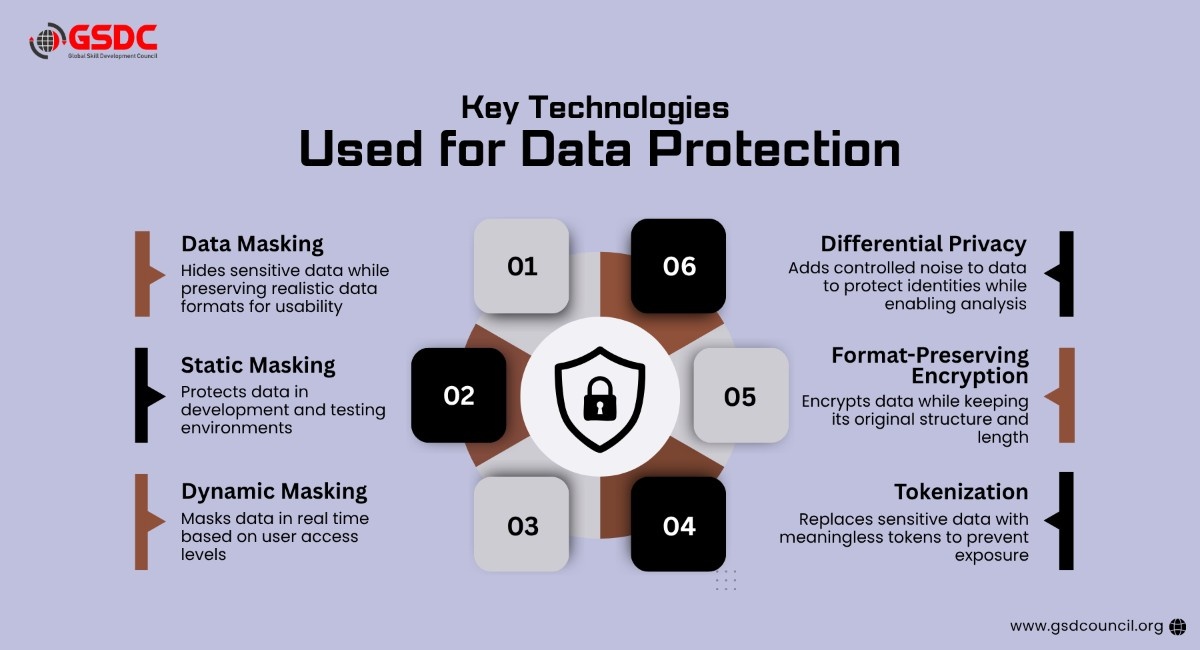
Several advanced technologies help organizations secure sensitive data effectively.
Data Masking
Data masking hides sensitive information while allowing users to work with realistic data formats. Two common types include:
- Static masking – used for development and testing environments.
- Dynamic masking – masks data in real time based on user access privileges.
Tokenization
Tokenization replaces sensitive data with random tokens that have no meaningful value outside the system. This ensures that sensitive data is never exposed during transactions.
Format-Preserving Encryption
This technique encrypts data while maintaining its original format and length. For example, a credit card number remains a 16-digit value after encryption. This allows legacy applications to process encrypted data without requiring major changes.
Differential Privacy
Differential privacy adds controlled statistical noise to datasets to protect individual identities while still allowing meaningful analysis. Many technology companies use this technique to analyze user behavior without exposing personal information.
Privacy Challenges in Generative AI Systems
The rise of generative AI and autonomous systems introduces new privacy risks. AI models often rely on massive datasets for training, and if these datasets contain sensitive information, the model may inadvertently memorize and reproduce that data.
Furthermore, as autonomous Agentic AI systems become more prevalent, the risk of agents inadvertently accessing, exposing, or transferring PII across connected enterprise tools increases [8].
Potential risks include:
- Training data leakage
- Prompt injection attacks targeting autonomous agents
- Exposure of confidential information through AI outputs
- Unintended cross-system data transfers by AI agents
To mitigate these risks, organizations are implementing privacy firewalls that sanitize prompts before sending them to AI models. These systems remove or tokenize sensitive information before it leaves the organization’s secure environment.
The Role of Governance in AI-Driven Privacy
Technology alone cannot solve privacy challenges. Effective governance is equally important. Organizations typically adopt a three-line defense model:
- Business teams: Responsible for managing data within their domains.
- Privacy and compliance teams: Define policies and oversee governance.
- Internal audit teams: Verify compliance and control effectiveness.
AI agents automate many operational tasks, but human oversight remains essential for decision-making and ethical governance.
Business Benefits of AI-Driven Data Privacy
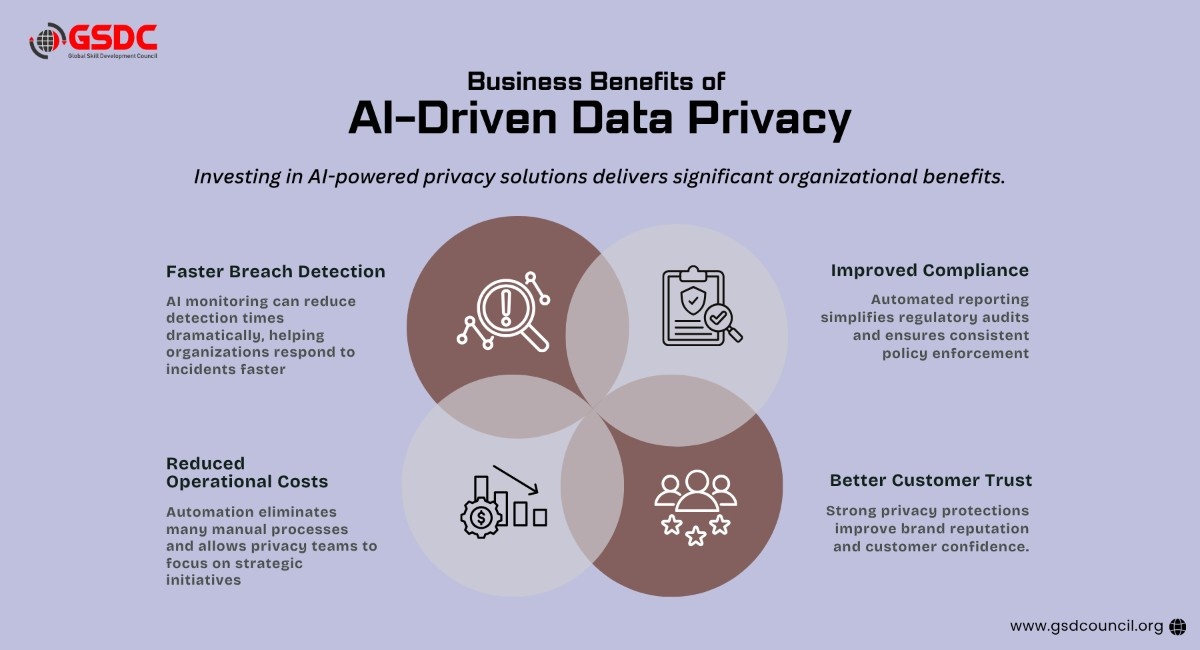
Investing in AI-powered privacy solutions delivers significant organizational benefits.
Faster Breach Detection
AI monitoring can reduce detection times dramatically, helping organizations respond to incidents faster.
Improved Compliance
Automated reporting simplifies regulatory audits and ensures consistent policy enforcement.
Reduced Operational Costs
Automation eliminates many manual processes and allows privacy teams to focus on strategic initiatives.
Better Customer Trust
Strong privacy protections improve brand reputation and customer confidence.
Building a Roadmap for AI-Driven Privacy
Organizations can implement AI-powered privacy solutions through a phased approach.
Phase 1: Discovery and Assessment (First 30 Days)
Deploy AI agents to scan critical data sources and identify PII exposure.
Phase 2: Policy Implementation (30–60 Days)
Define privacy policies, implement access controls, and reduce high-risk data exposure.
Phase 3: Operationalization (60–90 Days)
Automate compliance reporting, integrate privacy controls into development pipelines, and train business teams.
This agile approach enables organizations to achieve measurable results quickly while building a long-term privacy strategy.
The Future of Data Privacy with AI
As data ecosystems continue to expand, AI will play an increasingly important role in privacy protection. Future privacy systems will likely include:
- Autonomous privacy monitoring agents
- AI-driven compliance automation
- Real-time data protection frameworks
- Privacy-by-Design architectures embedded into applications [9]
Organizations that adopt these technologies early will gain a significant competitive advantage.
GSDC Certified Agentic AI Professional
The GSDC Agentic AI Professional certification helps professionals understand how AI agents can be applied to solve real business challenges, including data privacy, governance, automation, and compliance.
Certified Agentic AI Professional certification equips learners with practical knowledge of agentic AI concepts, workflows, responsible AI practices, and enterprise use cases to support secure, scalable, and effective AI adoption.
Conclusion
Data privacy has become one of the most critical challenges facing modern organizations. With the exponential growth of data and the rapid expansion of global privacy regulations, traditional manual approaches are no longer sufficient, especially as businesses increasingly rely on data privacy AI and advanced AI data security solutions.
AI agents provide a powerful solution by automating data discovery, improving PII detection accuracy, and enabling continuous compliance monitoring. By integrating AI-driven privacy systems into their data ecosystems, organizations can better understand what is an AI agent, apply what is AI detection in real-world privacy operations, protect sensitive information, reduce regulatory risks, and build stronger trust with customers.
Ultimately, AI-driven privacy is not just about compliance it is about creating a secure and responsible data environment that enables innovation while protecting individual rights through intelligent data privacy AI, stronger AI data security, and more proactive privacy governance.

Related Certifications
Frequently Asked Questions
Stay up-to-date with the latest news, trends, and resources in GSDC
If you like this read then make sure to check out our previous blogs: Cracking Onboarding Challenges: Fresher Success Unveiled
Not sure which certification to pursue? Our advisors will help you decide!