AI-Native Customer Experience: The Next Competitive Advantage Works
Written by Laura Onu
- How AI Is Changing the Customer Journey
- Seven Challenges Businesses Face in AI-Native Customer Experience
- How Businesses Can Turn AI-Native Experiences Into a Competitive Advantage
- Key Metrics to Measure AI-Native Customer Experience
- How GSDC Helps Professionals Prepare for AI-Native Business Transformation
- Conclusion
Artificial intelligence is changing how customers discover brands, evaluate products, make purchasing decisions, and interact with businesses. AI Customer Experience is transforming traditional customer journeys, which often begin with search engines, websites, advertisements, and product pages. Today, customers increasingly rely on AI assistants and autonomous agents to research options, compare products, receive recommendations, and even complete transactions. This shift highlights the growing role of AI chatbots for customer service and AI-Driven Customer Experience in modern businesses.
This shift is changing the way businesses attract and retain customers. Organizations can no longer depend only on website traffic, search rankings, and traditional marketing strategies. They must understand how artificial intelligence in customer experience influences customer decisions and adapt their customer experience strategies accordingly. Understanding How AI improves customer service is also essential for organizations looking to enhance customer interactions and deliver faster, more personalized support.
AI-native customer experience is becoming an important competitive advantage. It involves designing products, services, and customer interactions around AI capabilities while maintaining trust, transparency, personalization, and human oversight. As part of broader AI business transformation, organizations are increasingly adopting AI-driven solutions to create seamless, intelligent, and customer-focused experiences.
How AI Is Changing the Customer Journey
Traditionally, customers discovered products through search engines, advertisements, social media, and brand websites. Businesses could track each stage of the journey, from the first search to the final purchase, using website analytics and marketing metrics to understand AI Customer Experience opportunities and customer behaviour.
AI assistants are changing this process. Instead of visiting multiple websites, customers can ask an AI tool to compare products, recommend services, or identify the best option based on their requirements. Some users may also delegate research and purchasing tasks to autonomous agents. This shift is transforming AI-Driven Customer Experience, making artificial intelligence in customer experience an important part of modern business strategies.
This creates a different relationship between brands and customers. Businesses may no longer have direct access to every interaction influencing a purchase decision. An AI assistant may become the primary interface between the customer and the brand, changing how AI chatbots for customer service and other intelligent tools support customer interactions.
As a result, organizations need to rethink how they build visibility, communicate product value, and maintain customer relationships across AI-powered platforms. Adapting to this shift is becoming essential for successful AI business transformation and creating an effective AI-native customer experience.
Seven Challenges Businesses Face in AI-Native Customer Experience
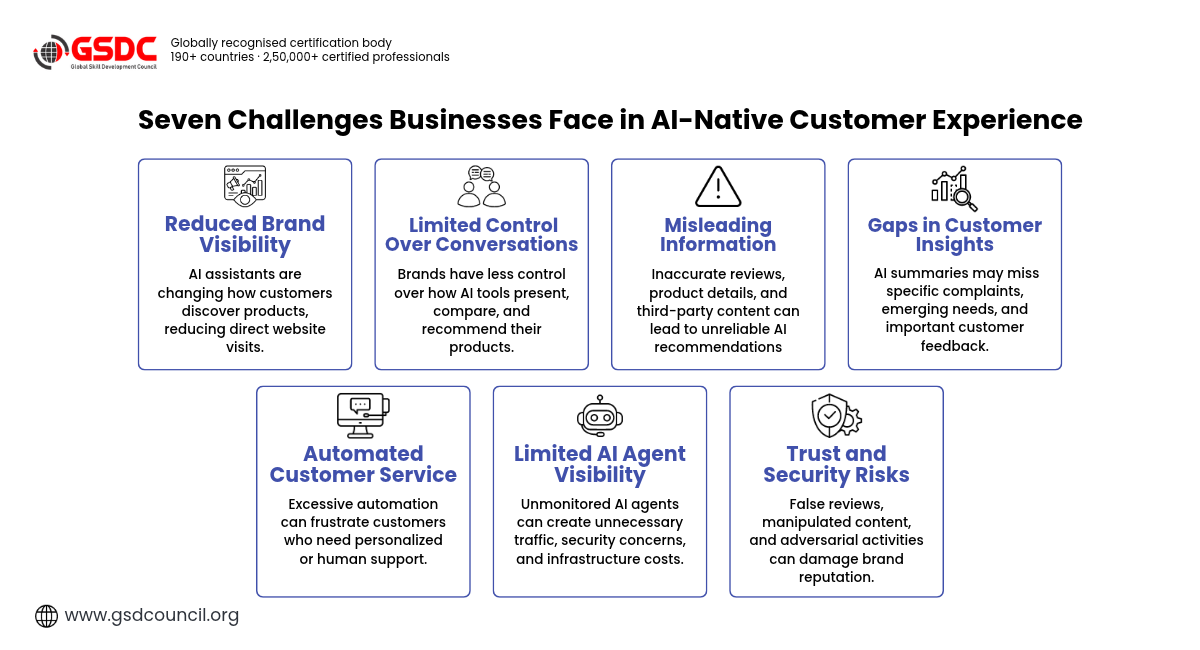
The transition to AI-driven customer experiences creates several challenges across the customer journey.
1. Reduced Brand Visibility and Discovery
Customers increasingly use AI assistants to discover products and services. This means brands may receive fewer direct visits from traditional search results.
Unlike conventional search engine optimization, where businesses can target specific keywords and monitor rankings, visibility in AI-generated recommendations depends on how models understand and represent a brand. Companies need reliable, relevant, and well-supported content that clearly communicates their products and services.
2. Limited Control Over Customer Conversations
When customers interact with AI assistants, brands have less control over how their products are presented. An AI tool may compare several options, summarize product information, or recommend a competitor without directing customers to the original brand website.
This makes it important for businesses to ensure that accurate product information, pricing, specifications, and policies are accessible to AI platforms.
3. Unverified and Misleading Content
AI systems depend on the information available to them. If product descriptions, online reviews, or third-party content contain inaccurate claims, AI-generated recommendations may also become misleading.
For example, a company may promote a product as highly reliable, but an AI assistant may not have enough independent evidence to verify that claim. Businesses should support their product information with credible sources, industry-standard measurements, and reliable evidence.
4. Gaps in Customer Feedback and Insights
AI tools can summarize customer reviews, support conversations, and social media discussions. However, summaries may overlook important details, unusual complaints, or emerging customer needs.
Customers may also discuss products using different names or expressions that automated monitoring systems fail to recognize.
Organizations should therefore combine AI-based analysis with regular human review. Examining original customer feedback helps businesses identify important insights that automated summaries may miss.
5. Automated Customer Service and Brand Experience
AI-powered customer support can handle routine queries, provide recommendations, and reduce response times. However, excessive automation may create frustration when customers need personalized assistance or help with complex problems.
Many customers still prefer speaking with a human representative when resolving important issues. Businesses should use AI to support customer service teams rather than automatically replacing human interaction in every situation.
6. Limited Visibility Into AI Agent Activities
As customers delegate tasks to AI agents, businesses may find it difficult to understand how those agents interact with their digital platforms.
AI agents can monitor prices, compare products, and perform automated activities. This may increase website traffic without generating meaningful customer engagement. It can also introduce security concerns and additional infrastructure costs.
Organizations need appropriate monitoring, access controls, and security testing to understand and manage agent activity.
7. Trust, Accountability, and Security Risks
AI-generated content and recommendations can be manipulated through misleading information or adversarial activities. For example, coordinated false reviews or defamatory content may influence how AI systems interpret a brand.
Businesses need to monitor online information, identify suspicious activity, and use platform reporting mechanisms when inaccurate content appears. Regular security testing and clear accountability processes are also important for protecting brand reputation.
How Businesses Can Turn AI-Native Experiences Into a Competitive Advantage
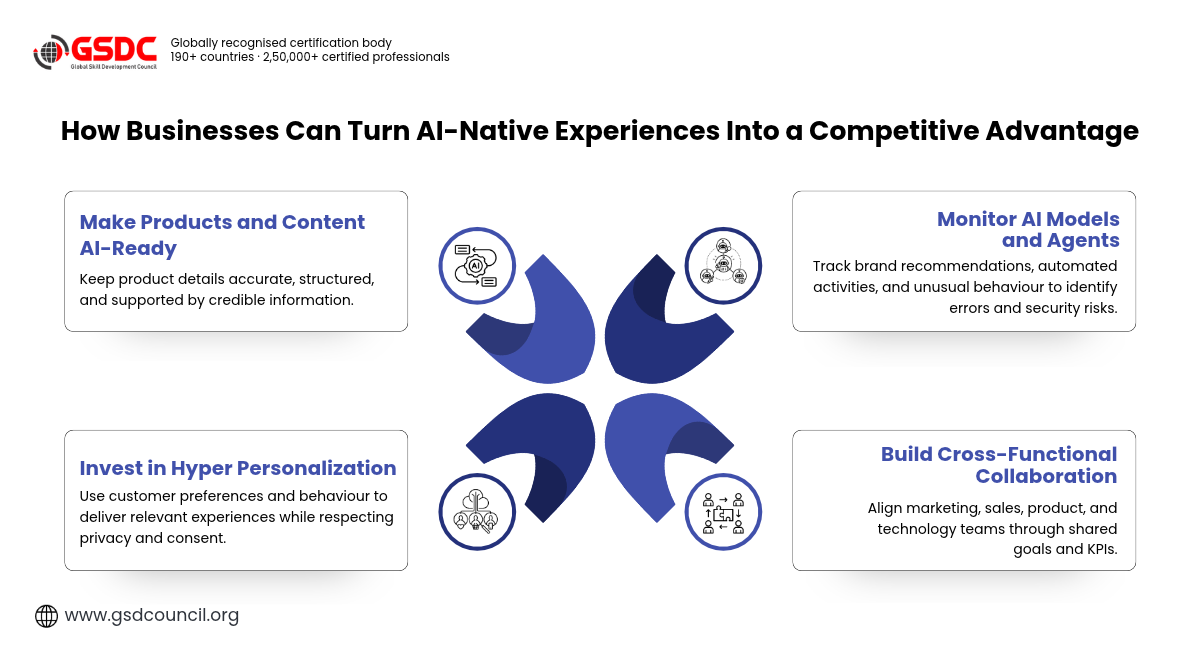
Addressing these challenges requires more than adopting AI tools. Businesses need a structured approach that connects customer experience, product strategy, marketing, operations, and technology.
Make Products and Content AI-Ready
Product information should be clear, accurate, structured, and easy for AI systems to interpret. Businesses should ensure that important details such as pricing, product specifications, ratings, return policies, and service information are accessible across relevant platforms.
Content should also be supported by credible evidence. Instead of relying only on promotional claims or paid influencer content, organizations can strengthen their credibility through independent reviews, industry-standard measurements, and trusted sources.
Invest in Hyper-Personalization
AI creates opportunities to deliver more relevant experiences based on individual customer needs, preferences, and behaviour.
For example, an online retailer can use relevant customer information to recommend products based on budget, previous interactions, and specific requirements. However, personalization should always respect customer consent and data privacy.
Businesses can begin with one customer segment where sufficient data is available, evaluate the results, and gradually expand the approach.
Monitor AI Models and Agent Activities
Organizations should regularly examine how AI models describe their brands, which products they recommend, and what information influences their responses.
They should also monitor agent activities, including automated searches, product comparisons, and transactions. This helps businesses identify inaccurate recommendations, unusual behaviour, and potential security issues.
Manual evaluation should complement automated monitoring because human reviewers can identify context and inconsistencies that automated systems may overlook.
Build Stronger Cross-Functional Collaboration
AI-native customer experience cannot be managed by a single department. Marketing, sales, product, engineering, and operations teams need to work toward shared business outcomes.
For example, a sales team may focus on increasing subscriptions, while the product team prioritizes long-term customer retention. If both teams use different success metrics, automated campaigns may attract customers who are unlikely to remain engaged.
Shared KPIs and jointly owned AI initiatives can help align these teams. Organizations can also develop AI agent prototypes that support common goals, such as improving customer insights while supporting sustainable sales growth.
Key Metrics to Measure AI-Native Customer Experience
Traditional metrics such as website impressions, search rankings, click-through rates, conversion rates, and customer retention remain relevant. However, businesses also need to understand how customers interact with AI platforms.
Some additional areas to monitor include:
- AI Recall and Share: How frequently AI platforms recognize and mention a brand in relevant conversations.
- Algorithmic Choice Share: How often a brand appears among the options recommended by AI models.
- Time from Signal to Action: How quickly businesses identify urgent customer concerns and respond to them.
- Agent Action Share: The volume and type of actions performed by AI agents across customer interactions.
These measurements help organizations understand their visibility and performance beyond traditional digital channels.
How GSDC Helps Professionals Prepare for AI-Native Business Transformation
AI-native customer experience requires professionals who understand how artificial intelligence influences business strategy, customer engagement, automation, and organizational change.
GSDC's Generative AI for Leaders certification supports professionals in developing knowledge of generative AI applications, business impact, advanced tools, and change management. It also covers practical use cases and the future of work, helping learners understand how AI can be applied across business functions.

A structured learning journey can help professionals progress from understanding AI foundations to exploring practical applications, hands-on demonstrations, and implementation planning. This Generative AI for Leaders certification’s knowledge can support leaders and professionals as they contribute to AI adoption, improve customer experiences, and align technology initiatives with business objectives.
Conclusion
AI-native customer experience is reshaping how customers discover brands, evaluate products, and interact with businesses. As AI assistants and autonomous agents become more involved in purchasing decisions, organizations must adapt their strategies beyond traditional websites and marketing channels.
Building a competitive advantage requires accurate and AI-ready content, meaningful personalization, continuous monitoring, strong security practices, and collaboration across business teams. Most importantly, organizations must maintain customer trust by balancing automation with transparency and human support.
Businesses that prepare for this shift can create more relevant customer experiences, strengthen brand visibility, and remain competitive in an increasingly AI-driven marketplace.

Related Certifications
Frequently Asked Questions
AI-native customer experience refers to designing customer interactions, products, and services around AI capabilities. It uses AI to support discovery, personalization, recommendations, customer service, and purchasing decisions. This approach strengthens AI Customer Experience by making interactions more intelligent, personalized, and efficient.
AI agents can research products, compare prices, monitor options, and perform tasks on behalf of customers. This reduces the need for customers to visit multiple websites and changes how businesses reach potential buyers. It also transforms AI-Driven Customer Experience by making AI assistants an important part of product discovery and purchasing decisions.
AI-ready content helps AI systems understand and accurately represent a brand's products and services. Clear product details, reliable evidence, pricing, specifications, and policies can improve the quality of information available to AI platforms. It also supports AI business transformation by helping businesses strengthen their visibility across AI-powered platforms.
Businesses can conduct regular security testing, monitor online content for misleading information, and report inaccurate or defamatory material through the relevant platform mechanisms. Continuous monitoring helps identify potential threats before they significantly affect brand reputation. These measures also help maintain trust in artificial intelligence in customer experience initiatives.
Teams can establish shared KPIs, agree on common business objectives, and collaborate on AI initiatives. Jointly developed AI solutions can help improve customer insights, support sales activities, and maintain long-term customer satisfaction. Organizations can also explore How AI improves customer service through intelligent support solutions and AI chatbots for customer service to create a more connected AI-native customer experience.
Stay up-to-date with the latest news, trends, and resources in GSDC
If you like this read then make sure to check out our previous blogs: Cracking Onboarding Challenges: Fresher Success Unveiled
Not sure which certification to pursue? Our advisors will help you decide!