How to Become a Certified Forward Deployed Engineer: Skills and Learning Path

Written by Emily Hilton
- What Is a Forward Deployed Engineer?
- What Are the Requirements to Become a Forward Deployed Engineer?
- 5 Essential Forward Deployed Engineer Skills to Develop
- Forward Deployed Engineer Roadmap: A Practical Learning Path
- Forward Deployed Engineer Interview: What Should You Prepare?
- How Does Forward Deployed Engineer Certification Help Your Career?
- What Is the Forward Deployed Engineer Career Path?
- Conclusion
Artificial intelligence is changing how businesses solve problems, build products, and improve operations. However, implementing AI successfully requires more than developing models or deploying software. Organizations need professionals who can understand business challenges, work directly with customers, and turn technical capabilities into practical solutions. This is where Forward Deployed Engineers (FDEs) play an important role.
The growing adoption of enterprise AI has increased interest in this career path. Companies are looking for professionals who can combine software engineering, AI knowledge, problem-solving, and customer collaboration.
If you are exploring how to become a Forward Deployed Engineer, understanding the required technical skills, qualifications, and learning opportunities is a good starting point. This guide explains the FDE career path, essential skills, interview preparation, and how certification can support your professional development.
What Is a Forward Deployed Engineer?
A Forward Deployed Engineer is a technical professional who works closely with customers to understand their challenges and implement solutions using software, AI, and data technologies.
Unlike traditional software engineers who may primarily focus on developing products, FDEs work at the intersection of engineering and business. They interact with customers, identify operational problems, build customized solutions, and ensure that these solutions deliver measurable results.
For example, a healthcare organization may want to reduce manual administrative work using AI. An FDE can understand its existing processes, connect relevant systems, develop an AI-powered workflow, and test the solution with actual users.
Companies such as Palantir have helped popularize this approach to engineering. The Palantir Forward Deployed Engineer role is often associated with solving complex customer problems through hands-on technical implementation and close collaboration.
What Are the Requirements to Become a Forward Deployed Engineer?
There is no single educational or professional route into this career. However, certain Forward Deployed Engineer requirements can help candidates prepare for the role.
Common requirements include:
- A background in computer science, software engineering, information technology, or a related technical field.
- Knowledge of programming languages such as Python, JavaScript, or Java.
- Understanding of APIs, databases, and software development.
- Familiarity with cloud platforms and deployment environments.
- Basic knowledge of AI, machine learning, and large language models.
- Strong analytical, communication, and problem-solving abilities.
- The ability to work with customers and understand business requirements.
Forward Deployed Engineer Qualifications
A bachelor's degree in computer science, engineering, or a related discipline can provide a strong foundation. However, practical experience is equally important.
Candidates with experience in software development, data engineering, solutions engineering, AI implementation, or technical consulting may find transferable opportunities in this field.
Relevant projects, internships, technical certifications, and hands-on experience can strengthen a candidate's profile. Employers generally look for professionals who can demonstrate their ability to build and implement solutions rather than relying only on theoretical knowledge.
5 Essential Forward Deployed Engineer Skills to Develop
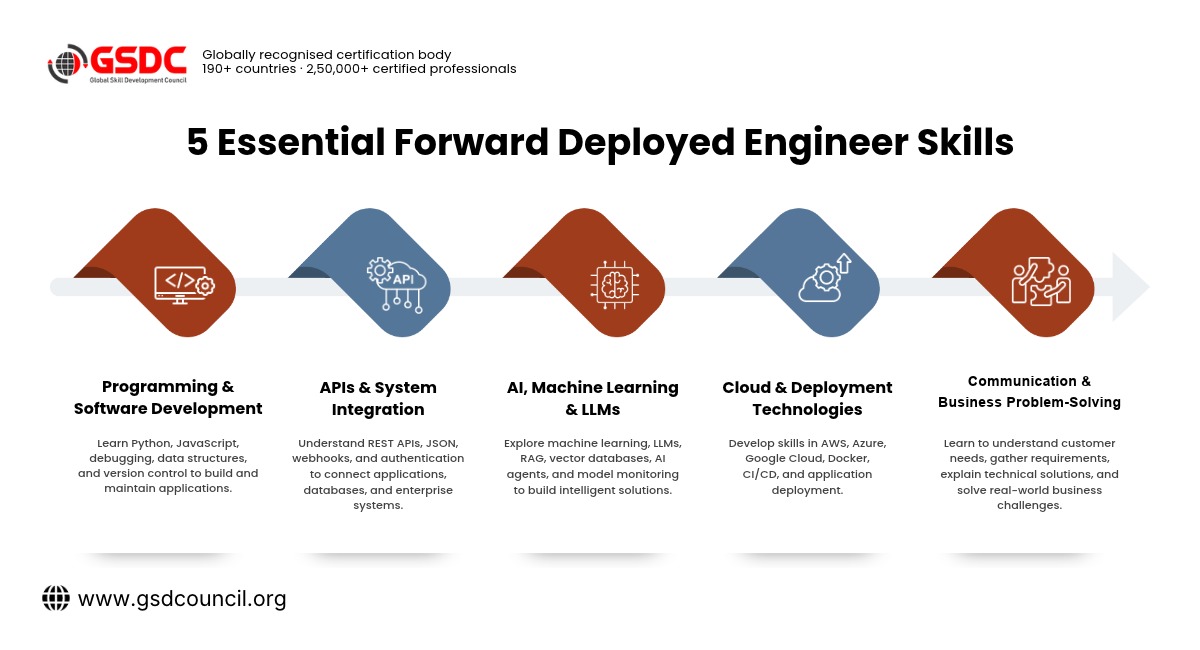
Building the right technical and professional capabilities is an important part of becoming an FDE. Here are five key Forward Deployed Engineer skills to focus on.
1. Programming and Software Development
Programming is one of the most important foundations of FDE work. Professionals should understand how to write, test, debug, and maintain code.
Python is particularly useful for AI development, automation, data processing, and backend applications. Knowledge of JavaScript can also help when developing user-facing applications.
Focus on:
- Python or JavaScript programming.
- Data structures and algorithms.
- Object-oriented programming.
- Git and version control.
- Debugging and software testing.
2. APIs and System Integration
FDEs frequently connect different applications, databases, and enterprise systems. Understanding APIs helps professionals integrate these technologies and build workflows that work across platforms.
Learn REST APIs, JSON, authentication methods, webhooks, and basic backend development. Understanding how to connect external services is particularly valuable when implementing enterprise AI solutions.
3. AI, Machine Learning, and LLMs
As more organizations adopt AI, FDEs need to understand how AI technologies can address business problems.
Important areas include:
- Machine learning fundamentals.
- Large Language Models (LLMs).
- Retrieval-Augmented Generation (RAG).
- Vector databases and embeddings.
- AI agents and workflow automation.
- Model evaluation and monitoring.
You do not need to become a research scientist, but you should understand how to integrate AI capabilities into working business applications.
4. Cloud and Deployment Technologies
Building a solution is only one part of the job. FDEs must also understand how to deploy, maintain, and monitor applications in real-world environments.
Develop familiarity with cloud platforms such as AWS, Microsoft Azure, or Google Cloud. Learn Docker, containerization, CI/CD pipelines, and basic infrastructure management.
These capabilities help professionals move applications from development environments into production.
5. Communication and Business Problem-Solving
Technical knowledge alone is not enough. FDEs must understand customer expectations, identify business challenges, and explain technical solutions in simple language.
They should be comfortable asking questions, gathering requirements, managing feedback, and collaborating with different teams.
This combination of technical expertise and business understanding distinguishes a Forward Deployed AI Engineer from professionals working exclusively on model development.
Forward Deployed Engineer Roadmap: A Practical Learning Path
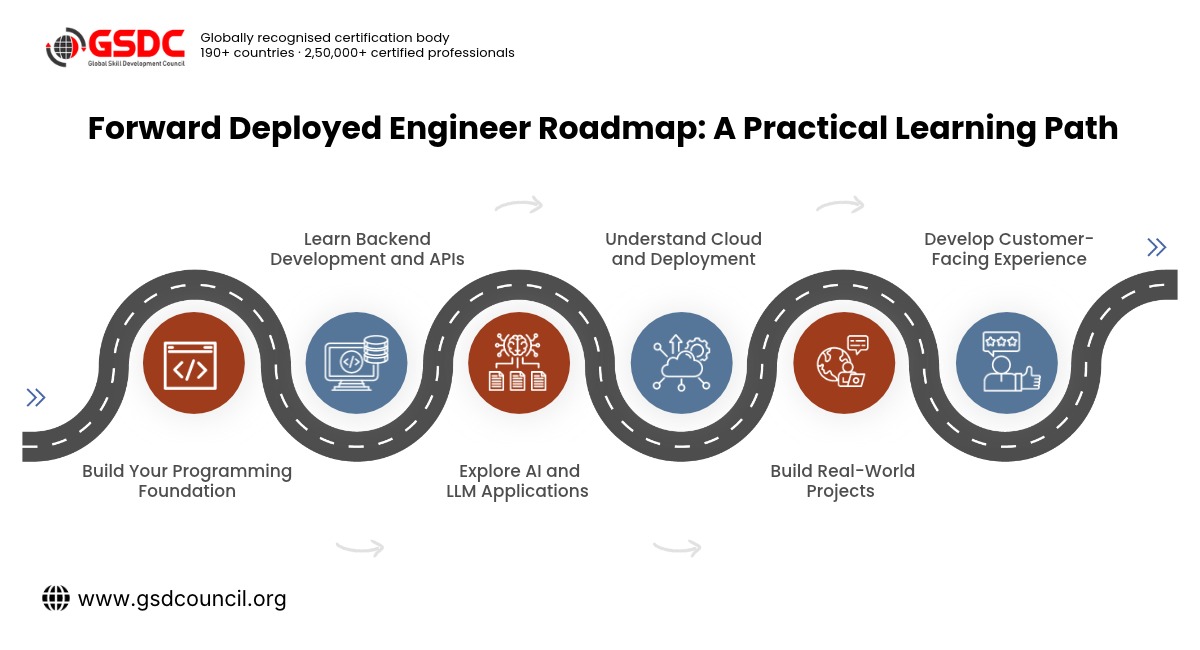
A structured Forward Deployed Engineer roadmap can help beginners and experienced professionals understand what to learn and when to apply it.
Here is a practical Forward Deployed Engineer learning path to follow.
Step 1: Build Your Programming Foundation
Start with Python or JavaScript. Practice writing programs, working with data, debugging errors, and building small applications.
Step 2: Learn Backend Development and APIs
Understand how applications communicate with each other. Build simple REST APIs and connect them with databases or external services.
Step 3: Explore AI and LLM Applications
Learn how LLMs work and experiment with AI-powered applications. Build a basic RAG chatbot or an AI assistant that can retrieve information from documents.
Step 4: Understand Cloud and Deployment
Learn how to deploy applications using cloud platforms. Practice containerization with Docker and explore application monitoring.
Step 5: Build Real-World Projects
Create projects that solve practical problems. For example, develop an AI-powered customer support assistant, an automated document processing system, or a business reporting application.
Step 6: Develop Customer-Facing Experience
Practice explaining technical solutions, gathering requirements, and presenting project outcomes. Internships, freelance projects, and client-facing technical roles can help develop these skills.
Following this roadmap can help you gradually build the capabilities expected from a Forward Deployed Software Engineer.
Forward Deployed Engineer Interview: What Should You Prepare?
Once you have developed the necessary skills and projects, the next step is preparing for an FDE interview.
Unlike conventional software engineering interviews, a Forward Deployed Engineer interview may evaluate both technical knowledge and the ability to solve customer problems.
Candidates should prepare for programming challenges, system design discussions, API integration scenarios, and real-world business problem-solving exercises.
Common Forward Deployed Engineer Interview Questions
Here are some examples of Forward Deployed Engineer interview questions you may encounter:
- How would you design an AI-powered solution for automating customer support?
- How would you integrate an LLM with an organization's existing database?
- What is RAG, and when would you use it instead of a standard LLM application?
- How would you debug an application that works locally but fails in production?
- How would you handle changing customer requirements during implementation?
- How would you measure whether an AI solution is delivering business value?
Prepare by practicing coding problems, explaining your technical decisions, and discussing projects you have developed.
How Does Forward Deployed Engineer Certification Help Your Career?
Developing practical skills is essential, but structured learning and professional recognition can further strengthen your career profile. A Forward Deployed Engineer certification can help professionals demonstrate their understanding of FDE concepts, technical implementation, AI integration, and customer-focused problem-solving.
GSDC's Forward Deployed Engineer (FDE) Certification offers professionals an opportunity to strengthen their knowledge of this emerging discipline and build a more structured understanding of the FDE role.

Pursuing an FDE certification can support professionals who want to validate their learning, demonstrate their commitment to continuous development, and explore opportunities in enterprise AI implementation. It can also complement hands-on projects and technical experience when preparing for FDE roles.
For aspiring FDEs, combining certification with practical implementation experience can help build a stronger professional profile.
What Is the Forward Deployed Engineer Career Path?
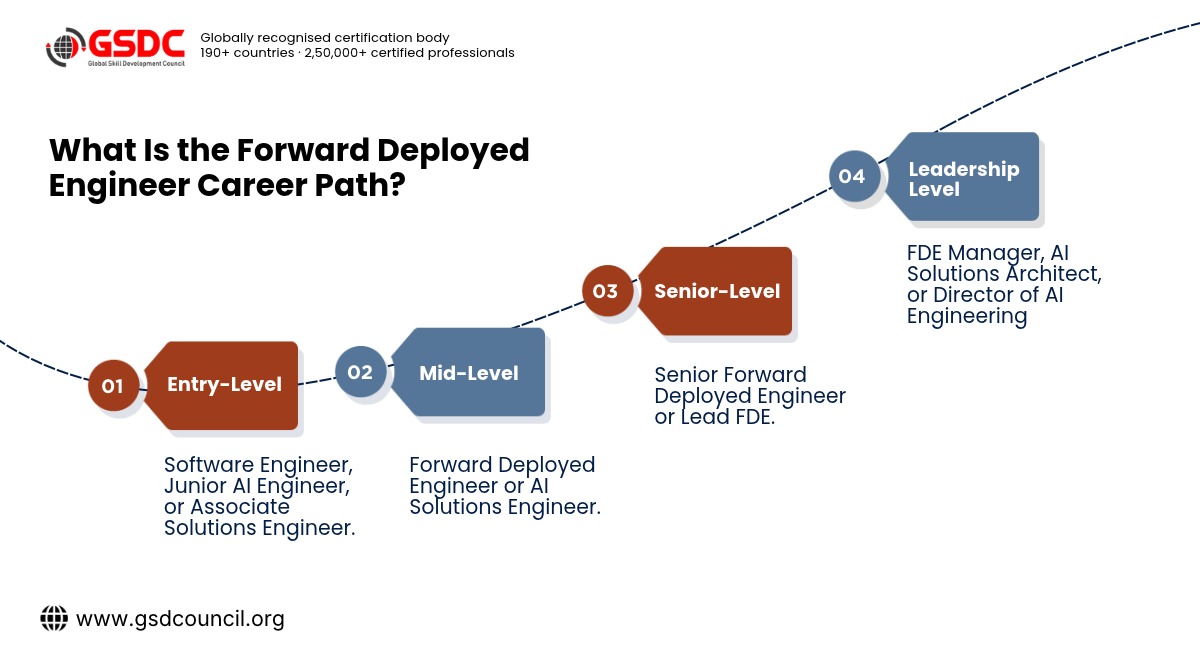
The Forward Deployed Engineer career path can vary depending on an individual's technical background, industry, and experience.With experience, professionals can move into technical leadership, enterprise AI consulting, solutions architecture, or AI transformation roles.
The career also offers opportunities to work across industries such as healthcare, finance, manufacturing, retail, and technology.
Conclusion
Becoming a Forward Deployed Engineer requires a combination of software development, AI knowledge, system integration, cloud technologies, and business problem-solving skills. It is a career path for professionals who enjoy working with technology while understanding how businesses operate.
If you want to enter this field, start by strengthening your programming foundation, exploring AI applications, and building projects that solve real-world challenges. Follow a structured learning roadmap, prepare for technical and customer-focused interviews, and consider professional certification to support your development.
As enterprise AI adoption continues to grow, professionals who can turn complex technical capabilities into practical business solutions will have exciting opportunities ahead.

Related Certifications
Stay up-to-date with the latest news, trends, and resources in GSDC
If you like this read then make sure to check out our previous blogs: Cracking Onboarding Challenges: Fresher Success Unveiled
Not sure which certification to pursue? Our advisors will help you decide!