From Engineer to Problem Solver: The Evolving FDE Career Path

Written by Emily Hilton
- What Is a Forward Deployed Engineer?
- Why the FDE Career Path Is Evolving
- From Software Engineer to FDE
- Essential Forward Deployed Engineer Skills
- How to Become a Forward Deployed Engineer
- Forward Deployed Engineer Jobs and Career Opportunities
- Forward Deployed Engineer Salary: What Influences Earnings?
- From FDE to Leadership: The Role of an FDE Manager and Head of Forward Deployed Engineering
- Can Forward Deployed Engineer Certification Help?
- Conclusion
Software engineering has traditionally focused on designing, building, testing, and maintaining software products. However, as organizations adopt artificial intelligence (AI), cloud platforms, and complex enterprise technologies, they increasingly need engineers who can do more than write code. They need professionals who can understand business challenges, work directly with customers, and turn technical capabilities into practical solutions.
This shift has helped make the Forward Deployed Engineer (FDE) role increasingly relevant. FDEs work at the intersection of engineering, product development, and customer problem-solving. They collaborate with clients, identify operational challenges, build tailored solutions, and ensure those solutions deliver value in real-world environments.
For software developers looking to expand their responsibilities, this role offers an alternative to a traditional engineering career path. It combines technical depth with communication, business understanding, and strategic thinking.
In this blog, we explore the evolving FDE career path, essential skills, career opportunities, salary considerations, and practical steps for becoming a Forward Deployed Engineer.
What Is a Forward Deployed Engineer?
A Forward Deployed Engineer is a technical professional who works closely with customers to implement technology in real-world environments. Unlike engineers who primarily build general-purpose products, FDEs focus on adapting and integrating technology to solve specific customer problems.
For example, a company might have an AI platform but struggle to integrate it into its existing business processes. An FDE works with the customer to understand the workflow, identify technical constraints, develop integrations, and deploy a solution that meets the organization's needs.
The role typically combines software engineering, system integration, troubleshooting, product feedback, and stakeholder collaboration.
FDEs are especially relevant in enterprise AI, data platforms, cybersecurity, cloud infrastructure, and other areas where implementing technology requires a deep understanding of customer environments.
The defining characteristic of the role is not simply working at a customer site. It is taking responsibility for translating a real-world problem into a working technical solution.
Why the FDE Career Path Is Evolving
The growing complexity of enterprise technology is changing what organizations expect from engineers. A technically impressive product does not automatically solve a business problem. It must fit existing systems, work with real data, meet security requirements, and deliver measurable outcomes.
Three major developments are contributing to the evolution of the FDE role.
1. AI Requires More Practical Implementation
AI systems often require data integration, workflow redesign, evaluation, monitoring, and ongoing refinement. Organizations need engineers who can connect AI models to business processes rather than simply demonstrate a prototype.
FDEs help bridge this gap by building practical applications, testing their behavior, and adapting them to customer requirements.
2. Enterprise Systems Are Increasingly Connected
Modern businesses use multiple applications, databases, APIs, and cloud services. Integrating these systems requires engineers who can understand the broader technical environment and resolve problems across system boundaries.
3. Businesses Expect Measurable Results
Customers increasingly want evidence that technology improves productivity, reduces costs, or increases reliability. FDEs connect engineering decisions to these outcomes.
As a result, the role is evolving from a specialized implementation position into a broader problem-solving career that can lead toward technical leadership, product strategy, or engineering management.
From Software Engineer to FDE
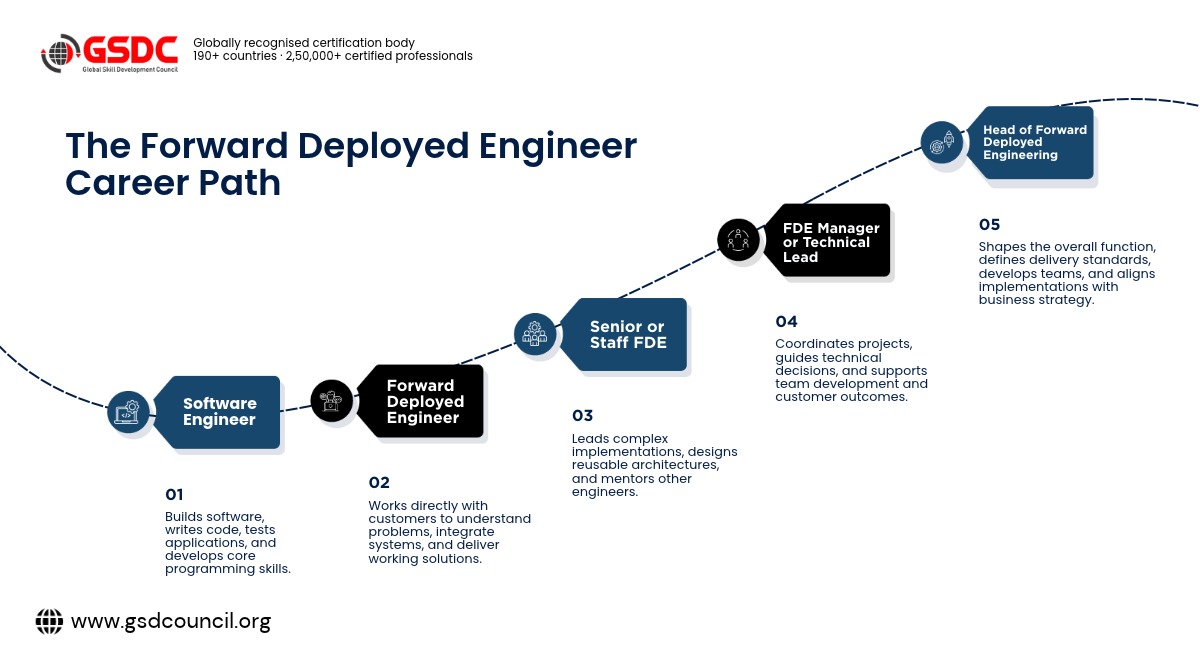
A traditional software engineer career path often progresses from junior developer to senior engineer, staff engineer, and engineering manager. The FDE route offers another option for professionals who enjoy solving ambiguous problems and working closely with end users.
Software engineers already possess many relevant foundations, including programming, debugging, testing, and system design. To transition successfully, they must also learn to ask better discovery questions, understand business processes, communicate trade-offs, and deliver solutions under real-world constraints.
For example, rather than receiving a detailed specification and implementing it, an FDE might need to investigate why a customer struggles with a manual reporting process, determine which data sources are involved, and design an appropriate automated workflow.
The challenge is not only technical. It is also about identifying the right problem to solve.
Essential Forward Deployed Engineer Skills
Successful FDEs combine engineering expertise with practical problem-solving and communication. The most important forward deployed engineer skills fall into four categories.
1. Technical Engineering Skills
FDEs need strong programming fundamentals, commonly in languages such as Python, JavaScript, TypeScript, Java, or Go, depending on the organization.
They should understand APIs, databases, authentication, cloud infrastructure, testing, logging, and debugging. System design skills are important because solutions must integrate with existing applications and remain maintainable after deployment.
For AI-focused roles, useful additional skills include LLM integration, retrieval-augmented generation (RAG), tool calling, model evaluation, and AI application monitoring.
2. Business and Problem-Solving Skills
FDEs must translate business needs into technical requirements. This involves mapping workflows, identifying bottlenecks, assessing constraints, and defining success metrics.
They should also recognize when a simpler solution is better than a complex AI application. The objective is to solve the problem effectively, not to use the most sophisticated technology available.
3. Communication and Collaboration
FDEs work with customers, product managers, executives, and engineering teams. They need to explain technical decisions in accessible language, ask clarifying questions, and manage expectations.
Active listening is particularly valuable because customers may describe symptoms rather than the underlying problem.
4. Deployment and Ownership
Building a prototype is only one stage of the work. FDEs must also consider security, reliability, testing, documentation, monitoring, and maintenance.
Taking ownership means ensuring that a solution continues to work after the initial demonstration and that users can adopt it successfully.
How to Become a Forward Deployed Engineer
If you are wondering how to become a forward deployed engineer, focus on developing practical engineering skills alongside customer-facing experience.
- Strengthen your software engineering foundation: Learn a programming language, APIs, databases, version control, testing, and debugging.
- Build end-to-end projects: Create applications that connect multiple systems and solve realistic problems rather than relying exclusively on isolated coding exercises.
- Learn cloud and AI integration: Practice deploying applications, connecting external services, and building AI-powered workflows where appropriate.
- Develop business understanding: Learn to map workflows, interview users, identify constraints, and define measurable outcomes.
- Gain implementation experience: Contribute to client projects, internal automation initiatives, technical consulting, or cross-functional product work.
- Prepare a problem-solving portfolio: Document the problem, your technical approach, important trade-offs, implementation, testing, and measurable results for each project.
When applying for forward deployed engineer jobs, highlight examples where you solved an unclear problem, integrated different systems, worked with stakeholders, and delivered a solution that people actually used.
Job descriptions vary, so review whether a position emphasizes hands-on coding, customer implementation, AI engineering, travel, or team leadership.
Forward Deployed Engineer Jobs and Career Opportunities
Demand for FDEs is closely connected to the growth of enterprise AI, cloud platforms, and specialized software implementation. Organizations developing complex products need engineers who can help customers move from experimentation to production.
Common opportunities include:
- AI Forward Deployed Engineer: Builds AI agents, integrates language models, and develops customized AI workflows.
- Enterprise Software FDE: Integrates business applications, APIs, databases, and customer systems.
- Data and Platform FDE: Helps customers implement data pipelines, analytics platforms, and infrastructure solutions.
- Senior FDE or Staff FDE: Leads complex deployments, solves architectural challenges, and develops reusable technical patterns.
- Forward Deployed Engineer Manager: Coordinates implementation teams, manages delivery priorities, and develops engineering talent.
An FDE may also transition into product engineering, solutions architecture, technical consulting, or product management. These paths are particularly relevant for engineers who want to expand beyond implementation into product strategy or organizational leadership.
Forward Deployed Engineer Salary: What Influences Earnings?
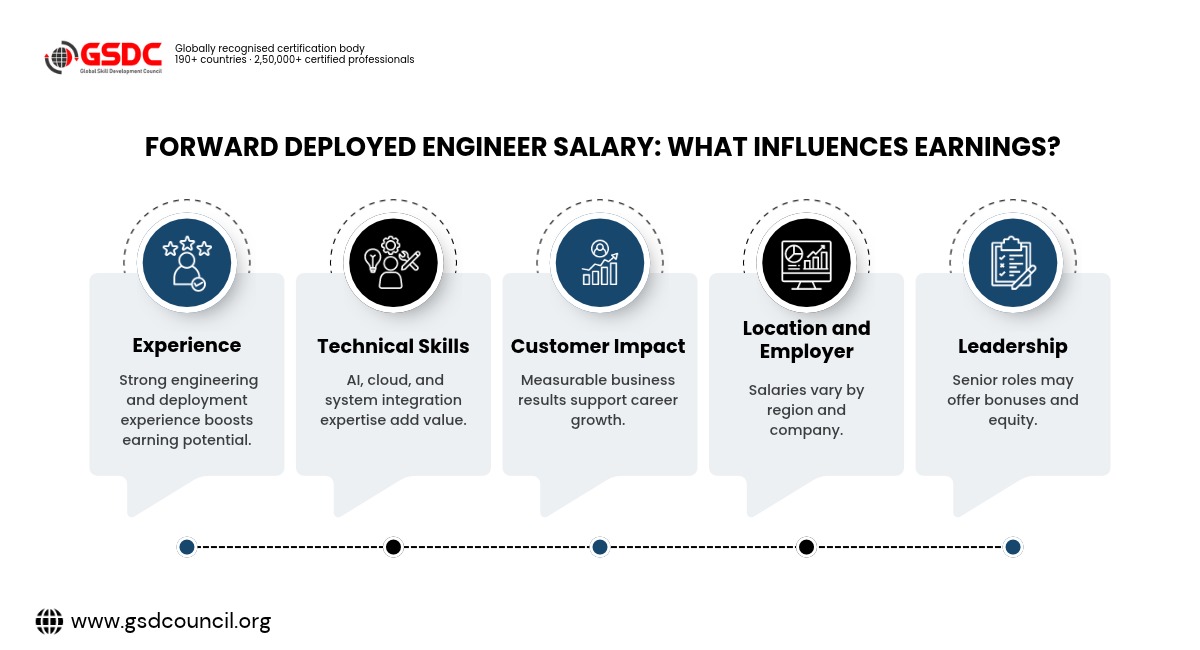
The forward deployed engineer salary varies by location, experience, employer, industry, and technical specialization. Compensation may also differ depending on whether the position focuses on customer implementation, advanced AI engineering, or technical leadership.
Several factors influence earning potential:
- Experience: Engineers with strong system design and production deployment experience may qualify for more senior positions.
- Technical specialization: Expertise in enterprise AI, distributed systems, cloud infrastructure, and complex integrations can be valuable.
- Customer impact: Demonstrating measurable improvements in efficiency, reliability, or business outcomes can strengthen career progression.
- Location and employer: Compensation varies considerably across countries, technology companies, and employment markets.
- Leadership responsibilities: Senior individual contributors and managers may receive different compensation packages, including performance bonuses or equity.
Candidates should compare current job postings in their target market rather than rely on a single salary estimate. They should also consider total compensation, travel expectations, work-life balance, and opportunities for professional development.
From FDE to Leadership: The Role of an FDE Manager and Head of Forward Deployed Engineering
As the FDE function expands, experienced engineers may move into technical leadership or management.
A forward deployed engineer manager typically oversees a team of engineers, coordinates customer implementations, allocates resources, and ensures that projects meet technical and business objectives. The role also involves mentoring engineers and maintaining consistent delivery practices.
The head of forward deployed engineering generally has broader responsibilities. Depending on the organization, this leader may define the team's operating model, establish implementation standards, develop hiring strategies, and work with product and executive teams to prioritize customer needs.
Leadership also involves identifying patterns across customer projects. If multiple customers experience the same integration challenge, the team can work with product engineering to develop a reusable capability instead of solving the problem repeatedly.
This creates a feedback loop between customer implementations and product development, allowing individual projects to contribute to improvements across the organization.
Can Forward Deployed Engineer Certification Help?
A forward deployed engineer certification can help professionals structure their learning and demonstrate relevant technical capabilities. An FDE Certification may be useful for engineers transitioning from conventional software development into implementation-focused or customer-facing AI roles.
When evaluating a certification, look for practical training in:
- API development and system integration.
- AI application and agent development.
- Testing, evaluation, and production deployment.
- Technical problem-solving and system design.
- Customer discovery and translating business needs into solutions.
A certificate is most valuable when supported by hands-on projects and demonstrable skills. It does not replace professional experience, and employers may prioritize practical engineering ability over formal credentials.

Conclusion
The Forward Deployed Engineer role reflects a broader shift in software engineering: success increasingly depends on solving real problems, not simply delivering code.
For engineers who enjoy technical challenges, customer collaboration, and building solutions from the ground up, the FDE career path offers opportunities to develop both engineering depth and business understanding. With experience, professionals can progress into senior engineering roles, management, or strategic leadership.
The key is to combine strong technical fundamentals with curiosity, communication, and ownership. Whether you are exploring forward deployed engineer jobs or planning your next career move, focus on building solutions that work in real environments and deliver measurable value.

Related Certifications
Frequently Asked Questions
Not exactly. Both roles require engineering skills, but FDEs typically work more directly with customers to understand business problems, integrate systems, and implement tailored solutions.
Programming, APIs, system integration, debugging, cloud technologies, and system design are important. Communication, problem-solving, and business understanding are equally valuable.
Yes, some organizations offer entry-level opportunities, although requirements vary. Building end-to-end projects, learning system integration, and demonstrating strong problem-solving skills can improve a candidate's prospects.
It can be a strong option for engineers who enjoy varied technical challenges and customer interaction. Experienced FDEs can progress into senior engineering, architecture, management, or product-related roles.
No. Certification can support structured learning and demonstrate relevant knowledge, but employers also evaluate practical skills, project experience, communication, and problem-solving ability.
Stay up-to-date with the latest news, trends, and resources in GSDC
If you like this read then make sure to check out our previous blogs: Cracking Onboarding Challenges: Fresher Success Unveiled
Not sure which certification to pursue? Our advisors will help you decide!