Debugging and Testing Agentic AI Systems: A Developer's Playbook
Written by Emily Hilton
- Understanding Why Agentic AI Systems Are Difficult to Debug
- 1. Start by Understanding the Agent's Architecture
- 2. Use Tracing and Logging to Identify Failures
- 3. Test Individual Components Before Testing the Entire Agent
- 4. Build Scenario-Based Tests for Real-World Situations
- 5. Evaluate Agent Performance Beyond Accuracy
- 6. Test Multi-Agent Communication and Coordination
- 7. Introduce Guardrails and Human Oversight
- 8. Create a Continuous Testing and Monitoring Process
- How AI Product Managers Contribute to Reliable Agentic AI Development
- How GSDC's Agentic AI Developer Certification Helps Professionals Build Skills
- Conclusion
Agentic AI systems are changing how businesses automate tasks, make decisions, and manage complex workflows. Unlike traditional AI applications that respond to individual prompts, AI agents can plan tasks, interact with external tools, retrieve information, and execute multi-step actions with limited human intervention. While these capabilities create new opportunities, they also introduce challenges for developers, particularly when it comes to debugging, testing, and maintaining reliable systems.
An AI agent may produce an incorrect response, select the wrong tool, lose track of its objective, or repeat actions without completing a task. These issues are not always easy to identify because an agent's behavior depends on multiple components, including language models, memory, APIs, external tools, and decision-making logic.
For developers, building an agent is only one part of the process. Ensuring that it performs consistently in real-world environments is equally important. This playbook explores practical approaches to debugging and testing agentic AI systems, helping development teams improve reliability, performance, and user trust.
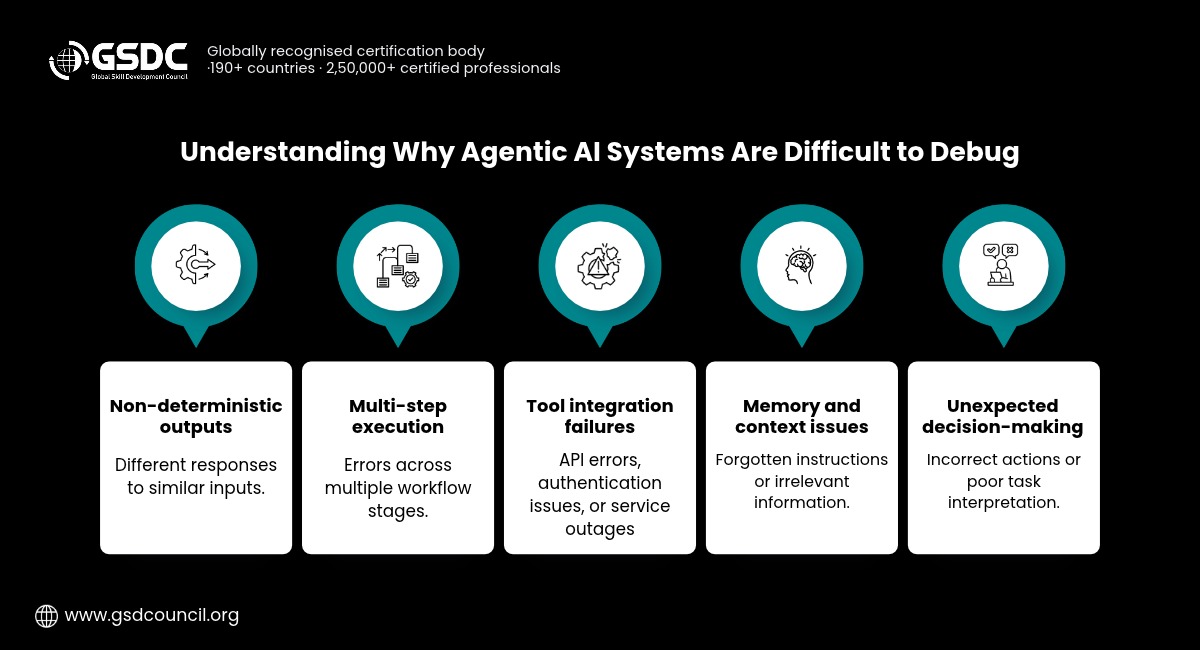
Understanding Why Agentic AI Systems Are Difficult to Debug
Traditional software generally follows predefined instructions. When an error occurs, developers can often trace it to a specific function, condition, or input. Agentic AI systems work differently because their outputs and actions may vary depending on context, model responses, and available tools.
Several factors make debugging more challenging.
1. Non-deterministic outputs:
AI agents may generate different responses when given similar inputs. Even when the same workflow is executed multiple times, the agent may choose different reasoning paths or tools.
2. Multi-step execution:
An agent might complete several actions before producing an incorrect result. Identifying the exact step responsible for the failure requires detailed execution logs.
3. Tool integration failures:
Agents frequently interact with APIs, databases, search systems, and third-party applications. Incorrect parameters, authentication problems, and unavailable services can interrupt workflows.
4. Memory and context issues:
Agents may retrieve irrelevant information, forget important instructions, or carry outdated context into subsequent actions.
5. Unexpected decision-making:
An agent may misunderstand a task, select an unsuitable action, or continue executing steps even when human intervention is required.
These challenges make systematic testing essential. Developers must evaluate not only whether an agent produces the correct answer but also whether it follows the right process to reach that result.
1. Start by Understanding the Agent's Architecture
Before debugging an agent, developers should understand how its different components interact. A typical agentic AI architecture includes:
- LLM layer: Processes instructions, interprets context, and generates responses.
- Planning layer: Breaks complex objectives into smaller tasks.
- Memory layer: Stores conversation history, user preferences, and relevant information.
- Tool execution layer: Connects the agent with APIs, databases, and external applications.
- Orchestration layer: Coordinates different agents, tools, and workflow stages.
- Evaluation layer: Measures whether the agent's outputs and actions meet defined requirements.
Understanding these components helps developers isolate problems instead of treating the entire system as a single application.
For example, consider an AI-powered customer support agent that processes refund requests. If it provides incorrect refund information, the issue could originate from outdated knowledge retrieval, an incorrect API response, or a decision-making error.
Checking each layer separately makes it easier to identify the root cause.
2. Use Tracing and Logging to Identify Failures
One of the most effective debugging practices is maintaining detailed execution traces.
An agent's final response rarely explains everything that happened during execution. Developers need visibility into the intermediate steps, including model requests, tool calls, retrieved information, and system responses.
Useful information to capture includes:
- User input and system instructions.
- Model responses and structured outputs.
- Tool names, arguments, and execution results.
- Retrieved documents and memory references.
- Execution timestamps and response latency.
- Errors, retries, and failed operations.
- Final outputs and task completion status.
For example, if an agent repeatedly calls a search API without completing a research task, its execution trace can reveal whether the issue comes from poor planning, incorrect tool selection, or missing stopping conditions.
Developers can also use observability platforms such as LangSmith, Langfuse, and OpenTelemetry-based tracing solutions to monitor agent execution.
The objective is to make agent behavior observable, measurable, and easier to reproduce.
3. Test Individual Components Before Testing the Entire Agent
Testing an entire agentic workflow without checking its individual components can make troubleshooting unnecessarily complicated.
A better approach is to use component-level testing.
- LLM response testing:
Check whether the model follows instructions, generates valid structured outputs, and handles ambiguous requests appropriately.
- Tool testing:
Verify that APIs receive correct parameters, return expected responses, and handle failures gracefully.
- Memory testing:
Check whether the agent stores, retrieves, updates, and removes information correctly.
- Planning testing:
Evaluate whether the agent breaks complex tasks into appropriate steps and follows a logical execution sequence.
- Integration testing:
Confirm that different components communicate correctly and that information passes between them without errors.
For example, a travel-planning agent may use a language model, flight search API, hotel database, and payment service. Each integration should be tested independently before evaluating the complete booking workflow.
This approach helps teams detect defects earlier and reduces the time required for debugging.
4. Build Scenario-Based Tests for Real-World Situations
Agentic AI systems should not be evaluated using only simple prompts or ideal scenarios. Real users provide incomplete instructions, change requirements, and sometimes request actions that the system cannot perform.
Scenario-based testing helps developers understand how agents behave under different conditions.
Consider an AI sales assistant that qualifies leads and schedules meetings. Its test scenarios could include:
- A customer provides incomplete contact information.
- Two leads have similar names.
- The scheduling API becomes temporarily unavailable.
- A customer changes their preferred meeting time.
- The agent receives conflicting instructions.
- The customer requests an action outside the agent's permissions.
Each scenario should have clearly defined expected behavior.
For instance, if contact information is incomplete, the agent should request clarification rather than invent missing details. If the scheduling API fails, it should communicate the issue instead of falsely confirming a meeting.
Testing these situations helps developers identify weaknesses before deployment.
5. Evaluate Agent Performance Beyond Accuracy
Traditional AI evaluation often focuses on accuracy, precision, recall, or other model-level metrics. However, these measurements alone cannot determine whether an agent successfully completes a business task.
Agentic AI requires a broader evaluation framework.
Evaluation metric | What it measures |
Task completion rate | Percentage of tasks completed successfully |
Tool selection accuracy | Whether the agent selects the appropriate tool |
Tool execution success | Whether tool calls execute correctly |
Response accuracy | Whether the final output is factually correct |
Latency | Time required to complete a task |
Cost per task | Model and tool expenses for each workflow |
Human intervention rate | How often human assistance is required |
Developers should also evaluate consistency across repeated executions.
For example, an AI research agent might complete 90 out of 100 tasks successfully. However, if it takes significantly longer or uses excessive API calls to complete those tasks, its overall performance may still be unsuitable for production.
A balanced evaluation framework helps teams understand both technical performance and business impact.
6. Test Multi-Agent Communication and Coordination
Many advanced agentic AI systems use multiple specialized agents to complete complex workflows. One agent may collect information, another may analyze it, and a third may generate recommendations.
Although this architecture distributes responsibilities, it introduces additional testing requirements.
Developers should evaluate:
- Whether agents exchange accurate information.
- Whether tasks are assigned to the correct agents.
- Whether agents follow shared instructions.
- Whether conflicting outputs are handled appropriately.
- Whether the workflow avoids unnecessary communication loops.
- Whether the final agent validates information before presenting results.
For example, in an AI-powered financial reporting workflow, one agent may retrieve transaction data while another prepares summaries. If the retrieval agent provides incomplete information, the reporting agent could generate misleading conclusions.
Testing communication between agents is therefore just as important as testing individual agent capabilities.
7. Introduce Guardrails and Human Oversight
Not every agent action should be executed automatically. Certain operations, particularly those involving financial transactions, sensitive information, or business-critical decisions, require additional controls.
Developers should establish guardrails that define what an agent can and cannot do.
Important practices include:
- Setting clear permissions for tool access.
- Validating inputs before executing actions.
- Restricting access to sensitive information.
- Defining maximum execution steps and retry limits.
- Requiring approval for high-impact actions.
- Maintaining logs for important decisions.
- Providing fallback mechanisms when the agent fails.
For example, an AI procurement agent may identify suitable suppliers and prepare purchase orders independently. However, final approval for high-value purchases should remain with an authorized employee.
Human oversight helps organizations balance automation with accountability.
8. Create a Continuous Testing and Monitoring Process
Debugging should not stop when an agent passes its initial testing phase. AI systems can behave differently when models, prompts, APIs, datasets, or external dependencies change.
A continuous testing process helps development teams identify performance issues after deployment.
A practical approach includes:
- Establish baseline performance metrics before deployment.
- Maintain a collection of real-world test cases.
- Run regression tests whenever prompts, models, or tools change.
- Monitor production traces for unusual behavior.
- Evaluate user feedback and failed executions.
- Update test scenarios based on newly discovered problems.
- Reassess performance after every significant system update.
Developers should also test agents against adversarial inputs, prompt injection attempts, unexpected tool responses, and incomplete information.
This is particularly important for enterprise systems that interact with external applications or sensitive business data.
How AI Product Managers Contribute to Reliable Agentic AI Development
Debugging and testing are technical responsibilities, but reliable AI products also require strong product direction. This is where AI product management becomes important.
An AI product manager connects engineering capabilities with business requirements, ensuring that AI agents solve meaningful problems rather than simply demonstrating technical potential.
While developers focus on system behavior, product managers help define success criteria, prioritize reliability improvements, and establish acceptable levels of automation.
Understanding AI product manager skills is increasingly valuable for professionals exploring ai product manager jobs and the broader product manager career path.
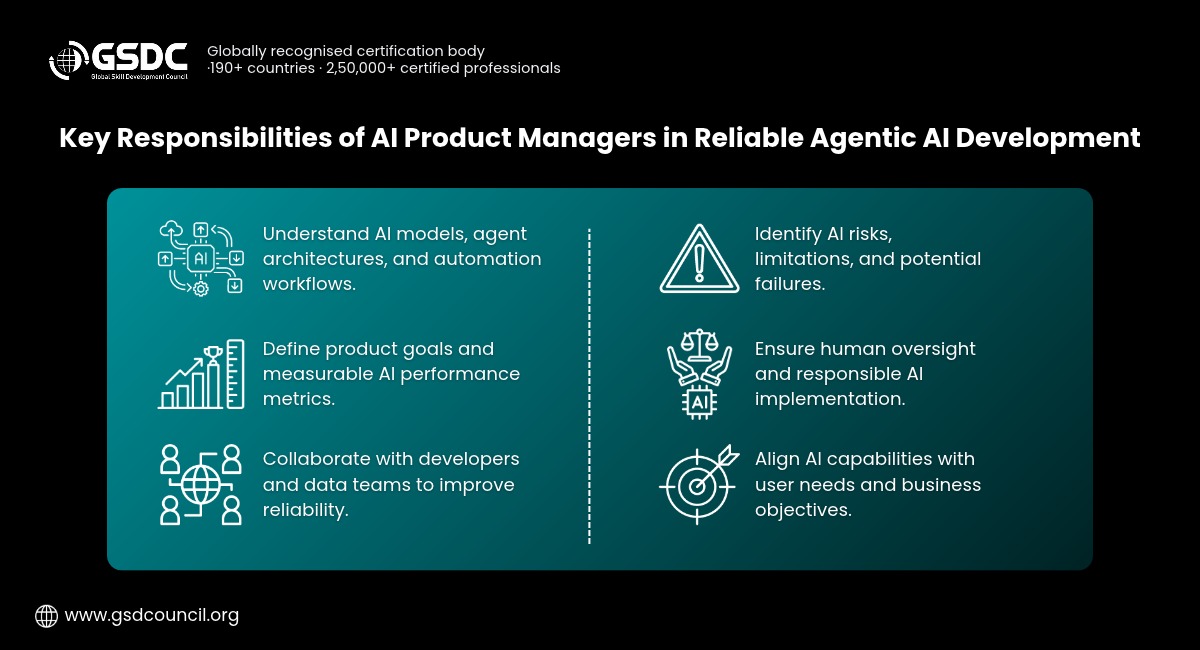
Important capabilities include:
- Understanding AI models, agent architectures, and automation workflows.
- Defining measurable product success metrics.
- Collaborating with developers and data teams.
- Identifying AI-related risks and product limitations.
- Understanding user expectations and business requirements.
- Making decisions about human oversight and responsible AI adoption.
Professionals interested in how to become an AI product manager should develop both product management fundamentals and practical AI knowledge.
A structured AI product manager roadmap can include learning AI fundamentals, understanding AI in product management, working with AI evaluation metrics, and gaining experience with real-world AI projects.
An ai product management course can help professionals build foundational knowledge, while an ai product manager certification can provide structured learning and demonstrate their understanding of AI product concepts.
How GSDC's Agentic AI Developer Certification Helps Professionals Build Skills
As agentic AI becomes part of enterprise operations, professionals need practical knowledge of how intelligent agents are designed, developed, tested, and deployed. GSDC's Agentic AI Developer Certification helps professionals strengthen their understanding of agentic AI concepts, autonomous agent development, AI workflows, and the technologies used to build intelligent systems.

The Agentic AI Developer Certification supports developers in understanding how AI agents plan tasks, interact with tools, manage information, and execute multi-step workflows. It also helps professionals build awareness of important areas such as agent performance, debugging, testing, and responsible AI implementation.
By developing these capabilities, professionals can better understand the challenges of building reliable agentic AI applications and contribute to AI development projects with greater confidence. It also helps them to understand the agentic AI career path.
Conclusion
Debugging and testing agentic AI systems require a more comprehensive approach than traditional software testing. Developers must examine individual components, monitor execution traces, evaluate multi-step workflows, and test how agents respond to unexpected situations.
As these systems become more autonomous, reliability, security, and human oversight will become essential parts of development. A combination of component-level testing, scenario-based evaluation, performance monitoring, and continuous improvement can help teams build agents that perform consistently in real-world environments.
Ultimately, successful agentic AI development is not just about creating agents that can take action. It is about creating systems that take the right actions, deliver measurable results, and remain reliable as business requirements evolve.

Related Certifications
Stay up-to-date with the latest news, trends, and resources in GSDC
If you like this read then make sure to check out our previous blogs: Cracking Onboarding Challenges: Fresher Success Unveiled
Not sure which certification to pursue? Our advisors will help you decide!