Beyond Chatbots: 7 Enterprise Workflows Where FDEs Add Value
Written by Emily Hilton
Artificial intelligence is changing how businesses manage operations, make decisions, and serve customers. While chatbots are among the most visible applications of AI, enterprise adoption goes much further. Organizations are now exploring AI systems that can analyze documents, process information, coordinate tasks, detect operational issues, and support complex business workflows.
However, implementing AI in an enterprise environment is not as simple as connecting an AI model to an application. Businesses need solutions that work with existing software, follow internal processes, protect sensitive information, and deliver measurable results.
This is where Forward Deployed Engineers (FDEs) become important. They help organizations identify suitable AI opportunities, build customized solutions, integrate different systems, and make sure AI applications work in real business environments.
Let's explore seven enterprise workflows where FDEs add value beyond traditional chatbots.
Why Enterprises Are Moving Beyond Chatbots
Chatbots generally respond to questions and provide information based on predefined instructions or connected knowledge sources. However, many business processes require more than generating a response.
For example, processing an insurance claim may involve reviewing documents, checking policy details, validating information, identifying missing records, and sending the claim for approval.
Handling this entire process requires multiple connected actions rather than a simple conversation.
This is where enterprise AI use cases are expanding towards workflow automation and AI agents. Instead of only answering questions, AI systems can analyze information, trigger actions, interact with business applications, and support employees throughout different stages of a process.
With the right implementation, these capabilities can improve productivity, reduce repetitive work, and help employees focus on more complex decisions.
7 Enterprise Workflows Where FDEs Add Value
1. Automating Invoice Processing and Financial Operations
Finance teams regularly handle invoices, payment records, expense reports, and financial documents. Processing these records manually can take considerable time and may lead to data entry errors.
AI can help automate several steps in this workflow.
For example, an AI-powered invoice processing system can:
- Extract vendor names, invoice numbers, and payment amounts.
- Compare invoice details with purchase orders.
- Identify duplicate invoices or missing information.
- Flag unusual transactions for further review.
- Send verified invoices into the payment approval workflow.
An FDE can connect the AI application with accounting software, enterprise resource planning (ERP) systems, and document management platforms.
They can also configure validation rules and approval processes to ensure that sensitive financial decisions remain under appropriate human supervision.
This is a practical example of enterprise workflow automation, where AI reduces repetitive administrative work while employees retain control over important financial approvals.
2. Intelligent Supply Chain and Inventory Management
Supply chain operations involve multiple activities, including inventory tracking, supplier coordination, demand forecasting, and order management.
When information is spread across different systems, identifying delays or shortages can become difficult.
AI agents can help businesses monitor these activities and identify potential problems.
For example, an AI-powered supply chain workflow could:
- Monitor inventory levels across warehouses.
- Analyze historical sales and demand patterns.
- Identify products that may run out of stock.
- Track supplier delivery updates.
- Recommend inventory adjustments based on demand.
An FDE helps connect inventory databases, supplier platforms, and business applications so information can move between systems.
They can also develop AI-powered workflows that notify procurement teams when stock levels reach a predefined threshold.
Such AI automation for business helps organizations respond to operational changes faster instead of depending entirely on manual monitoring.
3. Automating Customer Order Management
Order management involves more than receiving customer orders. Businesses must verify order details, check product availability, process payments, coordinate deliveries, and handle changes or cancellations.
AI can help coordinate these activities across different platforms.
Consider an online retailer receiving hundreds of orders every day. An AI agent could check order information, verify inventory availability, identify delayed shipments, and update the order management system.
If an order requires additional attention, the system can route it to the appropriate employee.
FDEs play an important role in connecting these workflows with existing e-commerce platforms, payment systems, inventory databases, and logistics applications.
They also test how the AI system responds to exceptions, such as incorrect addresses, unavailable products, or failed payments.
These AI agents use cases demonstrate how AI can support complete business processes rather than simply answering customer questions.
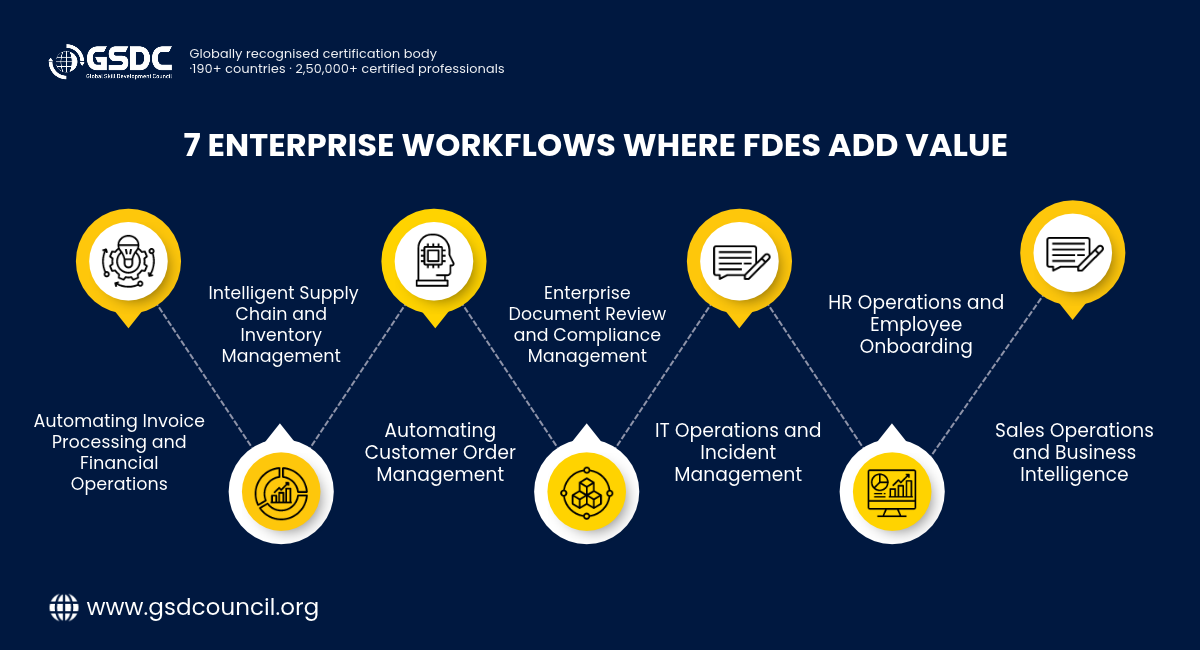
4. Enterprise Document Review and Compliance Management
Large organizations generate and manage thousands of documents, including contracts, policies, audit reports, employee records, and regulatory documents.
Reviewing these documents manually can be time-consuming, particularly when employees need to identify specific information across multiple files.
AI-powered document workflows can help by:
- Extracting important information from documents.
- Identifying missing clauses or required information.
- Comparing documents against internal policies.
- Highlighting potential compliance gaps.
- Organizing records for audits and reviews.
For example, a financial organization could use an AI system to review customer onboarding documents and identify missing information before the application moves to the next stage.
An FDE can build a retrieval-augmented generation (RAG) system that connects approved internal documents with an AI model. They can also configure access permissions, document retrieval rules, and human review processes.
This is one of the important agentic AI enterprise applications because AI can coordinate multiple document-related tasks while keeping sensitive decisions within established approval processes.
5. IT Operations and Incident Management
IT teams manage infrastructure, applications, network performance, and technical incidents. When systems experience problems, engineers must identify the root cause and restore normal operations.
AI agents can support this process by analyzing system alerts, reviewing logs, and identifying patterns associated with recurring issues.
For example, when a company application becomes unavailable, an AI-powered workflow could:
- Collect alerts from monitoring platforms.
- Analyze relevant system logs.
- Compare the issue with previously reported incidents.
- Suggest possible causes and troubleshooting steps.
- Create an incident ticket and assign it to the appropriate team.
Depending on the organization's permissions and risk controls, certain low-risk actions may also be automated.
FDEs help integrate monitoring tools, ticketing platforms, and internal infrastructure systems. They also test whether the AI-generated recommendations are accurate and whether automated actions follow the organization's security requirements.
These enterprise AI workflows can help IT teams reduce repetitive investigation work and respond to incidents more efficiently.
6. HR Operations and Employee Onboarding
Human resource teams manage several repetitive processes, including employee onboarding, leave requests, document collection, policy communication, and internal approvals.
AI can simplify these activities by connecting different HR applications and automating routine tasks.
For instance, when a new employee joins an organization, an AI-powered workflow could:
- Collect and organize onboarding documents.
- Check whether required forms have been submitted.
- Trigger account and system access requests.
- Schedule orientation sessions.
- Send reminders for pending onboarding activities.
An FDE can integrate the AI application with HR management systems, document repositories, and internal communication platforms.
They can also configure access controls to ensure that employee information is only available to authorized users.
This demonstrates how AI agents for enterprise environments can support internal operations, not just customer-facing activities.
7. Sales Operations and Business Intelligence
Sales teams work with customer records, sales reports, lead information, and performance dashboards. Collecting information from different platforms and preparing reports manually can slow down decision-making.
AI agents can help analyze sales information and automate routine reporting activities.
For example, an AI-powered sales workflow could:
- Analyze customer relationship management (CRM) data.
- Identify leads that require follow-up.
- Summarize customer interactions.
- Track sales performance against targets.
- Generate reports for sales managers.
An FDE can connect CRM platforms, sales databases, and reporting tools to create a unified workflow.
They can also configure AI agents to identify patterns and generate insights based on approved business data.
These applications help organizations use AI to support better business decisions rather than limiting its use to answering employee questions.
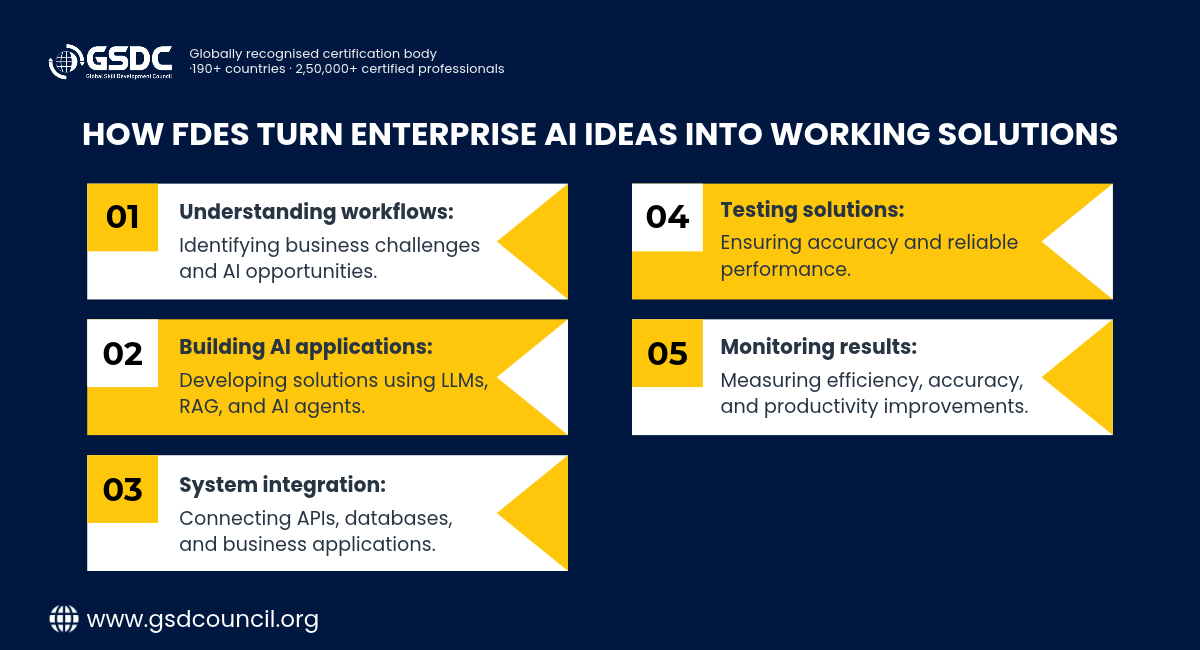
How FDEs Turn Enterprise AI Ideas into Working Solutions
Identifying an AI opportunity is only the beginning. Businesses need professionals who understand how to implement these solutions within existing technical environments.
This is where the FDE role becomes valuable.
A Forward Deployed Engineer works directly with customers and internal teams to understand business requirements and translate them into technical solutions.
The forward deployed engineer responsibilities in enterprise AI projects generally include:
- Understanding business workflows: Identifying repetitive tasks, operational challenges, and opportunities where AI can add value.
- Building AI applications: Developing customized AI solutions using LLMs, RAG systems, and agent frameworks.
- Connecting enterprise systems: Integrating APIs, databases, cloud platforms, and existing business applications.
- Testing and evaluation: Checking whether AI systems generate accurate outputs and perform reliably under real-world conditions.
- Monitoring performance: Measuring improvements in processing time, operational efficiency, accuracy, and employee productivity.
This is what forward deployed engineering looks like in practice. FDEs do not simply introduce AI tools; they help organizations make those tools useful within actual business operations.
What Is a Forward Deployed Engineer in the Age of Enterprise AI?
A Forward Deployed Engineer is a technical professional who works closely with customers to develop, integrate, and deploy technology solutions based on real business needs.
As organizations adopt agentic workflows, the importance of this role continues to grow.
An FDE must understand software development, APIs, cloud infrastructure, AI systems, and business processes. They also need strong communication and problem-solving skills to work with different stakeholders.
Unlike traditional software development, the work often involves adapting solutions to customer-specific environments and solving challenges that emerge during implementation.
With enterprise AI agents becoming more capable, FDEs can help businesses move from isolated AI experiments to connected workflows that deliver measurable operational value.
How GSDC's Forward Deployed Engineer Certification Can Help?
GSDC's Forward Deployed Engineer (FDE) Certification can help professionals develop the knowledge required to implement AI solutions in real-world enterprise environments. It covers relevant areas such as AI implementation, system integration, customer collaboration, and practical problem-solving.
These skills are valuable for working on enterprise AI workflows involving finance, supply chain, HR, IT operations, and business intelligence. The Forward Deployed Engineer (FDE) Certification also helps professionals understand how to connect AI technologies with existing business systems, address deployment challenges, and align technical solutions with organizational goals. For professionals looking to build expertise in enterprise AI and forward deployed engineering, this certification can support their career development.
Conclusion
Enterprise AI is moving beyond chatbots towards systems that can support complete business workflows. From invoice processing and supply chain management to IT operations, HR, and sales, AI agents are creating new opportunities to improve how organizations operate.
However, successful implementation requires more than selecting an AI model. Businesses must connect applications, manage data, establish security controls, and evaluate performance.
Forward Deployed Engineers help bridge this gap by turning enterprise AI ideas into practical solutions. Their ability to combine engineering knowledge with customer understanding makes them important contributors to the next phase of enterprise AI adoption.

Related Certifications
Stay up-to-date with the latest news, trends, and resources in GSDC
If you like this read then make sure to check out our previous blogs: Cracking Onboarding Challenges: Fresher Success Unveiled
Not sure which certification to pursue? Our advisors will help you decide!