What Does a Forward Deployed Engineer Do in a Typical Workday?

Written by Emily Hilton
Artificial intelligence and software solutions are becoming part of everyday business operations. However, building a working solution is only one part of the process. Organizations also need professionals who can understand customer problems, connect technology with existing systems, and make sure solutions deliver real results.
This is where a Forward Deployed Engineer (FDE) comes in.
But what does a forward deployed engineer do beyond writing code and developing AI applications? Unlike traditional software developers, FDEs work closely with customers, understand their requirements, solve technical challenges, and help deploy solutions in real business environments.
Their workday is rarely the same. One day might involve discussing customer requirements, while another could involve debugging an AI application, integrating APIs, or testing a newly developed feature.
Let's explore what a typical workday looks like for a Forward Deployed Engineer.
What Is a Forward Deployed Engineer?
A Forward Deployed Engineer is a technical professional who works directly with customers to implement software, AI systems, and other technology solutions based on their business requirements.
The forward deployed engineer meaning goes beyond simply developing software. These professionals understand both the technical and business sides of a problem. They work with customers to identify challenges and turn those challenges into practical solutions.
For example, imagine a healthcare organization wants to use an AI assistant to reduce the time employees spend answering patient queries. An FDE would understand the organization's workflow, identify the required data sources, connect the AI application with existing systems, and test whether the assistant provides accurate responses.
This explains what is FDE in a practical business environment: a professional who connects engineering capabilities with real customer needs.
A Typical Day in the Life of a Forward Deployed Engineer
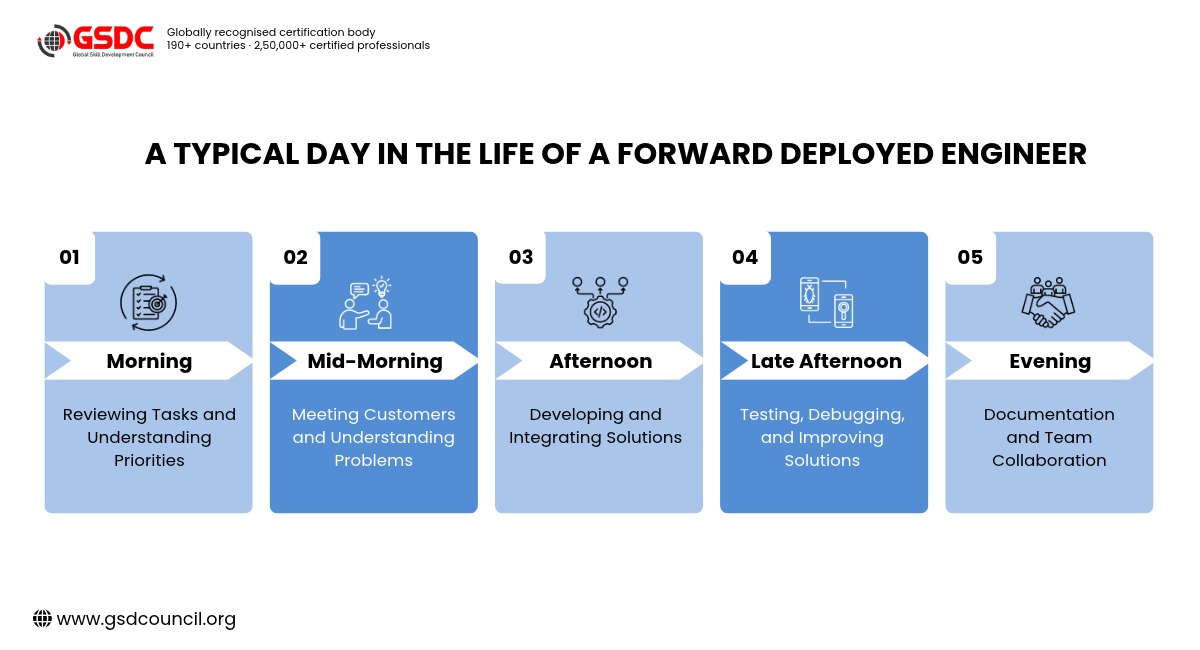
The forward deployed engineer role involves a combination of technical development, customer communication, testing, and problem-solving. Here is how a typical workday might look.
1. Morning: Reviewing Tasks and Understanding Priorities
A Forward Deployed Engineer usually begins the day by reviewing ongoing projects, checking updates, and identifying priority tasks.
This may include:
- Reviewing project progress and pending technical issues.
- Checking customer feedback from previous meetings.
- Identifying bugs or integration problems that need attention.
- Discussing priorities with product managers and engineering teams.
- Planning tasks based on customer requirements and deadlines.
For example, if a customer reported that an AI chatbot was giving incomplete answers, the FDE may review the previous test results and identify whether the problem is related to data quality, retrieval, or the AI model.
This initial planning helps the engineer focus on problems that directly affect the customer's experience.
2. Mid-Morning: Meeting Customers and Understanding Problems
Customer interaction is an important part of forward deployed engineering.
Unlike traditional developers who may receive requirements through product documents, FDEs often communicate directly with customers to understand how their systems work.
During these discussions, they may:
- Understand existing business workflows.
- Ask questions about technical challenges.
- Identify gaps in current software systems.
- Discuss expected outcomes and project priorities.
- Explain possible technical solutions.
For instance, a retail company might want to automate inventory reporting. However, its inventory information may be spread across multiple platforms.
The FDE needs to understand how these platforms communicate, where information is stored, and what prevents employees from accessing updated reports.
This is why communication and business understanding are important forward deployed engineer skills. An engineer must understand the actual problem before deciding how to solve it.
3. Afternoon: Developing and Integrating Solutions
After understanding customer requirements, the FDE moves towards technical implementation.
This is where much of the engineering work happens. Depending on the project, the engineer may work on:
- API integrations: Connecting different applications so they can exchange information and work together.
- AI application development: Building or customizing AI-powered tools based on customer requirements.
- Data integration: Connecting databases, internal platforms, and external data sources.
- RAG implementation: Connecting large language models with relevant business documents so they can generate more context-specific responses.
- Cloud deployment: Preparing applications to run in cloud environments and making them accessible to users.
Consider a company that wants an AI-powered internal knowledge assistant. Employees should be able to ask questions and receive answers from company documents.
The FDE might connect the document database with a retrieval system, configure the AI model, build the application interface, and test whether the assistant retrieves relevant information.
A forward deployed AI engineer may also work on agent-based applications that perform tasks such as retrieving information, updating records, or interacting with business software.
The objective is not simply to build something that works technically. It is to create something that solves the customer's actual problem.
4. Late Afternoon: Testing, Debugging, and Improving Solutions
Developing a solution does not mean the work is complete. FDEs must make sure that applications perform reliably in real business environments.
Testing and debugging are regular parts of their responsibilities.
For example, an AI assistant might work correctly during initial testing but provide irrelevant responses when employees ask complex questions.
The FDE may investigate:
- Whether the correct information is being retrieved.
- Whether the connected data sources are updated.
- Whether API requests are failing.
- Whether the AI model is following the expected instructions.
- Whether the application handles unexpected user inputs.
After identifying the problem, the engineer makes the required changes and tests the application again.
This process also involves collecting customer feedback and making improvements based on actual usage.
5. Evening: Documentation and Team Collaboration
Before ending the day, an FDE may document completed work, share updates, and communicate unresolved issues.
This includes:
- Recording technical changes and implementation details.
- Updating project documentation.
- Sharing progress with internal engineering teams.
- Discussing unresolved challenges with product managers.
- Preparing tasks for the next development cycle.
Documentation is particularly important because other engineers may need to maintain, improve, or troubleshoot the solution later.
It also helps ensure that customer requirements and technical decisions remain clear throughout the project.
Forward Deployed Engineer Responsibilities Beyond Coding
A typical workday shows that the forward deployed engineer responsibilities extend beyond software development.
Some of the major responsibilities include:
- Customer collaboration: Working directly with customers to understand their business challenges and technical requirements.
- Solution development: Building applications and customizing existing technology to meet specific needs.
- System integration: Connecting APIs, databases, cloud platforms, and enterprise applications.
- Technical troubleshooting: Identifying and resolving issues that affect application performance.
- Product feedback: Sharing customer insights with product teams to improve existing features.
- Deployment and maintenance: Supporting implementation, monitoring performance, and improving solutions after deployment.
These responsibilities make the FDE role different from a traditional software engineering position.
Forward Deployed Engineer vs. Solutions Engineer vs. Customer Engineer
People sometimes confuse an FDE with a solutions engineer or customer engineer because all three roles involve customer interaction.
However, their responsibilities can differ.
Role | Primary focus |
Forward Deployed Engineer | Building, integrating, and implementing technical solutions for customer-specific problems. |
Solutions Engineer | Explaining technical products, demonstrating capabilities, and helping customers understand suitable solutions. |
Customer Engineer | Helping customers implement and use technical products, troubleshoot issues, and improve adoption. |
There can be some overlap between these roles, depending on the organization. However, FDEs generally have deeper involvement in hands-on engineering and building customized solutions.
How to Become a Forward Deployed Engineer?
If this type of work interests you, you may be wondering how to become a forward deployed engineer.
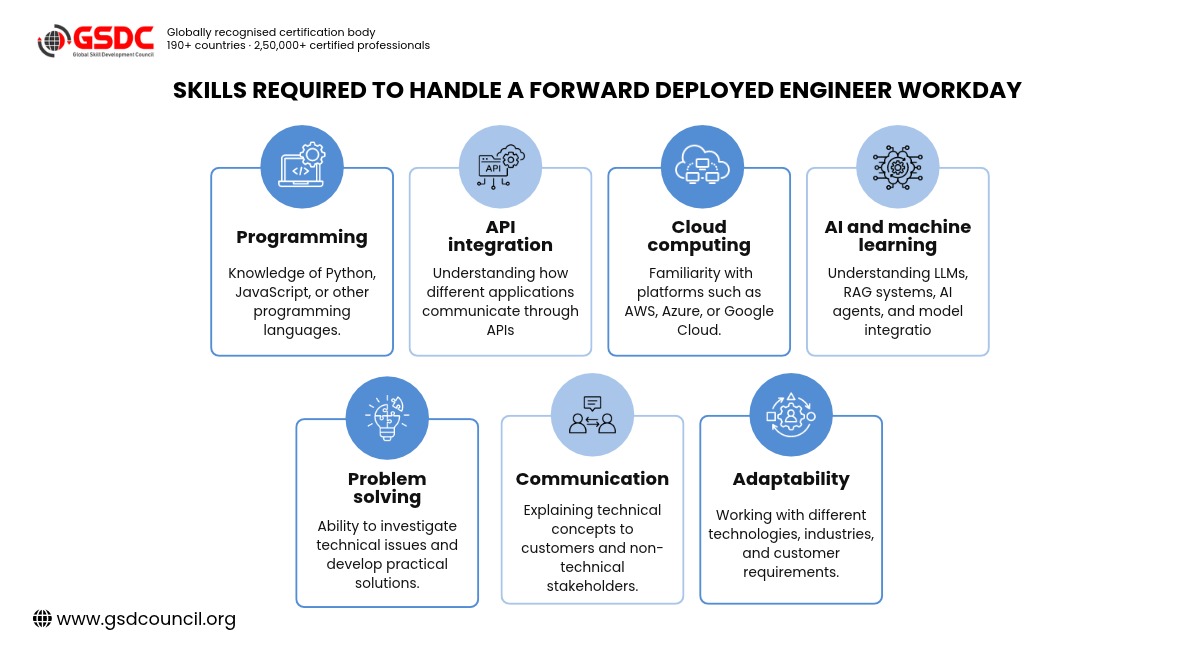
A good starting point is to build a strong foundation in software development. Learn a programming language, understand APIs, and gain experience working with databases and cloud platforms.
Next, explore AI application development. Build small projects involving LLMs, RAG pipelines, and AI agents to understand how these technologies work in practical situations.
You should also develop communication and problem-solving skills. Since FDEs work directly with customers, understanding requirements and explaining technical decisions are equally important.
Working on real-world projects, contributing to technical teams, and building a portfolio of practical implementations can help prepare you for the role.
How GSDC's Forward Deployed Engineer Certification Can Help
GSDC's Forward Deployed Engineer (FDE) Certification can help professionals strengthen their understanding of the skills and responsibilities required for this role. It provides an opportunity to build knowledge of AI implementation, software integration, customer collaboration, and real-world problem-solving.

The Forward Deployed Engineer (FDE) Certification also helps professionals understand how to connect technical solutions with business objectives, manage AI deployment challenges, and measure business impact. For aspiring FDEs and technology professionals looking to expand their career opportunities, this certification can be a valuable step toward developing relevant knowledge and demonstrating their commitment to AI-driven engineering.
Conclusion
A Forward Deployed Engineer's workday is a combination of engineering, customer interaction, and continuous problem-solving. From understanding business requirements in the morning to developing, testing, and improving applications throughout the day, the role involves much more than writing code.
As organizations continue adopting AI and advanced software solutions, they need professionals who can connect technical capabilities with real business needs.
Forward deployed engineering offers an opportunity to work at this intersection. For professionals who enjoy building technology, solving practical problems, and collaborating with customers, the FDE role can be an interesting career direction.

Related Certifications
Stay up-to-date with the latest news, trends, and resources in GSDC
If you like this read then make sure to check out our previous blogs: Cracking Onboarding Challenges: Fresher Success Unveiled
Not sure which certification to pursue? Our advisors will help you decide!