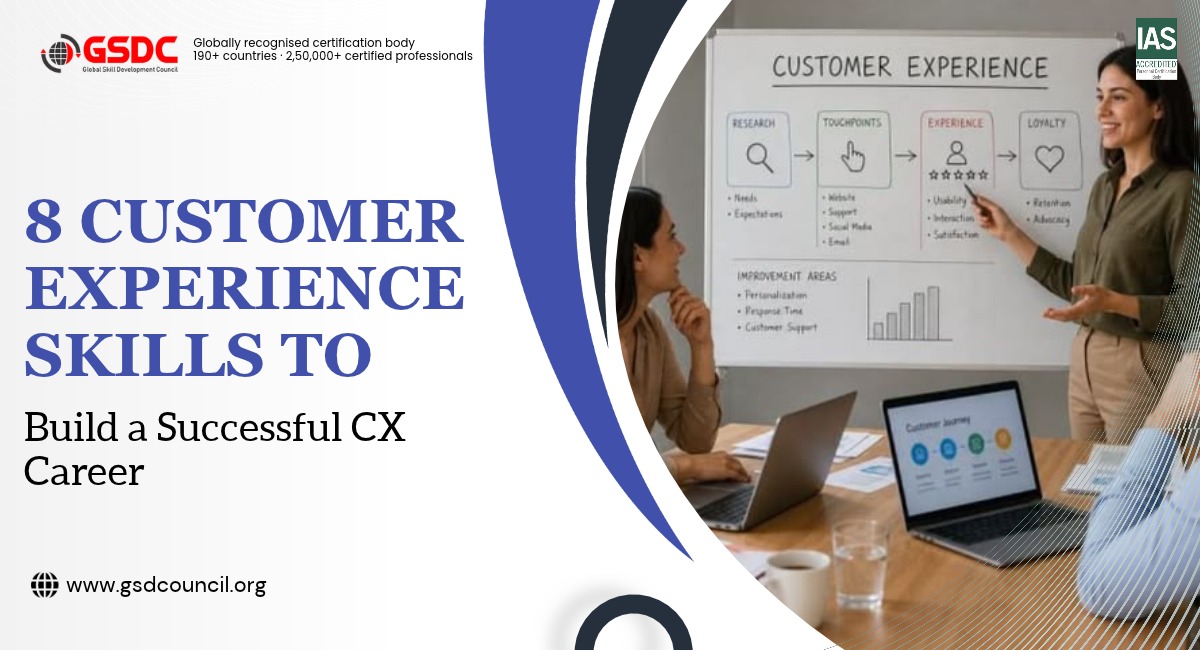
AI Customer Experience: How to Future-Proof Your CX Career
Written by Matthew Hale
- What Is AI Customer Experience?
- Customer Experience Trends to Watch in 2026
- Will AI Replace Customer Service Jobs?
- 9 AI Skills CX Professionals Need Now
- Prompt Engineering for CX Teams: The Skill to Learn First
- What Are Multi Agent Systems in Customer Service?
- The Future of Customer Experience: What to Expect Next
- Turn These Skills Into a Recognised Credential
- Final Thoughts: Skills Will Decide Who Benefits
AI customer experience has moved from a pilot project to a boardroom expectation. In a Gartner survey of 321 service and support leaders, 91% said they were under executive pressure to bring AI into their operations in 2026. The tools are arriving fast. The people who know how to run them well are arriving slower. If you work in customer support, customer success or CX strategy, this guide covers what is changing, what the data says about jobs, and the nine skills worth building next.
What Is AI Customer Experience?
AI customer experience means using artificial intelligence to make each step of a customer's journey faster, more personal and less frustrating. Think of the chatbot that answers at 2 a.m., the tool that suggests a reply while your agent is on a call, or the system that spots an unhappy customer before they complain.
You'll also hear it called AI for customer experience, mostly when teams talk about the software they buy. Whatever the label, it tends to show up in four places:
- Self-service: chatbots and voice assistants that handle simple requests like order status or password resets
- Agent assist: AI that suggests answers, summarises calls and fills in notes while a human talks to the customer
- Personalisation: recommendations shaped by what a customer has bought or asked before
- Insight: analysis of reviews, calls and chats that shows where customers get stuck
Here's the part many articles skip. The software does a lot, but someone still has to set it up, feed it good information and check its work. That someone is a CX professional, which is why skills matter more than tools right now.
Customer Experience Trends to Watch in 2026
Customer experience trends change fast, so here are the ones backed by recent survey data instead of guesswork.
Trend | What it means for you | Evidence |
AI takes routine work, people take the rest | Agents spend more time on complex and emotional cases | 85% of service leaders are adding new tasks to agent roles (Gartner, Apr 2026) |
Customers still want humans for advice | Keep a clear path to a person | 54% of surveyed U.S. customers trust human agents more than AI for recommendations, and 32% trust AI more (Gartner, Apr 2026) |
Knowledge becomes the fuel | AI answers are only as good as the help content behind them | 58% of leaders plan to upskill agents into knowledge management specialists (Gartner, Feb 2026) |
New job titles appear | Roles like conversational AI designer and automation analyst are being hired | 42% of organisations are hiring specialised AI roles (Gartner, Dec 2025) |
Pressure to show results | Leaders expect AI progress this year | 91% report executive pressure to implement AI (Gartner, Feb 2026) |
Will AI Replace Customer Service Jobs?
Short answer: not the way the headlines suggest. In a Gartner survey of 321 service leaders, only 20% had cut agent staffing because of AI, and 55% kept staffing stable while handling more customers.
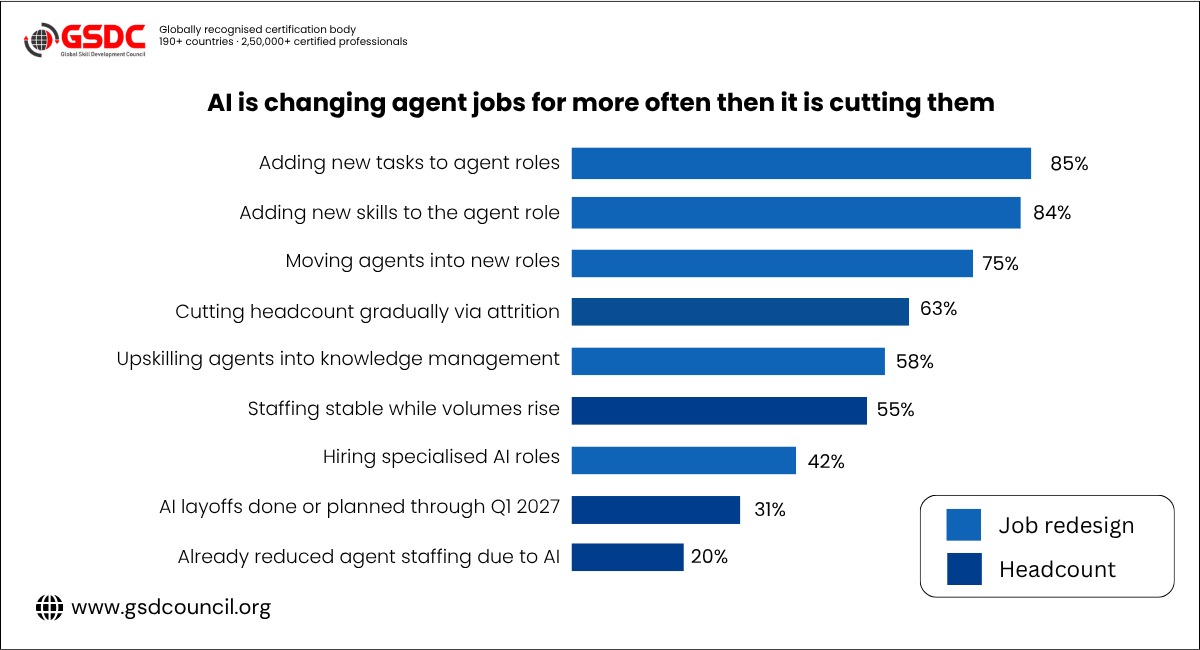
The same survey shows 31% of leaders have carried out or planned AI-driven layoffs through the first quarter of 2027. Gartner also expects half of the companies that attributed job cuts to AI to rehire for similar work by 2027, often under different job titles.
So, will AI replace customer service as a whole? Parts of it, yes. Routine tickets are already moving to bots. But the people who can work alongside AI are the ones getting the wider, better roles. Three things follow from the data:
- Routine tasks shrink, and complex ones grow
- Job descriptions are widening, not disappearing
- The new openings go to people who can manage and check AI, not just use it
Building these capabilities starts with developing the right skills. The Certified Customer Experience Professional (CCXP) certification can help professionals strengthen their customer experience knowledge and prepare to navigate evolving CX practices. Combined with practical AI skills, this foundation can help CX professionals adapt to changing responsibilities and deliver better customer experiences.
9 AI Skills CX Professionals Need Now
These are the AI skills that keep appearing in new job descriptions and in the Gartner data above. You don't need all nine at once. Start with the first three and build from there.
# | Skill | What it looks like at work |
1 | Prompt engineering | Writing clear instructions so AI gives usable replies, summaries and analysis |
2 | AI literacy | Knowing what AI does well, where it makes things up, and when a human must step in |
3 | Knowledge management | Keeping help articles accurate and current, because AI answers come from them |
4 | Data and insight reading | Turning survey, chat and call data into decisions, and spotting errors in AI summaries |
5 | Conversation design | Planning how a bot greets, asks questions, recovers from mistakes and hands over |
6 | Empathy and human handoff | Taking over for angry, worried or high-stakes customers with calm, clear communication |
7 | Multi agent systems awareness | Understanding how several AI agents share a job, and where the handoffs can break |
8 | Ethics, privacy and transparency | Telling customers when AI is involved and handling their data with care |
9 | Continuous learning | Testing new tools, tracking results and changing your approach when the data says so |
Notice that four of the nine (empathy, ethics, knowledge and learning) aren't technical at all. That's good news if you're coming from a pure service background.
Developing these skills requires more than learning new tools. It also means understanding customer needs, managing customer journeys and applying proven customer experience principles. The Certified Customer Experience Professional certification from the Global Skill Development Council (GSDC) can help professionals build a stronger foundation in CX practices and complement their efforts to develop AI-related skills.
Three skills in action (illustrative scenarios)
- Knowledge management: A customer asks the chatbot about the return window. The bot says 30 days, but the policy changed to 14 days last month and nobody updated the help article. The fix is a habit, not a new tool: give every article an owner, add a review date, and spot-check bot answers against current policy each month.
- Conversation design: A bank's bot keeps replying "I didn't understand that" to people who type "my card got stuck in the ATM". A conversation designer adds the plain phrases customers really use, asks one clarifying question instead of three, and offers a human after the second failed attempt.
- Empathy and human handoff: A customer has sent three messages about a delayed delivery of medical supplies. The AI notices the rising frustration and passes the chat to an agent with a short summary, so the customer doesn't have to repeat the story. The agent opens with the problem, not a script
Prompt Engineering for CX Teams: The Skill to Learn First
Prompt engineering sounds technical, but it's really about writing a good brief. You tell the AI who it is, what the situation is, what you want back and what to avoid. The clearer the brief, the less editing you do afterwards.
A simple five-part formula works for most support and CX tasks:
- Role: who the AI should act as
- Context: the customer's situation and any facts it needs
- Task: the exact job, such as a reply, summary or list
- Format: length, tone and layout
- Limits: what it must not say or promise
Here's the difference it makes on a real support case.
Version | Prompt | Why it works or fails |
Weak | Reply to this angry customer. | No context, tone or limits, so the reply will be generic and may promise things you can't deliver |
Better | You are a support agent for an online electronics store. A customer's laptop arrived late with a damaged box. Write a reply under 120 words. Apologise once, explain the replacement steps, offer a refund option and keep the tone calm and warm. Don't promise delivery dates. | Gives role, context, task, format and limits, so the draft needs only a quick human check |
Three habits keep this safe and useful:
- Read every AI draft before it reaches a customer
- Never paste personal customer data into a tool your company hasn't approved
- Save your best prompts in a shared library so the whole team gets the benefit
What Are Multi Agent Systems in Customer Service?
Multi agent systems are setups where several AI agents each handle one narrow job and pass the work along, a bit like a well-run help desk. Instead of one bot trying to do everything, you get a small team of specialists.
Here's how one customer message might travel through such a system:
- An intake agent reads the message and works out what the customer wants
- An account agent looks up the order or billing details
- A policy agent checks the refund or warranty rules
- A writing agent drafts the reply in the brand's tone
- A review agent checks accuracy and tone, and sends anything doubtful to a human
Why should a CX professional care? You probably won't build these systems, but you'll be asked to set the rules they follow, test the handoffs and catch the moment things go wrong. One agent's mistake can travel down the chain, so human oversight isn't optional. Knowing the basics of multi agent systems puts you in the room where those decisions are made.
The Future of Customer Experience: What to Expect Next
Nobody can predict the future of customer experience exactly, but four directions are worth planning for:
- Hybrid service wins. Gartner's analysts say the real advantage comes from combining AI efficiency with human judgment and empathy, not from AI alone.
- Support gets more proactive. AI that predicts problems lets teams reach out before a customer has to ask.
- Trust becomes a feature. Teams that are open about when AI is involved and how customer data is used will have an edge.
- Careers branch out. Roles such as conversational AI designer, automation analyst and knowledge specialist are growing alongside traditional agent jobs.
The common thread is simple. Technology handles volume, and people handle meaning.
Turn These Skills Into a Recognised Credential
Learning on the job is a great start. A certification adds structure and gives employers something they can verify.
The Global Skill Development Council (GSDC) offers professional certifications for people building future-ready careers. Its Certified Customer Experience Professional certification is designed for professionals who plan, manage and improve customer journeys, which is exactly the work AI is reshaping. Here's how it connects to what you've read:
- Knowledge management and conversation design: both depend on understanding how customers move through a journey
- Insight reading: better journeys start with knowing where customers get stuck
- Empathy and human handoff: the customer-first mindset the certification is built around

Final Thoughts: Skills Will Decide Who Benefits
AI customer experience rewards people who keep learning. Pick one skill from the list this week, practise it on a real task, and share the result with your team. Small, steady progress beats waiting for the perfect course.

Related Certifications
Frequently Asked Questions
Partly. AI takes over routine tasks, but most teams are redesigning agent roles instead of removing them. The full numbers are in the section above.
For most teams, not yet. Routine, repetitive tasks are where AI takes over first, which is why building new skills early helps.
It's the use of AI tools across the customer journey, including chatbots, agent assist, personalisation and customer insight analysis. The goal is faster, easier and more consistent service.
No. Prompt engineering is mostly clear writing and good judgment. If you can explain a task well to a new colleague, you can learn it.
Start with prompt engineering, AI literacy and knowledge management. They're useful in almost every CX role and don't need a technical background.
They're setups where several specialised AI agents split a job and pass work between them. In customer service, one might read the request, another check the account and a third draft the reply.
Stay up-to-date with the latest news, trends, and resources in GSDC
If you like this read then make sure to check out our previous blogs: Cracking Onboarding Challenges: Fresher Success Unveiled
Not sure which certification to pursue? Our advisors will help you decide!