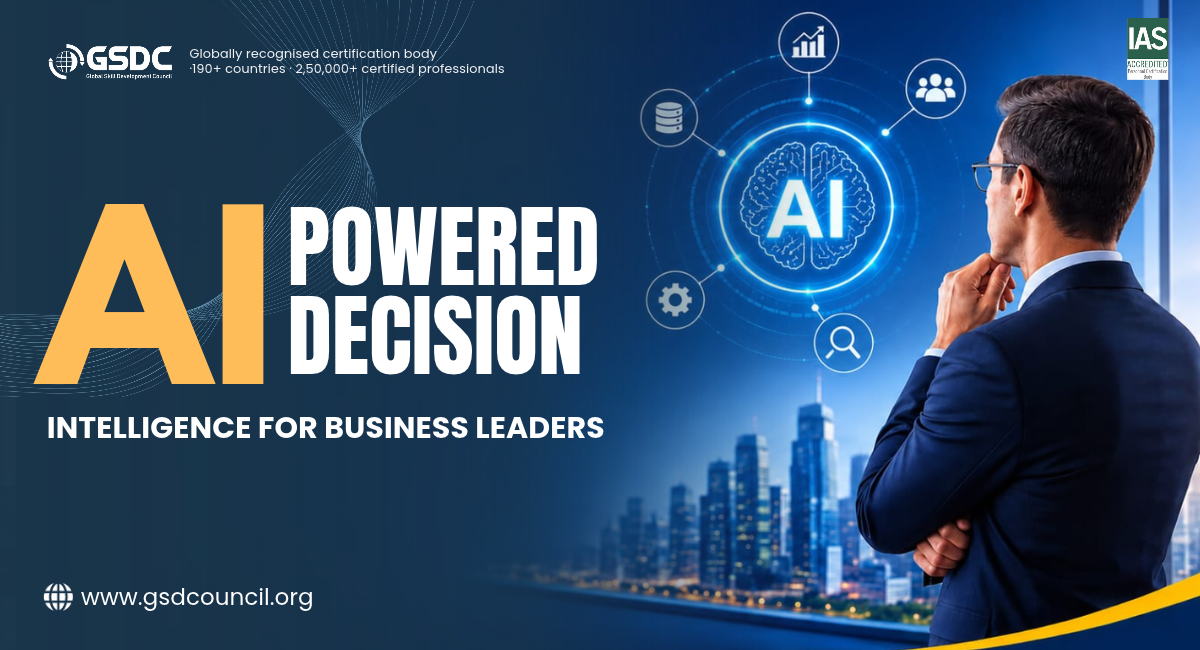
AI-Powered Decision Intelligence for Business Leaders
Written by Laura Onu
- What Is AI-Powered Decision Intelligence?
- The Role of AI Agents in Business Decision-Making
- Four Key Layers of an AI Agent System
- AI Business Intelligence: Monitoring Behaviour Beyond Average Metrics
- Three Important Principles for Reliable AI Insights
- Why Human Judgment, Privacy, and Governance Still Matter
- Building Accountability Through Decision Logs and Monitoring
- How GSDC Helps Professionals Prepare for AI-Driven Decision-Making
- Conclusion
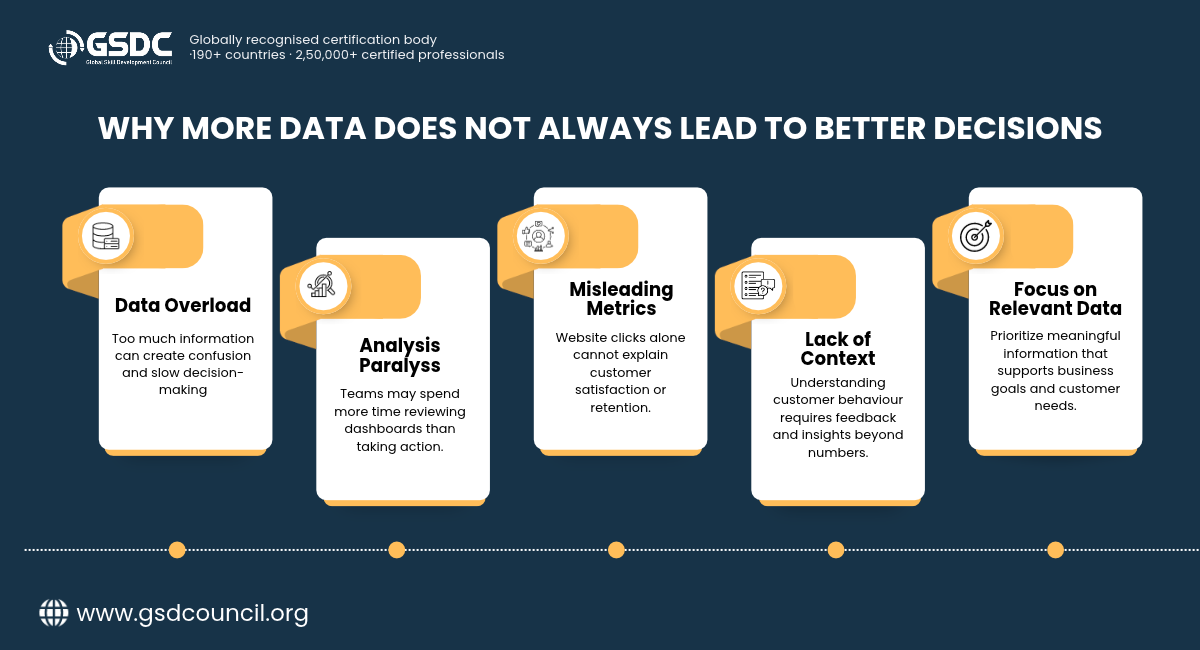
Artificial intelligence is changing how businesses collect information, understand customer behaviour, and make important decisions. However, having access to large amounts of data does not automatically lead to better business outcomes. Organizations need the ability to identify meaningful insights, understand possible risks, and turn information into practical actions.
This is where AI-powered decision intelligence becomes important. It combines artificial intelligence, advanced analytics, and human judgment to help businesses make faster, more informed decisions. It also introduces new considerations around governance, privacy, accountability, and the role of human oversight.
What Is AI-Powered Decision Intelligence?
Traditional business analytics mainly focuses on understanding past performance. It helps organizations identify what happened by examining historical reports, dashboards, and performance metrics. This approach forms an important part of AI business intelligence, as it provides the data businesses need to evaluate their performance.
Predictive analytics takes this a step further by using historical information to estimate what may happen in the future. AI-powered decision intelligence expands these capabilities by combining data analysis, learning, reasoning, and automation to support better business decisions. But what is decision intelligence, and how does it improve organizational decision-making? It is an approach that connects data, analytical insights, and human judgment to help businesses make more informed choices.
For example, a business may use traditional analytics to understand why customer retention declined during a particular quarter. Predictive analytics may estimate which customers are more likely to leave. An AI-powered decision intelligence system can go further by identifying possible reasons, suggesting relevant actions, and supporting teams in evaluating the next steps. This demonstrates how decision intelligence uses AI to turn insights into practical recommendations and strengthen AI in business decision-making.
The objective of business decision intelligence is not simply to generate more reports. It is to make information useful for real business decisions while keeping people involved in important judgment calls. With the right AI in business intelligence tools, organizations can connect data insights with business priorities and make decisions with greater clarity and confidence.
The Role of AI Agents in Business Decision-Making
AI agents are expanding the role of artificial intelligence in business operations. Unlike traditional AI systems that only provide recommendations, AI agents for business can perform tasks and take actions with limited human intervention through AI-powered automation.
For example, an AI agent may initiate an advertising campaign, adjust computing resources, or complete a routine operational task based on predefined conditions.
However, greater autonomy also introduces greater responsibility. If an AI agent makes an incorrect decision, the consequences may affect business operations, customer experience, or financial performance. This makes AI agent governance and human oversight important for managing risks.
A practical approach is to begin with low-risk and low-impact tasks. Organizations can observe how an agent performs, evaluate its results, and gradually expand its responsibilities. High-impact and business-critical decisions should continue to involve human review and approval.
This approach allows businesses to benefit from AI-driven business automation without giving up accountability.
Four Key Layers of an AI Agent System
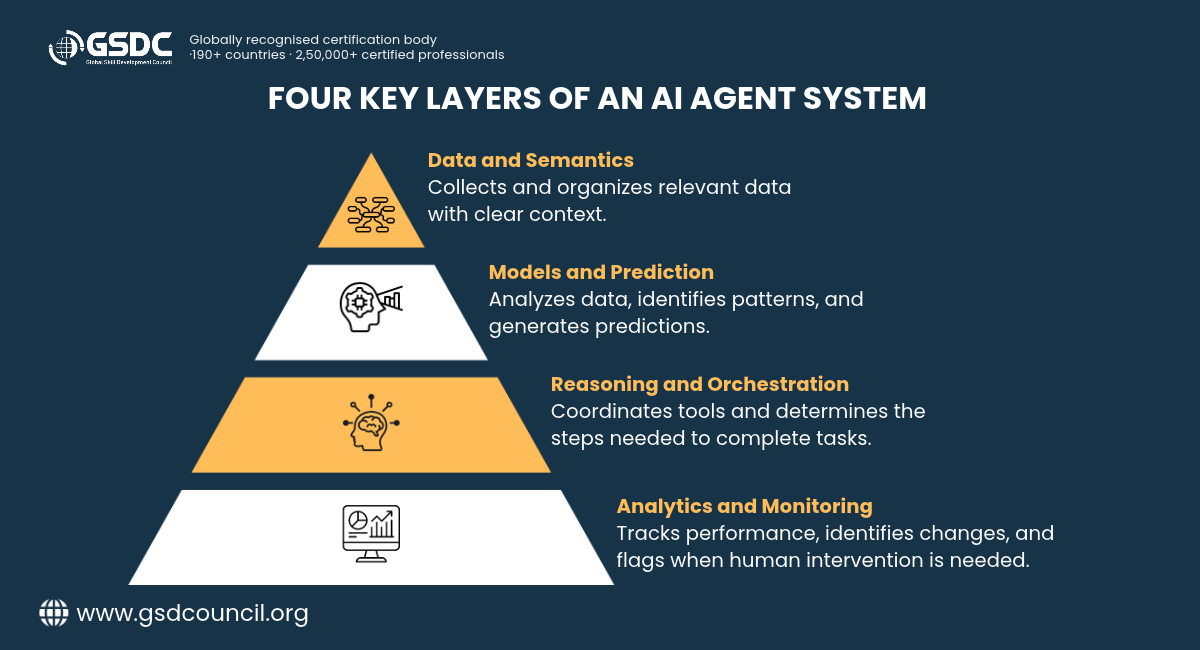
An effective AI agent system requires more than an AI model. It depends on multiple connected layers that work together to process information, make decisions, and monitor outcomes.
1. Data and Semantics
The first layer focuses on collecting, organizing, and understanding relevant information. Data must have clear meaning and context so that AI systems can interpret it correctly.
2. Models and Prediction
This layer uses AI models to identify patterns, analyze information, and generate predictions. The quality of these outputs depends on the relevance and reliability of the available data.
3. Reasoning and Orchestration
The reasoning layer helps AI agents determine what steps to take. It may involve coordinating different tools, connecting systems, and deciding how to complete a task.
4. Analytics and Monitoring
The final layer evaluates system performance and tracks behaviour over time. Monitoring helps organizations identify unexpected changes, measure outcomes, and determine when human intervention is required.
Together, these layers create a foundation for AI systems that can support business processes more effectively.
AI Business Intelligence: Monitoring Behaviour Beyond Average Metrics
AI-powered business intelligence is not limited to tracking performance through traditional averages. Organizations also need to understand how systems and users behave across different situations.
For example, an average response time may appear acceptable even when a significant group of customers experiences delays. Monitoring percentile-based measurements such as P25, P50, and P90 can provide a clearer picture of performance across different user experiences.
Quantitative information should also be considered alongside qualitative feedback. Numbers may show what customers are doing, while reviews, comments, and support conversations can help explain why they behave in a particular way.
Combining these perspectives gives businesses a more complete understanding of customer experience and operational performance.
Three Important Principles for Reliable AI Insights
AI-generated insights can help organizations identify patterns and opportunities that may not be immediately visible. However, these insights should be evaluated carefully before they influence important decisions.
1. Be Prepared for Unexpected Insights
AI systems may identify patterns that differ from existing business assumptions. Organizations should examine these findings rather than automatically accepting or dismissing them.
2. Collect Additional Data When Necessary
More data is not always better. However, when existing information is insufficient to understand a problem, organizations may need to collect additional data with a clear purpose and appropriate permissions.
3. Measure Confidence and Failure Rates
AI predictions are not guaranteed to be correct. Businesses should evaluate confidence levels, uncertainty, and possible failure rates to understand how much trust can be placed in a recommendation.
These principles help organizations use AI insights responsibly and avoid treating predictions as certain outcomes.
Why Human Judgment, Privacy, and Governance Still Matter
AI systems can recommend actions that appear useful from a technical or operational perspective but may create concerns for customers or employees.
For example, an AI system might suggest collecting frequent facial images to improve user identification. While this may appear to offer additional information, it also raises questions about consent, privacy, data protection, and regulatory requirements.
Organizations must evaluate AI recommendations in the context of applicable regulations and user expectations. Privacy requirements, including those established under frameworks such as the GDPR, should remain central to decisions involving personal information.
AI recommendations should be treated as opportunities for consideration, not instructions that must be followed automatically. Businesses need to work backwards from user needs, legal obligations, and potential risks before implementing a recommendation.
Human oversight is particularly important when decisions involve sensitive information, customer rights, or significant business consequences.
Building Accountability Through Decision Logs and Monitoring
As AI systems become more involved in business operations, organizations need to understand how decisions are made and what information influences them.
A decision log can help maintain this transparency. It records the decisions taken, the reasons behind them, and the data or recommendations used during the process.
Businesses can also identify one suitable, low-risk task for AI agent implementation. The system can then be monitored to evaluate its performance before additional decision-making responsibilities are delegated.
This gradual approach helps organizations understand the strengths and limitations of AI systems while maintaining clear accountability.
How GSDC Helps Professionals Prepare for AI-Driven Decision-Making
Professionals working with AI need more than technical knowledge. They must understand how AI systems support business objectives, how autonomous agents operate, and why governance and human oversight are essential for responsible AI adoption.
GSDC’s Agentic AI Professional Certification helps professionals develop the knowledge needed to understand and work with autonomous AI agents. It introduces key concepts related to agentic AI, intelligent workflows, AI-driven automation, and real-world applications. This learning can help professionals understand how AI agents make decisions, perform tasks, and support business processes with greater autonomy.
GSDC also offers learning pathways covering AI operating models, decision intelligence, governance, and intelligent project management. These areas help professionals connect AI capabilities with business objectives and understand the practical considerations involved in AI-driven transformation.
A structured 90-day learning approach can further help professionals progress from understanding AI foundations to exploring practical scenarios, automation, and oversight. The next stage focuses on leading AI initiatives, designing workflows, supporting data-driven decisions, and managing AI-related projects.
Conclusion
AI-powered decision intelligence is changing how organizations understand information and make business decisions. However, successful adoption depends on more than advanced models and automated systems. Businesses must prioritize meaningful data, establish strong governance, monitor AI performance, and maintain human accountability.
By combining AI capabilities with human judgment, organizations can make more informed decisions, improve operational processes, and build AI systems that support long-term business objectives.

Related Certifications
Frequently Asked Questions
AI-powered decision intelligence combines artificial intelligence, analytics, and human judgment to help organizations understand information, evaluate possible outcomes, and make informed decisions. It uses AI in business decision-making to turn data into actionable insights.
Traditional analytics mainly explains past performance, while business decision intelligence combines historical analysis, predictions, reasoning, and actionable insights to support future decisions. It goes beyond reporting to improve how organizations make choices.
AI agents for business can analyze information, recommend actions, and perform certain tasks with limited human intervention. They support AI-powered automation in activities such as campaign management and routine operational processes.
Human oversight helps identify incorrect recommendations, evaluate risks, protect user interests, and ensure that important decisions remain accountable and aligned with business requirements. It is an essential part of responsible AI-powered decision intelligence.
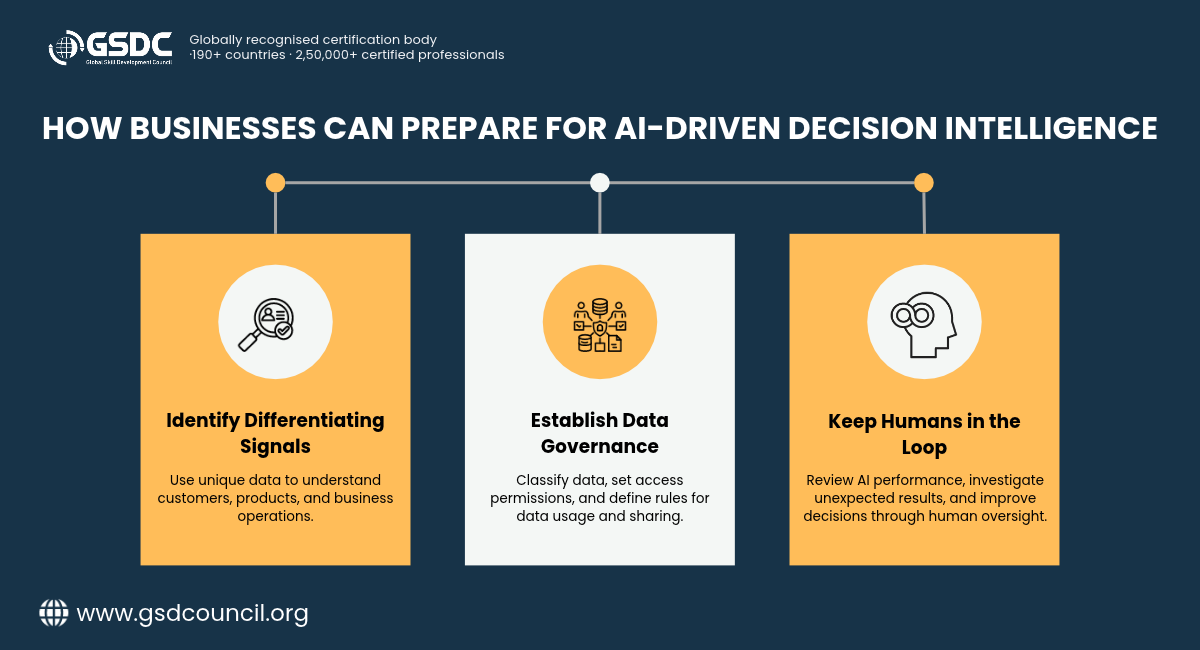
Organizations can prepare by identifying valuable data, establishing clear governance practices, monitoring AI performance, and involving human experts in reviewing important decisions. They can also explore suitable AI business intelligence tools to support data-driven decision-making.
Stay up-to-date with the latest news, trends, and resources in GSDC
If you like this read then make sure to check out our previous blogs: Cracking Onboarding Challenges: Fresher Success Unveiled
Not sure which certification to pursue? Our advisors will help you decide!