Generative AI in Marketing: How It Drives Growth & Engagement
Written by Matthew Hale
- Adoption of Generative AI in Marketing: What the Data Shows
- What Is Generative AI in Marketing?
- Essential Applications of Generative AI in Marketing
- How Marketing Departments Currently Use Marketing
- Benefits of Generative AI in Marketing
- How to Implement Generative AI in Your Marketing Strategy
- Challenges to Be Aware Of
- Building Skills for the Next Phase of Marketing
- Conclusion: A Strategic Imperative for Modern Marketing
- FAQs
Imagine launching a product campaign where your emails, social posts, landing pages, and ad creatives are all customer-specific, and you don't even have to work harder for that. This is exactly what generative AI in marketing is making possible. In fact, close to 71% of companies are currently using generative AI in marketing, and more than 80% of marketers say that they use AI primarily for content creation to both speed up their work and to increase the relevance.
With the help of such AI-driven tools, marketing content generation gets automated, and at the same time, hyper-personalization can be done at scale. So, marketing teams get to work faster, and at the same time, customer experiences become more relevant. What used to require weeks of coordination can now be done in days or even hours, in some cases.
Adoption of Generative AI in Marketing: What the Data Shows
Generative AI adoption in marketing has gone beyond just early pilots. Research worldwide shows organizations from different parts of the world are already using or actively testing generative AI. Thus, the experiment phase is clearly over, and the technology is being applied in the real world.
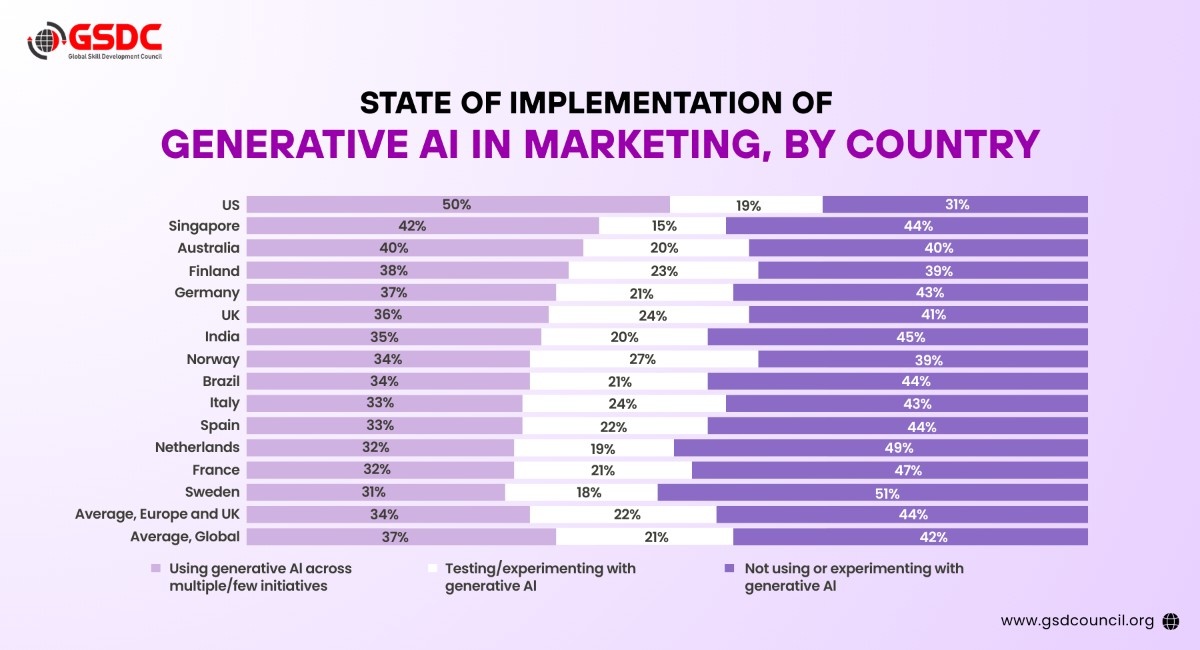
Markets like the US, Singapore, Australia, and parts of Europe have seen strong adoption, whereas other markets are still at the testing stage, pointing to different maturity levels, but overall, a very clear fast pace of adoption.
What Is Generative AI in Marketing?
To understand what is generative AI, it helps to see how these systems create value-added content and insights from vast datasets. Such systems are capable of generating text, creating images, tailoring messages, and making prediction, based recommendations that help with customer acquisition, retention, and the brand experience as a whole.
Generative AI models differ from conventional automation tools since they don't merely adhere to the rules but understand the data patterns to create outputs that are close to human creativity and thinking strategically. Hence, marketing departments get the ability to mass-produce content while maintaining its quality and relevance.
Essential Applications of Generative AI in Marketing
The Marketing departments have an increased demand for a greater volume of content, more personalization, and faster results. Generative AI in marketing is thus a neat way to increase the effects without increasing the efforts. Below are some of the most impactful generative AI marketing use cases seen in practice today.
-
Automated Content Generation and Refinement
One of the most revolutionary generative AI marketing use cases is to generate high-quality, SEO, friendly content automatically such as blogs, social posts, emails, and web pages. This brings down the number of hours spent on repetitive tasks, releases the teams to plan the strategy, and boosts the visibility and engagement of the content across channels.
-
Hyper-Personalized Customer Experiences
Generative AI for marketing allows brands to personalize messages, product recommendations, and website content on a large scale. As a result, they can offer customers more relevant and valuable experiences that not only deepen the customer, brand relationship but also increase loyalty.
-
AI-Powered Chatbots for Engagement and Support
AI-powered chatbots and virtual assistants can offer 24/7 customer service, shorten waiting times, and increase customer satisfaction, at the same time, they give a hand in reduction of the company's operational costs.
-
Predictive Insights and Smarter Campaigns
By processing enormous volumes of data, generative AI in marketing comes up with predictive insights that significantly improve targeting, budgeting, and overall campaign effectiveness.
Combined, these use cases show that generative AI in marketing has moved beyond experimentation into everyday practice. As teams build the skills to use these tools effectively, organizations like the GSDC (Global Skill Development Council) play an important role in supporting continuous learning and future-ready capability development.How Marketing Departments Currently Use Marketing
Teams Have Generative AI Understanding adoption is merely one side of the coin the way teams use generative AI marketing is equally important.
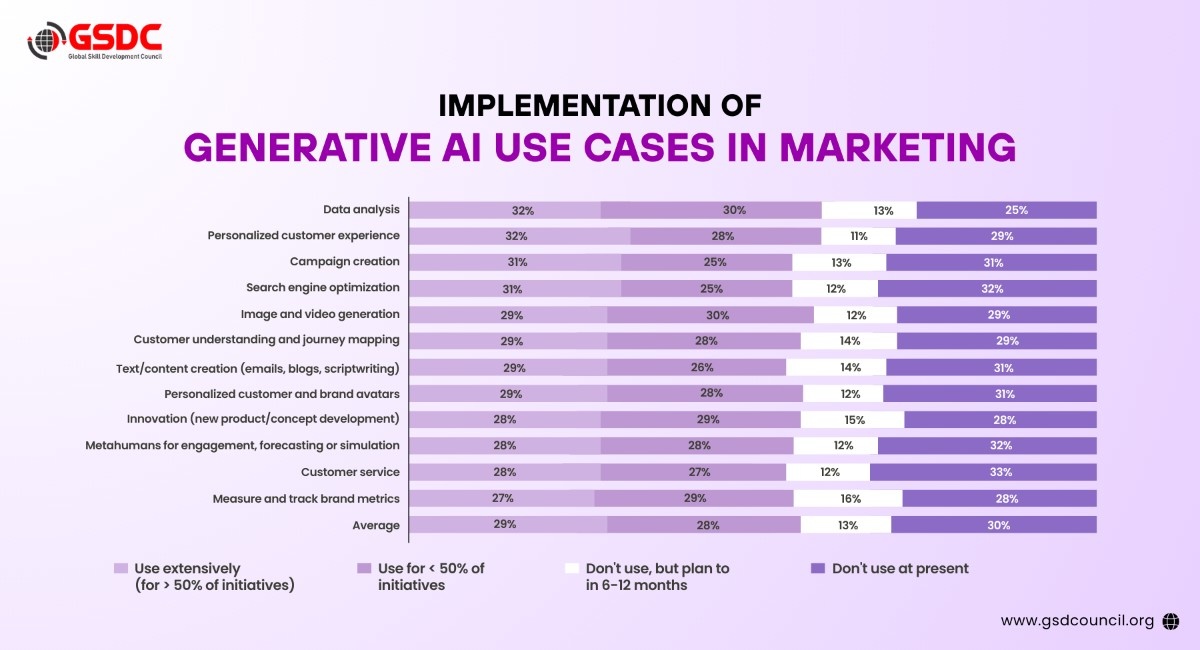
The most common generative AI marketing use cases include data analysis, personalization, campaign creation, SEO, and content generation - reflecting a focus on speed, relevance, and performance rather than isolated experimentation.
Benefits of Generative AI in Marketing
There are several very practical, business-driven benefits that integrating generative AI in marketing strategies can bring to modern teams:
-
More efficient operations:
Automates the generation of content as well as repetitive workflows, which leads to faster campaigns and shorter cycle times.
-
Improved personalization:
Tweaks the message for each audience segment, thus enabling brands to provide more relevant and timely customer experiences.
-
Ability to scale:
Enables multi-channel campaigns and content production without the need to increase team size or resources proportionally.
-
Cost Reduction:
One of the impacts is reduced manual work, which helps marketing to be more efficient with its budget while also improving the quality of the output.
-
Stronger Engagement:
By providing customers with more relevant experiences at different touchpoints, companies can significantly increase customer engagement and conversion rates.
Collectively, these advantages demonstrate how the use of generative AI in marketing is not just a matter of trying out new things but can truly bring about measurable growth in business and a sustained competitive edge if it is applied in a careful and responsible manner.
How to Implement Generative AI in Your Marketing Strategy
To unlock the full potential of generative AI in marketing, follow a clear implementation roadmap:
-
Establish clear goals:
Nail down what you want to achieve for your business - whether it’s lead generation, improving retention, or growing your content.
-
Make data quality a priority:
Ensure that your customer and performance data are organized, clean, and easily actionable, this is what drives improved AI outcomes.
-
Select the right tools:
Choose AI platforms that integrate smoothly with your current tech stack and meet your technical and creative requirements.
-
Integrate AI into processes:
Use generative AI in your content strategy, execution, and analysis of results.
-
Optimize and refine:
Continuously evaluate performance and optimize AI outputs for greater effectiveness.
By approaching adoption strategically, teams can move beyond experimentation and realize long-term value from generative AI in marketing - balancing speed and innovation with governance, quality, and brand trust. As demand grows for practical skills in this space, structured learning pathways such as a Certification in Generative AI in Marketing can help professionals build the capabilities needed to apply these technologies responsibly and effectively in real-world marketing environments.Challenges to Be Aware Of
Although generative AI in marketing provides obvious advantages, there are a few practical risks that teams have to handle.
-
Brand Voice Consistency:
Without clear guidelines and human review, AI-generated content can deviate from your brand voice.
-
Accuracy and Bias:
AI content can be very confident, but it still can include errors or bias, so it has to be reviewed before it is published.
-
Data Privacy and Compliance:
Managing customer data securely and having in place strong governance as well as compliance with regulations is a must.
-
Over-Reliance on Automation:
The AI should be used to stimulate creativity and not to substitute human judgment and uniqueness.
These problems can be solved by means of appropriate governance, human oversight, and clearly defined usage policies, thus enabling teams to realize the benefits of AI on a large scale without sacrificing trust and quality.
Building Skills for the Next Phase of Marketing
As generative AI in marketing reshapes how teams create, personalize, and engage at scale, building the right skills becomes just as important as adopting the technology itself. The Global Skill Development Council (GSDC) supports this shift by enabling structured, future-ready learning pathways.
Programs such as Professional Certification in Generative AI in Marketing enable individuals and businesses to develop skills that work in the real world, ensuring that innovation is accompanied by effective implementation.Conclusion: A Strategic Imperative for Modern Marketing
Generative AI in marketing is no longer a futuristic idea; it has already started to become an essential tool for the growth of companies. This technology enables marketing teams to work at a faster pace, come up with smarter ideas, and create more influence across different channels. It can be used for various purposes, such as automating simple tasks and even planning very personalized customer journeys.
Brands that invest early in the right tools, skills, and governance frameworks will be best positioned to lead customer engagement, unlock operational efficiency, and turn AI innovation into sustained business Those brands that will be the first to make a move by buying the right products and setting up the appropriate structures of skills and frameworks for governance will be leaders in customer engagement, gain more operational efficiency, and make their AI innovation to be a source of continuous business resul.
Together, these shifts highlight how AI is changing marketing - from faster execution to more personalized customer journeys.
FAQs
1. What is generative AI and how does it work in marketing?
The term generative AI in marketing essentially relates to AI systems that use massive datasets to produce content, insights, and suggestions. The main applications of marketers in this case are to generate copy, make messaging more personal, support chatbots, and optimize campaigns at scale.
2. How is generative AI used in marketing today?
Marketing teams rely on generative AI to think of new content, deliver highly, personalized email and web experiences, operate AI chatbots that help customers have a smooth conversation, and leverage predictive insights to both raise campaign effectiveness and make better decisions.
3. What are the main benefits of generative AI in marketing?
The major advantages are, among others, increased productivity, quicker creation of content, enhanced personalization, ability to scale campaign execution, reduced costs, and improved customer engagement across different channels.
4. Is generative AI replacing marketers?
No. Generative AI supports marketing teams by taking over repetitive tasks and speeding up workflows. The need for human judgment, creativity, and strategy is still there, for brand voice, campaign direction, and governance.
5. What skills do marketers need to work effectively with generative AI?
Marketers can enhance their performance by acquiring expertise in prompt design, data literacy, content strategy, and AI governance. A well-structured educational program, such as a Certification in Generative AI in Marketing, can enable a team to gain a practical, real-world understanding of how to harness AI in a responsible and effective manner.

Related Certifications
Stay up-to-date with the latest news, trends, and resources in GSDC
If you like this read then make sure to check out our previous blogs: Cracking Onboarding Challenges: Fresher Success Unveiled
Not sure which certification to pursue? Our advisors will help you decide!