5 Ways Generative AI in HR Is Transforming Talent Management
Written by Matthew Hale
Generative AI in HR is quickly becoming part of how modern HR teams work every day. In fact, around 43% of organizations are already using AI in HR functions, a sharp rise from the previous year.
What started as experimentation is now turning into real, practical use across hiring, employee experience, and workforce planning. Companies using generative AI in human resources are already seeing faster hiring, better decision-making, and more efficient HR operations.
With growing pressure to hire the right talent and improve productivity, generative AI for HR is helping teams move beyond repetitive tasks and focus on more strategic work.
From automating recruitment to improving employee engagement, the impact of generative AI on HR practices is becoming more visible across industries.
In this blog, we’ll explore key generative AI use cases in HR, the benefits of AI in HR, and what this shift means for the future of HR careers with AI.
What is Generative AI in HR?
Generative AI in HR refers to AI tools that can create content, analyze data, and support better decision-making in HR.
In simple terms, generative AI in human resource management helps reduce manual work and makes HR processes faster and more efficient. Unlike traditional tools, generative AI for HR can generate job descriptions, screen resumes, and personalize employee communication while also supporting workforce planning.
This clearly shows how generative AI is transforming human resource management across organizations.
5 Ways AI is Used in Human Resources
Generative AI in HR is helping teams do their job more quickly and effectively. From hiring to employee development, these tools are increasingly a part of everyday activities in the field. Here are a few of the most common AI use cases in HR today.
1. AI in Talent Acquisition
One of the biggest applications of AI in talent acquisition process is the improvement of the hiring process. It assists the HR department in saving time and acquiring the best talent without reviewing all the resumes individually.
How AI assists the HR department in the talent acquisition process:
- Reviewing a huge number of resumes in a short time
- Filtering the best talent based on their skill set and the job requirement
- Helping the HR department reduce biases in the hiring process
This makes it one of the most effective AI use cases in HR, especially for companies hiring at scale.
2. ChatGPT for HR Professionals
ChatGPT for HR professionals is helping to make their daily work easier. Such tools can help HR teams handle their communication and content management without having to spend too much time on such activities.
These tools can help HR professionals:
- Write emails, HR policies, and other messages
- Develop content for onboarding and training
- Answer employee queries quickly
This is another instance of how generative AI is helping make life easier for HR teams.
3. AI Workforce Planning Tools
AI workforce planning tools enable organizations to plan ahead rather than responding to a situation at the last minute. These tools assist in making more informed decisions based on data.
Some of the advantages of using these tools include:
- Making predictions on hiring in the future
- Identifying skill deficiencies in teams
- Making effective workforce planning decisions
Additionally, organizations such as the Global Skill Development Council (GSDC) emphasize the need to develop skills in AI for HR teams since workforce planning is data-driven.
This is a clear indication of how generative AI in human resource management is beneficial in planning.
4. Employee Engagement and Experience
With generative AI in human resources, companies can improve how they engage with employees. It allows more personalized and meaningful interactions.
AI helps by:
- Creating personalized communication
- Recommending learning and development paths
- Improving engagement using real-time feedback
These are some of the most useful generative AI use cases in HR today.
5. Performance and Learning Insights
AI creates vital benefits for organizations through its role in employee development and assessment procedures. The system provides HR teams with data-backed solutions that help them support their employees better.
It can:
- Analyze performance data
- Suggest training and development programs
- Guide employees on career paths
HR professionals currently investigate the Certification in Generative AI in HR & L&D program because it provides an understanding of AI applications throughout the entire employee lifecycle, from recruitment through workforce development to employee engagement and educational experiences.
The system enables career advancement through generative AI in HR processes while it prepares teams to handle upcoming HR job market demands that will involve AI technology.
Benefits of AI in HR
Any organization that wants to enhance its productivity needs to understand how artificial intelligence benefits of AI in HR work. The implementation of Generative AI in HR by numerous organizations enables assessments of its effects on various HR operations.
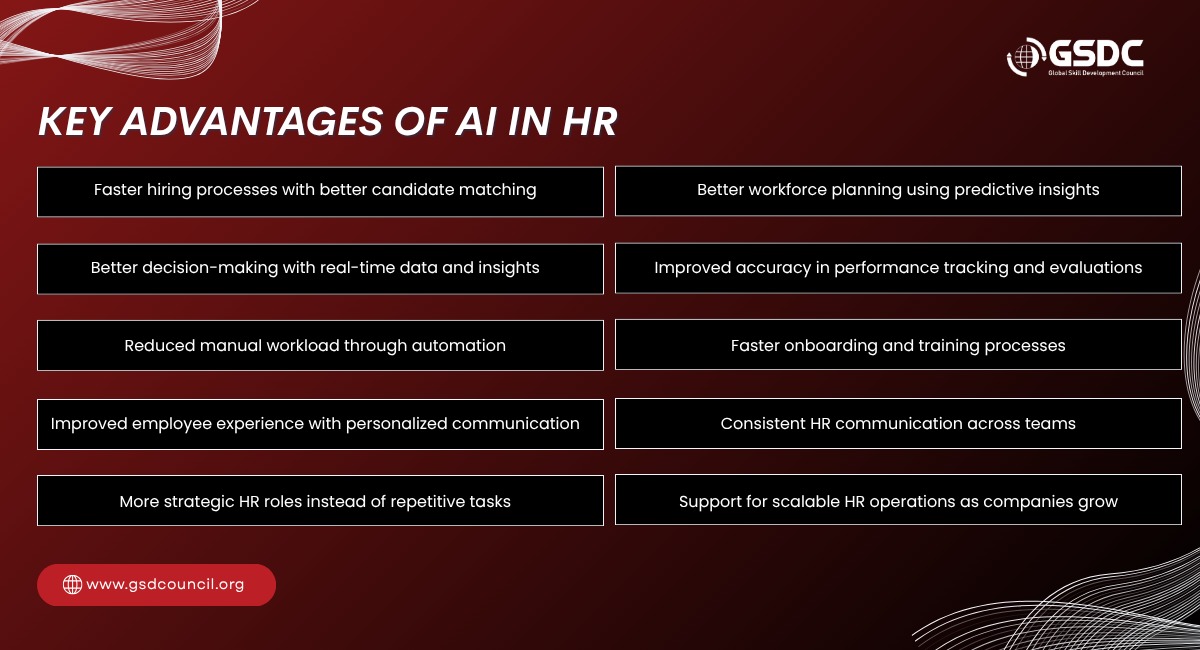
All these points highlight the real benefits of AI in HR and clearly answer the question: what are the benefits of generative AI in HR. The advantages will transform modern HR operations because they will become more common in organizations.
Impact of Generative AI on HR Practices
The impact of generative AI on HR practices is already visible in how HR teams work today. It is helping teams move from manual work to more strategic roles.
Administrative tasks → Strategic decision-making
HR teams used to spend most of their working hours on various administrative tasks, which included handling documents and coordinating activities. The implementation of generative AI in HR processes now enables automatic task execution, which frees up teams to concentrate on strategic planning and achieving organizational objectives.
Reactive hiring → Predictive hiring
AI technology enables teams to create their operational strategy through predictive modeling instead of responding to emergencies. The system uses data analysis to generate forecasts that enable organizations to make better decisions at an earlier stage.
Generic employee experience → Personalized journeys
AI helps to provide a unique experience for every employee, from onboarding to learning and development, to increase engagement and satisfaction along the way.
Overall, this change demonstrates the impact that generative AI in human resource management is having on proactivity, data-driven decision-making, and long-term thinking.
Generative AI Use Cases in HR: Real-World Applications
Here are some practical generative AI use cases in HR that organizations are already using today:
Resume screening and candidate ranking
Artificial intelligence is capable of rapidly reviewing resumes, creating a shortlist of candidates, and ranking them according to how well their skills match the job, thus making the recruitment process quicker and more precise.
Automated job description creation
The HR field can use Generative AI to write clear and structured job descriptions very quickly, saving both time and effort on the part of the HR teams.
Employee sentiment analysis
AI can analyze employee feedback, surveys, and communication to understand employee mood and identify issues early.
AI-powered onboarding assistants
AI assistants provide new hires with instant answers, guidance, and support, improving their onboarding experience.
Internal knowledge bots
AI bots help employees quickly find company policies, documents, and answers without depending on HR teams.
These examples show how generative AI in human resources is helping organizations save time, improve efficiency, and scale HR operations effectively.
Future of HR Careers with AI
The future of HR careers with AI is changing very fast. Almost half of the companies have incorporated AI into HR processes.
HR experts now have to collaborate with AI systems for recruiting, interacting, and managing human resources. Besides, they should be skilled at interpreting and using data insights for decision-making.
Since AI will be handling the most basic jobs, HR departments will have more time to be involved in strategy, employee engagement, and developing company culture. This change is giving rise to the strong use of generative AI for HR purposes and staff development in the HR sector.
How to Get Started with Generative AI for HR
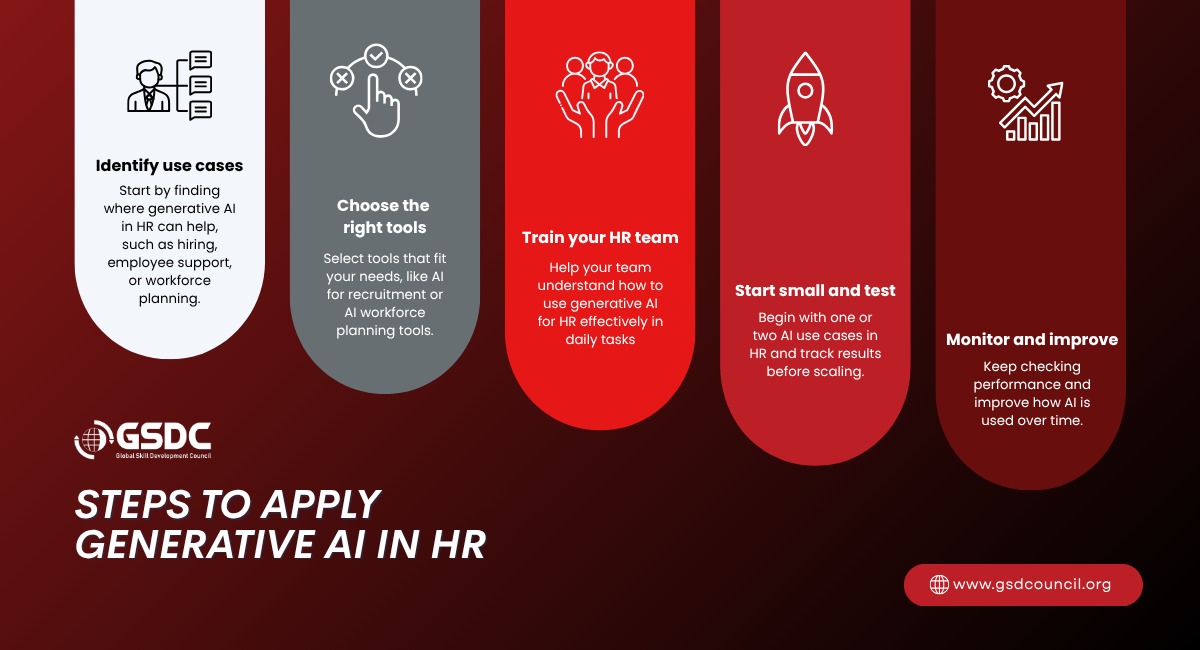
Getting started with generative AI for HR begins with simple steps like identifying repetitive tasks, using AI tools in hiring and communication, and gradually building data-driven decision-making.
Organizations like the Global Skill Development Council (GSDC) focus on the need to learn and apply the knowledge of AI in the real world in the field of HR. The Certification in Generative AI in HR & L&D is a program designed to enable the application of generative AI in the entire gamut of HR functions.
The best way forward is to learn and then scale up the application of generative AI in HR successfully.
Conclusion
Generative AI in HR is no longer just a trend it is changing how organizations hire, manage, and grow talent.
From AI in talent acquisition to workforce planning and employee experience, its role is expanding quickly across every HR function.
For HR professionals, this is a clear opportunity. Those who learn and adapt early will lead the future of generative AI in human resource management.

Related Certifications
Frequently Asked Questions
Stay up-to-date with the latest news, trends, and resources in GSDC
If you like this read then make sure to check out our previous blogs: Cracking Onboarding Challenges: Fresher Success Unveiled
Not sure which certification to pursue? Our advisors will help you decide!