Leading Change: How L&D Drives Successful Change Initiatives

Written by Kacie Walls
- Why Coaching Matters in Change Management
- Core Skills for Transformational Coaching
- Distinguishing Roles: Mentor, Facilitator, Counselor, and Coach
- Enabling Managers to Coach
- Common Coaching Pitfalls
- Master Learning Excellence with GSDC’s Certified Learning and Development Professional (CLDP) Certification
- Conclusion
Change is an inevitable part of today’s fast-paced organizational environment. Yet, despite its inevitability, change remains one of the most challenging aspects for organizations to navigate. Success in change management isn’t just about strategy, processes, or technology; it’s about people, making effective organizational change management strategies essential.
Learning and Development (L&D) plays a crucial role in enabling organizations to lead change effectively by equipping employees and leaders with the skills and mindsets needed to adapt, grow, and thrive while leading organizational change. A recent webinar, “Leading Organizational Change: How Learning and Development Supports Successful Change Management Initiatives”, highlighted the transformative power of coaching, mentorship, and facilitation in driving organizational change using proven change management strategies.
Hosted by seasoned L&D and coaching experts, the session explored practical strategies to enable managers and leaders to support their teams, while also addressing common pitfalls and best practices in coaching for transformation and sustainable organizational change management strategies.
Why Coaching Matters in Change Management
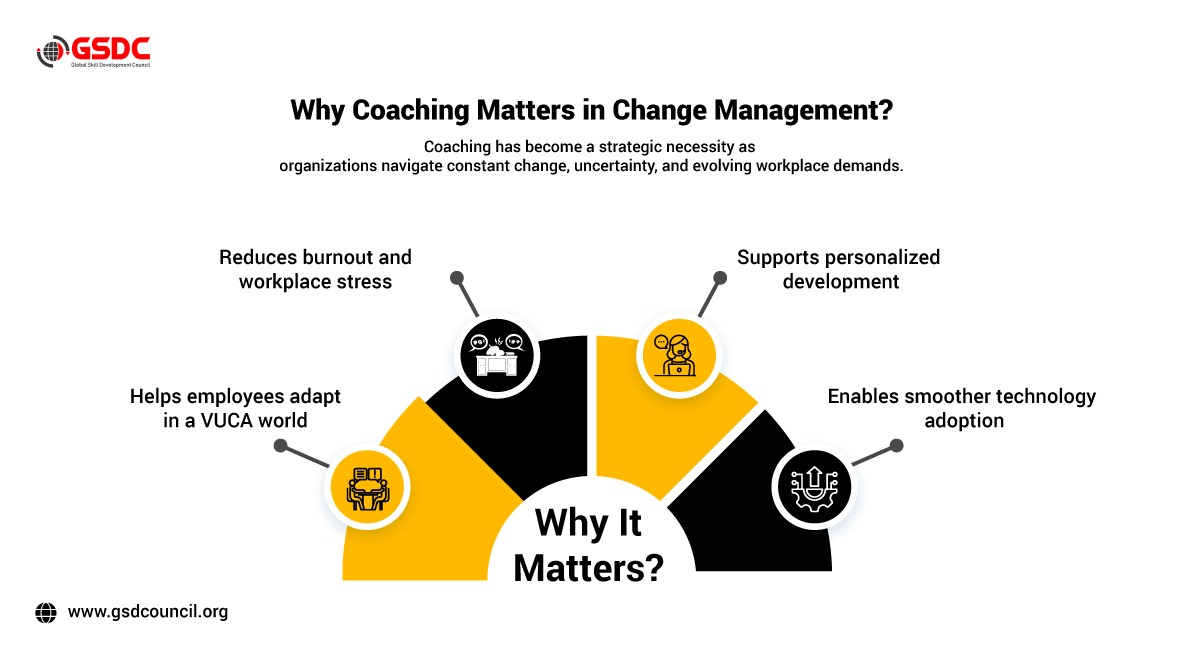
The coaching industry has experienced exponential growth over the past few years. According to the International Coaching Federation (ICF), the coaching industry reached $7.3 billion in 2023, representing a 60% growth since 2019. The number of active coaches worldwide has more than doubled, reflecting a significant demand for personalized professional guidance.
This surge can be attributed to several factors:
- VUCA World: Organizations today operate in an environment of volatility, uncertainty, complexity, and ambiguity (VUCA). Employees face constant changes, new technologies, and shifting business priorities. Personalized coaching helps individuals navigate these challenges effectively while supporting change management initiatives.
- Burnout and Stress: With growing pressures at work, burnout is increasingly prevalent. Coaching addresses these stressors by fostering self-awareness, resilience, and proactive problem-solving, while strengthening essential change management skills for leaders.
- Need for Personalized Development: Traditional training programs often adopt a “one-size-fits-all” approach. While such programs can introduce frameworks and concepts, they rarely cater to the unique challenges, strengths, and aspirations of individual employees. Coaching provides that tailored guidance aligned with a robust change management framework.
- Technology Integration: AI and other technologies are reshaping workflows and expectations. Coaching supports employees in adapting to these changes and leveraging new tools effectively, while building strong change leadership skills.
In short, coaching isn’t just a luxury; it’s a strategic necessity for organizations transforming.
Core Skills for Transformational Coaching
The webinar emphasized four essential skills that make coaching transformational:
1. Deep Listening
Listening is not merely hearing words; it involves understanding the underlying thoughts, emotions, and intentions. The ICF framework identifies three levels of listening:
- Internal Listening: Focusing on one’s own thoughts and reactions. While useful for self-awareness, this is not sufficient for effective coaching.
- Focused Listening: Concentrating on the coachee, resisting the urge to pre-plan responses, and truly understanding their perspective. This builds trust.
- Global Listening: Paying attention to non-verbal cues, tone, body language, and context to understand the coachee’s true state and challenges.
Mastering these levels ensures that coaches can identify not just what is said, but what may be unsaid or hidden.
2. Asking Powerful Questions
Effective coaching hinges on the ability to ask insightful questions. Instead of asking “why” (which can feel confrontational), coaches should ask “what” or “how” questions to explore challenges and encourage reflection. For example:
- “What’s the real challenge here for you?”
- “What would be different if you believed you could achieve this?”
- “How can you overcome the barriers you’re facing?”
These questions empower individuals to uncover insights, clarify goals, and take ownership of their decisions.
3. Creating Awareness and Challenging Assumptions
Coaching is not about giving advice; it’s about facilitating self-discovery. By reflecting on what they hear and gently challenging assumptions, coaches help individuals uncover obstacles and identify solutions for themselves. Techniques include:
- Recapping insights: “Here’s what I’m noticing…”
- Asking thought-provoking questions: “What if the opposite were true?”
- Encouraging self-reflection: Guiding the coachee to explore their beliefs, fears, and assumptions.
4. Building Accountability
Coaching also involves helping individuals take responsibility for their actions. Coaches support coachees by co-creating next steps, setting stretch goals, and checking in on progress through accountability questions, such as:
- “What will help you follow through?”
- “What support do you need to achieve this goal?”
- “What would you like me to ask you about in our next session?”
Accountability fosters ownership, motivation, and long-term behavior change.
Distinguishing Roles: Mentor, Facilitator, Counselor, and Coach
The webinar also clarified how different support roles contribute to organizational development:
- Mentor: Provides guidance and feedback based on personal experience for long-term career growth. Mentors act as role models, helping individuals navigate challenges with wisdom from their own journeys while contributing to an effective learning and development strategy.
- Facilitator: Guides group processes without imposing personal opinions. Facilitators help teams collaborate, brainstorm, and make decisions efficiently, strengthening overall Learning and Development outcomes.
- Counselor: Offers emotional support, helping individuals manage personal or professional challenges with empathy and guidance as part of a holistic learning and development strategy.
- Coach: Focuses on facilitating transformation through self-discovery, accountability, and skill-building rather than providing direct answers, making change leadership coaching highly impactful.
Each role plays a unique part in supporting employees, but coaching is particularly effective for enabling change at both the individual and organizational levels within Learning and Development.
Enabling Managers to Coach
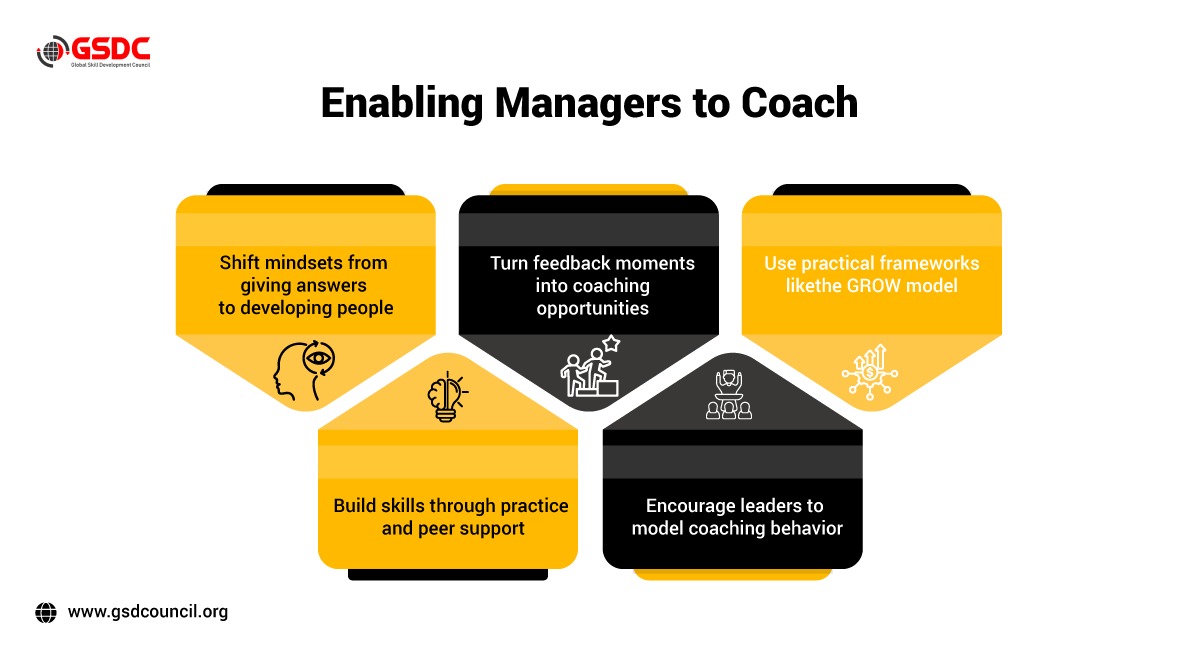
Managers often struggle to adopt coaching practices due to perceived time constraints, pressure to provide answers, or fear of appearing less authoritative. However, coaching can be integrated seamlessly into everyday management through simple strategies:
- Shift Mindsets: Reframe coaching as an investment in team development rather than a time-consuming task.
- Feedback vs. Coaching: Feedback is often past-focused, while coaching is future-oriented. Every feedback moment can be turned into a coaching opportunity.
- Use Practical Models: The GROW model Goal, Reality, Options, Way Forward helps structure coaching conversations effectively. Managers can ask:
- Goal: “What are you trying to achieve?”
- Reality: “What is happening now?”
- Options: “What could you do next?”
- Way Forward: “What will be your first step?”
- Practice and Peer Support: Managers can participate in coaching drills, role-plays, and peer coaching circles to refine their skills.
Model Behavior: Leaders who embrace coaching culture and make their coaching practices visible encourage their teams to adopt similar behaviors.
Common Coaching Pitfalls
Even experienced managers and coaches encounter challenges. The webinar highlighted some common pitfalls to avoid within effective learning and development strategies and change management initiatives:
- Fixing Instead of Facilitating: The instinct to solve problems can undermine the coaching process. Coaches must guide individuals to find their own solutions, a key aspect of strong change leadership coaching.
- Leading Questions: Avoid questions that imply a desired answer. Instead, encourage open-ended exploration to strengthen change leadership skills.
- Attachment to Outcomes: Coaches should focus on empowering coachees, not controlling the results. Success is defined by the coachee, not the coach, aligning with effective change management framework practices.
- Skipping Goal Setting: Establishing objectives at the start ensures coaching stays focused on achieving meaningful results and supports change management skills for leaders.
By being aware of these pitfalls, organizations can create a culture of effective coaching that drives real change and enhances Learning and Development.
Master Learning Excellence with GSDC’s Certified Learning and Development Professional (CLDP) Certification
The Certified Learning and Development Professional certification by the Global Skill Development Council (GSDC) is designed for professionals aiming to build expertise in modern learning strategies and talent development.
Certified Learning and Development Professional certification equips individuals with the skills to design, implement, and evaluate effective L&D programs aligned with business goals. It covers key areas such as instructional design, performance improvement, learning technologies, and data-driven decision-making.
CLDP also emphasizes building scalable learning ecosystems and enhancing employee engagement. Ideal for L&D professionals, HR leaders, and trainers, it enables organizations to develop future-ready talent and drive a continuous learning culture.

Conclusion
Leading organizational change is a complex but achievable endeavor when supported by effective Learning and Development strategies. Coaching empowers employees to navigate uncertainty, build resilience, and embrace transformation. By equipping managers with the skills to coach, organizations can foster a culture of growth, collaboration, and accountability.
As the webinar emphasized, the essence of coaching is not about fixing; it’s about listening deeply, asking boldly, reflecting clearly, and supporting growth. Organizations that embrace these principles can drive meaningful change, enhance engagement, and prepare their workforce for the challenges and opportunities of the future.

Related Certifications
Frequently Asked Questions
Stay up-to-date with the latest news, trends, and resources in GSDC
If you like this read then make sure to check out our previous blogs: Cracking Onboarding Challenges: Fresher Success Unveiled
Not sure which certification to pursue? Our advisors will help you decide!