Beyond the Certificate: How to Make ISO 9001 Actually Work

Written by Matthew Hale
- Case Study 1: Toyota - When the World's Best Quality System Breaks
- Crisis timeline & response
- Case Study 2: Company C, Malaysia - What Customers Actually Think ISO 9001 Means
- Key research conclusions
- Reading Both Cases Together
- Lessons Every Quality Leader Should Take From These Two Cases
- How GSDC Helps You Close the Gap
- What These Two Studies Mean for Quality Professionals
Quality management certifications are credentials of intent. They signal to customers, regulators, and trading partners that an organisation has built a system capable of consistently delivering conforming product. But as two very different automotive case studies demonstrate - one from a global manufacturing giant, the other from a small company in Malaysia's domestic market - ISO 9001 certification and genuine quality management performance are not the same thing. The gap between them is where real quality crises grow.
Toyota built what many consider the world's most sophisticated quality system. Company C, a small Malaysian motorcycle manufacturer, sought ISO 9001 certification partly to signal quality to customers who were already sceptical. The outcomes of both stories illuminate the same fundamental challenge: earning trust through certification is the beginning of the work, not the end of it.
Case Study 1: Toyota - When the World's Best Quality System Breaks
Source: Toyota Quality System Case Study documentation; peer-reviewed analysis of TPS and the recall crisis
- Background: Toyota built its reputation on the Toyota Production System (TPS) - a manufacturing philosophy that embedded quality at every stage of the process rather than inspecting it in at the end. TPS introduced lean production principles: eliminating waste (muda), reducing process variation, and empowering workers to halt production immediately upon detecting a defect through jidoka (autonomation). The fourteen Business Principles of Toyota, codified by researcher Jeffrey Liker, described an organisation built around long-term philosophy, continuous process flow, demand-pull systems, and strategic supplier partnerships. This system was admired globally and widely studied as the benchmark for manufacturing quality management.
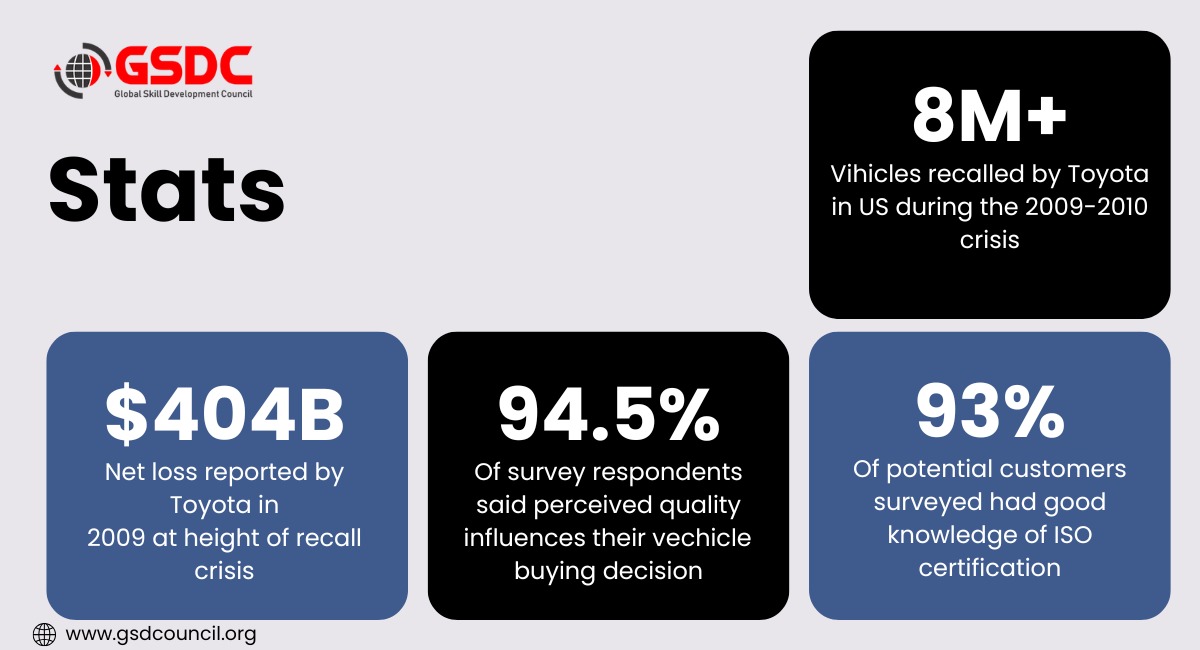
- The crisis: In 2009, Toyota began recalling vehicles on a scale that shocked an industry that had held the company up as a quality exemplar. The trigger was a fatal accident in California in August 2009 - four people killed in a Lexus ES 350 experiencing unintended acceleration. The investigation identified two mechanical defects: accelerator pedals that could become trapped by floor mats, and pedals with a "sticking" mechanism that would not return to idle. By early 2010, approximately 8 million vehicles had been recalled in the United States alone. Production and sales of eight affected models were halted. Toyota's president, Akio Toyoda, was called to testify before the US Congress in February 2010.
- Root cause - not a technical failure: The defects themselves were mechanical and identifiable. The deeper failure was organisational. Toyota had pursued aggressive global expansion through the early 2000s with the explicit goal of becoming the world's largest automaker - a target it achieved. That pace of growth stretched the TPS system beyond its cultural and procedural coherence. Training could not keep up with the expansion of the supply base. The informal knowledge networks that made TPS function - the shop-floor relationships, the stop-and-fix discipline, the supplier development investment - did not scale at the same rate as production volume. The result was predictable in retrospect: process variability crept in precisely where TPS was designed to eliminate it.
- The additional compliance failure: Toyota later paid $33 million in civil penalties following investigations into whether the company had notified NHTSA in a timely manner about the defects. The situation highlights issues similar to those addressed by ISO 9001 requirements for nonconformance management and corrective action. The question was not whether Toyota had a documented nonconformance management process. It did. The question was whether that process was functioning as designed under operational stress.
Crisis timeline & response
1. August 2009 - Fatal accident triggers NHTSA investigation
A Lexus ES 350 in California experiences unintended acceleration, killing four. NHTSA identifies two mechanical defects and begins pushing Toyota for rapid recall action.
2. November 2009 - First major recall: 4.2 million vehicles
Toyota announces a voluntary recall covering floor mat entrapment risk across multiple models including the Camry and Prius. Communication to customers is criticised for confusion and lack of clarity.
3. January 2010 - Second recall & production halt
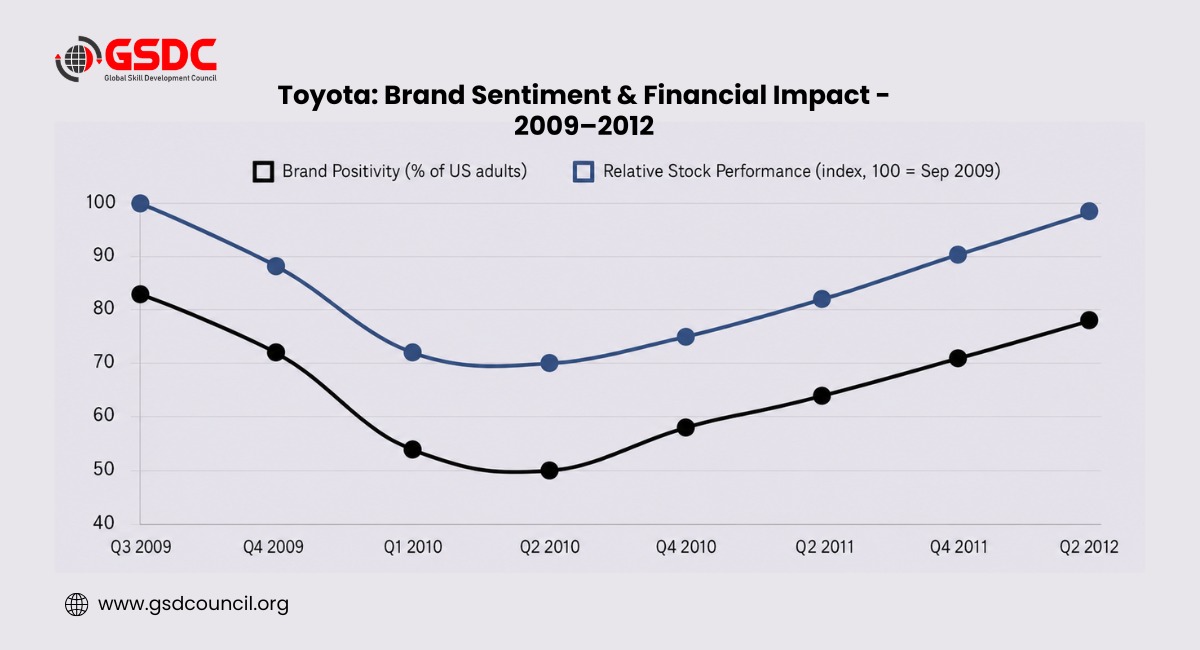
An additional 2.3 million vehicles recalled for sticking pedal mechanisms. Sales of eight affected models halted. Toyota reports a $4.4 billion net loss for 2009. The company's stock falls approximately 30% relative to the S&P 500 between September 2009 and April 2010.
4. February 2010 - Congressional testimony & public apology
President Akio Toyoda testifies before the US Congress, acknowledging failures in the company's responsiveness and quality oversight. Toyota's pre-crisis brand positivity of 83% among US adults drops sharply.
5. 2010 onward - Structural quality reform
Toyota establishes a global quality task force. A brake override system is implemented. Customer service infrastructure is expanded. Investment in supplier development and training is renewed. By 2012, Toyota had recovered to become the world's largest automaker - demonstrating that the TPS framework itself was sound; what had failed was its consistent application at scale.
“Toyota's production system was not the problem. The problem was that a functioning quality system was allowed to drift during a period of aggressive growth - and by the time external pressure exposed the gaps, the damage to reputation, finances, and trust was already severe.”
Case Study 2: Company C, Malaysia - What Customers Actually Think ISO 9001 Means
Source: Ong, Teh, Soh & Teoh (2015). Advanced Science Letters, 21(6), 1948–1951
- Research context: The automotive sector is central to Malaysia's economy, yet peer-reviewed research examining ISO certification outcomes in that market remained sparse at the time of this study. Researchers at Universiti Tunku Abdul Rahman - Ker Hsin Ong, Sin Yin Teh, Keng Lin Soh, and Wei Lin Teoh - conducted a structured case study on "Company C," a Malaysian automotive and motorcycle manufacturer, to investigate two distinct questions: What do potential customers actually understand and believe about ISO 9001 certification? And does ISO 9001 certification measurably improve overall organisational performance?
- The methodology: The study used a survey instrument targeting potential customers of Company C's motorcycle products. The researchers assessed respondents across three dimensions: knowledge (awareness and understanding of what ISO 9001 certification means), perception (whether certification influenced their sense of product quality), and attitude (their overall disposition toward purchasing an ISO-certified vehicle). Separately, the study investigated the relationship between ISO certification status and broader organisational performance metrics.
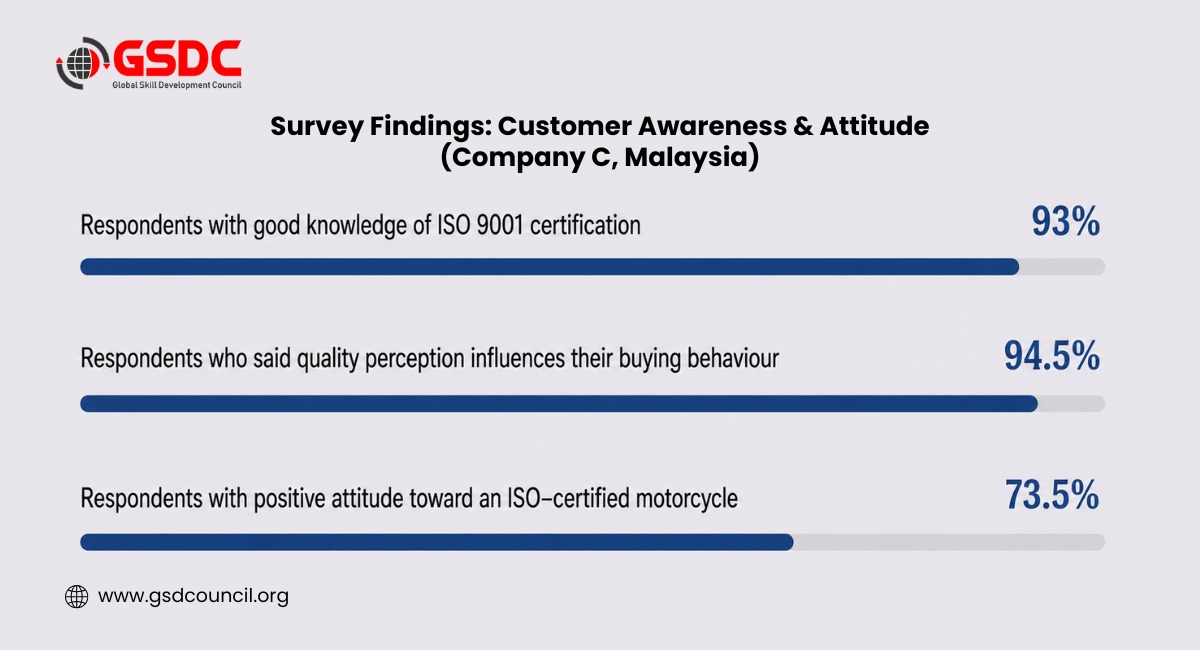
- What the survey found - the customer side: The findings on customer awareness were striking for their strength. A substantial majority of respondents demonstrated genuine knowledge of ISO certification, reported that quality perception influenced their purchasing decisions, and expressed positive attitudes toward ISO-certified motorcycles. This validated a core commercial rationale for certification: the market is aware, the market cares, and certification generates measurable customer confidence. ISO 9001, the study concluded, functions as a legitimate marketing signal in the Malaysian automotive market, and creates tangible business opportunity by differentiating certified products in the eyes of potential buyers.
What the study found - the performance paradox: The more nuanced finding emerged on the organisational performance side. While customers responded positively to ISO certification, the study found that certification alone does not drive overall organisational performance improvements. The researchers concluded explicitly: a business requires a better quality strategic plan - one that goes beyond certification compliance - to compete effectively in international markets. ISO 9001 provides the framework. What fills the framework with operational value is the organisation's own management discipline, measurement culture, and continuous improvement commitment.
Key research conclusions
- Certification generates market trust and business opportunity
Potential customers possess greater levels of trust and confidence in ISO-certified products. The study found that certification creates measurable commercial differentiation - functioning as a quality signal that translates into purchasing intent.
- ISO 9001 is an effective marketing tool in this market
The researchers explicitly concluded that ISO certification can and should be used as a marketing tool in the automotive sector - not as a superficial badge, but as a substantive signal of process quality that resonates with informed buyers.
- Certification alone does not drive organisational performance
The critical finding: ISO 9001 certification does not, by itself, improve organisational performance. Businesses need a more comprehensive quality strategic plan - one in which certification is a component, not the strategy itself - to achieve sustained competitive performance.
- International competitiveness requires more than a certificate
The researchers noted that to compete internationally, automotive manufacturers must translate the framework of ISO 9001 into an active quality management culture - continuous improvement, measurement discipline, management engagement - not merely maintain documented compliance.
Reading Both Cases Together
Placed side by side, these two studies offer a complete picture of what ISO 9001 and quality management systems can and cannot accomplish. Toyota demonstrates the consequences of a world-class quality system allowed to drift under operational pressure. Company C demonstrates the opportunity created by certification - and the limits of that opportunity if the underlying system is not actively managed.
| Dimension | Toyota - TPS/QMS Crisis | Company C - Malaysian ISO 9001 Study |
| Scale | Global OEM; 333,000+ employees; millions of vehicles per year | Domestic motorcycle manufacturer; Malaysian market |
| Quality framework | Toyota Production System (TPS) - lean, jidoka, JIT, supplier partnerships | ISO 9001 certification - international standard, process-based QMS |
| Core failure / finding | QMS drifted from active management during rapid expansion; nonconformance response delayed | Certification alone does not improve organisational performance; strategic quality plan required |
| Customer impact | Brand positivity fell from 83% to critical lows; $4.4B net loss in 2009 | 94.5% of customers say quality perception drives buying behaviour; certification creates business opportunity |
| Recovery / recommendation | Global quality task force; renewed supplier investment; brake override system; transparency measures | Move beyond compliance posture - build a quality strategic plan that uses ISO 9001 as operational infrastructure |
The shared lesson: Certification and quality system frameworks create conditions for performance - they do not guarantee it. Active management, measurement discipline, and leadership engagement are what determine actual outcomes.
Lessons Every Quality Leader Should Take From These Two Cases
01. ISO 9001 certification is a market signal, not a performance guarantee
The Malaysian study confirmed that 93% of potential customers have good knowledge of ISO certification and that quality perception directly drives purchasing decisions. But certification without an active quality strategy does not automatically improve the performance that sits behind that signal. Customers trust the label; your quality system has to justify it.
02. Quality systems drift during periods of rapid growth - deliberately guard against it
Toyota's most important lesson is not about defective parts. It is about what happens to even a world-class QMS when an organisation grows faster than its cultural infrastructure. The supplier development investment, the stop-and-fix discipline, the training depth - none of these scaled at the rate production expanded. Plan explicitly for quality system maintenance during growth cycles.
03. Nonconformance notification delays compound every quality failure
Toyota paid $33 million in civil penalties not for the defects themselves - but for the delay in notifying NHTSA. In ISO 9001 terms, this is a Clause 10.2 failure: the corrective action system existed but did not produce timely escalation. The moment a known nonconformance is not reported to the relevant authority, the original problem becomes a management failure.
04. To compete internationally, certification must be embedded in a strategic quality plan
The Heriot-Watt research paper's core conclusion applies as directly to a multinational as it does to a small Malaysian manufacturer: ISO 9001 alone does not drive organisational performance. The framework must be animated by a quality strategic plan that sets measurable objectives, allocates resources to improvement, and maintains management review discipline.
05. Recovery is possible - if the underlying system is sound
Toyota recovered to become the world's largest automaker by 2012. The TPS framework was not discarded - it was recommitted to. This mirrors the finding from the Malaysian study: the value is in the quality management approach, not in the certificate. Organisations that treat ISO 9001 as an operational system rather than a compliance requirement are the ones that recover fastest when something goes wrong.
How GSDC Helps You Close the Gap
Both case studies point to the same problem: organizations that knew enough about ISO 9001 to earn the Certified ISO 9001:2015 Lead Auditor, but hadn't built the internal capability to keep the system honest under pressure.
That capability lives in people. Trained auditors who know what to look for beyond the checklist. Quality managers who build corrective action programs that actually close. Leaders who treat management review as a decision-making meeting, not a calendar obligation.
That's what Global Skill Development Council certifications are built around, not just passing an exam, but developing the professional instinct to run a QMS that performs on a difficult Tuesday, not just on audit day.
What These Two Studies Mean for Quality Professionals
The certificate opens the door. The quality management system is what keeps you in the room.
Toyota had the world's most admired quality system and still recalled eight million vehicles when the culture behind it stopped keeping pace with growth. A Malaysian manufacturer had customers who genuinely valued its ISO 9001 certification — and still needed more than a certificate to compete.
The shared lesson isn't that certification doesn't matter. It's that certification creates an obligation: to maintain the system it's supposed to represent.
The suppliers who consistently win contracts don't treat ISO 9001 compliance as a finish line. They treat every audit, every corrective action, every management review as a tool. That discipline is what separates a certified organization from a trusted one.

Related Certifications
Stay up-to-date with the latest news, trends, and resources in GSDC
If you like this read then make sure to check out our previous blogs: Cracking Onboarding Challenges: Fresher Success Unveiled
Not sure which certification to pursue? Our advisors will help you decide!