From Intuition to Risk Intelligence with Data, AI & Insights
Written by Krishni Arumugam
- Understanding the Shift: From Knowledge to Interpretation
- The Gut Feel Paradox in Modern Decision-Making
- The Hidden Gap: From Data to Action
- Why Organizations Miss Early Warning Signals
- The Role of Human Bias in Risk Failures
- Where AI Fits Into Risk Intelligence
- Culture: The True Driver of Risk Intelligence
- The Future of Strategic Decision-Making
- Strengthen Strategic Decision-Making with GSDC's Certified Learning & Development Professional
- Conclusion
In an era defined by rapid technological advancement, digital transformation, and constant uncertainty, organizations are being pushed to rethink how they make decisions. For decades, intuition shaped by experience, expertise, and instinct has guided leaders through complex situations. While this human capability remains valuable, today’s risk landscape demands something more structured, responsive, and data-driven decision-making. As organizations navigate evolving challenges, integrating risk management, business intelligence, and data analytics into everyday operations has become essential for building a resilient business strategy.
The webinar “From Intuition to Risk Intelligence: Using Data, AI, and Operational Insights to Improve Strategic Decision Making” explored this critical shift. It highlighted how organizations can move beyond gut-driven decisions toward a more proactive, intelligence-led approach, one that blends data, artificial intelligence (AI), and human judgment to anticipate risks before they escalate.
By leveraging AI in Business, organizations can enhance operational intelligence, decision intelligence, and data-driven insights, thereby strengthening enterprise risk management and improving AI for informed decision-making across all levels of the business.
Understanding the Shift: From Knowledge to Interpretation
Traditionally, intelligence was defined by the amount of knowledge a person or organization possessed. Today, that definition has evolved. In a world overflowing with data, intelligence is no longer about access to information; it’s about the ability to interpret signals quickly and act decisively. This shift has increased the importance of data analytics, business intelligence, and real-time analytics in helping organizations transform raw information into actionable outcomes.
Risk Intelligence takes this a step further. It is not just about understanding uncertainty but about detecting early warning signs and responding before failures occur. This proactive mindset separates resilient organizations from reactive ones. By combining predictive analytics, operational intelligence, and decision intelligence, organizations can strengthen operational risk management and improve long-term resilience.
However, despite having access to vast amounts of data, many organizations still rely heavily on intuition. This creates what the speaker described as a “decision illusion,” the belief that decisions are data-driven when, in reality, they are influenced by hierarchy, experience, and gut feeling. Effective data-driven decision making requires more than data availability; it depends on integrating AI analytics, artificial intelligence, and AI for decision making into organizational processes to support better strategic decision making and stronger enterprise risk management.
The Gut Feel Paradox in Modern Decision-Making
Intuition is not inherently flawed. In simple or familiar environments, it can be incredibly effective. But in complex, interconnected systems, relying solely on instinct can lead to blind spots.
Modern organizations operate in environments characterized by:
- Interconnected risks across systems and geographies
- Real-time data streams from multiple sources
- Increasing reliance on AI and analytics
- Rapidly changing external conditions
In such settings, intuition alone cannot process the sheer volume and complexity of information. The challenge is not replacing intuition, but augmenting it with structured insights and analytical rigor.
The Hidden Gap: From Data to Action
One of the most critical insights from the webinar was the existence of a translation gap within organizations. While technical teams and systems generate valuable insights, these insights often fail to reach decision-makers in a meaningful way.
This gap leads to:
- Delayed responses to emerging risks
- Reactive rather than proactive strategies
- Missed opportunities to prevent failures
A classic example discussed was large-scale industrial and organizational failures where early warning signs were present but not acted upon. These failures were not due to a lack of data but a failure to interpret and escalate that data effectively.
Bridging this gap requires more than technology it demands alignment between technical expertise and executive decision-making.
Why Organizations Miss Early Warning Signals
Contrary to popular belief, major failures rarely occur without warning. They are often preceded by weak signals, small, seemingly insignificant indicators that something is wrong.
These signals may include:
- Near misses and minor incidents
- Deviations from standard procedures
- Equipment or system anomalies
- Audit findings and compliance gaps
- Cultural or operational inconsistencies
The problem is not visibility; these signals are often available. The real issue lies in recognizing their significance and connecting them into a meaningful pattern.
As highlighted in the webinar, disasters don’t start with explosions; they start with ignored signals.
The Role of Human Bias in Risk Failures
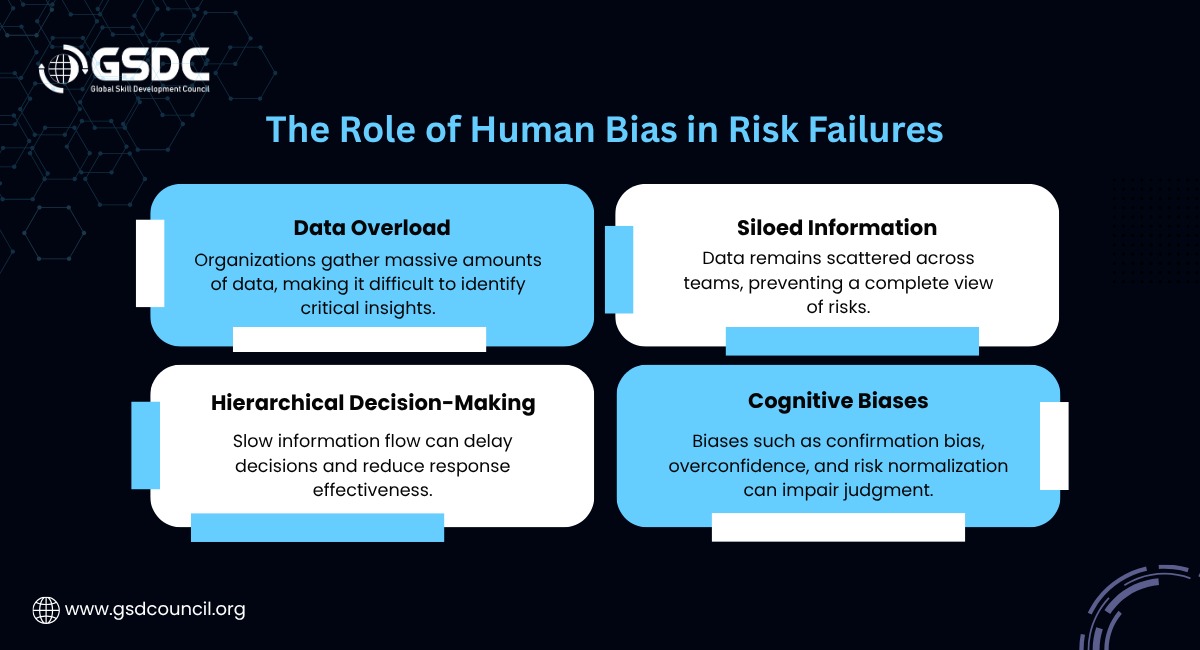
Even when data is available, human factors can distort decision-making. Some of the most common challenges include:
1. Data Overload
Organizations collect vast amounts of data, but struggle to identify what truly matters. When everything appears important, critical signals get lost in the noise.
2. Siloed Information
Different teams hold pieces of the puzzle, but lack integration. Without a unified view, risks remain fragmented and misunderstood.
3. Hierarchical Decision-Making
In rigid organizational structures, information moves slowly. By the time it reaches decision-makers, it may be outdated or diluted.
4. Cognitive Biases
Human judgment is influenced by biases such as:
- Confirmation bias (favoring information that supports existing beliefs)
- Overconfidence in experience
- Normalization of deviation (accepting risks as “normal” over time)
These factors can prevent organizations from acting on critical insights even when the data is clear.
Where AI Fits Into Risk Intelligence
Artificial intelligence offers a powerful opportunity to enhance risk intelligence, but it is not a standalone solution.
AI excels at:
- Detecting anomalies in large datasets
- Identifying patterns and trends
- Predicting potential failures
- Enabling real-time monitoring
For example, in areas like fraud detection, AI can quickly flag unusual activity that would be difficult for humans to detect manually.
However, AI does not replace human judgment. Instead, it acts as an enabler, a “flashlight” that highlights potential risks. Humans are still responsible for interpreting these signals, making decisions, and taking action.
The most effective approach is a hybrid model where:
- AI enhances signal detection
- Humans provide context, judgment, and accountability
involves four key components:
1. Signal Detection
Organizations must develop the capability to identify weak signals early. This includes collecting data from across operations, systems, and environments.
2. Interpretation
Raw data must be translated into meaningful insights. This requires analytical skills, domain expertise, and contextual understanding.
3. Decision Governance
Clear processes must be defined:
- Who makes decisions
- How quickly decisions are made
- How information flows across the organization
Without governance, even the best insights fail to drive action.
4. Continuous Learning
Organizations must learn from past events, both successes and failures. Embedding learning into systems and culture helps prevent repeated mistakes.
Culture: The True Driver of Risk Intelligence
While technology and frameworks are important, the webinar emphasized that culture is the real differentiator. Building a risk intelligence culture is essential for organizations seeking to improve resilience, strengthen decision-making, and maximize the value of their investments in AI-driven business intelligence, operational intelligence for business growth, and advanced analytics.
Risk intelligence thrives in environments where:
- Employees feel safe to report concerns
- Leaders are open to bad news
- Collaboration across teams is encouraged
- Learning is prioritized over blame
This concept, often referred to as psychological safety, ensures that critical information flows freely across the organization. It also enables teams to make better use of risk analytics and predictive modeling, support real-time risk monitoring, and effectively leverage a decision intelligence platform to identify and respond to emerging threats.
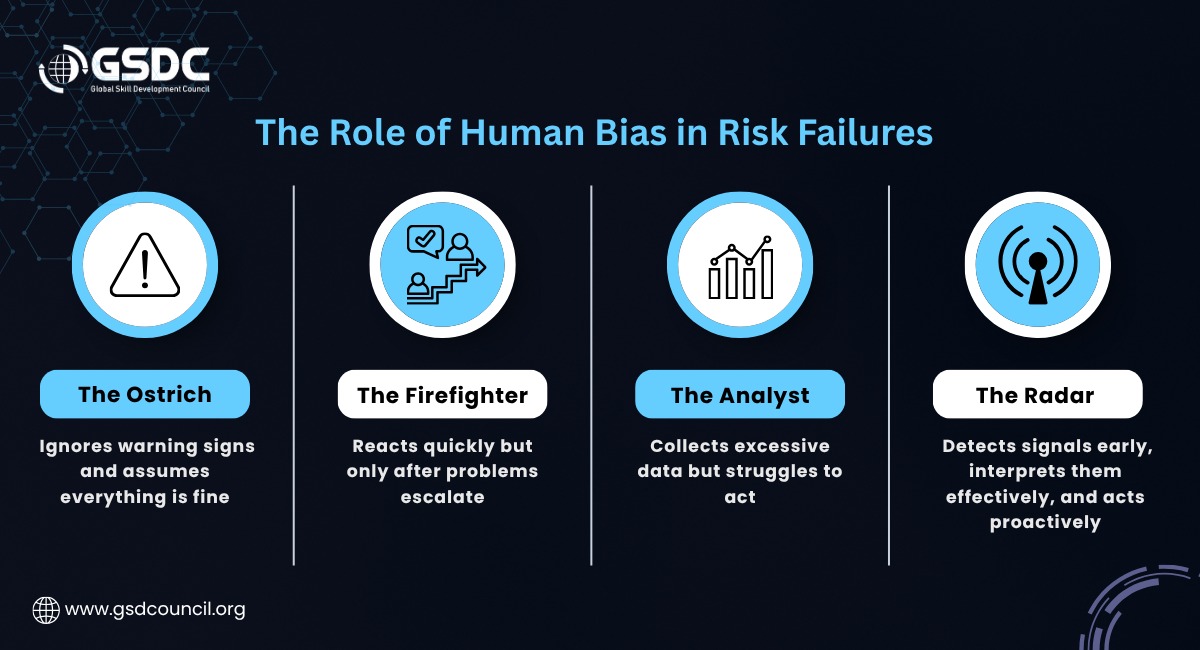
Without the right culture, even the most advanced tools and systems will fail to deliver results. Technologies such as AI for operational risk management can enhance risk detection and analysis, but they cannot replace transparency, trust, and collaboration. The goal for any organization is to evolve into the radar model, where early detection and timely action prevent crises before they occur.
The Future of Strategic Decision-Making
Strengthen Strategic Decision-Making with GSDC's Certified Learning & Development Professional
As organizations navigate increasing complexity and digital transformation, strategic decision-making requires the right balance of digital expertise, operational excellence, and continuous improvement. The Certified Learning & Development Professional by the GSDC equips professionals with the skills needed to drive digital transformation, optimize business processes, and leverage data-driven insights for better outcomes.
The program focuses on lean principles, digital technologies, and innovation strategies that help organizations improve efficiency and resilience. By earning the Certified Learning & Development Professional, professionals can enhance their ability to support risk intelligence initiatives, streamline operations, and make informed decisions that contribute to long-term business growth and success.
Conclusion
The journey from intuition to risk intelligence is not about abandoning human judgment; it is about enhancing it. In a world of increasing complexity, organizations must move beyond reactive decision-making and embrace a proactive, intelligence-driven approach.
By combining data, AI, operational insights, and a strong organizational culture, businesses can detect risks earlier, respond faster, and make better strategic decisions.
Ultimately, risk intelligence is about one thing: making the right decisions before failure occurs.

Related Certifications
Frequently Asked Questions
Risk Intelligence focuses on detecting early warning signals and acting proactively before failures occur, whereas traditional risk management often reacts to events after they happen. By leveraging predictive analytics, operational intelligence, and data-driven insights, organizations can identify emerging threats earlier and support better strategic decision making.
The issue is not a lack of data but a failure to interpret and translate that data into actionable insights. Many organizations invest heavily in data analytics and business intelligence tools, yet struggle to convert information into effective data-driven decision making. This often leads to delayed or ineffective decision-making.
Artificial Intelligence (AI) improves risk intelligence by identifying patterns, detecting anomalies, and predicting potential risks. Through AI analytics, machine learning, and real-time analytics, organizations can uncover risks faster and strengthen enterprise risk management. However, human judgment is still required to interpret these insights and take action, making AI for decision making most effective when combined with human expertise.
Weak signals are early indicators of potential problems, such as minor incidents, deviations, or anomalies, which may seem insignificant individually but can point to larger risks when combined. Detecting these signals through operational intelligence, predictive analytics, and operational risk management practices helps organizations respond before issues escalate.
Culture is critical to successful risk intelligence. Organizations that encourage transparency, open communication, and psychological safety are more likely to detect and act on risks effectively. A strong culture also supports decision intelligence, promotes data-driven insights, and enables leaders to align business strategy with informed, proactive decision-making.
Stay up-to-date with the latest news, trends, and resources in GSDC
If you like this read then make sure to check out our previous blogs: Cracking Onboarding Challenges: Fresher Success Unveiled
Not sure which certification to pursue? Our advisors will help you decide!