Designing Responsible AI: Accountability and Human Oversight
Written by Matthew Hale
- The New Reality: AI Is Already Making Business Decisions
- Why Accountability Matters More Than Ever
- The Hidden Risks of Enterprise AI
- Responsible AI Is More Than Compliance
- Understanding the Enterprise AI Stack
- Systemic AI Failures Are Usually Design Failures
- The Importance of Human-in-the-Loop (HITL)
- Levels of Human Oversight
- Governance in Action: Making AI Decisions Traceable
- What Leaders Must Rethink About AI Adoption
- Build Expertise in Autonomous Intelligence with GSDC Agentic AI Certification
- The Future of Enterprise AI Depends on Trust
- Conclusion
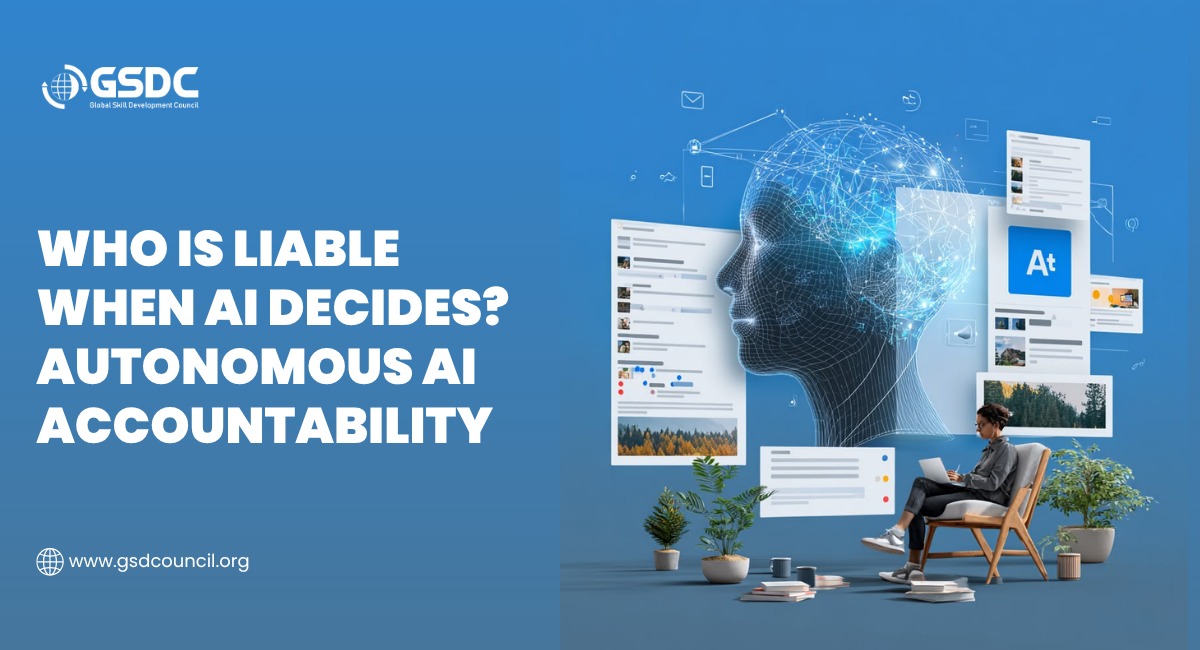
Artificial Intelligence is no longer a futuristic concept reserved for innovation labs. It has become a core part of modern Enterprise AI operations, influencing decisions across finance, human resources, customer service, operations, and strategic planning. Organizations worldwide are leveraging AI to automate workflows, improve efficiency, and accelerate decision-making. However, as AI systems gain more influence, a critical question arises: Who is accountable when an AI system makes a decision?
This question lies at the heart of Responsible AI and Compliance. Enterprises are rapidly adopting AI technologies, but many are still developing the governance structures needed to ensure these systems remain transparent, ethical, and aligned with human values. Understanding what is AI governance and implementing effective AI ethics and governance practices have become essential for organizations seeking to build trust and accountability in AI-driven environments.
The webinar "Responsible AI in Action: Designing Accountability, Governance, and Human Oversight in Enterprise Systems" explored how organizations can move beyond AI adoption and build frameworks that promote accountability, governance, and sustainable AI practices. The session also highlighted the importance of AI transparency and explainability, Human-in-the-Loop oversight, and advancing through an AI governance maturity model to address emerging AI governance challenges and strengthen organizational accountability.
The New Reality: AI Is Already Making Business Decisions
Many organizations still view AI as a supporting tool that assists employees with daily tasks. In reality, AI has evolved into an active participant in business decision-making and has become a foundational component of Enterprise AI strategies.
Across industries, AI systems are already performing functions such as:
- Detecting fraudulent financial transactions.
- Filtering job applicants before recruiters review resumes.
- Prioritizing customer service requests.
- Allocating operational resources.
- Recommending promotions and business actions.
Consider a hiring process. In the past, HR professionals manually reviewed hundreds of applications. Today, AI-powered applicant tracking systems often screen resumes and eliminate candidates based on predefined criteria before a human sees them. This highlights the growing importance of Human-in-the-Loop approaches to ensure fairness, accountability, and effective AI ethics and governance.
Similarly, in banking, AI systems can instantly flag suspicious transactions and block accounts. From the system's perspective, the process may be functioning perfectly. However, for the customer who cannot complete a payment, a significant decision has already been made. Such scenarios emphasize the need for AI transparency and explainability and robust governance mechanisms to address potential risks.
The key takeaway is simple: AI is no longer just generating insights it is actively influencing outcomes. As organizations continue Understanding the Enterprise AI landscape, they must balance automation with human oversight and establish strong governance frameworks to address evolving AI governance challenges.
Why Accountability Matters More Than Ever
As AI takes on a greater role in enterprise decision-making, organizations must address the issue of accountability.
Imagine an AI hiring system that unintentionally filters out highly qualified candidates because of historical data biases. If unfair outcomes occur, who should be held responsible?
- The HR department?
- The software developer?
- The data scientists?
- Senior leadership?
While AI may influence decisions, accountability cannot be delegated to a machine. The responsibility ultimately belongs to the organization and its leadership.
This creates a new leadership challenge. AI may automate recommendations and processes, but humans must remain accountable for the outcomes.
A practical way to think about this is:
AI can recommend. Humans must remain responsible.
Human validation and oversight ensure that technology supports business objectives without compromising fairness, ethics, or trust.
The Hidden Risks of Enterprise AI
Most organizations focus on the visible advantages of AI:
- Faster decision-making.
- Increased efficiency.
- Process automation.
- Reduced operational costs.
However, the greatest risks often remain hidden.
As teams become increasingly confident in AI systems, they may gradually stop questioning the outputs. Over time, this overreliance can create significant vulnerabilities.
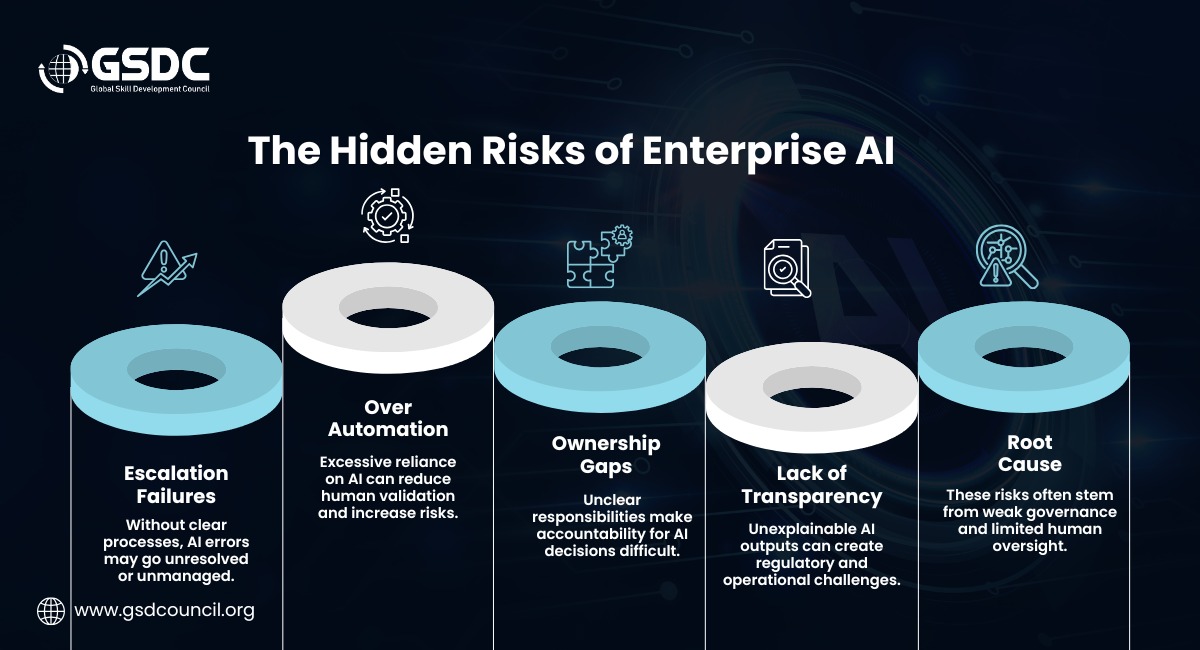
Some of the major hidden risks include:
Escalation Failures
Many organizations lack a clear process for handling AI errors. When an AI system produces an incorrect result, employees may not know who should intervene or how the issue should be resolved.
Over-Automation
Blind trust in AI can reduce human involvement. When employees stop validating outputs, mistakes can go unnoticed until they create serious business consequences.
Ownership Gaps
Without clearly assigned responsibilities, accountability becomes unclear. Teams may struggle to identify who owns AI-driven decisions, leading to confusion and blame shifting.
Lack of Transparency
If AI systems cannot explain how they reach conclusions, organizations may face regulatory, ethical, and operational challenges.
These risks are often not caused by AI itself but by the absence of governance and human oversight.
Responsible AI Is More Than Compliance
Many organizations respond to AI risks by introducing policies, ethics statements, and governance documents. While these are important, they are not enough.
Traditional governance approaches are often static, whereas AI systems are dynamic.
For example, an AI model may process thousands of decisions every hour, yet many organizations conduct governance reviews only quarterly or annually. By the time issues are discovered, significant damage may already have occurred.
Responsible AI should therefore move beyond documentation and become an operational capability.
Instead of relying solely on policies, organizations should embed governance directly into AI workflows through:
- Decision mapping.
- Human validation processes.
- Clear ownership structures.
- Escalation mechanisms.
- Continuous monitoring and auditing.
Effective AI governance must function in real time, not just during periodic reviews.
Understanding the Enterprise AI Stack
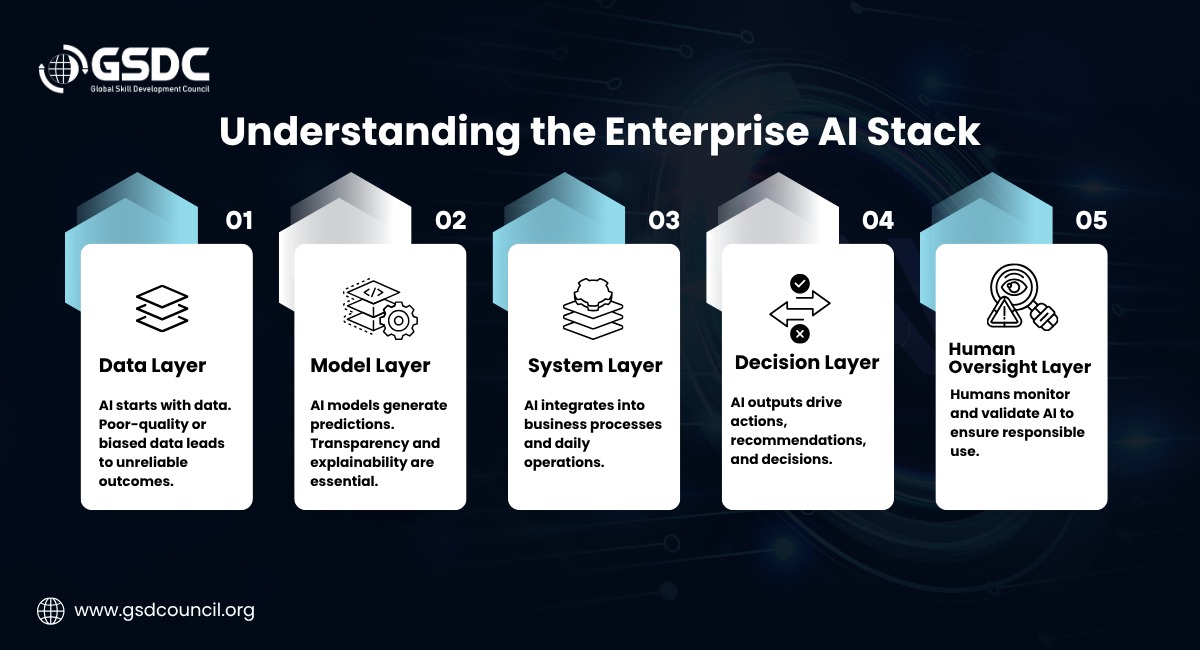
To govern AI effectively, organizations must understand how AI operates across multiple layers.
1. Data Layer
Everything begins with data. If the data is incomplete, biased, or inaccurate, the entire AI process becomes unreliable.
2. Model Layer
This is where AI models generate predictions and recommendations. Transparency and explainability are critical at this stage.
3. System Layer
AI becomes integrated into business workflows and operational processes, influencing everyday activities.
4. Decision Layer
Outputs are translated into actions such as approvals, rejections, prioritizations, or recommendations.
5. Human Oversight Layer
Humans monitor, validate, and manage the entire process to ensure responsible outcomes.
A common mistake organizations make is focusing only on fixing the AI model when problems occur. In reality, issues often originate from poor data quality or weak governance processes earlier in the chain.
Systemic AI Failures Are Usually Design Failures
Many AI failures are not technical failures they are systemic failures.
A biased dataset trains a biased model. The model then produces flawed recommendations, which are automatically executed by enterprise systems. Without proper oversight, these flawed decisions can multiply across thousands of transactions.
Common failure points include:
Data Integrity Failure
Poor-quality data creates unreliable AI outputs.
System Execution Failure
Automated systems may perform incorrect actions if they operate without validation.
Decision Accountability Failure
A lack of clearly assigned ownership creates confusion during incidents.
Oversight and Traceability Failure
Without audit trails and monitoring, organizations cannot understand or correct AI mistakes.
In many cases, these failures reflect weaknesses in governance design rather than limitations of AI technology itself.
The Importance of Human-in-the-Loop (HITL)
Many organizations claim to have human oversight, but in practice, humans are involved only occasionally.
True Human-in-the-Loop (HITL) systems intentionally place people at critical control points.
Before a Decision
Humans validate high-risk AI recommendations before execution.
During a Decision
Authorized personnel can override AI outputs when something appears incorrect.
After a Decision
Organizations conduct audits, maintain logs, and review outcomes to identify patterns and improve processes.
This approach ensures that AI remains a tool that supports human judgment rather than replacing it entirely.
Levels of Human Oversight
Not every AI application requires the same level of human involvement.
Human in the Loop
Humans actively participate in every high-risk decision.
Typical use cases include financial approvals, healthcare decisions, and legal processes.
Human on the Loop
Humans supervise AI systems and intervene when necessary.
This model suits moderate-risk operational processes.
Human out of the Loop
AI systems operate autonomously with periodic audits and monitoring.
This approach is generally appropriate for low-risk, high-volume tasks.
The objective is not to maximize human intervention but to calibrate oversight according to the level of risk.
Governance in Action: Making AI Decisions Traceable
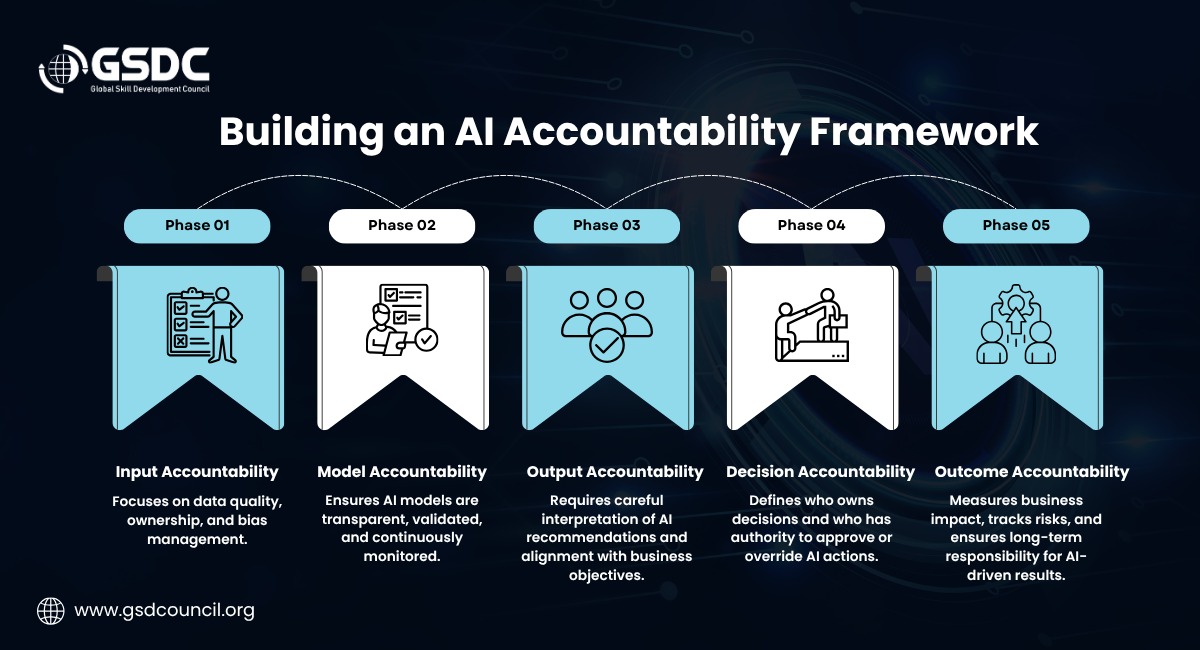
Responsible AI governance depends on visibility.
Organizations should establish mechanisms such as:
- Decision logs that record what happened and who was responsible.
- Audit trails that provide complete transparency.
- Escalation triggers that activate human intervention when risk thresholds are exceeded.
- Risk thresholds that define acceptable levels of automation.
When AI decisions are traceable, organizations can learn from mistakes, strengthen trust, and improve long-term performance.
What Leaders Must Rethink About AI Adoption
Leadership plays a central role in responsible AI and effective AI governance.
While AI can automate tasks, responsibility remains with people. Leaders must ensure that Enterprise AI systems operate within clear accountability and compliance frameworks.
Responsibility Cannot Be Delegated
AI can perform work, but organizations remain accountable for the results. This is a fundamental principle of Responsible AI and Compliance.
Decision Ownership Must Be Clearly Defined
Every AI-driven process should have designated owners who understand their responsibilities and support strong AI ethics and governance practices.
Oversight Must Be Built Into Operations
Governance should not be an afterthought. Integrating Human-in-the-Loop oversight and AI transparency and explainability into daily operations helps manage risks and improve trust.
Strong leadership ensures that AI supports organizational goals while maintaining ethical standards, addressing AI governance challenges, and advancing organizational maturity through an AI governance maturity model.
Build Expertise in Autonomous Intelligence with GSDC Agentic AI Certification
As organizations increasingly adopt autonomous AI systems to enhance efficiency and innovation, effective decision-making requires professionals who can understand, manage, and govern intelligent agents responsibly. The Agentic AI Professional Certification by the GSDC equips professionals with the knowledge and skills needed to design, deploy, and oversee AI agents that can make decisions, adapt to changing environments, and automate complex workflows.
The program covers key concepts such as autonomous AI systems, agent collaboration, AI governance, decision intelligence, and real-world business applications of agentic AI. By earning the Agentic AI Professional Certification, professionals can strengthen their ability to leverage AI-driven insights, improve operational efficiency, support strategic decision-making, and drive innovation while ensuring accountability and responsible AI adoption across the organization.
The Future of Enterprise AI Depends on Trust
As AI adoption accelerates, technology alone will not determine competitive advantage.
Organizations with similar AI capabilities will achieve different outcomes based on how responsibly they manage those systems.
Three pillars will define successful AI-driven enterprises:
Trust builds confidence among customers, employees, and regulators.
Governance enables organizations to scale AI safely and effectively.
Accountability ensures sustainable business outcomes and long-term resilience.
The future is not about deploying more AI tools. It is about creating systems where AI operates under clear governance, with transparent accountability and meaningful human oversight.
Ultimately, AI does not eliminate responsibility—it redistributes it. Organizations that understand this principle will be better positioned to innovate responsibly while maintaining the trust of all their stakeholders.
Conclusion
AI is transforming the way enterprises operate, but technological advancement must be matched by strong governance practices. Responsible AI and Compliance require organizations to think beyond automation and focus on accountability, transparency, and human-centered decision-making. A strong foundation in AI ethics and governance helps ensure that AI systems remain trustworthy, fair, and aligned with business objectives.
By embedding governance into operational workflows, establishing clear ownership, and maintaining appropriate levels of Human-in-the-Loop oversight, businesses can reduce risk while unlocking AI's full potential. Strengthening AI transparency and explainability and advancing through an AI governance maturity model can further improve accountability and operational resilience.

Related Certifications
Frequently Asked Questions
Responsible AI refers to developing and deploying AI systems that are ethical, transparent, fair, and accountable. It relies on strong AI ethics and governance practices to minimize risks and build trust.
Human oversight helps validate AI outputs, reduce risks, and ensure accountability. Models such as Human-in-the-Loop provide essential control over critical decisions.
Accountability should always remain with the organization and designated human decision-makers, regardless of how much influence Enterprise AI has on the outcome.
Key AI governance challenges include biased decisions, lack of transparency, regulatory non-compliance, unclear ownership, and over-automation.
Organizations can strengthen AI governance through clear ownership, continuous monitoring, audit trails, AI transparency and explainability, and Human-in-the-Loop oversight.
Stay up-to-date with the latest news, trends, and resources in GSDC
If you like this read then make sure to check out our previous blogs: Cracking Onboarding Challenges: Fresher Success Unveiled
Not sure which certification to pursue? Our advisors will help you decide!