Key Generative AI Skills and Real-World Uses for Mid-Level Professionals
Written by Matthew Hale
- Understanding Generative AI: Beyond the Buzz
- Why Mid-Level Professionals Should Care
- Top Generative AI Skills Every Professional Should Build
- The Rise of AI Skill Development Programs
- Real-World Generative AI Use Cases for Mid-Level Professionals
- Benefits of Artificial Intelligence for Professionals
- How Generative AI Is Reshaping Career Paths
- The Future Belongs to the AI-Ready Professional
- FAQs:
As we move deeper into 2025, Generative AI is reshaping how professionals work, create, and make decisions. From marketing analysts using generative AI tools to automate reports to designers crafting visuals with text prompts, this technology is no longer confined to research labs; it’s now a practical driver of productivity and innovation.
For mid-level professionals, understanding generative AI applications and mastering in-demand AI skills in 2025 are becoming essential to staying competitive.
The combination of technical fluency and business insight is what separates those who adapt from those who lead in the AI-powered workplace.
We’ll explore the most valuable generative AI skills, high-impact use cases, and how professionals can integrate AI-powered productivity tools into their day-to-day roles.
Understanding Generative AI: Beyond the Buzz
Before diving into the skills, it’s important to clarify what generative AI actually is.
Unlike traditional AI that classifies data or predicts outcomes, generative AI creates new content, text, images, audio, code, or even strategies based on learned patterns.
In short, it can generate something new rather than just analyze existing information.
So, what is generative AI vs AI? Traditional AI is task-driven; generative AI is creativity-driven.
The former might tell you which ad performs best, while the latter can write that ad for you.
If you’ve ever asked ChatGPT to summarize a report or used Midjourney to design visuals, you’ve already seen Generative AI Technology in action.
But how does generative AI work? It relies on deep learning models, especially large language models (LLMs) and diffusion models trained on vast datasets to predict and generate outputs that appear contextually human.
This capability has unlocked hundreds of generative AI applications across industries, from education to cybersecurity.
Why Mid-Level Professionals Should Care
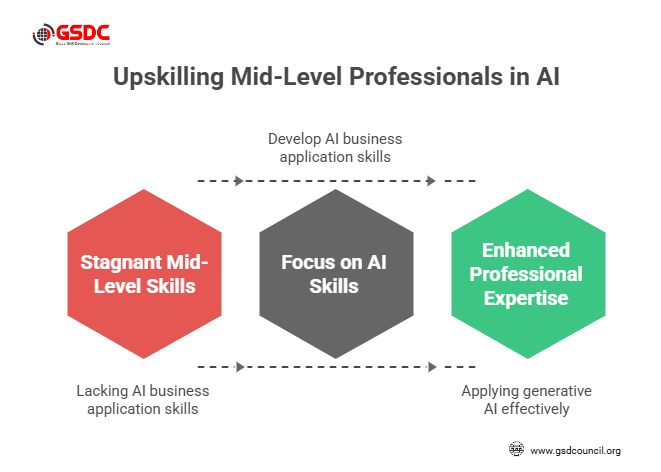
According to AWS and PwC research, two out of three organizations have increased their investment in AI skill development by mid-2025, focusing particularly on upskilling mid-career employees.
That’s because generative AI use cases are now directly tied to productivity and revenue. The top 25% of organizations are automating up to 30% of work hours with AI systems, while roles requiring AI skills for professionals have surged nearly 180x since 2021.
For mid-level professionals, marketing managers, data analysts, HR specialists, and consultants, the ability to apply generative AI business applications effectively is quickly becoming the new measure of expertise.
Top Generative AI Skills Every Professional Should Build
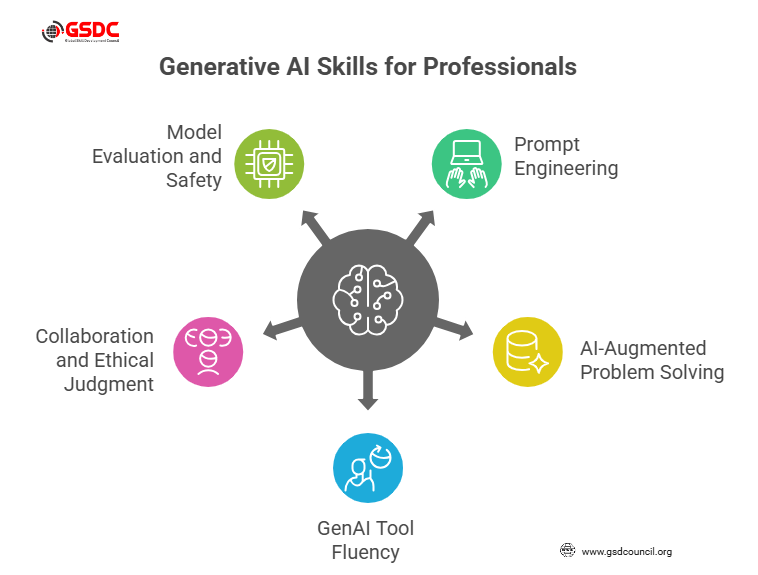
Developing generative AI skills goes far beyond learning how to use a chatbot. It involves understanding both the logic behind these systems and the ways to harness them for value creation.
Based on insights from Lightcast, AWS, and Telefónica Tech, here are the five core skills shaping 2025’s job space.
1. Prompt Engineering
Prompt engineering is the art and science of communicating effectively with AI models.
It’s the foundation of modern generative AI tools like ChatGPT, Gemini, and Claude, enabling users to produce accurate, context-aware results.
For example, a marketing manager can create an entire campaign brief by refining prompts around tone, audience, and style. This skill improves not just efficiency but creativity, an essential aspect of Content Creation in today’s AI-driven workplaces.
By 2025, prompt engineering is listed as one of the most in-demand AI skills 2025, appearing in thousands of job descriptions globally.
2. AI-Augmented Problem Solving
This skill blends analytical reasoning with AI-powered insights. Professionals use generative AI applications to synthesize data, brainstorm strategies, and model business scenarios.
For example, analysts can feed raw reports into AI-powered productivity tools to extract actionable insights, generate executive summaries, or even predict outcomes.
This “fusion skill” is particularly valuable in fields like finance, marketing, and consulting, where human intuition meets machine precision.
As McKinsey notes, these hybrid competencies define the next generation of knowledge work.
3. GenAI Tool Fluency
Fluency in the best generative AI tools from Microsoft Copilot and Jasper to Midjourney and Notion AI has become the new digital literacy.
Employers now expect mid-level professionals to know how to use these tools effectively for daily tasks.
For instance, content strategists use generative AI business applications to automate copywriting, while HR professionals leverage AI to screen resumes and draft job descriptions.
Knowing what the best AI tools are for your role (and when to use them) can drastically enhance workflow speed and quality, turning routine tasks into opportunities for strategic impact.
4. Collaboration and Ethical Judgment
While generative AI technology is powerful, human oversight remains irreplaceable.
Mid-level professionals need to balance automation with ethical considerations, understanding bias, data privacy, and the social impact of AI decisions.
Collaborating with both humans and AI systems requires clear judgment and communication skills. In team settings, professionals who can guide ethical AI usage become indispensable contributors to long-term business trust and compliance.
5. Model Evaluation and Safety
Understanding how to evaluate AI model performance using metrics like accuracy, bias, and privacy is becoming a core part of AI skill development.
Professionals don’t need to be data scientists to benefit. A basic grasp of prompt safety, model limitations, and data governance can prevent costly missteps.
This skill ensures that generative AI use cases remain both efficient and responsible, especially in regulated sectors like healthcare and finance.
The Rise of AI Skill Development Programs
Organizations are rapidly integrating structured learning paths focused on AI skills for professionals.
GSDC now offers generative AI professional certification programs that teach foundational and advanced competencies covering everything from model understanding to workflow design.
These programs not only upskill individuals but also enable companies to standardize their workflow automation initiatives across departments.
Such adoption proves that AI for workflow automation isn’t a distant concept; it’s already part of modern career growth.
Real-World Generative AI Use Cases for Mid-Level Professionals
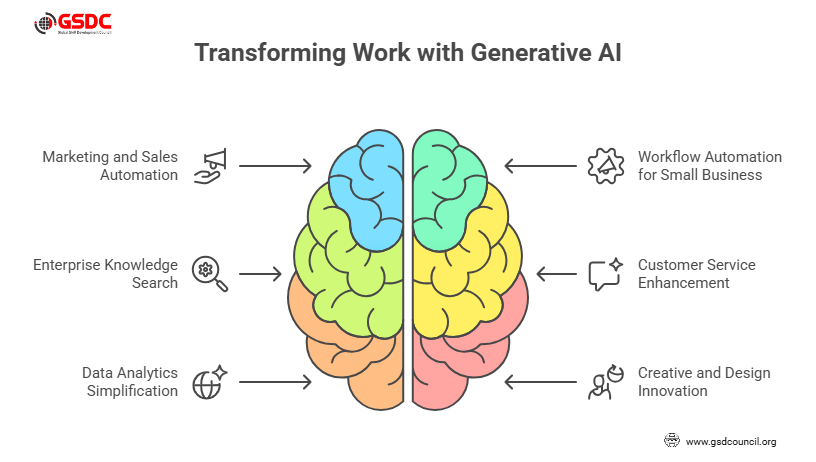
The shift toward practical applications of artificial intelligence has redefined work across industries.
Here’s how professionals are applying generative AI business applications in real scenarios.
1. Marketing and Sales Automation
Generative AI is transforming marketing workflows by generating proposals, blog drafts, and personalized campaigns in seconds.
Marketers use AI-powered productivity tools to build custom audiences, write email sequences, and create brand visuals. The result: higher conversion rates and faster turnaround times.
This evolution is Changing Creative work forever, freeing teams from repetitive content tasks to focus on strategy and storytelling.
2. Workflow Automation for Small Business
Small and mid-sized businesses are using workflow automation for small businesses powered by AI to reduce manual labor.
From generating invoices to managing customer communications, AI for workflow automation simplifies back-office operations and improves consistency.
For professionals managing these processes, mastering generative AI tools can cut hours of work each week and enhance productivity.
3. Enterprise Knowledge Search
Finding buried data across emails, reports, and documents can take hours. Tools like Vertex AI Search and ChatGPT’s enterprise integrations enable employees to locate key insights instantly.
This is one of the fastest-growing generative AI applications, turning disorganized data into actionable intelligence. It’s a prime example of building a Generative AI solution that enhances decision-making across departments.
4. Customer Service Enhancement
AI-driven chatbots now handle multilingual queries, perform sentiment analysis, and provide accurate responses.
This allows customer service teams to focus on more complex issues while AI manages routine requests.
According to IoT Analytics, 35% of enterprise AI projects focus on customer issue resolution, making it one of the top generative AI use cases worldwide.
5. Data Analytics Simplification
Traditionally, business analysts needed advanced coding skills to analyze large datasets. Now, generative AI business applications handle data summarization and visualization automatically.
Professionals can use AI-powered productivity tools like Tableau GPT or Power BI Copilot to generate reports or scenario-based predictions with natural language queries.
This democratizes analytics any employee can now leverage data without needing a technical background.
6. Creative and Design Innovation
In creative industries, generative AI technology like DALL·E and Runway ML empowers designers to experiment with new concepts rapidly.
They can create dynamic visuals, prototype ad campaigns, or modify brand assets in minutes.
By blending AI suggestions with human creativity, teams produce faster, more impactful designs. This synergy of applications of artificial intelligence is revolutionizing modern content workflows.
Benefits of Artificial Intelligence for Professionals
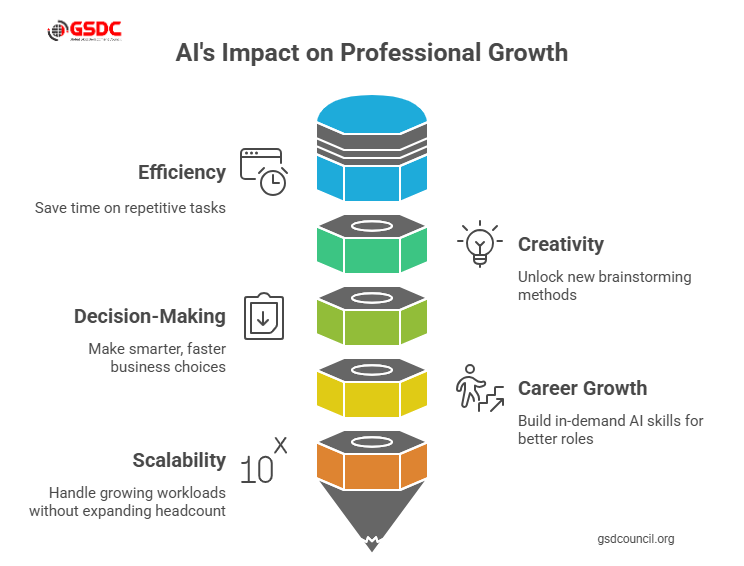
The benefits of artificial intelligence extend well beyond automation. For mid-level professionals, the advantages are practical and measurable:
- Efficiency: Save hours on repetitive work through automated document generation and data analysis.
- Creativity: Unlock new ways to brainstorm and visualize ideas with top generative AI tools.
- Decision-Making: Use AI-driven insights to make smarter, faster business choices.
- Career Growth: Building in-demand AI skills in 2025 leads to better roles and higher earning potential.
- Scalability: Integrate AI for workflow automation to handle growing workloads without expanding headcount.
McKinsey research confirms that organizations adopting generative AI business applications see productivity gains between 15% and 40% a direct reflection of how valuable these skills are becoming.
How Generative AI Is Reshaping Career Paths
The arrival of generative AI tools is redefining what it means to be “mid-level.” Professionals who adapt quickly will see their roles evolve, not disappear.
For example:
- A marketing executive might become an “AI-enabled strategist.”
- A financial analyst could transform into an “AI insights specialist.”
- HR professionals may pivot to “AI policy and compliance leaders.”
These roles depend on continuous AI skill development, understanding how generative AI works, and applying it ethically and effectively.
What Is Skill Development in the Age of AI?
At its core, what is skill development today? It’s not just about learning new software; it’s about learning how to think alongside AI.
Professionals who can harness generative AI applications to create, analyze, and innovate are building “fusion skills,” the blend of human creativity and machine capability.
As generative AI matures, AI skill development will shift from basic literacy to applied mastery, where every employee can become an innovator in their field.
The Future Belongs to the AI-Ready Professional
Generative AI is not taking over professionals; it is giving them the power. The individuals who succeed in 2025 will be those who learn the mechanics of generative AI, use it in a way that is responsible way, and upgrade their own skills in generative AI on a regular basis.
Automating reports, creative asset design, streamlining workflows, etc., the idea is clear: AI is your partner, not your rival.
This is the time to learn, change, and become a leader to all the middle-level professionals who are willing to step up.
The future is to get acquainted with AI in order to automate workflows, investigate the most useful generative AI applications, and dedicate time to lifelong learning in AI.
The subsequent jump in your career might begin with one question: How will you use generative AI today?
FAQs:
1. Which Generative AI skills are most valuable for mid-level professionals in 2025?
Employers are prioritizing prompt engineering, AI-augmented problem solving, and GenAI tool fluency as top in-demand AI skills in 2025.
Mid-career professionals who can blend analytical thinking with AI-powered productivity tools such as Copilot or ChatGPT stand out for promotions and leadership roles.
2. How are Generative AI tools transforming project management and business workflows?
AI assistants now handle status reporting, timeline forecasting, and task automation, cutting manual work by up to 30%.
Mid-level managers use AI for workflow automation to streamline approvals, summarize meetings, and track KPIs, boosting team productivity and accuracy.
3. What are the best Generative AI applications for marketing and content professionals?
Tools like Jasper, ChatGPT, and Midjourney are top Generative AI applications for content creation, social-media strategy, and visual design.
They help professionals draft campaigns, personalize emails, and generate brand visuals, saving hours of creative effort while maintaining quality.
4. How can professionals use Generative AI for data analysis without coding experience?
Modern Generative AI business applications like Tableau GPT and Power BI Copilot let analysts query data in plain language.
These tools summarize reports, spot anomalies, and create visual dashboards, democratizing analytics for non-technical professionals.
5. Which industries are hiring the most mid-level professionals with Generative AI skills?
According to 2025 labor-market data, roles demanding Generative AI skills are growing fastest in marketing, finance, healthcare, IT services, and consulting.
Companies in these sectors invest heavily in AI skill development and seek professionals who can integrate AI into decision-making.
6. How can I start AI skill development while working full-time?
Short, stackable credentials like the Generative AI Certification from GSDC help professionals upskill without leaving their jobs.
Many courses focus on practical projects using Generative AI tools for automation, analysis, and strategic planning.
7. What are real-world Generative AI use cases for business operations?
Common Generative AI use cases include automated client reporting, proposal generation, risk analysis, and training content creation.
Professionals use AI-powered productivity tools to save time and reduce human error in repetitive operational tasks.
8. How does workflow automation for small businesses benefit mid-level managers?
For managers in SMEs, workflow automation for small businesses simplifies invoice generation, HR reporting, and customer communication.
Using tools like Zapier AI or Microsoft Copilot, mid-level professionals can automate routine approvals and free up time for strategic work.
9. How can Generative AI improve cross-team collaboration and creativity?
Generative AI assists teams in brainstorming, summarizing discussions, and visualizing shared ideas in real time.
By using Generative AI technology for ideation and documentation, professionals strengthen collaboration, reduce miscommunication, and change creative workflows for the better.
Ready-to-use templates to automate repetitive tasks and save time.Download this guide to unlock practical ways to simplify your work, enhance productivity, and integrate Generative AI into your daily workflows:
Real-world use cases to help you apply AI tools effectively in your role.
Actionable insights to boost creativity and make smarter, data-driven decisions.

Related Certifications
Stay up-to-date with the latest news, trends, and resources in GSDC
If you like this read then make sure to check out our previous blogs: Cracking Onboarding Challenges: Fresher Success Unveiled
Not sure which certification to pursue? Our advisors will help you decide!