How Generative AI is Transforming Marketing in 2026

Written by Matthew Hale
- What does AI Marketing mean?
- How AI is Changing Marketing
- Generative AI in Marketing Use Cases
- How to Use Generative AI in Marketing
- Generative AI Market Trends and Growth
- AI Marketing Jobs: Career Opportunities
- Why Generative AI Certification Matters
- Benefits and Challenges of Generative AI in Marketing
- Preparing for AI-Driven Marketing
- Conclusion
Marketing these days is not what it used to be - and a major factor behind this is the use of generative AI.
In the last year alone, content demand has exploded by more than 50%, but most teams are still struggling to cope. This gap is exactly why generative AI is transforming marketing.
By helping teams create content faster, automate tasks, and personalize campaigns, generative AI for marketing is becoming a practical solution. In fact, marketers report saving around 11 hours per week using AI tools.
This shift clearly shows the growing impact of AI on marketing and how quickly AI is changing marketing today.
What does AI Marketing mean?
It is really helpful to know what AI marketing is before exploring it further.
Simply put, AI marketing is the use of artificial intelligence to make marketing faster and more efficient. It assists in automating marketing tasks, enhancing audience targeting, and enabling smarter decisions based on data.
The biggest chunk of this is probably generative AI for marketing, which is all about creating content like articles, emails, social media posts, and ads.
Very simply, it is a tool that allows marketing professionals to achieve more in less time while maintaining the same level of quality.
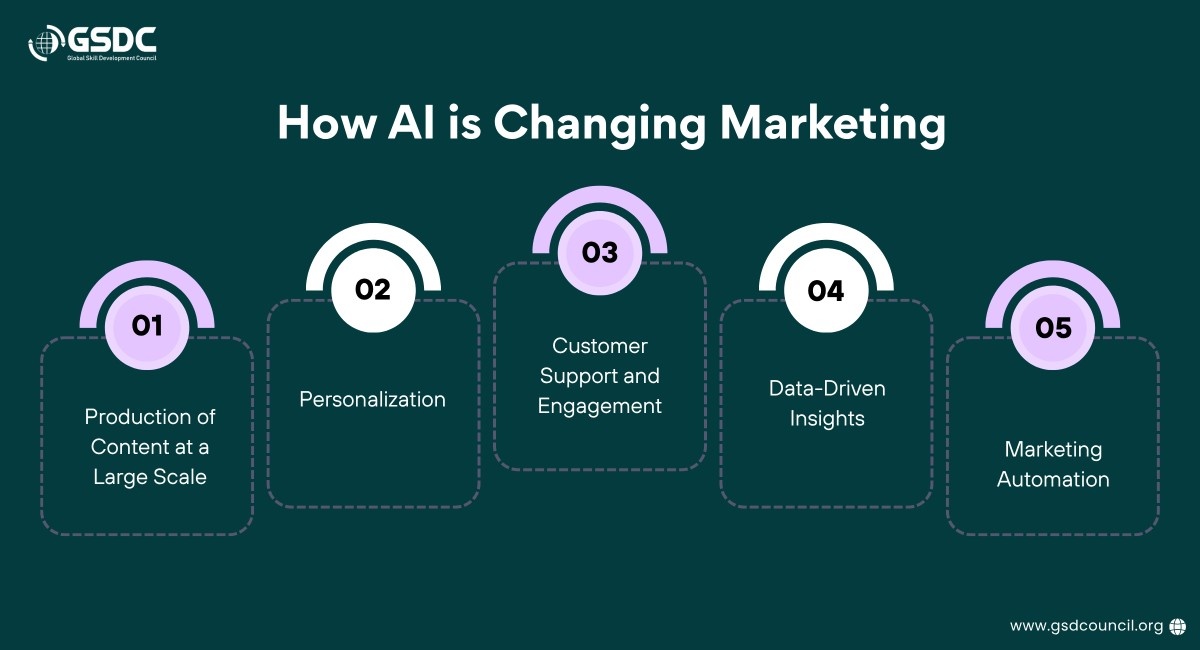
How AI is Changing Marketing
In order to grasp how AI is changing marketing, it is beneficial to identify the largest changes brought about by AI.
1. Production of Content at a Large Scale
AI programs can create blogs, mail ads, and social media messages within minutes.
Hence, it is simpler to generate more content without increasing the amount of work.
2. Personalization
Marketers now personalise the content to the user's behavior, by:
- Personalized emails
- Dynamic website content
- Targeted recommendations
This underlines the increasing impact of AI on marketing, as it transitions from mass communication to more relevant interaction.
3. Customer Support and Engagement
AI-based solutions offer instant replies, support around the clock, and a well-directed user path, thus making the customer experience better.
4. Data-Driven Insights
AI assists in processing the information for spotting trends, comprehending behavior, and forecasting results, making it possible to arrive at decisions swiftly and effectively.
5. Marketing Automation
Handlers, such as the running of campaigns, creation of content, and workflows, can be automated.
This leads to marketing teams concentrating primarily on strategy and creativity aspects.
Moreover, as the use of AI becomes more widespread, marketers are obtaining hands-on skills and progressing through a generative AI marketing certification to prepare themselves for future roles.
Generative AI in Marketing Use Cases
Looking at real-life generative AI marketing use cases is a great way to see the true power of the technology.
1. Content Marketing and SEO
Many businesses currently use AI in the production of web content, product descriptions, and blogs. An example would be that eCommerce stores typically rely on AI algorithms to mass-produce product descriptions, thus reducing the time it takes to produce them while still being able to deliver product descriptions that are consistent.
2. Email Marketing Automation
AI is capable of automating the creation and personalization of email campaigns based on user activity, thereby increasing overall engagement and conversion.
3. Digital Advertisements
AI is used to create ads with different variations (or creatives) for several audiences. Testing the ad variations provides an opportunity for the optimization of performance and ROI.
4. Customer Segmentation and Targeting
By analyzing customer data, AI can segment customers into groups based on their behavior and preferences, which in turn can lead to targeted campaigns that are more effective.
5. Social Media Content Creation
AI systems are capable of writing posts, captions, and giving content ideas in order to assist the team in maintaining consistency across the platform.
6. Marketing Analytics and Reporting
By working with huge data sets, AI is capable of highlighting trends, keeping track of performance, and forecasting results, thus enabling well-informed decision-making.
These examples show how generative AI in marketing examples are closely related to actual use cases, and they illustrate how companies are learning how to use generative AI in marketing in a more effective manner.
How to Use Generative AI in Marketing
For professionals and teams getting started, the best way to adopt AI is to take it step by step.
- Use AI to create content, like blogs, emails, and social media posts, first.
- Campaign personalization should be applied to provide customers with more relevant product offers based on their past behavior by using data points.
- Automate routine campaigns, for instance, marketing emails and ads, in order to save time and enhance the level of consistency.
- Data analytics should be used to evaluate the success of marketing activities and to subsequently fine-tune the capabilities of the target audience.
- Keep on enhancing by experimenting and adjusting your marketing plan.
Along with their rising interest, professionals are also paving the way to gain knowledgeable skills through classes that are held by the Global Skill Development Council (GSDC) to assist them in applying AI in marketing situations.
This way it becomes very simple to learn how to use generative AI in marketing, without making things complicated.
Generative AI Market Trends and Growth
The rate of marketers adopting and using AI is rapidly changing with each passing day.
The evidence of this change is not only seen in the generative AI market growth trend but also in the overall market growth trend of generative AI.
As companies continue to switch more and more to personalized and targeted marketing through the use of AI, on one hand, they require AI tools to increase the pace of content generation, and on the other hand, they use these tools to facilitate their decision-making processes.
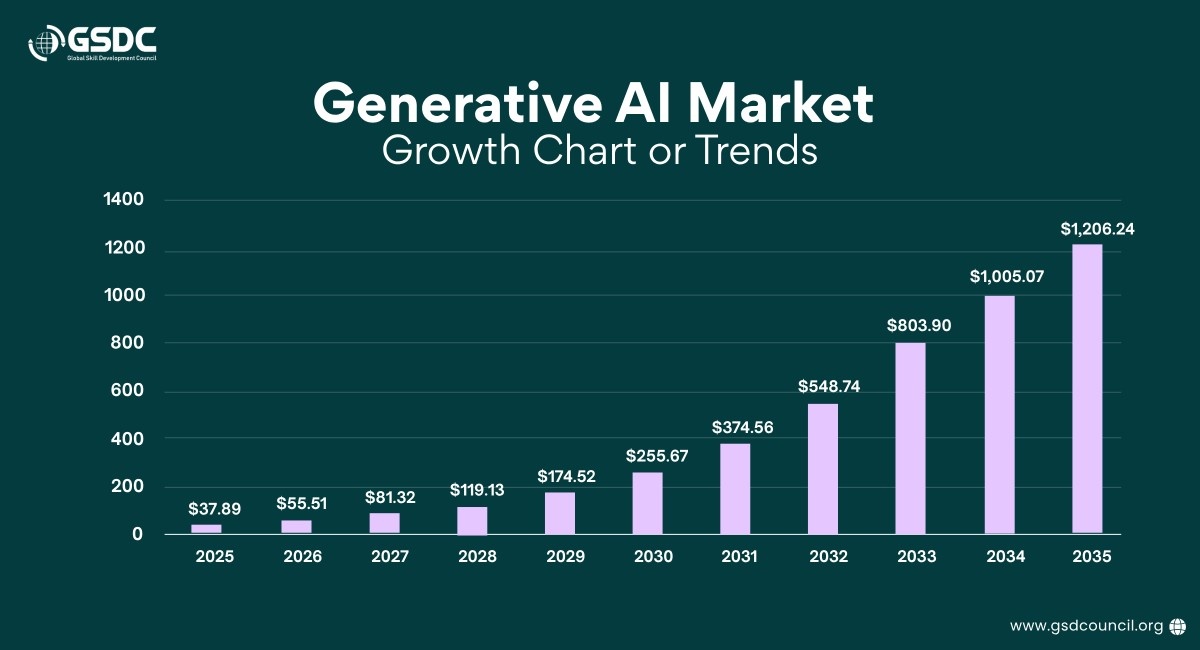
The global market for generative AI is still in its infancy, but is predicted to be worth about $37. 89 billion in 2025 (and it is expected to reach over $1. 2 trillion by 2035). This is a reflection that companies are investing heavily in AI technology for all of their different business processes.
To sum up, the inclination towards using generative-based AI is turning the marketing function into a more capable and productive mechanism for customer engagement.
AI Marketing Jobs: Career Opportunities
The emergence of AI has led to substantial demand for AI marketing jobs in many sectors.
Businesses are hiring for positions that are able to leverage AI tools for content generation, campaign automation, and data-based decision-making.
Among the highly sought-after roles are:
Role | What They Do | Average Salary |
AI Marketing Specialist | Uses AI tools for campaigns, content, and insights | |
Marketing Automation Manager | Manages automated campaigns and workflows | |
Data-Driven Content Strategist | Creates content based on data and AI insights | |
AI Campaign Analyst | Tracks performance and optimizes campaigns |
Those with marketing knowledge combined with technical skills in generative AI will be favored as opportunities for these roles continue to increase.
Why Generative AI Certification Matters
With AI becoming more widespread, it’s increasingly important for professionals to have the skills required to use it.
A generative AI certification provides marketers with an understanding of how AI products work and how to apply them to their marketing efforts. Additionally, a certifying body can help marketers remain current with the continuing needs and changes in their jobs.
For marketers, a generative AI marketing certification will give them specific knowledge about using AI in campaign planning and development, creating digital content, and analyzing digital performance.
As companies are looking for practical experience with AI, certifications are becoming an effective means of establishing credibility and remaining competitive in today’s job market.
Benefits and Challenges of Generative AI in Marketing
Applying AI to marketing provides noticeable benefits, yet it also has a few obstacles that the marketing departments should handle.

Here is a graphical representation that not only illustrates how generative AI in marketing can help businesses to save time and money, provide better customer service, and increase output, but also the various dilemmas like content accuracy, privacy of data, and necessity of human supervision that come along with it.
Preparing for AI-Driven Marketing
Preparing for AI-Driven Marketing AI is being integrated in marketing at a core level, so the focus has changed from merely understanding to acquiring the right skills.
The Global Skill Development Council (GSDC) has rolled out training programs that enable marketing professionals to leverage AI in actual marketing situations. Getting a Certification In Generative AI In Marketing equips marketers with practical capabilities in creating content, enhancing campaigns, and making data-driven decisions.
Such skills are necessary for staying relevant as the use of AI increases.
Conclusion
Marketing is undergoing a change, and generative AI is leading the way in marketing transformation of various industries.
AI is assisting marketing teams not only in content creation and personalization automation but also in working faster and making better decisions.
Besides just using tools, the focus should be on using them properly. The greatest benefit is achieved when AI is combined with human creativity and strategy.
As more and more people start embracing generative AI marketing, those who will know how to skillfully use it will be at a distinct advantage. Acquiring these skills via gaining practical knowledge or a generative AI marketing certification is becoming a necessity.
AI will not substitute marketing but will rather reshape it. Those who will be quick to adapt to this change will have the best chance to lead.

Related Certifications
Frequently Asked Questions
Stay up-to-date with the latest news, trends, and resources in GSDC
If you like this read then make sure to check out our previous blogs: Cracking Onboarding Challenges: Fresher Success Unveiled
Not sure which certification to pursue? Our advisors will help you decide!