Python Interview Questions: A Practical Guide for Developer Roles

Written by Emily Hilton
Preparing for a Python interview can feel challenging, especially when you are unsure whether the interviewer will focus on basic programming concepts, problem-solving, frameworks, databases, or real-world development scenarios. Whether you are a beginner applying for your first role or an experienced developer preparing for a technical interview, understanding the questions interviewers commonly ask can make your preparation more focused and effective.
Python remains one of the most widely used programming languages because of its readable syntax, extensive libraries, and applications across web development, automation, data science, artificial intelligence, cybersecurity, and software development. This makes Python knowledge valuable across many career paths.
If you are searching for an interview question for Python developer roles, it is important to prepare beyond memorizing definitions. Interviewers often want to know how you think, how you solve problems, and how you apply Python concepts to practical situations.
This guide covers common Python interview questions for freshers as well as questions that test intermediate knowledge. For candidates preparing for more advanced technical rounds, a separate downloadable PDF can provide additional questions, coding challenges, and scenario-based answers.
Why Python Is Still a Valuable Skill for Developers
One reason why Python is the best choice for many developers is its flexibility. A developer can use Python for backend development with Django or Flask, API development with FastAPI, automation, data processing, artificial intelligence, and machine learning.
Python also has a large developer community and a mature ecosystem of libraries and frameworks. Its relatively simple syntax allows beginners to learn programming concepts without dealing with excessive language complexity.
For organizations, Python can support faster development while remaining suitable for large-scale applications when designed properly. As businesses continue adopting AI, automation, cloud applications, and data-driven systems, Python is likely to remain an important development skill.
Python Full Stack Developer: A Skill Set for the Future
A Python full stack developer works across both the frontend and backend of web applications, combining Python-based backend technologies with HTML, CSS, JavaScript, databases, APIs, and modern development tools. Understanding what is Python full stack helps learners see how different parts of an application work together.
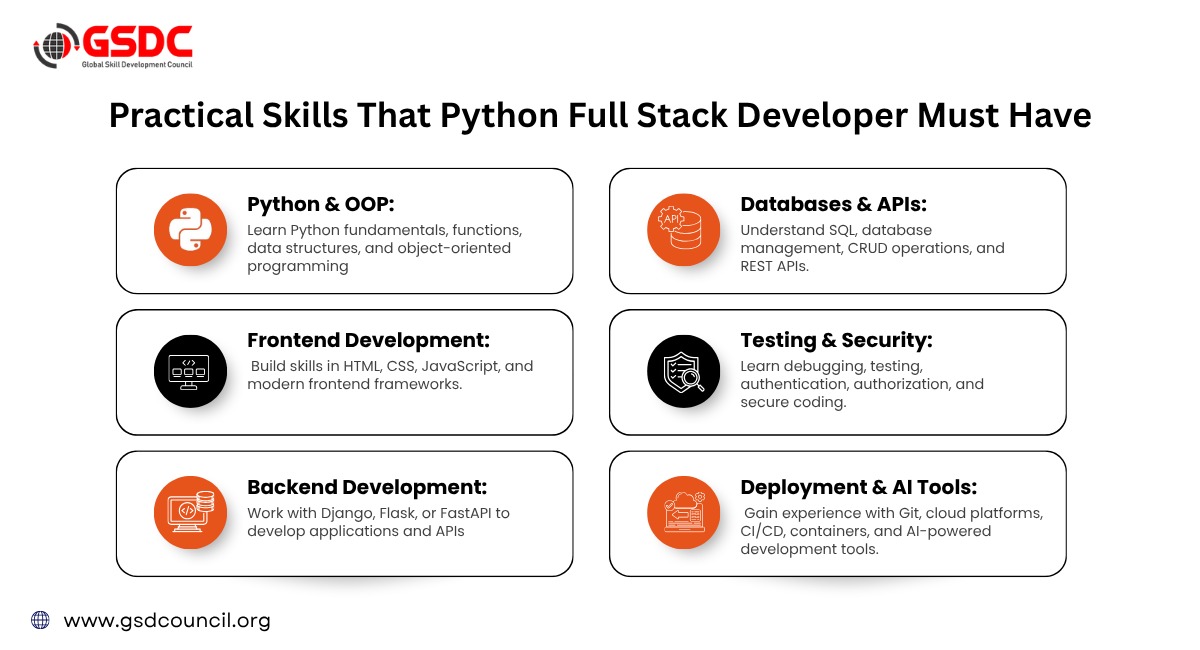
These Python full stack developer skills can help professionals adapt to the growing demand for web applications, automation, AI-integrated software, and cloud-based solutions in the coming years.
18 Python Interview Questions and Answers
1. What is Python?
Python is a high-level, interpreted, general-purpose programming language known for its readable syntax and extensive ecosystem. It supports multiple programming approaches, including procedural, object-oriented, and functional programming.
Python is commonly used for web development, automation, data analysis, artificial intelligence, machine learning, scripting, and application development.
2. What are the main features of Python?
Some important Python features include simple syntax, dynamic typing, automatic memory management, extensive libraries, portability, and support for object-oriented programming.
Python also provides a large standard library and a broad ecosystem of third-party packages. These features allow developers to build applications without implementing every component from scratch.
3. What is the difference between a list and a tuple?
A list is mutable, meaning its elements can be changed after creation. A tuple is immutable, meaning its elements cannot normally be changed after the tuple has been created.
Lists are useful when data needs to be modified, while tuples are useful when you want an ordered collection that should remain unchanged.
For example, [1, 2, 3] is a list, while (1, 2, 3) is a tuple.
4. What are dictionaries in Python?
A dictionary stores data as key-value pairs. Each key is used to access its corresponding value.
For example:
employee = {"name": "Asha", "role": "Developer"}
Here, name and role are keys, while their associated values are "Asha" and "Developer".
Dictionaries are frequently used when applications need structured and quickly accessible data.
5. What is the difference between == and is?
The == operator checks whether two objects have equivalent values. The is operator checks whether two references point to the same object in memory.
For example, two separate lists may contain the same elements and return True when compared using ==, while is can return False because they are different objects.
Understanding this distinction is important when working with objects and memory references.
6. What are Python functions?
A function is a reusable block of code designed to perform a specific task. Functions help developers organize programs, avoid repetitive code, and improve maintainability.
A function can accept parameters and return a result.
def add(a, b):
return a + b
Here, add() accepts two values and returns their sum.
7. What is object-oriented programming in Python?
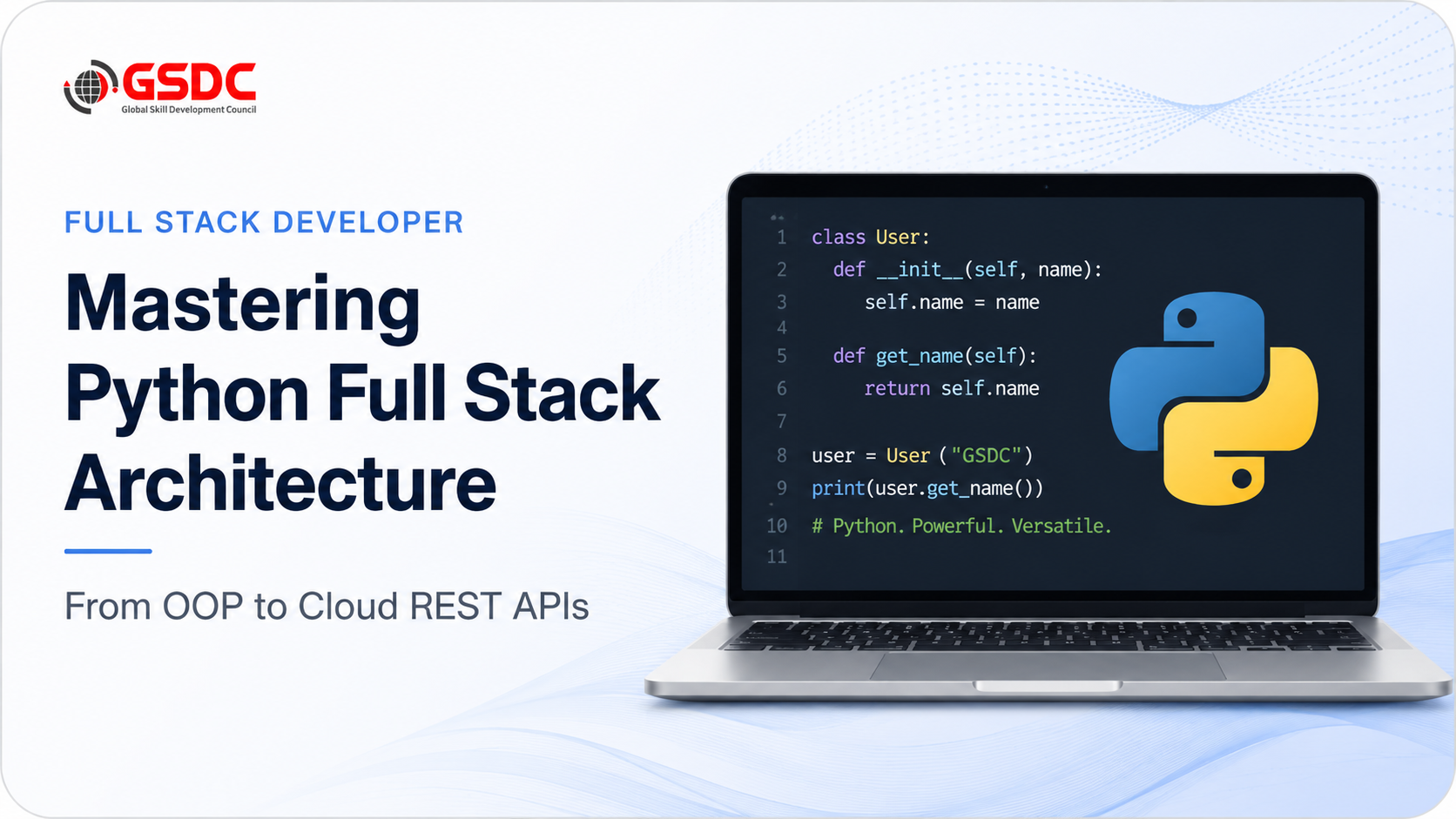
Object-oriented programming, or OOP, organizes software around objects and classes. A class acts as a blueprint, while an object is an instance of that class.
Python supports important OOP concepts such as inheritance, encapsulation, polymorphism, and abstraction.
OOP is particularly useful for developing larger applications where code needs to be organized into reusable and maintainable components.
8. What is inheritance in Python?
Inheritance allows one class to acquire properties and methods from another class. The existing class is commonly called the parent or base class, while the new class is called the child or derived class.
Inheritance promotes code reuse and allows developers to create specialized versions of existing classes.
9. What are decorators in Python?
Decorators are functions that modify or extend the behavior of another function without changing its original source code.
They are commonly used for logging, authentication, authorization, performance measurement, and other cross-cutting requirements.
Python decorators use the @ syntax and are an important concept for intermediate-level interviews.
10. What is exception handling in Python?
Exception handling allows developers to manage unexpected errors without abruptly terminating an application.
Python commonly uses try, except, else, and finally blocks for handling exceptions.
try:
result = 10 / 0
except ZeroDivisionError:
print("Cannot divide by zero")
Good exception handling helps applications respond gracefully to predictable runtime problems.
11. What is a Python module?
A module is a Python file containing code such as functions, classes, and variables that can be reused in another program.
Developers can import modules using the import statement. Python's standard library contains many built-in modules, while developers can also create their own modules.
Modules help keep large applications organized and make reusable functionality easier to maintain.
12. What is the difference between shallow copy and deep copy?
A shallow copy creates a new outer object but may continue referencing nested objects from the original structure. A deep copy creates a new object and recursively copies nested objects as well.
This distinction becomes important when working with nested lists, dictionaries, or other mutable structures.
Python provides the copy module for performing both shallow and deep copies.
13. What is a virtual environment in Python?
A virtual environment creates an isolated Python environment for a project. It allows developers to install project-specific packages without affecting other Python projects or the system-wide environment.
Virtual environments are particularly useful when different projects require different package versions.
Tools such as venv can be used to create virtual environments.
14. What Python interpreter should I use?
The choice of Python interpreter depends on the project and development environment. For most modern projects, developers generally use a current supported Python 3 release rather than older Python versions.
The interpreter can be installed from the official Python distribution or managed through development tools and environment managers.
In an interview, explain that interpreter selection should consider project compatibility, package support, operating system requirements, and the team's development environment rather than simply choosing the newest version.
15. What is the difference between Python and JavaScript?
Python and JavaScript are both widely used programming languages, but they are commonly used for different purposes.
Python is popular for backend development, automation, data science, AI, and machine learning. JavaScript is essential for browser-based frontend development and is also widely used on the server through environments such as Node.js.
Modern full-stack development can involve both languages, depending on the architecture and technology stack.
16. How is Python used in web development?
Python is widely used for backend and API development. Frameworks such as Django, Flask, and FastAPI help developers build web applications, APIs, authentication systems, and backend services.
A Python full stack developer may combine a Python backend with HTML, CSS, JavaScript, databases, APIs, and cloud infrastructure to create complete web applications.
17. What is PEP 8?
PEP 8 is the Python Enhancement Proposal that provides style recommendations for writing readable and consistent Python code.
It covers areas such as naming conventions, indentation, line length, spacing, imports, and code organization.
Following PEP 8 makes code easier for developers to read, review, and maintain, particularly when working on collaborative projects.
18. How would you debug a Python application?
Debugging starts by reproducing the problem and understanding the error message or unexpected behavior. Developers can then inspect variables, review application logs, add appropriate debugging statements, and use debugging tools.
A systematic approach is important: identify the problem, isolate the affected component, determine the root cause, implement a fix, and test the application again.
Interviewers often ask debugging questions because they reveal practical problem-solving ability rather than only theoretical knowledge.
Want to go beyond the basics? Download the advanced Python Interview Questions PDF for additional technical questions, coding challenges, and detailed answers to strengthen your interview preparation.
Preparing for Advanced Python Interviews
If you are building toward a Python full stack developer career, follow a structured learning path and combine theoretical knowledge with hands-on projects. The questions covered here can help you prepare for common discussions, but advanced interviews may also test coding challenges, system design, debugging, APIs, databases, security, and real-world problem-solving.
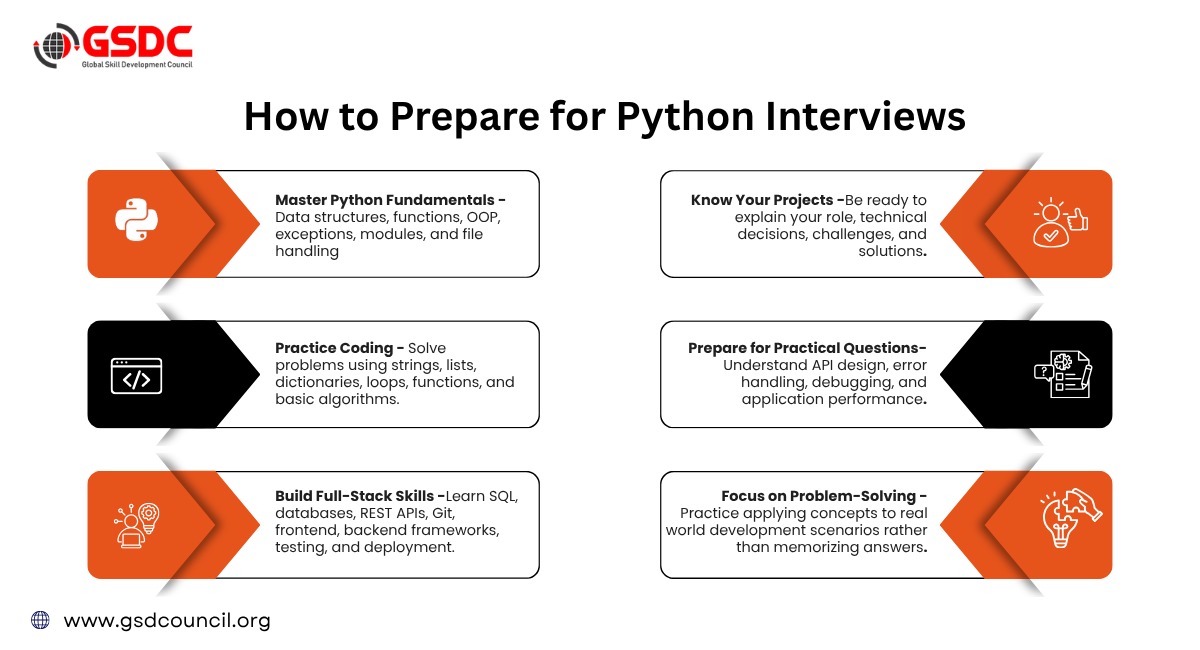
Build Job-Ready Skills with GSDC’s Python Full Stack Developer Certification
GSDC’s Python Full Stack Developer Certification is designed for professionals who want to build practical skills across the complete web development lifecycle.
The Python Full Stack Developer Certification covers Python programming, OOP, frontend development, backend frameworks, databases, REST APIs, testing, security, Git, and deployment. It supports learners following a Python full stack developer roadmap while developing the Python full stack developer skills employers value.

By combining core concepts with practical development knowledge, the certification can also help candidates prepare for an interview question for Python developer roles, including Python interview questions for freshers. It is a structured pathway for building confidence toward a Python full stack developer career.
Conclusion
Python continues to be a practical and versatile skill for developers entering or advancing in software development. Its applications across web development, automation, AI, data, and backend engineering make it relevant to a wide range of career opportunities.
For beginners, these Python interview questions for freshers provide a useful starting point for understanding the concepts commonly discussed during technical interviews. For experienced candidates, the focus should shift toward architecture, optimization, debugging, testing, security, and real-world problem solving.
If you are building toward a Python full stack developer career, follow a structured learning path and combine theoretical knowledge with hands-on projects. The questions covered here can help you prepare for common discussions, while advanced coding problems and scenario-based questions can help you prepare for more challenging technical rounds.

Related Certifications
Stay up-to-date with the latest news, trends, and resources in GSDC
If you like this read then make sure to check out our previous blogs: Cracking Onboarding Challenges: Fresher Success Unveiled
Not sure which certification to pursue? Our advisors will help you decide!