Prompt Engineering Masterclass: Unlocking the Full Potential of LLMs
Written by 𝗝𝗮𝘀𝗹𝗲𝗲𝗻 𝗦𝗶𝗻𝗴𝗵
- From Casual AI Chatting to Engineered Workflows
- Why Context, Intent, and Format Matter
- The CREATE Framework for Better Prompts
- Zero-Shot vs. Few-Shot Prompting
- Using Chain-of-Thought for Complex Problems
- Enterprise Case Studies: Turning Prompts Into Business Value
- The Prompt Delta: From Individual Experimentation to Scalable AI
- Different Departments Need Different AI Workflows
- Prompt Engineering Goes Beyond Content Creation
- A 90-Day Roadmap for Enterprise Prompt Engineering
- Building a Sustainable Prompt Engineering Culture
- The Future of AI: From Prompting to Agentic Workflows
- Conclusion
Generative AI has moved beyond experimentation. Organizations are now looking for practical ways to turn large language models (LLMs) into measurable productivity, efficiency, and business-value engines. However, simply giving employees access to AI tools does not guarantee meaningful results. The quality of the interaction between humans and AI often determines the quality of the outcome.
The “Prompt Engineering Masterclass: Unlocking the Full Potential of LLMs” explored the evolving role of prompt engineering in modern AI adoption. The session examined how prompt engineering is moving beyond simple question-and-answer interactions to become an essential business skill for working effectively with AI systems, AI agents, and increasingly autonomous workflows.
The masterclass covered practical LLM prompting techniques, advanced techniques such as few-shot and chain-of-thought prompting, enterprise case studies, AI governance considerations, and a roadmap for building prompt engineering capabilities across organizations.
From Casual AI Chatting to Engineered Workflows
For years, interacting with computers required people to understand programming languages, database queries, and rigid instructions. Generative AI has changed this relationship by allowing users to communicate with machines through natural language. However, simply typing a question into an AI tool does not guarantee a useful result.
Effective AI prompting requires users to move from casual chatting to structured, goal-oriented prompting. Instead of treating an LLM like a search engine, users should approach it as a capable but literal digital assistant that needs clear direction.
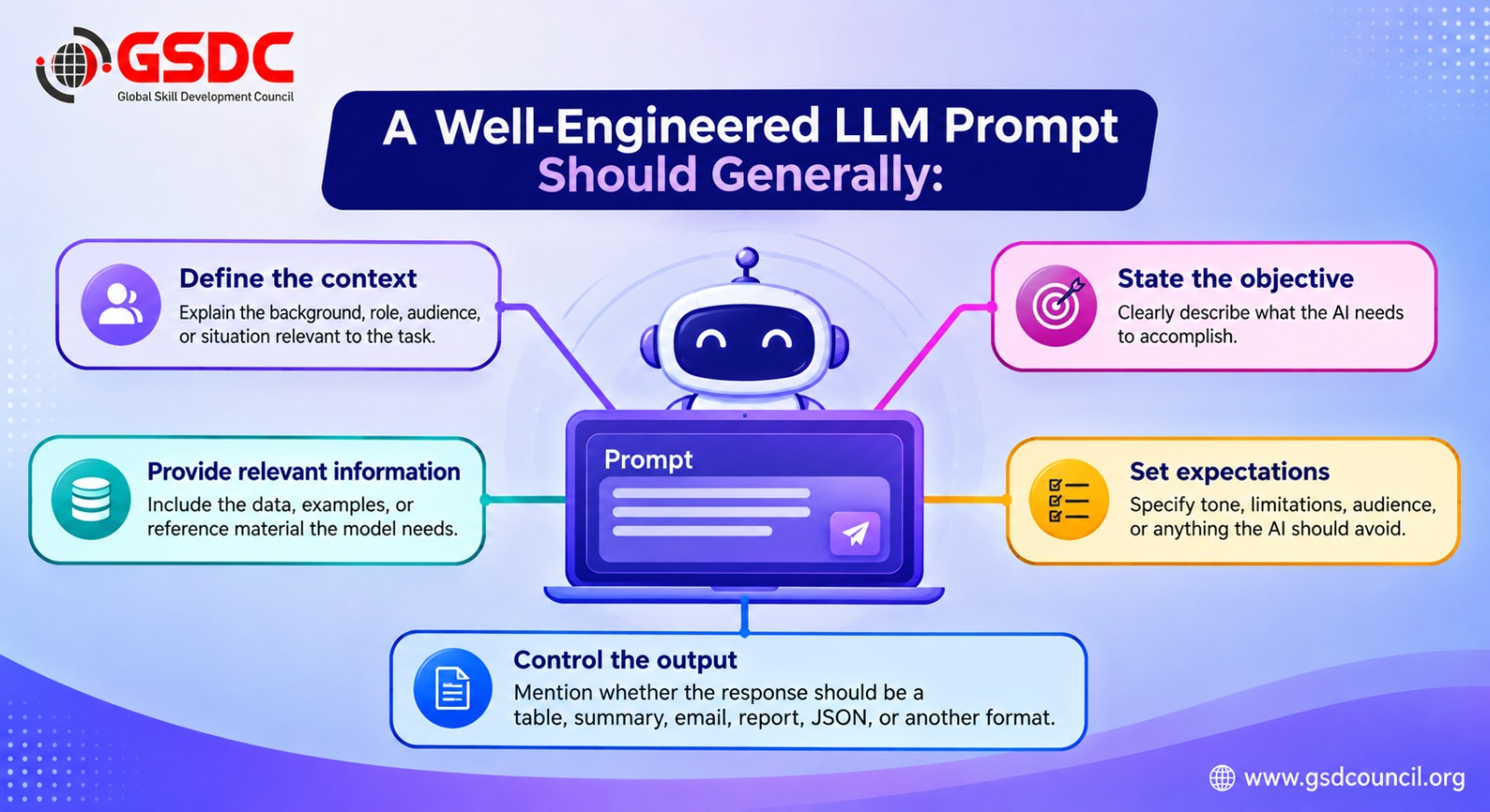
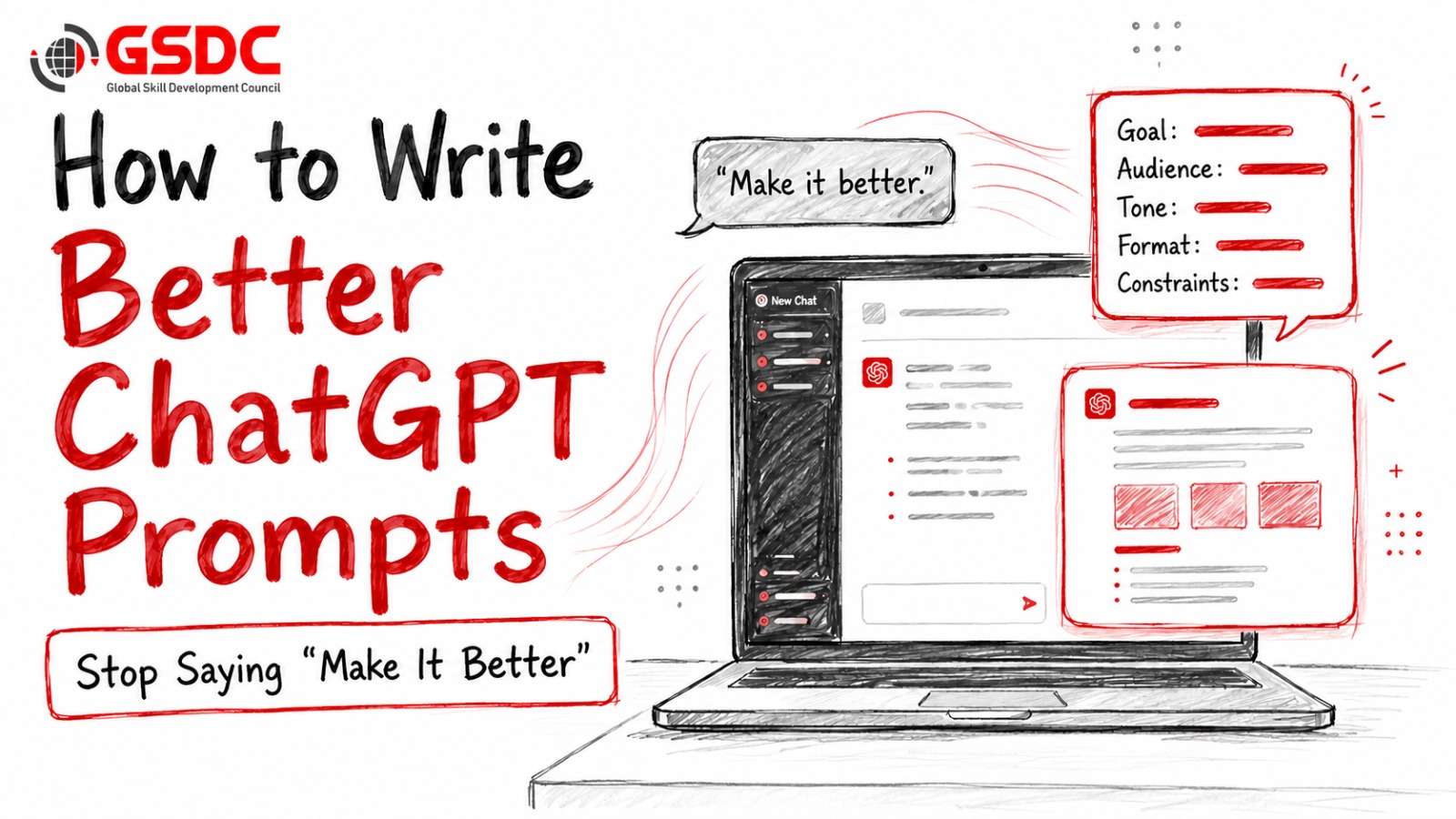
For example, instead of asking an AI to “write a project update,” a more effective prompt could specify the project background, target audience, key developments, risks, and desired format.
This shift from asking simple questions to engineering precise instructions is what makes AI prompt engineering valuable. It enables employees to get more consistent outputs and transform AI from a general-purpose chatbot into a practical tool for everyday business workflows.
Why Context, Intent, and Format Matter
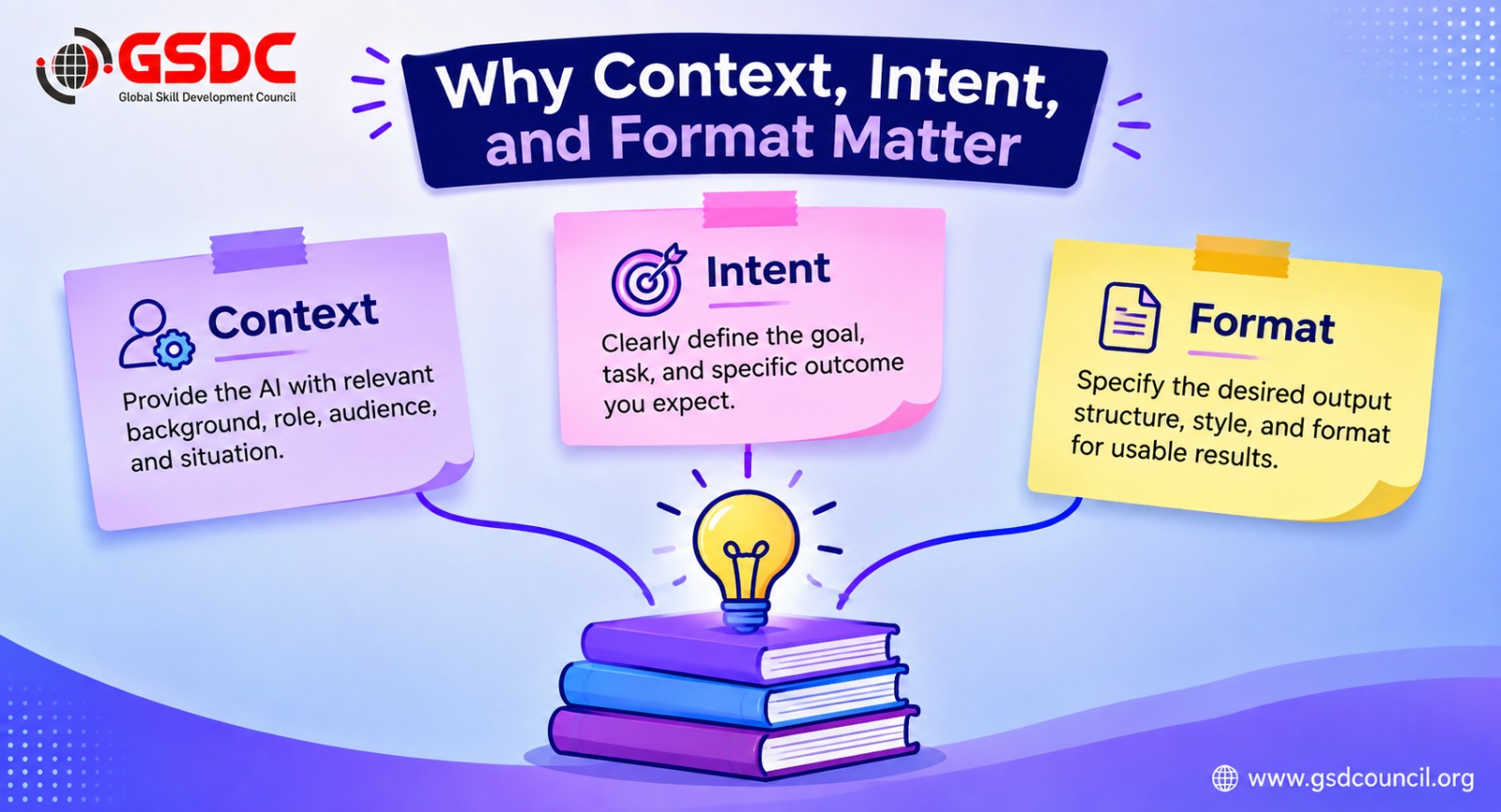
Three foundational elements sit at the heart of effective prompt engineering for generative AI: context, intent, and format.
Context: Give the AI the Right Background
Context establishes the environment in which the AI should perform the task.
For example, asking an AI to “write a project update” leaves numerous questions unanswered. Who is the audience? What industry is involved? What is the project's status? What information matters most?
A stronger instruction could establish a role, audience, and situation—for example, asking the model to act as a senior project manager preparing an executive update for a fintech organization.
The more relevant context the model receives, the less it has to guess.
Intent: Clearly Define the Goal
Intent explains what you actually want the AI to accomplish.
Instead of saying “make this report better,” a more precise instruction might ask the model to analyze the report, remove passive voice, identify major financial risks, and summarize the findings for senior leadership.
The distinction is important because ambiguity creates unpredictable outputs. A model can only optimize its response around the objective that the user communicates.
Format: Specify the Expected Output
The final element is format. Even an accurate answer may have limited business value if it is delivered in an unusable structure.
If the output needs to be a table, JSON structure, executive summary, presentation outline, or database-ready format, the prompt should explicitly state that requirement.
Controlling format helps transform AI-generated content into a reusable business asset and is an important part of LLM prompt optimization.
The CREATE Framework for Better Prompts
To make these principles easier to apply consistently, the masterclass introduced the CREATE framework, a practical checklist for improving prompt quality.
C – Context: Establish the situation, background, role, and relevant information.
R – Request: Clearly define the task or outcome the AI needs to produce.
E – Examples: Provide examples that demonstrate what a successful output should look like.
A – Adjustments: State what the AI should avoid, such as jargon, unnecessary detail, unsupported claims, or a particular writing style.
T – Tone: Specify the desired voice, whether professional, conversational, authoritative, persuasive, technical, or accessible.
E – Extras: Define additional requirements such as output structure, length, formatting, audience, or constraints.
The value of CREATE is not simply that it produces longer prompts. Its real benefit is that it encourages users to think through the task before submitting the instruction.
This structured approach can also help organizations standardize how employees interact with AI large language models rather than leaving prompt quality entirely to individual experimentation.
Zero-Shot vs. Few-Shot Prompting
Not every AI task requires an elaborate prompt. The masterclass distinguished between two important prompting approaches: zero-shot and few-shot prompting.
Zero-Shot Prompting
Zero-shot prompting means asking an AI model to complete a task without providing examples.
For instance, a user might simply ask an LLM to write a product description. The model uses its existing knowledge and general language patterns to generate the response.
This approach can work well for straightforward tasks, but the result may be generic because the model has little information about the organization's specific expectations.
Few-Shot Prompting
Few-shot prompting improves alignment by giving the model examples before asking it to perform the actual task.
For example, a marketing team could provide several examples of successful LinkedIn posts, showing the preferred structure, sentence length, tone, and use of emojis. The model can then use those examples as a pattern for creating a new post.
This technique is particularly useful when organizations need consistency in brand voice, formatting, terminology, or specialized outputs.
Few-shot prompting effectively teaches the model what “good” looks like within the context of a particular task, making it an important technique for professionals looking to learn prompt engineering.
Using Chain-of-Thought for Complex Problems
Some tasks require more than straightforward content generation. Complex reasoning, mathematical problems, analytical exercises, and multi-step logic can be difficult for LLMs when users request an immediate answer.
The session introduced chain-of-thought prompting as a technique for encouraging the model to work through complex problems step by step before concluding.
The underlying principle is that breaking a complicated task into intermediate reasoning stages can help the model handle the problem more systematically.
For organizations, the broader lesson is important: different tasks require different prompting strategies. A simple content request may need only clear context and intent, while a complex analytical workflow may benefit from structured reasoning, examples, constraints, and validation steps.
Enterprise Case Studies: Turning Prompts Into Business Value
The masterclass demonstrated that prompt engineering for LLMs becomes especially powerful when it is integrated into enterprise workflows.
KPMG: Applying Prompt Engineering to Tax Work
Tax-related work presents a challenging environment for AI because the information is highly specialized, complex, and sensitive to errors.
KPMG's internal AI environment, discussed during the session, demonstrates how organizations can move beyond generic prompting. Domain experts and prompt engineers worked together to create detailed instructions containing guardrails, examples, and formatting requirements.
The result was a significant reduction in the time required to produce complex tax-related drafts. Work that previously required substantial manual effort could be transformed into a highly accurate first draft much faster.
The broader lesson is that enterprise AI success often comes from combining domain expertise with prompt engineering expertise.
UBS: Training People Instead of Only Buying AI Tools
Another important example discussed was UBS. The organization recognized that purchasing enterprise AI licenses alone would not automatically make employees effective AI users.
Instead, UBS invested in formal prompt engineering training and treated AI literacy as an important organizational capability.
The example highlights a common mistake businesses make: focusing heavily on the technology while underinvesting in the people who use it.
AI tools are only as valuable as the workflows built around them. Training employees to create better prompts can reduce repeated attempts, improve output quality, and make AI usage more efficient.
The Prompt Delta: From Individual Experimentation to Scalable AI
One of the key distinctions discussed in the webinar was the gap between generic AI usage and engineered AI usage.
With ad hoc prompting, employees repeatedly interact with AI until they eventually receive something useful. The process can be time-consuming, inconsistent, and difficult to reproduce.
The knowledge also remains trapped in an individual's conversation history. If one employee discovers an excellent prompt for creating a weekly sales report, that knowledge may never reach the rest of the organization.
Engineered prompting changes this model.
A successful prompt can be tested, documented, saved as a reusable template, and shared across a department. Instead of hundreds of employees solving the same problem independently, the organization can create a standardized workflow that everyone can use.
This is where mastering prompt engineering moves from an individual productivity trick to an enterprise capability.
Different Departments Need Different AI Workflows
The impact of AI is not identical across every business function.
Customer service and engineering teams, for example, often handle large volumes of repetitive text generation, summarization, classification, and analytical tasks. These workflows can therefore experience substantial productivity improvements.
Legal and compliance teams operate differently. Their work is often high-stakes and highly regulated. AI can assist with research, drafting, and information synthesis, but human review remains essential before final decisions or client-facing outputs are produced.
The important takeaway is that organizations should not apply a single AI workflow everywhere. AI adoption should reflect the risk, complexity, volume, and nature of each function's work.
Prompt Engineering Goes Beyond Content Creation
AI usage is often associated with drafting emails, reports, marketing content, and other written materials. While these applications remain valuable, the webinar highlighted a more advanced use case: information retrieval and synthesis.
Imagine an employee working with a lengthy PDF, spreadsheet, and meeting transcript. Instead of manually reviewing each source, an engineered prompt can instruct an AI system to cross-reference the materials, identify discrepancies, summarize important findings, and surface areas requiring attention.
This is more than saving time on typing. It represents augmentation of human cognitive work.
As AI systems become better at working with larger context windows and multiple sources, the ability to provide relevant context and define the desired outcome becomes increasingly important.
A 90-Day Roadmap for Enterprise Prompt Engineering
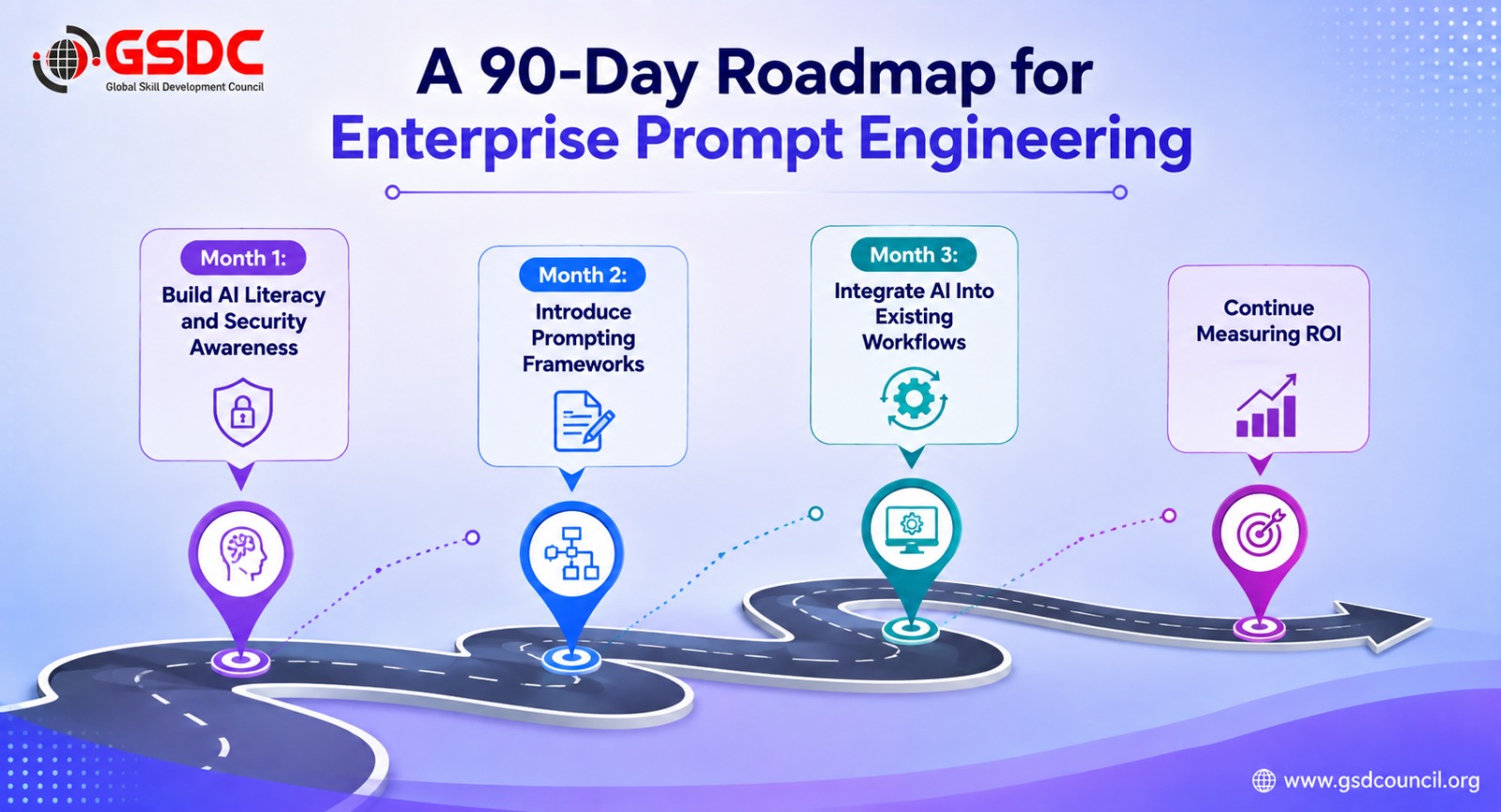
Organizations looking to build prompt engineering capabilities can approach adoption in stages.
Month 1: Build AI Literacy and Security Awareness
The first stage should focus on fundamentals. Employees need to understand how generative AI works at a practical level, what hallucinations are, and what information can or cannot be entered into AI systems.
Data privacy, security, and responsible AI usage should be established before organizations begin building advanced workflows.
Month 2: Introduce Prompting Frameworks
Once employees understand the basics, organizations can introduce structured prompting methods such as CREATE.
The goal is to move employees away from vague conversational requests and toward repeatable, outcome-focused instructions.
Month 3: Integrate AI Into Existing Workflows
AI should not remain a separate destination that employees visit only when they remember to use it.
Tested prompts can be integrated into existing CRM, CMS, analytics, productivity, and other business platforms. This makes AI part of the workflow rather than an additional task.
Continue Measuring ROI
AI adoption should be measured against business outcomes. Organizations can track factors such as task completion time, output quality, error rates, operational costs, and employee productivity.
Prompt engineering should also be treated as an iterative discipline. Models change, workflows evolve, and employee needs shift. Prompts that perform well today may require refinement later.
Building a Sustainable Prompt Engineering Culture
Organizations can scale prompt engineering by focusing on three key practices:
- Centralized prompt libraries: Store, test, categorize, and share effective prompts instead of keeping them in individual chat histories.
- Cross-functional teams: Combine domain expertise with AI and prompt engineering skills to build practical workflows.
- Active risk management: Maintain human review for sensitive outputs and regularly update prompts as AI models evolve.
These practices help organizations move from individual experimentation to a more consistent, scalable, and responsible AI culture.
The Future of AI: From Prompting to Agentic Workflows
As AI evolves toward more autonomous and intelligent workflows, professionals need practical skills to design, deploy, and manage AI solutions in real-world environments. GSDC’s Certified Forward Deployed Engineer (FDE) certification is designed to help professionals build these capabilities.
The certification focuses on applying AI engineering skills to practical business challenges, helping learners understand how to:
- Design and implement AI-powered solutions for real-world use cases.
- Integrate AI systems with business workflows, tools, and data.
- Work with AI agents and develop solutions for practical deployment.
- Evaluate AI solutions for performance, reliability, and effectiveness.
- Bridge the gap between technical AI capabilities and business requirements.
By developing hands-on AI deployment skills, the Certified Forward Deployed Engineer (FDE) certification can help professionals prepare for emerging roles where AI implementation, integration, and problem-solving are central to business transformation.
Conclusion
Prompt engineering is becoming an essential AI skill, helping organizations turn capable LLMs into practical, measurable workflows. Effective AI adoption depends on clear prompts, relevant context, skilled users, and well-designed processes. As AI agents become more autonomous, the ability to define intent, provide context, and guide AI effectively will remain valuable.

Related Certifications
Frequently Asked Questions
Prompt engineering involves creating clear, structured instructions to help AI generate accurate and relevant outputs. Good prompts provide the context, intent, and requirements the model needs.
CREATE stands for Context, Request, Examples, Adjustments, Tone, and Extras. It provides a simple structure for creating more effective and consistent prompts.
Zero-shot prompting provides no examples, while few-shot prompting gives the AI examples of the desired output. Few-shot prompting is useful for maintaining specific styles, formats, or requirements.
Yes. Effective prompts can reduce repetitive work, improve output quality, and support faster research, content creation, and information synthesis. Reusable prompts can also help scale these benefits across teams.
Yes. Even as AI agents become more autonomous, humans still need to define objectives, provide context, set constraints, review results, and manage risks.
Stay up-to-date with the latest news, trends, and resources in GSDC
If you like this read then make sure to check out our previous blogs: Cracking Onboarding Challenges: Fresher Success Unveiled
Not sure which certification to pursue? Our advisors will help you decide!