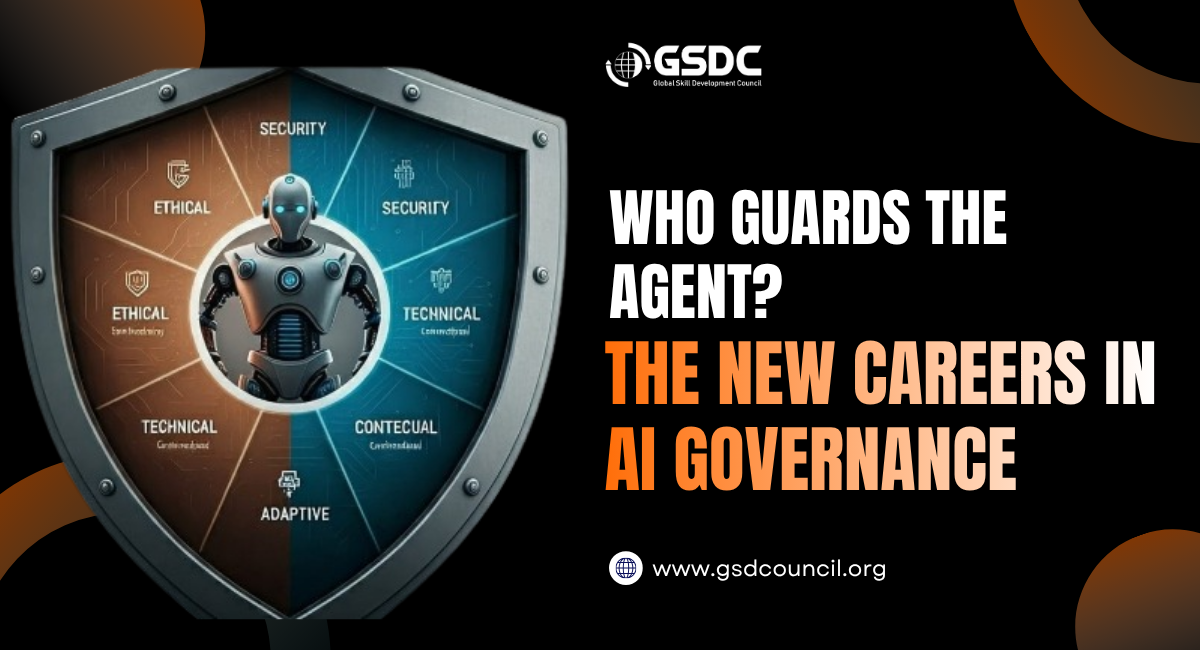
Who Guards the Agent? The New Careers in AI Governance
Written by Matthew Hale
- From Chatbots to Coworkers: Why Agentic AI Changes the Rules
- What "Governance" Actually Means for an AI Agent
- Guardrails: The Practical Side of Governance
- Human Oversight of AI: What It Actually Looks Like Day to Day
- The New Job Market: Agentic AI Careers Are Taking Shape
- Agentic AI Governance Challenges Nobody Talks About Enough
- Agentic AI Governance Best Practices Worth Adopting Early
- Building an Agentic AI Career Path: Where to Start
- Ready to Build a Career in Agentic AI Governance?
- A Simple Way to Think About It
Somewhere right now, an AI agent is approving an expense report, rerouting a delayed shipment, or flagging a transaction as fraud without anyone reviewing it first.
Not a suggestion waiting for a click. A decision, already acted on.
That shift, from AI that advises to AI that acts, is creating a new accountability layer inside organizations. Someone has to decide what an autonomous system can do, monitor its actions, and step in when needed.
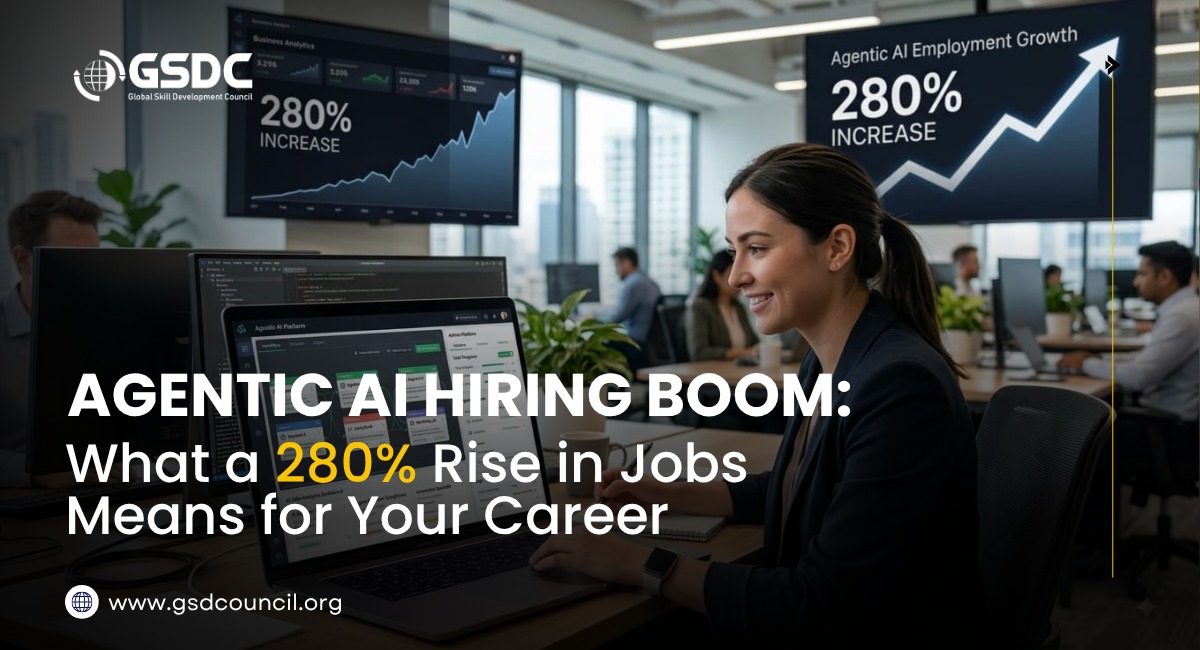
LinkedIn's 2026 Skills on the Rise report lists governance, risk management, and compliance among the fastest-rising skill categories in the job market.
Agentic AI is changing the question from “What can AI do?” to “Who is responsible for what AI does?”
And that question is creating a new class of AI governance careers.
From Chatbots to Coworkers: Why Agentic AI Changes the Rules
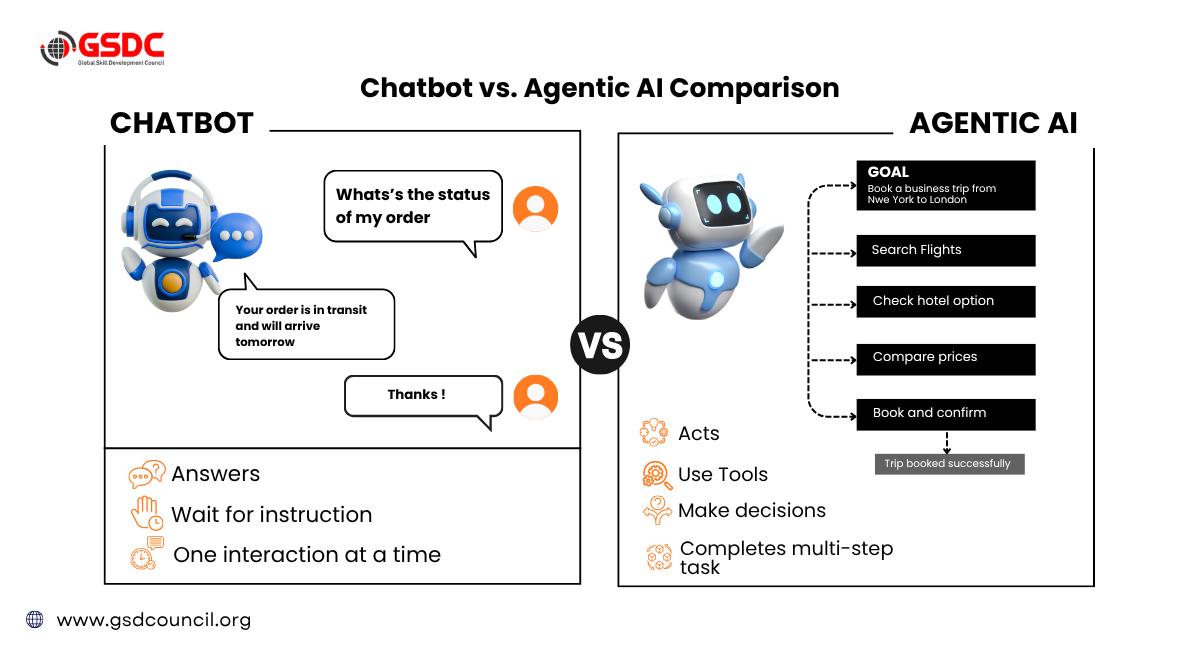
Most people's first experience with AI was a chatbot. You ask something, it answers, and the conversation ends.
Agentic AI works differently. It is given a goal, such as processing a refund, negotiating a vendor contract, or monitoring a network, and it figures out the steps needed to achieve it. It can use tools, access data, and even interact with other AI agents.
That independence makes agentic AI valuable, but it also makes it risky.
Gartner has warned that more than 40% of current agentic AI projects could be cancelled by the end of 2027 due to costs, unclear business value, and inadequate risk controls.
Deloitte's research adds another concern: nearly three-quarters of companies plan to deploy agentic AI within two years, yet only 21% report having a mature model for agent governance.
In other words, companies are adopting agents faster than they are building the systems to govern them.
What "Governance" Actually Means for an AI Agent
The word "governance" can sound like corporate jargon, so let's ground it in something simple.
Agentic AI governance is the set of rules, checks, and structures that decide:
- What an agent is allowed to do and what it absolutely cannot do
- Who is accountable when it makes a decision
- How its actions get logged, reviewed, and audited
- What happens the moment something goes wrong
Think about giving a new employee a company credit card.
You would not simply hand it over with no spending limit, no receipts, and no manager checking in. You would set boundaries, keep records, and review activity regularly.
AI agent governance does the same thing, except the "employee" is a piece of software that can act thousands of times a day across multiple systems without getting tired or asking for a lunch break.
Enterprise AI agent governance frameworks usually rest on a few common pillars:
- Identity and access control: Every agent gets its own verified identity, rather than using a shared login, so its actions can be traced back to it specifically.
- Permission boundaries: Agents only get access to the data and tools they genuinely need for their task.
- Logging and auditability: Every decision and action is recorded so it can be reviewed later, especially when something goes wrong.
- Escalation paths: Clear rules determine when an agent must stop and hand a decision to a human instead of continuing on its own.
Several established references shape how organizations build these frameworks today, including the NIST AI Risk Management Framework in the US, the EU AI Act's obligations for high-risk systems, and ISO/IEC 42001, the international standard for AI management systems.
None of these were written specifically for autonomous agents, which is part of the challenge. The rulebooks are still catching up to the technology.
That gap helps explain why, per IAPP's AI Governance Profession Report, 98.5% of organizations say they don't currently have enough AI governance staff to keep pace with what they're deploying. It's also why bodies like the Global Skill Development Council (GSDC) have started building dedicated training around agentic AI governance. Specifically, the frameworks above are a starting point, not a finished playbook, and someone still has to learn how to apply them to a system that's making its own calls.
Guardrails: The Practical Side of Governance
If governance is the policy, guardrails are the fences that actually enforce it in real time.
AI agent guardrails are technical and procedural limits built directly into how an agent operates.
A few common examples:
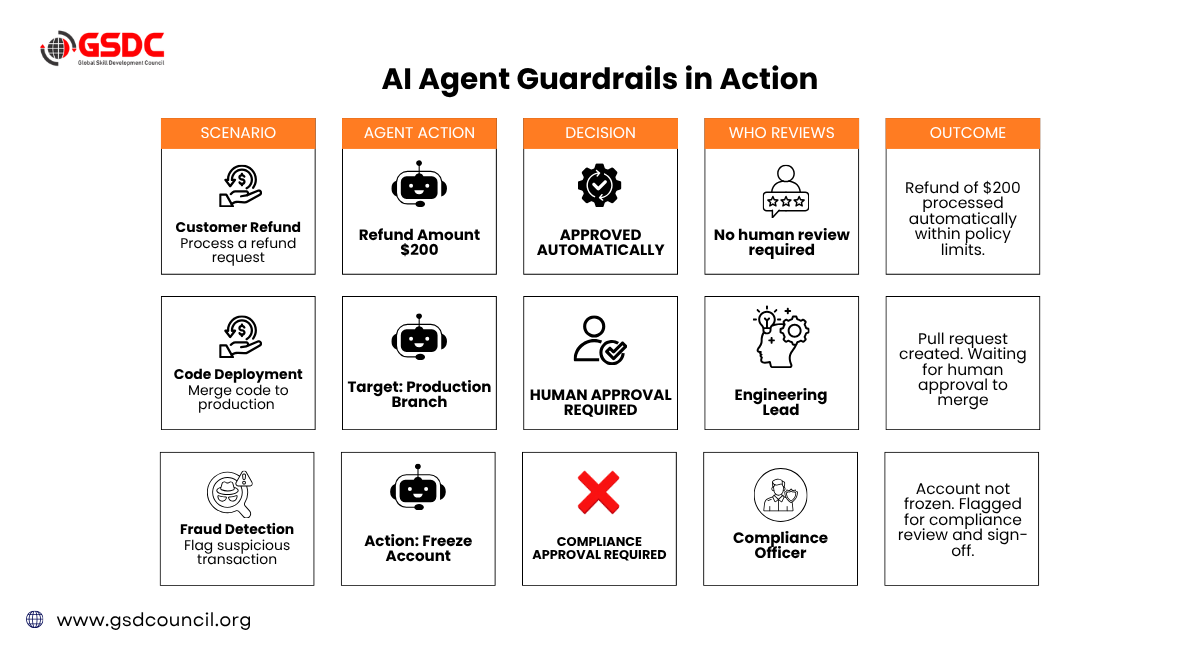
- A customer service agent can approve refunds up to $200 on their own, but anything higher automatically routes to a human.
- A coding agent can open a pull request, but it cannot merge code into the production branch without approval.
- A financial agent can flag a suspicious transaction, but it cannot freeze an account without sign-off from a compliance officer.
AI security guardrails go a step further. They protect against agents being manipulated or hijacked through prompt injection, data poisoning, or attempts to trick an agent into misusing its permissions.
This is a different kind of security problem because the attack surface is no longer just a login page. It can also involve the agent's reasoning process, tools, permissions, and interactions with other systems.
Guardrails do not need to be complicated to be effective.
Often, simple controls such as hard spending caps, rate limits, and mandatory human approval for irreversible actions can prevent serious problems.
Human Oversight of AI: What It Actually Looks Like Day to Day
"Human oversight" is used a lot. But in an agentic AI context, human oversight means more than someone watching a dashboard somewhere.
Real human oversight usually involves three models:
- Human-in-the-loop: A person must approve certain actions before the agent can execute them. This is common for activities involving money, legal commitments, or safety.
- Human-on-the-loop: The agent acts independently, but a person monitors its behavior and can intervene or pause it when necessary.
- Human-after-the-loop: The agent operates autonomously within its guardrails, while humans review outcomes afterward through audits and reporting.
Which model an organization chooses depends on the stakes. A marketing agent drafting social posts may only need a light human-in-the-loop review. An agent with access to payroll systems may require a human in the loop for anything unusual. Good governance is not about slowing every agent down equally. It is about matching the level of oversight to the level of risk and knowing which model fits which situation is exactly the kind of judgment an Agentic AI Professional Certification is built to teach.
The New Job Market: Agentic AI Careers Are Taking Shape
Here is where this stops being abstract and starts becoming personal for a lot of readers.
As agentic AI spreads across industries, someone has to design the guardrails, write the policies, run the audits, and sit in the room when an agent's decision gets questioned.
That work is creating a growing category of AI governance and agent-focused roles. It is not a niche corner of tech anymore. It is becoming a standing function that companies are actively building out, often faster than they can hire for it.
It is also worth noting that this field does not only pull from computer science backgrounds.
People moving into AI governance can come from compliance, legal, risk management, privacy, and audit backgrounds. These fields already require a core skill that matters in AI governance: figuring out what could go wrong and building a process to prevent it.
They are layering AI-specific knowledge on top of expertise they already have, rather than starting from zero.
Agentic AI Governance Challenges Nobody Talks About Enough
It would be dishonest to pretend this is simple.
A few agentic AI governance challenges that even well-resourced organizations still struggle with include:
- Speed versus scrutiny: Agents can act in seconds, while review processes were built for human timelines.
- Multi-agent chaos: When several agents interact, it becomes difficult to trace which one made which decision and why.
- Shadow AI: Employees may quietly use unauthorized agents to get work done faster, entirely outside established governance frameworks.
- Regulatory patchwork: Different countries, and even different US states, are developing AI rules on different timelines.
None of these challenges has a single fix.
That is exactly why agentic AI governance is becoming a discipline of its own rather than a checkbox tucked inside an IT security policy.
Agentic AI Governance Best Practices Worth Adopting Early
For organizations building their approach from scratch, a few practices consistently appear in governance frameworks designed to hold up under pressure:
- Start with a clear inventory. Know every agent that exists, what it can access, and who owns it.
- Apply the principle of least privilege. An agent should never have more access than the task strictly requires.
- Build kill switches before you build capabilities. An agent should be easy to pause or shut down when something looks wrong.
- Run regular red-team exercises designed specifically to trick or manipulate your own agents.
- Treat every agent decision as auditable by default, rather than adding auditability later.
- Assign a named human owner to every agent. Not a team, but a person, so accountability never gets lost in the shuffle.
Building an Agentic AI Career Path: Where to Start
If this field is calling to you, the agentic AI career path is not as narrow as it might look from the outside.
A few common entry points include:
- AI Governance Analyst / Officer: Maps regulations to internal policy, often making it a natural step for people coming from compliance or legal backgrounds.
- AI Risk Manager: Assesses and documents risk before and after agent deployment.
- AI Auditor: Reviews agent logs, decisions, and outcomes against internal and external standards. This is one of the roles seeing strong growth as organizations expand their AI oversight capabilities.
- AI Ethics Specialist: Focuses on fairness, bias, and the broader social impact of autonomous decisions.
- AI Agent Security Specialist: Works closely with cybersecurity, focusing on guardrails and preventing agent manipulation.
- Director / Head of AI Governance: Oversees governance strategy across an entire organization.
So, what skills do these roles require?
Common AI governance skills include working knowledge of frameworks such as NIST AI RMF and the EU AI Act, familiarity with AI observability tools, and enough technical literacy to understand how agents actually reason and act.
You do not necessarily need to be a developer. You do need to be able to follow the logic.
Strong stakeholder communication also matters. So does the ability to translate technical risk into language that a board, executive, auditor, or regulator can understand.
Certifications can help too. IAPP's own salary research found that professionals holding relevant certifications consistently out-earned uncertified peers, with pay increasing further for professionals who combined multiple relevant credentials.
Credentials such as the AIGP (AI Governance Professional) are becoming increasingly relevant for professionals building careers in this space.
Ready to Build a Career in Agentic AI Governance?
This field doesn't just need people who can explain how an AI agent works. It needs people who can look at one and ask the harder questions: what could go wrong, who's accountable if it does, and what guardrails does it actually need before it touches something that matters.
That's the gap the Global Skill Development Council (GSDC) built its Agentic AI Professional Certification to close. It's a practical program, not theory for theory's sake, covering how to assess risk in autonomous systems, build governance frameworks that actually hold up, and put the guardrails in place that let organizations deploy AI agents without crossing their fingers.
Whether you're coming from compliance, risk, IT, or you're simply trying to future-proof a career that already touches AI in some way, this is the kind of credential that signals you know how to do the work, not just talk about it.
A Simple Way to Think About It
If generative AI was about giving machines a voice, agentic AI is about giving them hands.
And anytime something gets into someone's hands, somebody responsible has to decide what it is allowed to touch, when it needs to ask first, and what happens when it reaches for the wrong thing.
That responsibility is not a side conversation anymore. It is becoming its own profession, with its own career paths and growing demand.
Doing that job well takes an unusual mix: enough governance knowledge to know which frameworks apply, enough technical literacy to understand how an agent works, and enough risk instinct to spot a problem before it becomes an incident.
Very few people walk in with all three. Most build them deliberately.

Related Certifications
Frequently Asked Questions
It's real, and it's growing fast. Companies deploying autonomous agents need someone who can set boundaries, track decisions, and step in when something breaks - that's an actual day-to-day job now, not a side project someone's IT team handles on top of everything else.
Governance is the policy - the rules about what an agent can and can't do. Guardrails are how those rules get enforced in the moment, like a spending cap or a mandatory approval step. You need both; one without the other doesn't hold up.
It's not someone glancing at a dashboard once a day. It means a person is either approving an agent's actions before they happen, watching them unfold in real time, or reviewing them afterward - and which one you pick depends on how much is at stake.
It varies a lot by role and seniority, but pay in this space tends to sit well above general compliance or IT roles, simply because so few people have both the technical and governance background employers are asking for.
You don't need to code. Backgrounds in compliance, risk, legal, or audit transfer surprisingly well - you already know how to spot what could go wrong. What you'll need to add is enough technical literacy to understand how an agent actually reasons and acts.
Stay up-to-date with the latest news, trends, and resources in GSDC
If you like this read then make sure to check out our previous blogs: Cracking Onboarding Challenges: Fresher Success Unveiled
Not sure which certification to pursue? Our advisors will help you decide!