The $25.6 Million Deepfake Call That Changed CEO Fraud
Written by Matthew Hale
- What Is CEO Fraud?
- Case Study: How Arup Lost $25.6 Million in One Afternoon
- Why This Isn't a One-Off
- How to Spot a Deepfake, and the One Thing That Matters More
- The Three-Step Rule
- Detection Tools, Briefly
- Generative AI Cuts Both Ways
- Why This Matters for Your Career
- Where the Industry Is Headed
- Final Thoughts
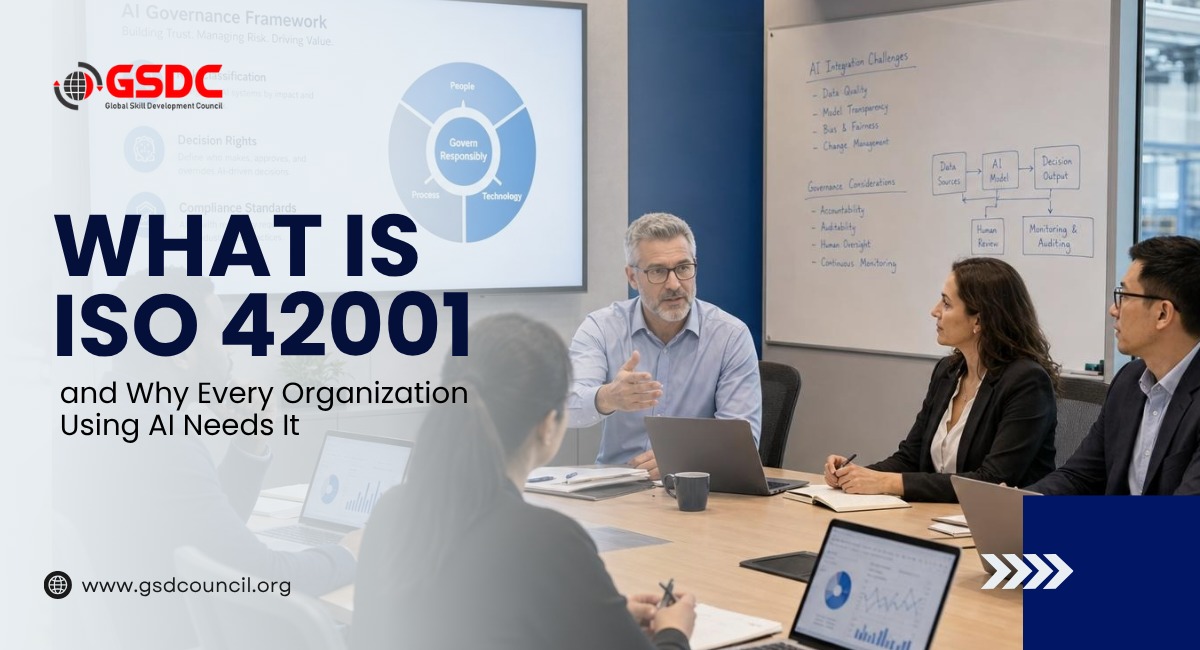
A finance employee in Hong Kong once sat through a video call with his CFO and half a dozen familiar colleagues. Everyone looked right. Everyone sounded right. By the end of the call, he had approved fifteen wire transfers worth $25.6 million.
Not one person on that screen was real.
This is the new face of corporate fraud, and it's not a rare, one-off horror story anymore. It's a fast-growing category of financial crime that any business, a five-person startup, or a global engineering firm can be targeted by tomorrow morning. Here's exactly how it happened to one company, why it's becoming so common, and what actually stops it.
What Is CEO Fraud?
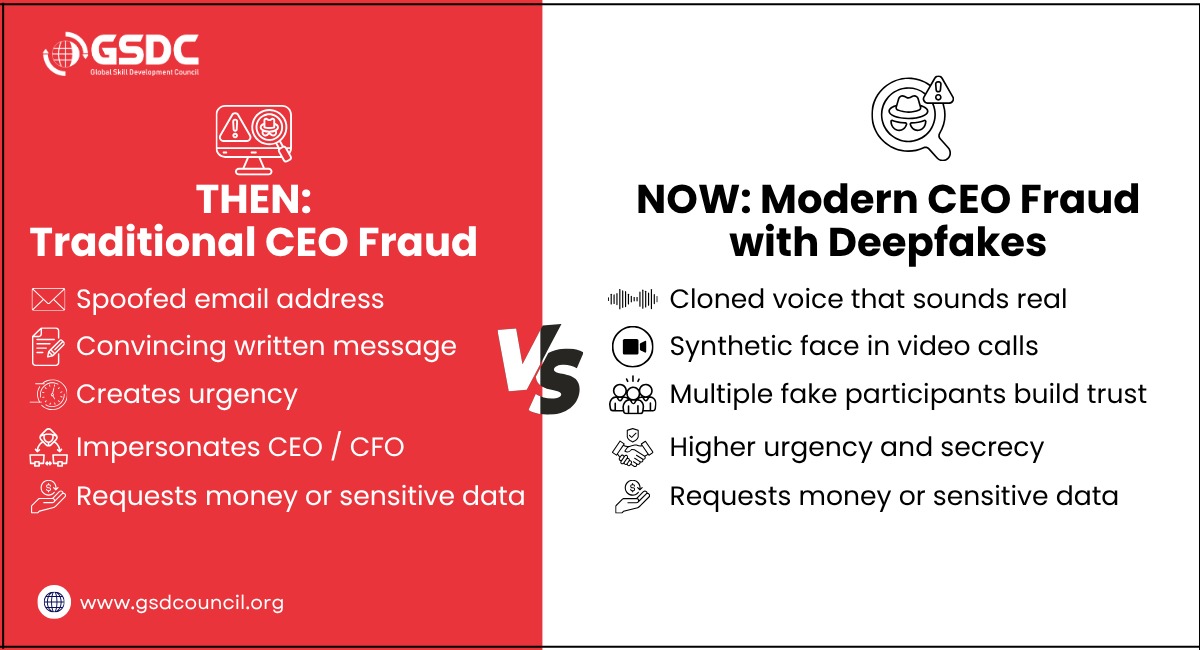
CEO fraud is a form of social engineering where a criminal impersonates a senior executive, usually the CEO or CFO, to trick an employee into transferring money, sharing sensitive data, or approving a transaction they'd normally question.
It's a close cousin of what security teams call executive phishing or Business Email Compromise. The formula hasn't changed much in a decade: create urgency, invoke authority, ask for secrecy, and target someone with the power to move money. What's changed is the tools. Where this used to rely on a spoofed email address and a convincing writing style, it now increasingly comes with a cloned voice or a synthetic face attached. That brings us to the case that put this threat on every CFO's radar.
Case Study: How Arup Lost $25.6 Million in One Afternoon
Arup is a London-headquartered engineering firm behind landmarks like the Sydney Opera House and Beijing's "Bird's Nest" stadium, employing roughly 18,500 people across 34 offices worldwide. In January 2024, one of those offices, Hong Kong, became the site of one of the most detailed, publicly documented deepfake frauds on record.
The message.
A finance employee received a message that appeared to come from the company's UK-based CFO. It referenced a confidential transaction and asked him to join a private video call to discuss it.
The hesitation.
He was initially wary. The message had the hallmarks of a phishing attempt. That hesitation dissolved the moment he joined the call.
The call.
On the other end were what looked and sounded like the CFO and several colleagues he recognized by sight and voice. Investigators later confirmed the attackers had spent time collecting public footage of Arup's executives, recordings from webinars, press interviews, and online conferences, and used it to train AI models capable of generating realistic video and voice in real time.
The ask.
During the call, the fake CFO and "colleagues" instructed him to proceed with a series of transfers tied to the confidential deal. Reassured by what he'd just seen and heard, he authorized fifteen separate wire transfers totaling HK$200 million, about $25.6 million, sent to five different Hong Kong bank accounts.
The discovery.
The fraud only came to light when he later checked in with Arup's head office about the transaction and was told no such deal existed. By then, the money was gone.
Arup's CIO, Rob Greig, was careful to point out what this wasn't: no internal systems were breached, no network was infiltrated, no data was stolen. As he put it, this was "technology-enhanced social engineering." The attack didn't go through a firewall. It went through a person on a video call. No arrests have been publicly announced, and the funds were never recovered.
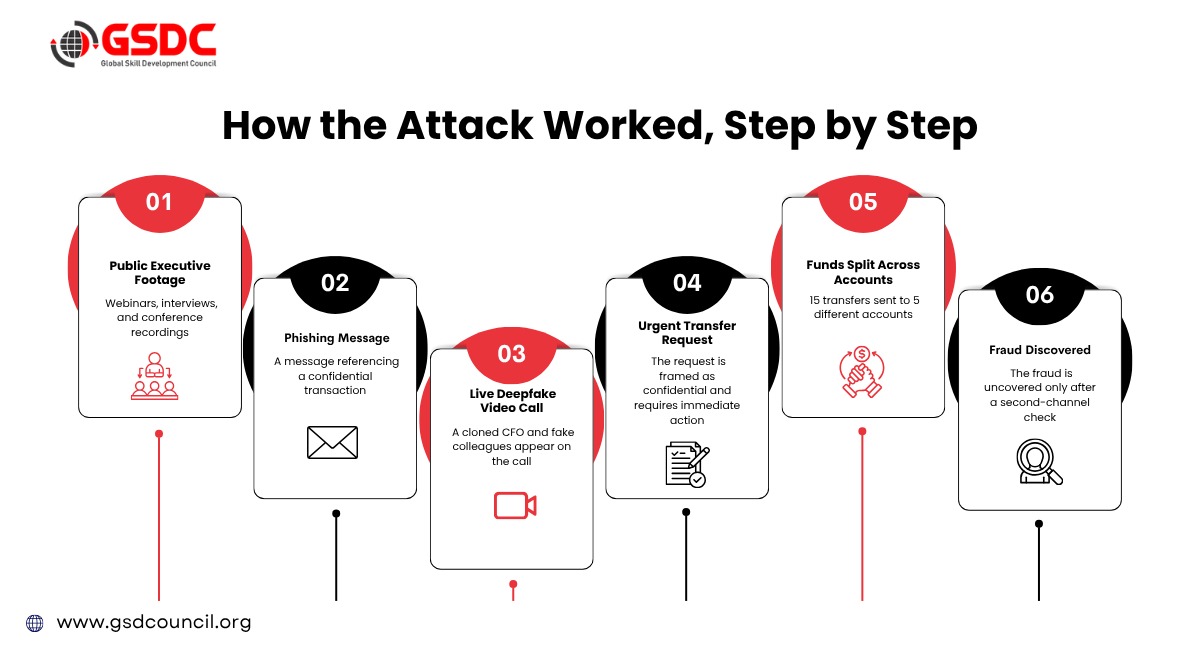
That last arrow is the whole lesson. The one thing that eventually caught the fraud, checking in through a separate, verified channel, is the exact step that could have stopped it before a single dollar moved.
Why This Isn't a One-Off
Arup is the most detailed case on record, but it's not an outlier. A few numbers, each independently sourced, show the shape of the trend:
- $893 million. Losses the FBI logged in 2025 under "AI-related fraud," the first year it tracked this as its own category, across 22,364 complaints. The Bureau itself notes this almost certainly understates the real total, since most AI involvement in fraud isn't yet identified as such when victims report it.
- $40 billion by 2027. Deloitte's Center for Financial Services projection for US generative-AI-enabled fraud losses is up from a $12.3 billion baseline in 2023, at a 32% compound annual growth rate.
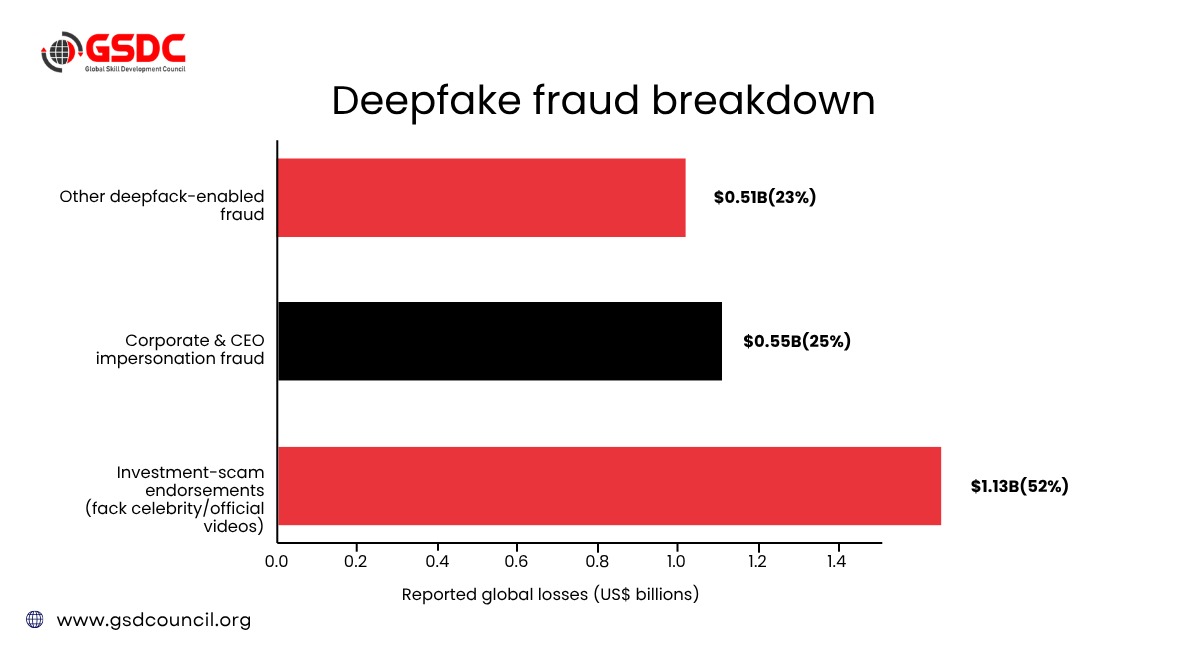
- 25% of all reported deepfake fraud losses globally trace back to corporate and CEO impersonation specifically, out of $2.19 billion in total documented losses, the single largest slice after investment-scam endorsements.
That third figure is the one worth sitting with if you run a business: a quarter of every dollar lost to deepfakes worldwide is aimed squarely at finance teams and wire approvals, not celebrities or influencers.
How to Spot a Deepfake, and the One Thing That Matters More
Detecting a deepfake in the moment is genuinely hard. A 2025 systematic review pooling 56 studies and over 86,000 participants found average human detection accuracy of just above 55%, barely better than a coin flip. That number should reset how you think about this problem: the goal isn't to prove a video is fake. It's to verify that the request is real. That's the one idea worth carrying out of this whole article.
Visual cues can still help at the margins: unnatural blinking, lighting that doesn't quite match the background, slight blurring around the hairline, audio that drifts out of sync with lip movement. Worth knowing, not worth relying on. Generation quality improves every few months; these tells fade fast.
What doesn't fade is the behavioral pattern behind almost every one of these attacks: unusual urgency, insistence on secrecy, resistance to a callback on a known number, pressure to skip the normal approval step. Many documented cases, including Arup, share that pattern regardless of how convincing the video was. That's the signal to build a process around, not pixels.
The Three-Step Rule
If there's one habit worth building into your organization, it's this:
STOP → VERIFY → APPROVE
Stop.
Any request involving money, credentials, or confidential deals doesn't get actioned in the moment it's received, no matter how convincing the call, no matter how senior the person appears to be.
Verify.
Call back on a number you already had on file before the request came in, never one provided in the message itself. For high-stakes requests among senior leadership, a shared verification phrase, rotated periodically, adds another layer that's very hard for an attacker to fake.
Approve.
Only after independent verification, and ideally with a second person signing off on anything unusual or large. A short cooling-off period for high-value transfers can add another powerful barrier against these attacks.
This is the layer that would have stopped Arup. The employee eventually did verify, just after the money had already gone out, instead of before.
Detection Tools, Briefly
Beyond training people on the pattern above, a growing set of tools scan calls and files directly for signs of synthetic media:
- Biometric liveness checks read micro-movements that AI-generated faces struggle to fake
- Audio spectral analysis flags the frequency artifacts voice clones leave behind
- Real-time classifiers built into video conferencing platforms flag synthetic video as a call happens
None of them are foolproof. Detection tends to lag a step behind generation quality, so treat these as one layer, not a replacement for STOP → VERIFY → APPROVE.
Generative AI Cuts Both Ways
Deepfake fraud is really the most visible symptom of a broader shift: generative AI has become both a weapon for criminals and one of the more useful tools available to the people defending against them. AI-written phishing emails with no grammatical tells and voice-cloning tools sold as cheap subscriptions are becoming just as common as deepfake video calls. On the defense side, that same technology now powers fraud-detection systems that flag anomalous transactions in milliseconds and red-team simulations that let organizations rehearse an attack like Arup's before a criminal tries the real thing.
That overlap, the same technology enabling both sides, is exactly why organizations increasingly need people who understand both, not just a tool that promises to catch the fakes.
Why This Matters for Your Career
Organizations don't just need better detection tools. They need people who know how to deploy them, evaluate them, and respond when something slips through, and that's created real, sustained demand. ISC2's 2025 workforce study found AI/ML skills are now the single most-requested skill in cybersecurity hiring, and the World Economic Forum's 2026 outlook found AI-related vulnerabilities are seen as the fastest-growing cyber risk by the vast majority of security leaders surveyed.
New titles are emerging directly out of this gap: AI security analyst, deepfake and fraud-detection specialist, AI governance analyst, and none of them are purely technical roles. The skills that matter most are the same ones this article has been about all along: recognizing social engineering, building verification into a process, and explaining risk clearly enough that someone stops before they click approve.
Where the Industry Is Headed
As deepfake fraud has moved from novelty to boardroom-level concern, training and certification bodies have started building programs specifically for the gap this article has been describing: the space between traditional cybersecurity skills and generative-AI-specific threats. The Global Skill Development Council (GSDC), for one, offers a Certification in Generative AI in Cybersecurity that covers this exact intersection, how generative AI is used in attacks like the one on Arup, and how that same technology is being used to detect and stop them. It's a useful signal of where the field is heading: this is increasingly treated as a distinct, durable skill set, not a one-off awareness session bolted onto existing security training.

Final Thoughts
The Arup case cost one company $25.6 million and a very public lesson. A similar attempt is being made somewhere in the world right now. The tools required have never been cheaper, and the targets range from multinational firms to small companies with far fewer defenses in place.
None of this requires panic. It requires a verification habit that doesn't bend under urgency, and detection tools placed where money actually moves. The lesson isn't "spot the fake." It's STOP → VERIFY → APPROVE, every time, no exceptions for how convincing the request looks.

Related Certifications
Frequently Asked Questions
CEO fraud is when someone impersonates an executive, usually the CEO or CFO, to pressure an employee into moving money or sharing sensitive data. Regular phishing is broad and generic. CEO fraud phishing is targeted and personal, using a name people already trust, which is why it works even on people who'd spot a normal scam email.
The eye test alone isn't reliable anymore. Detection now relies on liveness checks that catch micro-movements a synthetic face can't replicate, audio analysis that flags frequency glitches from voice cloning, and AI models trained to catch manipulated media in real time. None are perfect alone. Pairing a tool with a callback to a known number works best.
The Arup case in this article is the clearest one on record: a finance employee joined a video call where the CFO and colleagues were all AI-generated and authorized $25.6 million in transfers. There's also the Ferrari attempt, where a cloned CEO voice on WhatsApp failed only because the employee asked a personal verification question.
Never approve a transfer or sensitive request based on one channel alone, no matter how convincing it looks. Call back on a number you already had on file, not one given in the message. Add a short cooling-off period for large or unusual requests, with a second person signing off. This alone would have stopped Arup.
Both. The same generative AI that builds a convincing deepfake also powers the tools that catch one. AI-driven fraud detection can flag a strange transaction in milliseconds, work that would take a human hours. It's not good or bad here. It's on both sides now, which is exactly why understanding it matters, whether you're defending a business or building a career in the space.
Stay up-to-date with the latest news, trends, and resources in GSDC
If you like this read then make sure to check out our previous blogs: Cracking Onboarding Challenges: Fresher Success Unveiled
Not sure which certification to pursue? Our advisors will help you decide!