AI Consultant Certification: What Should You Look for in a Program
Written by Matthew Hale
Artificial intelligence is becoming part of everyday business decisions. Companies are using AI to improve customer service, automate tasks, analyze information, support employees, and build new products and services.
But using AI successfully is not only about choosing an AI tool. Organizations also need to know where AI can actually help, whether they have the right data and technology, how much an AI project may cost, and what risks they need to consider. This is where an AI consultant can help.
For professionals who want to work in this field, choosing the right AI consultant certification is important. There are many AI certification programs available, but not all of them teach the skills needed for consulting.
This blog explains what professionals should look for when choosing an AI Consultant Certification. It covers the key skills and topics a good program should include, such as AI use-case assessment, business case and ROI, modern AI technologies, AI readiness, risk and governance, and practical learning. It also explains the difference between a general AI certification and an AI consulting certification and provides a simple checklist to help professionals choose a program that matches their career goals.
What Is an AI Consultant?
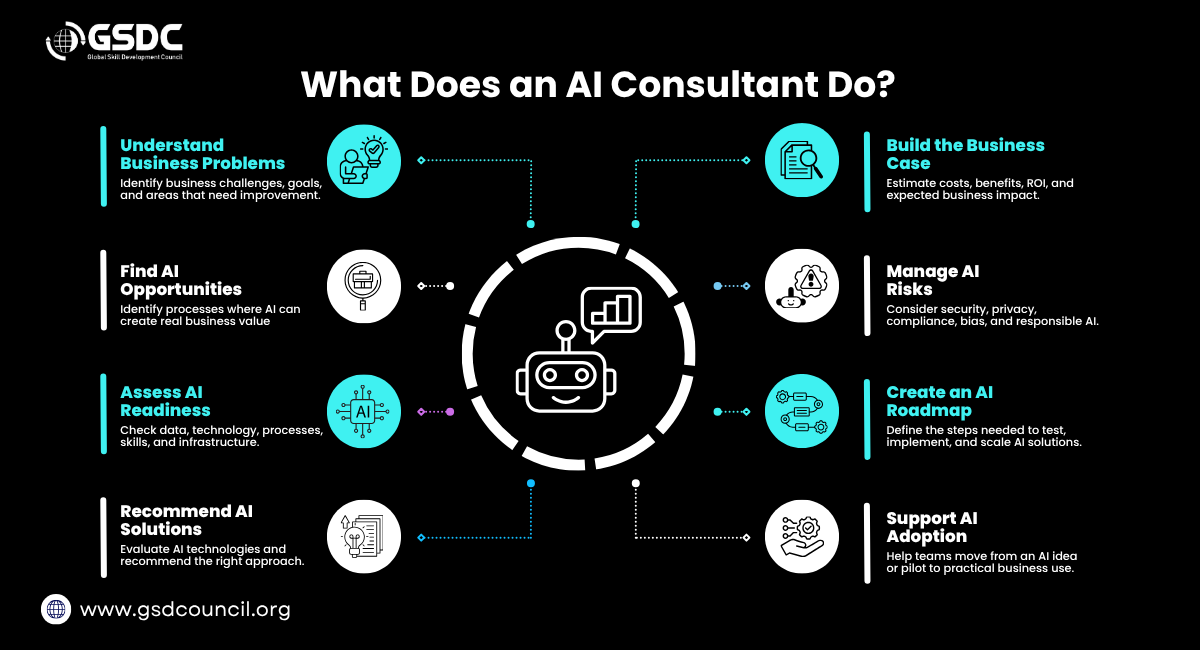
An AI consultant helps organizations understand how they can use artificial intelligence to solve business problems. The work starts with understanding the organization's needs. An AI consultant may look at a business process, find areas where AI could help, and check whether the organization is ready to use it.
They may also help the organization choose an AI solution, compare different vendors, calculate the expected business value, identify risks, and create a plan for implementation.
For example, a company may want to use AI to improve its customer support. An AI consultant would not simply recommend a chatbot. They would first understand the current support process, look at the type of customer questions being received, check the available data, estimate the expected benefits, and consider security and privacy requirements. This means an AI consultant needs both AI knowledge and business understanding. And a good AI consultant certification should help professionals develop both.
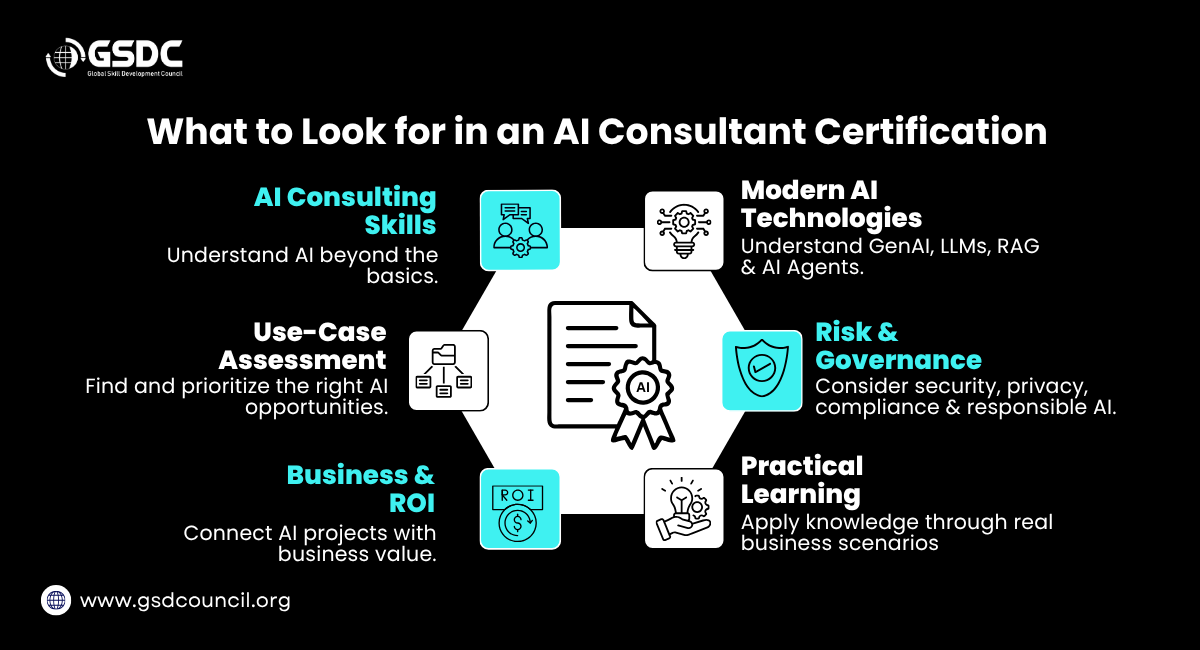
6 Things to Look for in an AI Consultant Certification
1. The Program Should Teach AI Consulting, Not Only AI Basics
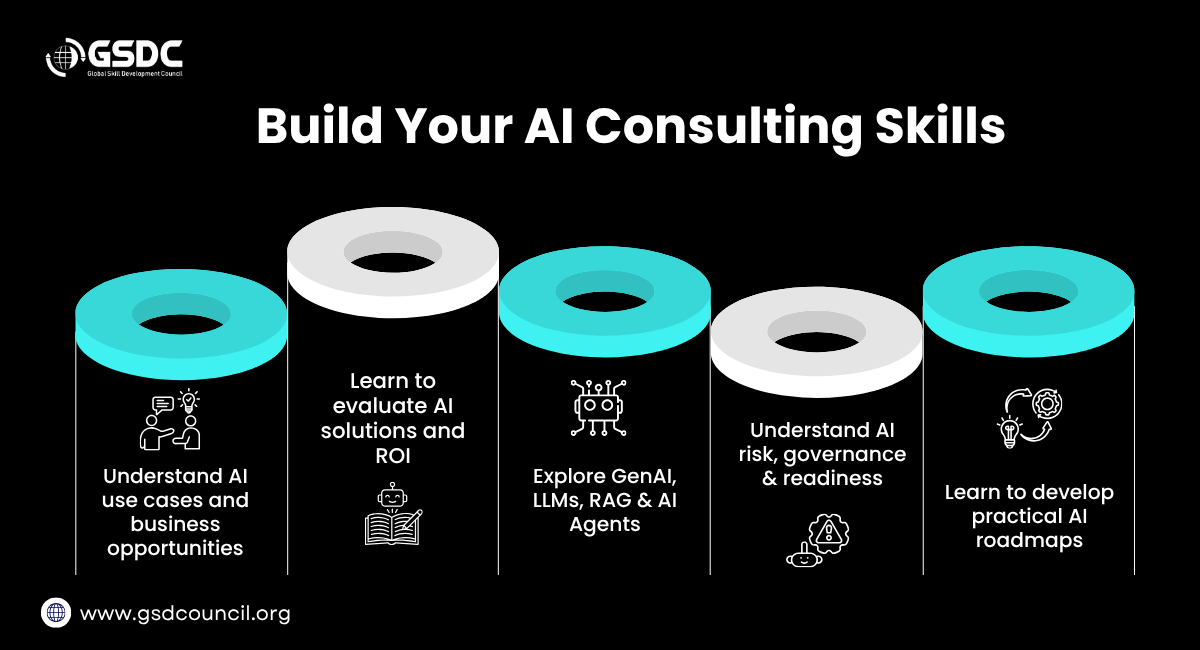
Learning AI fundamentals is important. However, an AI consultant needs more than a basic understanding of artificial intelligence. When reviewing a certification, check whether the syllabus covers how AI is used to solve business problems.
The program should include topics such as:
- AI fundamentals
- Machine learning basics
- Generative AI
- AI use cases
- Business problem analysis
- AI opportunity assessment
- AI strategy
- AI solution planning
- AI implementation
For example, knowing what Generative AI is does not automatically mean you can recommend it to a business. You also need to understand where it can be useful, what information it needs, what problems it may create, and whether it is the right solution for the business problem.
This is an important difference between a general AI certification and an AI consulting certification. A good program should teach you how to connect AI capabilities with business needs.
2. It Should Teach You How to Find and Evaluate AI Use Cases
One of the most important jobs of an AI consultant is finding the right opportunities for AI. A company may have many processes that could potentially use AI. But that does not mean all of them should be automated or changed.
A good certification should teach you how to identify and compare AI use cases.
Look for topics such as:
- Business process analysis
- AI use-case identification
- Use-case prioritization
- Business value assessment
- Data readiness
- Technical feasibility
- Implementation effort
- Risk assessment
For example, a company may want to use AI to process invoices. Before recommending a solution, an AI consultant should look at how invoices are processed today, how much time employees spend on the task, what type of data is available, how accurate the current process is, and what improvement AI could provide. The consultant can then decide whether the use case is worth pursuing.
A useful certification should help you answer questions such as:
- Is AI needed for this problem?
- Can the organization support the solution?
- Will it provide enough value?
- What are the risks?
These skills are important for anyone who wants to become a certified AI consultant.
3. It Should Cover Business Case, ROI, and Solution Selection
AI projects need money, time, and people. Before starting a project, business leaders need to understand what they are likely to get in return. This is why an AI consultant should know how to build a basic business case.
When comparing an AI consultant certification program, check whether it covers:
- Return on Investment (ROI)
- Total Cost of Ownership (TCO)
- Net Present Value (NPV)
- Payback period
- Cost-benefit analysis
- Expected business outcomes
You do not need to become a financial expert. But you should be able to explain the financial side of an AI recommendation. For example, suppose an AI solution can reduce the time required to process customer requests. A consultant should be able to estimate the expected savings and compare them with the cost of implementing and maintaining the solution.
A business may have several AI tools or vendors to choose from. An AI consultant should know how to compare them based on factors such as:
- Cost
- Features
- Security
- Integration
- Scalability
- Vendor support
- Business requirements
This helps organizations make informed decisions instead of choosing a solution simply because it is popular.
4. It Should Cover Modern AI Technologies
AI is changing quickly. Professionals working in AI consulting need to understand the technologies that organizations are currently considering.
When evaluating an AI consultant certification, check whether it covers areas such as:
- Generative AI
- Large Language Models (LLMs)
- Retrieval-Augmented Generation (RAG)
- AI agents
- Agentic AI
- AI automation
- Predictive AI
- Natural Language Processing (NLP)
However, simply having these topics in the syllabus is not enough. The program should also explain how these technologies can be used in business. For example, an organization may want to build an AI assistant that can answer questions using its internal documents.
An AI consultant should understand how RAG can be used for this type of requirement and what data and systems may be needed. Similarly, AI agents can be useful for tasks that involve several steps and decisions. But they are not necessary for every business process. This is why professionals should look for a program that explains when to use a technology and when not to use it. You do not need to become a developer in every AI technology. You need enough knowledge to understand the options and make better recommendations.
5. It Should Include AI Readiness, Risk, and Governance
Having a good AI idea does not always mean an organization is ready to implement it.
The organization may not have the required data. Its existing technology may not support the solution. Employees may not have the required skills. There may also be privacy, security, or compliance concerns. An AI consultant should know how to identify these issues.
A good certification should cover areas such as:
- Data readiness
- Technology readiness
- Organizational readiness
- AI risk
- Data privacy
- AI security
- Responsible AI
- Bias and fairness
- AI governance
- Compliance
For example, a company may want to use a generative AI application with internal business information.
Before recommending the solution, the consultant should consider questions such as:
- Who can access the information?
- How is the data handled?
- What security controls are required?
- Could sensitive information be exposed?
- How will incorrect AI responses be managed?
These questions are part of responsible AI adoption.
A certification that includes AI risk and governance gives professionals a better understanding of the issues they may face when advising organizations.
6. It Should Include Practical Learning and Real Business Scenarios
A certification should not only teach concepts. It should also help you understand how those concepts are used in real situations.
This is especially important for an AI consultant.
When comparing programs, check whether they include:
- Case studies
- Business scenarios
- Practical exercises
- AI use-case assessments
- Solution evaluation
- Business case exercises
- AI roadmap activities
- Scenario-based assessments
Consider a simple example.
A company wants to introduce AI into its HR process. There may be several possible solutions. One option may be cheaper, another may be easier to integrate, and another may offer more advanced features.
There may not be one correct answer.
A consultant needs to look at the business requirements, cost, data, risks, technology, and expected results before making a recommendation. Practical exercises help professionals develop this type of decision-making ability. Also look at how the certification exam is designed. A good assessment should test whether you understand how to apply the concepts, not only whether you can remember definitions.
General AI Certification vs AI Consultant Certification
It is easy to assume that all AI certifications teach the same things. They do not.
A general AI certification may focus more on AI concepts and technologies. An AI consultant certification should also focus on business problems, use cases, ROI, solution selection, risk, and implementation.
General AI Certification | AI Consultant Certification |
| AI concepts | AI and business problems |
| AI technologies | AI use-case assessment |
| AI applications | Solution selection |
| Technical knowledge | Business case and ROI |
| AI tools | AI strategy |
| AI capabilities | Implementation planning |
Neither type is automatically better. Your choice should depend on your career goals.
If you want to work in AI consulting, look for a program that combines AI knowledge with business and consulting skills.
How to Choose the Right AI Consultant Certification
Before enrolling, take a close look at the syllabus and ask yourself these questions:
- Does the program teach AI consulting, not only AI fundamentals?
- Does it teach how to find and prioritize AI use cases?
- Does it cover AI readiness and data assessment?
- Does it explain ROI and business case development?
- Does it cover current technologies such as Generative AI, RAG, and AI agents?
- Does it include AI risk, security, privacy, and governance?
- Does it provide practical exercises or business scenarios?
- Does the exam test practical understanding?
- Is the content relevant to current AI consulting work?
- Does the program match your career goals?
Do not choose a certification only because it has a large number of modules or popular AI terms in its syllabus. Look at what you will actually learn and how that knowledge can be used in your work.
Looking for the Right AI Consultant Certification? Here’s Our Recommendation
If you are looking for an AI consultant certification that covers both AI technology and its practical use in business, the GSDC Certified AI Consultant Certification is a strong option to consider. It covers AI use-case identification, AI readiness, solution design, Generative AI, RAG, AI agents, ROI, vendor evaluation, AI risk, governance, and AI roadmapping. The program is designed to help professionals understand how to evaluate AI opportunities, make informed recommendations, and support organizations through their AI adoption journey.
What the Certification Covers
- AI Consulting Fundamentals: Understand the AI landscape, consulting engagement process, capability patterns, and business requirements.
- AI Use-Case Identification: Learn how to identify, evaluate, and prioritize AI opportunities based on business value and feasibility.
- AI Readiness & Data Assessment: Assess data, technology, processes, and organizational readiness before recommending an AI solution.
- AI Solution Design: Understand how to design AI solutions and evaluate approaches such as build vs. buy.
- Generative AI & Modern AI: Learn about Generative AI, LLMs, RAG, fine-tuning, orchestration, and Agentic AI.
- Business Case & ROI: Learn how to build AI business cases and evaluate ROI, costs, benefits, and payback.
- Vendor Evaluation: Understand how to compare AI vendors and solutions based on business and technical requirements.
- AI Roadmapping: Learn how to create practical AI implementation and scaling roadmaps.
- AI Risk & Governance: Understand AI security, governance, responsible AI, and key risks involved in AI adoption.
Change & Adoption: Learn how to support organizational change and help teams adopt AI solutions.
For professionals who want to build a career in AI consulting, this certification provides a structured way to develop the skills needed to work with organizations on AI adoption. It combines AI knowledge with business analysis, solution evaluation, risk management, and implementation planning. Whether you are an IT professional, business consultant, project manager, business analyst, or technology leader, the certification can help you build a stronger foundation for advising businesses on their AI initiatives.

Related Certifications
Frequently Asked Questions
An AI consultant certification is a professional certification that focuses on using AI to solve business problems. It may cover AI use cases, business analysis, solution selection, ROI, risk, governance, and implementation planning.
To become an AI consultant, you need a mix of AI knowledge, business understanding, problem-solving, communication, and consulting skills. Learning about AI use cases, business cases, AI solutions, risk, and implementation can help build the required foundation.
Look for a program that covers AI consulting, use-case assessment, business value, modern AI technologies, AI readiness, risk and governance, and practical business scenarios.
The best AI certification depends on your career goal. If you want to move into AI consulting, choose a program that combines AI knowledge with business application, consulting skills, practical learning, and AI strategy.
Stay up-to-date with the latest news, trends, and resources in GSDC
If you like this read then make sure to check out our previous blogs: Cracking Onboarding Challenges: Fresher Success Unveiled
Not sure which certification to pursue? Our advisors will help you decide!