AI Consultant Jobs: Roles, Skills, and Career Opportunities
Written by Emily Hilton
- Understanding the AI Consulting Profession
- Key Responsibilities of an AI Consulting Professional
- Where AI Consulting Skills Are in Demand
- Types of AI Consulting Roles to Explore
- Essential Skills for AI Consultant Jobs
- Your Roadmap to Becoming an AI Consultant
- Career Paths and Job Opportunities in AI Consulting
- Technical Expertise Required for AI Consulting Roles
- Build Your AI Consulting Expertise With Certification
- Conclusion
Artificial intelligence is no longer something businesses discuss only in innovation labs. Companies are using AI to automate workflows, analyze data, improve customer experiences, develop products, and support decision-making. But adopting AI successfully is not as simple as buying a tool and asking employees to use it.
This is where AI consultants come in.
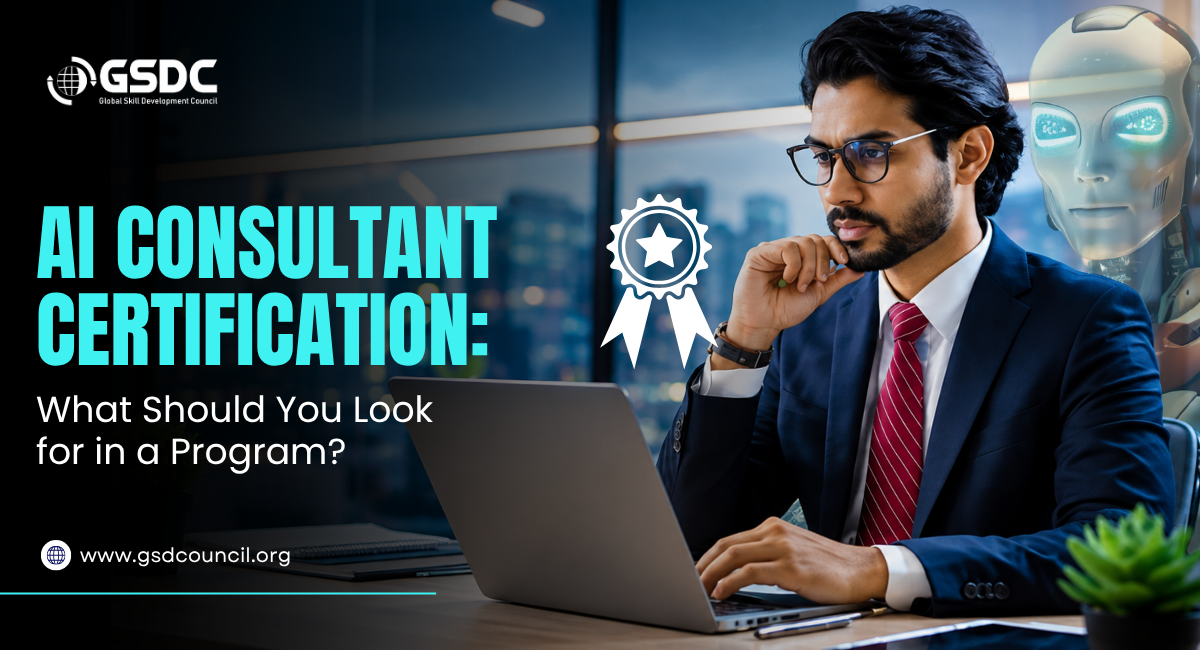
An AI consultant helps organizations understand where AI can create value, which technologies are appropriate, what risks need to be addressed, and how AI initiatives can move from an idea to implementation. As businesses increasingly look for practical ways to integrate AI, AI consultant jobs are becoming an attractive career option for professionals with a combination of technical, business, analytical, and communication skills.
The World Economic Forum's Future of Jobs Report 2025 identifies AI and big data as the fastest-growing skills through 2030, while AI and machine learning specialists are among the fastest-growing job categories.
So, what does an AI consultant do, what skills are required, and how can you build a career in this field? Let's explore.
Understanding the AI Consulting Profession
An AI consultant is a professional who helps organizations identify, evaluate, plan, and implement artificial intelligence solutions that address specific business problems.
Unlike professionals who focus primarily on developing AI models, consultants connect business objectives with AI capabilities. They may analyze business processes, identify potential use cases, evaluate technologies, assess data readiness, estimate business value, and create implementation plans.
For example, imagine a company wants to reduce customer-service costs. An AI consultant might analyze its support workflow, identify repetitive tasks, evaluate whether an AI chatbot or retrieval-augmented generation system would be appropriate, assess available data, estimate potential savings, consider privacy requirements, and develop an implementation roadmap.
In simple terms, an AI consultant acts as a bridge between business needs and AI technology.
The role can vary significantly depending on the organization. Some consultants focus primarily on strategy and advisory work, while others work closely with developers, data scientists, product teams, and IT departments to support implementation.
Key Responsibilities of an AI Consulting Professional
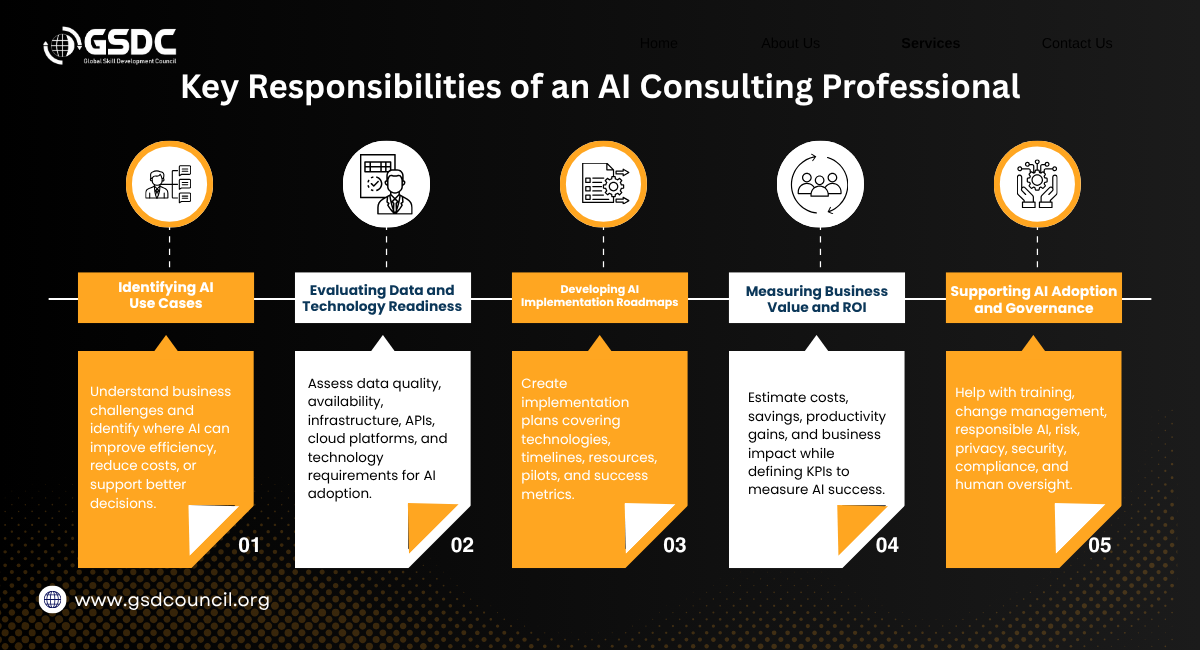
AI consultant role responsibilities can vary by industry, employer, and specialization. However, most professionals are involved in several stages of the AI adoption process.
Identifying AI Use Cases
An AI consultant begins by understanding the organization's business objectives and challenges. They identify processes where AI could potentially improve efficiency, reduce costs, increase revenue, improve customer experiences, or support better decisions.
The goal isn't to recommend AI simply because it is available. Consultants need to determine whether AI is actually appropriate for the problem.
Evaluating Data and Technology Readiness
AI solutions depend heavily on data. Consultants may assess whether the organization has sufficient data, whether that data is accessible and reliable, and whether privacy or security issues could affect implementation.
They may also evaluate existing technology infrastructure, APIs, cloud platforms, databases, AI models, and third-party tools.
Developing AI Implementation Roadmaps
Once a viable use case has been identified, consultants help organizations determine how to move forward.
This can include defining project stages, identifying required resources, selecting technologies, establishing timelines, setting success metrics, and planning pilots or proof-of-concept projects.
Measuring Business Value and ROI
Organizations need to understand whether an AI investment is producing measurable value.
AI consultants may help estimate implementation costs, potential savings, productivity improvements, revenue opportunities, and other business outcomes. They can also define KPIs for evaluating AI initiatives.
Supporting AI Adoption and Governance
Successful AI adoption involves more than technology. Employees need to understand new workflows, stakeholders need to know how systems should be used, and organizations need appropriate governance.
Consultants may support training, change management, responsible AI practices, risk assessment, privacy, security, compliance, and human oversight.
Where AI Consulting Skills Are in Demand
AI consultant jobs are emerging across industries because organizations in many sectors are exploring how artificial intelligence can improve their operations.
Consulting Firms
Traditional consulting organizations are expanding their AI capabilities to help clients with strategy, implementation, transformation, and technology adoption.
Technology Companies
Technology companies need professionals who can help customers understand and implement AI products, platforms, APIs, and enterprise solutions.
Financial Services
Banks, insurance companies, and financial organizations can use AI for fraud detection, customer support, document processing, risk analysis, personalization, and operational automation.
Healthcare
Healthcare organizations are exploring AI for administrative automation, clinical support, medical documentation, research, and patient engagement, subject to applicable regulatory and privacy requirements.
Manufacturing
Manufacturers can use AI for predictive maintenance, quality control, supply-chain optimization, process automation, and demand forecasting.
Retail and E-Commerce
Retail organizations can apply AI to recommendation systems, customer service, inventory management, demand forecasting, personalization, and marketing.
Startups and Large Enterprises
AI startups may need consultants who can help customers adopt emerging solutions, while large enterprises may hire internal AI consultants to coordinate organization-wide AI initiatives.
Because of this broad adoption, professionals searching for AI consultant jobs should look beyond the exact job title. Similar opportunities may appear under titles such as AI strategy consultant, AI implementation consultant, AI transformation consultant, AI solutions consultant, AI advisory consultant, or AI business consultant.
Types of AI Consulting Roles to Explore
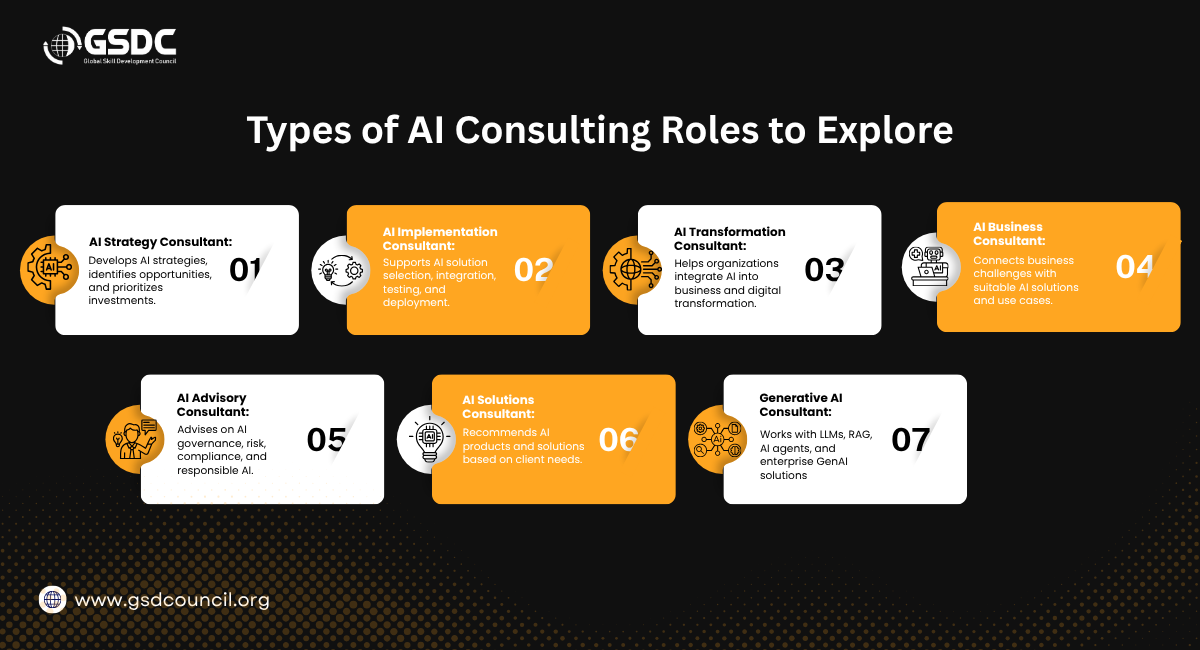
The AI consulting field includes several specialized roles. The responsibilities can overlap, but each position has a different emphasis.
AI Strategy Consultant
AI strategy consultants help organizations identify AI opportunities, prioritize investments, define strategic goals, and develop long-term AI roadmaps.
AI Implementation Consultant
AI implementation consultants focus on turning AI strategies into operational solutions. They may support technology selection, configuration, integration, testing, deployment, and adoption.
AI Transformation Consultant
AI transformation consultants help organizations integrate AI into broader business and digital transformation initiatives. Their work may involve processes, operating models, workforce changes, technology infrastructure, and organizational transformation.
AI Business Consultant
AI business consultants focus heavily on business requirements and outcomes. They translate organizational challenges into potential AI use cases and help stakeholders evaluate expected value and limitations.
AI Advisory Consultant
AI advisory professionals provide guidance on AI governance, responsible AI, risk management, technology choices, organizational readiness, and compliance.
AI Solutions Consultant
AI solutions consultants work closely with customers and technical teams to understand requirements and recommend appropriate AI products, architectures, and implementation approaches.
Generative AI Consultant
Generative AI consultants specialize in technologies such as large language models, AI assistants, retrieval-augmented generation, prompt engineering, AI agents, and enterprise GenAI applications.
Essential Skills for AI Consultant Jobs
You don't necessarily need to become a machine learning engineer to pursue AI consultant jobs. However, you need enough technical knowledge to evaluate AI solutions, understand their limitations, and communicate effectively with technical teams.
AI and Machine Learning Knowledge
Understand the fundamentals of machine learning, deep learning, natural language processing, generative AI, large language models, computer vision, predictive analytics, and AI agents.
You should be able to explain these technologies in practical business language.
Business and Strategic Thinking
AI consultants solve business problems, not technology problems alone.
Understanding business models, processes, KPIs, operational challenges, costs, ROI, and strategic priorities helps consultants determine where AI can create meaningful value.
Data Literacy
You should understand data quality, availability, governance, privacy, security, integration, and data readiness.
An AI solution cannot deliver reliable results if the organization lacks appropriate data or cannot use it responsibly.
Analytical and Problem-Solving Skills
Consultants need to break complex business challenges into manageable problems, compare alternatives, evaluate feasibility, and make evidence-based recommendations.
Analytical thinking is also identified by the World Economic Forum as an important skill expected to remain highly relevant as technology changes the workplace.
Communication and Stakeholder Management
Communication is one of the most important skills for an AI consultant.
You may need to explain an AI strategy to executives, discuss technical requirements with developers, present ROI calculations to finance teams, and train employees on new workflows.
Consulting and Project Management
Knowledge of requirements gathering, stakeholder management, workshops, process mapping, project planning, risk management, and change management can significantly improve your effectiveness as a consultant.
Responsible AI Awareness
AI consultants should understand issues such as bias, hallucinations, privacy, cybersecurity, explainability, human oversight, governance, and regulatory considerations.
Responsible AI awareness is particularly important when organizations deploy AI systems at scale.
Your Roadmap to Becoming an AI Consultant
If you're wondering how to become an AI consultant, there is no single mandatory career path. Professionals enter AI consulting from technology, business consulting, data, project management, product management, finance, marketing, operations, and other backgrounds.
A practical route can include the following steps.
Build Your AI Foundation
Start with AI fundamentals, machine learning, generative AI, large language models, automation, AI agents, and common enterprise AI applications.
The goal isn't to master every technology. Instead, understand what different AI approaches can and cannot accomplish.
Strengthen Business and Consulting Knowledge
Learn how businesses evaluate investments, improve processes, measure performance, manage projects, and handle organizational change.
This helps you move from simply identifying interesting AI technologies to identifying useful business applications.
Develop Technical Fluency
You don't necessarily need advanced programming skills for every consulting position, but technical fluency is valuable.
Depending on your target role, learn the basics of Python, APIs, databases, cloud platforms, prompt engineering, RAG, automation, model evaluation, and AI application development.
Practice Solving Real Business Problems
Take common business processes and analyze them from an AI consulting perspective.
Ask:
- What problem currently exists?
- Which tasks are repetitive or inefficient?
- What data is available?
- Could AI improve the process?
- What would implementation cost?
- What risks could arise?
- How would success be measured?
This exercise helps develop the problem-solving mindset required for consulting.
Create an AI Consulting Portfolio
A portfolio can demonstrate your ability to apply AI to realistic business scenarios.
You could create case studies involving:
- Customer-service automation
- Document analysis
- Recruitment workflows
- Internal knowledge assistants
- Marketing automation
- Business intelligence
- AI-powered process optimization
Instead of simply listing tools you know, explain the business problem, proposed AI solution, implementation approach, expected value, and risks.
Consider an AI Consultant Certification
An AI consultant certification can provide structured learning for professionals transitioning into AI consulting or strengthening existing consulting skills.
A certification can help organize knowledge around AI strategy, use-case identification, solution design, business value, implementation planning, governance, and responsible AI.
However, certification works best when combined with practical projects and business problem-solving experience.
Career Paths and Job Opportunities in AI Consulting
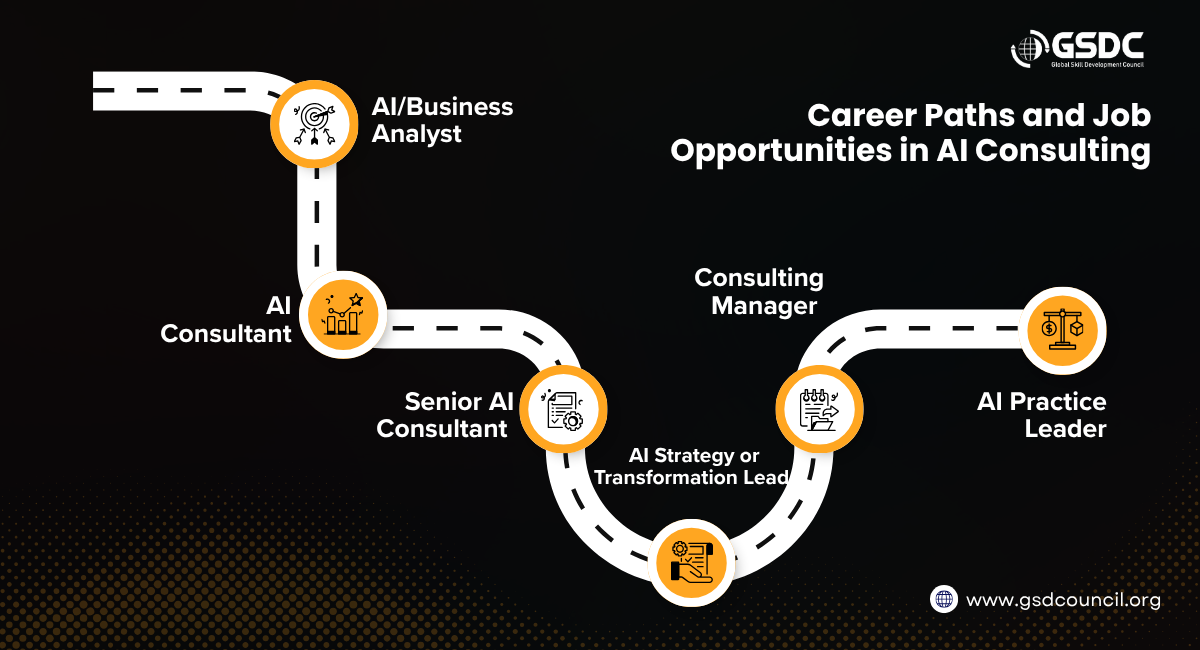
An AI consulting career can develop in multiple directions depending on your background and interests.
A professional might begin in an entry-level position such as business analyst, technology analyst, data analyst, AI analyst, or implementation specialist.
With experience, they may move into consulting roles and eventually specialize in strategy, transformation, implementation, solutions, governance, or industry-specific AI.
A possible career progression could look like:
AI/Business Analyst → AI Consultant → Senior AI Consultant → AI Strategy or Transformation Lead → Consulting Manager → AI Practice Leader
Professionals can also move into adjacent areas such as:
- Enterprise AI strategy
- AI product management
- Digital transformation
- AI governance
- AI program management
- AI solutions architecture
- Independent AI consulting
The growing range of AI applications also creates opportunities for professionals with domain expertise. Someone with a finance background, for example, could specialize in AI for financial services, while someone with experience in cybersecurity could focus on AI security and governance.
Technical Expertise Required for AI Consulting Roles
The amount of technical knowledge required depends heavily on the role.
A strategy-focused consultant may need strong AI literacy, business knowledge, and consulting capabilities without writing production code.
An implementation consultant, however, may need deeper knowledge of APIs, cloud services, data pipelines, software architecture, model integration, automation, and testing.
A solutions consultant may need to understand AI platforms and architectures well enough to recommend an appropriate technical approach.
Therefore, the goal isn't necessarily to become an expert in every area. The goal is to develop technical fluency.
You should be able to:
- Understand how AI systems work at a practical level
- Evaluate technical feasibility
- Identify technology limitations
- Ask useful questions of engineering teams
- Understand implementation requirements
- Explain technical concepts to business stakeholders
Build Your AI Consulting Expertise With Certification
If you're looking for a structured way to develop AI consulting capabilities, the GSDC Certified AI Consultant Certification focuses on the practical business side of AI consulting.
The program covers areas such as AI fundamentals, capability patterns, consulting engagements, process and value-chain mapping, AI use-case identification and prioritization, data readiness, solution design, build-versus-buy decisions, ROI modeling, AI roadmaps, governance, risk, security, and responsible AI.

It also includes practical learning activities, capstone projects, expert-led sessions, practice exams, and a Learn by Doing approach.
The certification can be relevant for professionals from consulting, business analysis, technology, IT, strategy, digital transformation, product management, and related backgrounds.
According to GSDC, there are no mandatory prerequisites, although a basic understanding of AI, business strategy, or consulting can be beneficial.
Conclusion
AI consulting combines AI knowledge, business understanding, and practical problem-solving to help organizations adopt AI effectively.
If you're exploring AI consultant jobs or learning how to become an AI consultant, focus on understanding business challenges, evaluating AI solutions, communicating their value, and supporting implementation. Building technical fluency, consulting skills, and practical experience can help you develop a strong career in AI consulting.

Related Certifications
Frequently Asked Questions
An AI consultant identifies AI opportunities, recommends solutions, develops implementation plans, and helps manage risks, governance, and adoption.
Learn AI fundamentals, business strategy, and consulting skills, then build technical knowledge, practical projects, and consider an AI consultant certification.
Not always. Strategy roles may require limited coding, while technical and implementation roles need stronger programming and systems knowledge.
Key skills include AI knowledge, business strategy, analytical thinking, data literacy, communication, problem-solving, project management, and responsible AI
Search for roles such as AI strategy, implementation, transformation, solutions, advisory, and Generative AI consultant across consulting firms, technology companies, startups, and enterprises.
Yes. It suits professionals who enjoy combining technology and business problem-solving, with growing opportunities as organizations adopt AI.
Stay up-to-date with the latest news, trends, and resources in GSDC
If you like this read then make sure to check out our previous blogs: Cracking Onboarding Challenges: Fresher Success Unveiled
Not sure which certification to pursue? Our advisors will help you decide!