10 AI Certifications That Actually Get You Hired
Written by Matthew Hale
- Why AI Certifications Matter More Now Than Ever
- The Top AI Certifications to Watch Right Now
- 1. Certified Artificial Intelligence Foundation
- 2. Agentic AI Professional Certification
- 3. Certified Generative AI Professional
- 4. Certified AI Tool Expert
- 5. Certified Generative AI in Project Management
- 6. Certified Artificial Intelligence Testing Professional (CAITP)
- 7. Certified Generative AI in Cybersecurity
- 8. Prompt Engineering Certification
- 9. Certified Generative AI in HR and L&D
- 10. Certified Generative AI in Finance and Banking
- Bonus AI Certifications Worth Exploring
- Who Should Actually Pursue an AI Certification
- Conclusion: Getting Ready for What's Next in the AI Job Market
If you've scrolled LinkedIn lately, you've probably noticed the same thing I have: half the job titles now have "AI" bolted onto them somewhere. AI Product Manager. AI-augmented Analyst. Prompt Engineer. Head of AI Governance. It's not a fad. It's a structural shift in how companies staff their teams.
Recent Census Bureau data puts a number on it: about 1 in 5 US businesses now say they're actively using AI, with roughly another fifth planning to adopt it within six months. But here's the catch nobody puts on the recruiting poster: adoption without skilled people is a liability, not an advantage. Plenty of companies have rolled out AI training, yet a lot of leaders will privately admit their teams still can't apply it well in practice.
That gap is exactly where certifications earn their keep. Not as a line on a resume, but as proof that you can actually do the work: build with generative AI, manage an AI-driven project, audit an AI system for bias, or write prompts that produce consistent output instead of guesswork.
Why AI Certifications Matter More Now Than Ever
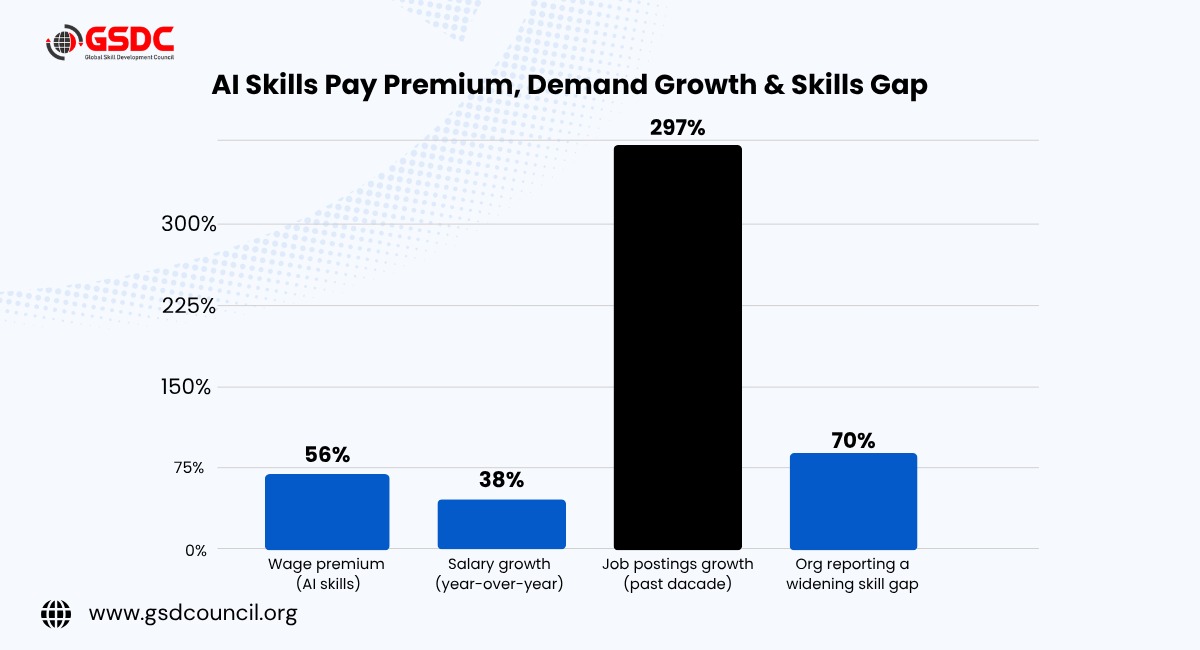
A few things changed the calculus this year. Pay for AI skills is climbing fast: PwC's latest AI Jobs Barometer found a 56% average wage premium for roles requiring AI skills, and separate research from Iternal puts year-over-year salary growth as high as 38% in some sectors. Demand is climbing too. Stanford HAI's latest AI Index found AI-related skills now appear in about 2.5% of all US job postings, up 297% over the past decade.
And with AI tools now writing resumes and cover letters, employers are leaning harder on verifiable credentials to separate real capability from a polished prompt. Companies are looking for people who can:
- Apply core AI and generative AI concepts to real business problems, not just define them in an interview
- Use AI tools and automation to solve operational bottlenecks
- Work responsibly with agentic AI systems as they move from pilot projects into production
- Maintain AI quality, reliability, and compliance, especially in regulated industries. Professionals who want a structured path here can follow GSDC's AI compliance certification roadmap, a 90-day track from compliance generalist to certified AI governance specialist
- Apply responsible and ethical AI principles consistently, not just when someone's watching
McKinsey's ongoing workforce research puts the share of organizations reporting a widening AI and analytics skills gap at close to 70%. That's a hiring bottleneck companies are actively trying to solve, and it's why structured, verifiable AI upskilling is having a moment.
The Top AI Certifications to Watch Right Now
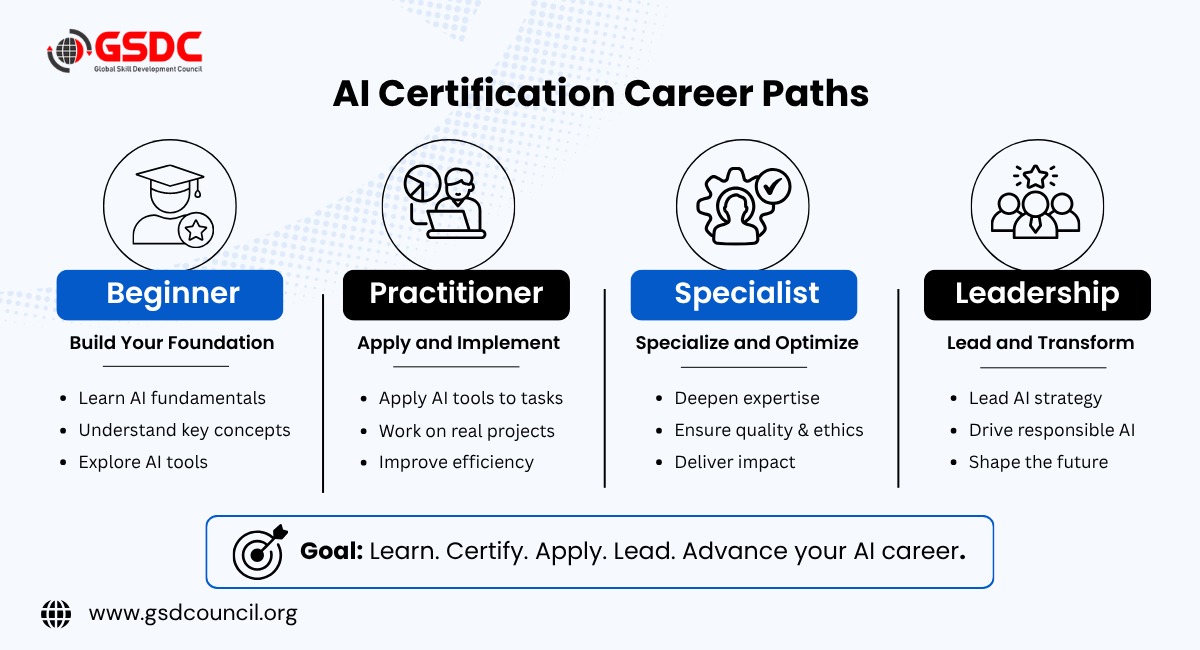
AI competence isn't one skill anymore. It splits into foundational, applied, and specialized tracks depending on your role. Here's how the landscape breaks down.
# | Certification | Level | Best For | Core Focus | Why It Matters Now |
1 | Certified Artificial Intelligence Foundation | Entry | Career switchers, early-career professionals | AI fundamentals, ML basics | Baseline AI literacy is now table stakes across industries |
2 | Agentic AI Professional Certification | Advanced | Senior professionals, AI strategists | Autonomous agents, multi-step decisioning | Agentic AI is moving from pilots into live production systems |
3 | Certified Generative AI Professional | Intermediate | Working professionals, AI practitioners | Applied GenAI, workflow integration | Employers want GenAI skills applied to real output, not theory |
4 | Certified AI Tool Expert | Intermediate | AI tool implementers, operations teams | Tool evaluation, ROI measurement | Budgets are up, and leaders now demand measurable AI ROI |
5 | Certified Generative AI in Project Management | Specialized | PMs, transformation leads | AI-assisted forecasting and planning | AI-augmented delivery is becoming the default, not the exception |
6 | Certified AI Testing Professional (CAITP) | Intermediate | QA professionals, AI auditors | Bias detection, reliability testing | Trustworthy, auditable AI is a board-level priority now |
7 | Certified Generative AI in Cybersecurity | Specialized | Security professionals and leaders | AI-driven threat detection and response | Attackers are using AI too, so defenders can't afford to lag |
8 | Prompt Engineering Certification | Intermediate | GenAI users, product and technical roles | Prompt design and output optimization | Prompt skill is the main lever most people have over GenAI quality |
9 | Certified Generative AI in HR and L&D | Specialized | HR and L&D leaders | AI in talent and workforce analytics | AI is reshaping hiring, onboarding, and learning design |
10 | Certified Generative AI in Finance and Banking | Specialized | Finance and banking professionals | AI in risk, compliance, operations | Regulated adoption is accelerating, not slowing down |
1. Certified Artificial Intelligence Foundation
The AI Certification is where most people should start if AI still feels a little abstract. It's built for beginners, and it doesn't assume you're already fluent in machine learning jargon.
- What you'll actually learn: the core mechanics of AI and machine learning, and how businesses use AI-driven applications to make decisions, not in theory, but in day-to-day operations.
- Who it's for: professionals just starting out, students, and career changers who need a real foundation before specializing.
- Why it's worth doing now: basic AI fluency is becoming a baseline expectation, not a differentiator, and that bar keeps rising every quarter.
2. Agentic AI Professional Certification
The Agentic AI Certification goes deep into the systems that plan, decide, and act with minimal human oversight, arguably the fastest-moving corner of AI right now.
- What you'll learn: how to design, deploy, and govern autonomous AI agents, and how agentic systems reshape workflows and decision-making structures once they're live.
- Who it's for: senior leaders, AI strategists, and innovation heads responsible for rolling out advanced automation.
- Why it's worth doing now: as more companies push agentic systems past the pilot stage, understanding how autonomous AI actually behaves (and fails) becomes a genuinely rare and valuable skill.
3. Certified Generative AI Professional
The Gen AI Certification is deliberately practical. It's less about defining generative AI and more about wiring it into real business and technical workflows.
- What you'll learn: how to connect generative AI with existing tools and processes to get actual work done.
- Who it's for: AI professionals who want to go beyond surface-level GenAI knowledge.
- Why it's worth doing now: people who can control and productively harness GenAI, instead of just experimenting with it, remain in short supply.
4. Certified AI Tool Expert
The AI Tools Certification is built around a practical question every organization is now asking: which AI tools are actually worth the spend?
- What you'll learn: how to evaluate AI applications, integrate them into existing workflows, and measure the productivity they actually deliver.
- Who it's for: managers and operations professionals responsible for selecting and rolling out AI tools.
Why it's worth doing now: AI budgets are climbing (CEOs are projected to nearly double generative AI investment this year), and leaders want proof of ROI, not just adoption.
5. Certified Generative AI in Project Management
The Project Management Certification looks at generative AI as a working tool across the full project lifecycle, from initiation through delivery.
- What you'll learn: AI-assisted forecasting and risk assessment, applied to real project timelines.
- Who it's for: project managers and transformation teams delivering in AI-enabled environments.
- Why it's worth doing now: AI-augmented delivery is quickly becoming a standard expectation rather than a competitive edge.
6. Certified Artificial Intelligence Testing Professional (CAITP)
The AI testing credential (CAITP) focuses on validating AI systems before they cause a problem in the real world.
- What you'll learn: structured AI testing methodology, bias detection techniques, and how to evaluate an AI system's overall reliability.
- Who it's for: QA professionals, AI auditors, and risk teams responsible for monitoring AI solutions.
- Why it's worth doing now: with regulators and boards paying closer attention to AI accountability, trustworthy AI validation has shifted from "nice to have" to a genuine risk-management function.
7. Certified Generative AI in Cybersecurity
The AI Cybersecurity Certification looks at how AI is reshaping threat detection, incident response, and security analysis.
- What you'll learn: how to apply generative AI to threat detection, incident response, security monitoring, and large-scale security data analysis.
- Who it's for: cybersecurity professionals and security leaders responsible for protecting systems and data.
- Why it's worth doing now: attackers are already using AI to scale their tactics. SANS/GIAC's latest research found skills gaps have overtaken headcount shortages as the top workforce challenge in security, with capability gaps directly linked to breach risk. Defenders need to match that pace.
8. Prompt Engineering Certification
- The Prompt Engineering Certification covers the discipline behind getting consistent, usable output from generative AI systems.
- What you'll learn: prompt structuring, optimization techniques, and how to evaluate and refine AI outputs for accuracy and reliability.
- Who it's for: anyone who works with generative AI regularly and wants more control over what it produces.
- Why it's worth doing now: as GenAI adoption widens, prompt engineering has become one of the few skills that directly determines whether AI output is useful or just plausible-sounding noise.
9. Certified Generative AI in HR and L&D
Generative AI in HR and L&D Certification looks at how generative AI is reshaping talent management and learning functions.
- What you'll learn: how to apply AI across talent management, learning design, workforce analytics, and employee development.
- Who it's for: HR professionals and L&D leaders shaping people strategy.
- Why it's worth doing now: as companies rebuild hiring, onboarding, and learning programs around AI, the ability to apply it responsibly in HR contexts is becoming a durable, high-value skill.
10. Certified Generative AI in Finance and Banking
The Generative AI in Finance and Banking Certification focuses on applying generative AI inside one of the most tightly regulated industries there is.
- What you'll learn: how AI supports risk analysis, compliance monitoring, customer service, and day-to-day operations in finance.
- Who it's for: finance and banking professionals.
Why it's worth doing now: AI adoption in finance keeps accelerating even under close regulatory scrutiny, which means professionals who understand both the technology and the compliance guardrails are unusually valuable.
Bonus AI Certifications Worth Exploring
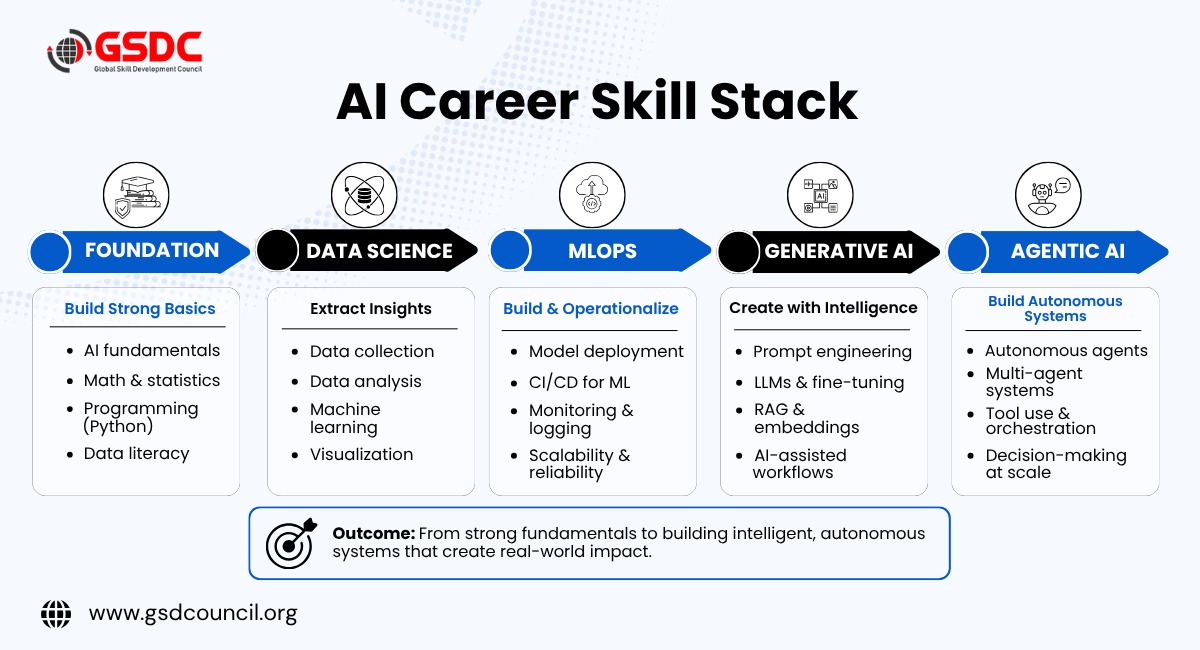
Beyond the core list, a few adjacent certifications strengthen your ability to work with AI systems at scale:
- Certified MLOps Professional: for deploying, managing, and supporting machine learning and AI models in production environments.
- Certified Data Science Professional: strengthens the statistical and modeling foundation that good AI work depends on.
- Certified Big Data Foundation: helps professionals manage the data infrastructure that AI and machine learning systems run on.
Think of these as complementary tracks rather than replacements for the foundational and specialized certifications above; they round out the operational side of AI work.
Who Should Actually Pursue an AI Certification
As AI keeps spreading across sectors, more professionals need a structured way to build credible, role-relevant skills, not just general awareness. Certification programs from established skill-development bodies like the Global Skill Development Council (GSDC) give professionals a way to prove that competence and use it as a real career lever.
GSDC currently offers more than 20 AI-focused certification programs spanning foundational, applied, advanced, and domain-specific tracks, enough range that most people can find a path that actually matches their role and industry rather than a generic one-size-fits-all course.
Worth noting: among GSDC's programs, the CGAIC track shows some of the strongest salary outcomes for cybersecurity professionals. GSDC's live AI security professional certification salary calculator shows CGAIC-certified AI Security Engineers earning $185K–$298K in the US, compared with $120K–$145K for professionals holding traditional security certifications alone.
AI certifications tend to make the most sense for:
- People starting out in AI who want a solid, comprehensive base before specializing
- Working professionals who need to keep pace with AI tools, automation, and data-driven decision-making in their current role
- Practitioners building frontier generative or agentic AI systems who need formal, verifiable proof of skill
- Managers and leaders overseeing AI-assisted teams who need a working understanding of AI strategy, implementation, and governance
Given how role-specific the AI job market has become, certifications that map to a specific function (rather than generic "AI awareness" courses) tend to move careers forward faster.
Conclusion: Getting Ready for What's Next in the AI Job Market
AI isn't just changing technology roles. It's reshaping governance, leadership, and virtually every function in between. And as AI capability keeps evolving, so will the expectations placed on the people working alongside it.
Role-based, industry-aligned certifications give professionals a structured way to close that gap instead of trying to keep up by osmosis. They turn "I've used ChatGPT a bit" into demonstrable, job-ready capability, and they help professionals move deliberately from general knowledge to applied skill to genuine specialization.
If the past few years have made anything clear, it's that the AI skills gap isn't closing on its own. The professionals who invest in structured, verified learning now are the ones who'll be setting the pace ahead, not scrambling to catch up.

Related Certifications
Stay up-to-date with the latest news, trends, and resources in GSDC
If you like this read then make sure to check out our previous blogs: Cracking Onboarding Challenges: Fresher Success Unveiled
Not sure which certification to pursue? Our advisors will help you decide!