Teacher to Instructional Designer: Is the Career Change Worth It?
Written by Matthew Hale
- What Does an Instructional Designer Actually Do?
- Teacher vs. Instructional Designer: What Actually Changes?
- Why Teachers Make Natural Instructional Designers
- How Much Do Instructional Designers Make?
- How to Become an Instructional Designer
- Building a Resume and Portfolio That Actually Gets You Hired
- Where the Jobs Actually Are
- Is Instructional Design a Good Career for Former Teachers?
- The Bottom Line
If you have spent years grading papers late into the night and wondered whether there is a version of teaching that does not leave you this exhausted, you are far from alone. According to the Center for American Progress, roughly seven in ten teachers with five years of experience or less have already left the classroom or seriously thought about it. For many of them, the move from teacher to instructional designer has become the obvious next step, since the skills overlap more than people expect.
The short answer: for many teachers, yes, instructional design can be a worthwhile career change, especially if you enjoyed designing lessons more than delivering them. But it is not simply "teaching without the classroom." You are trading classroom management and parent emails for project deadlines and stakeholder reviews. Whether that trade is worth it depends on what specifically wore you down about teaching, and that's what the rest of this guide breaks down.
What Does an Instructional Designer Actually Do?
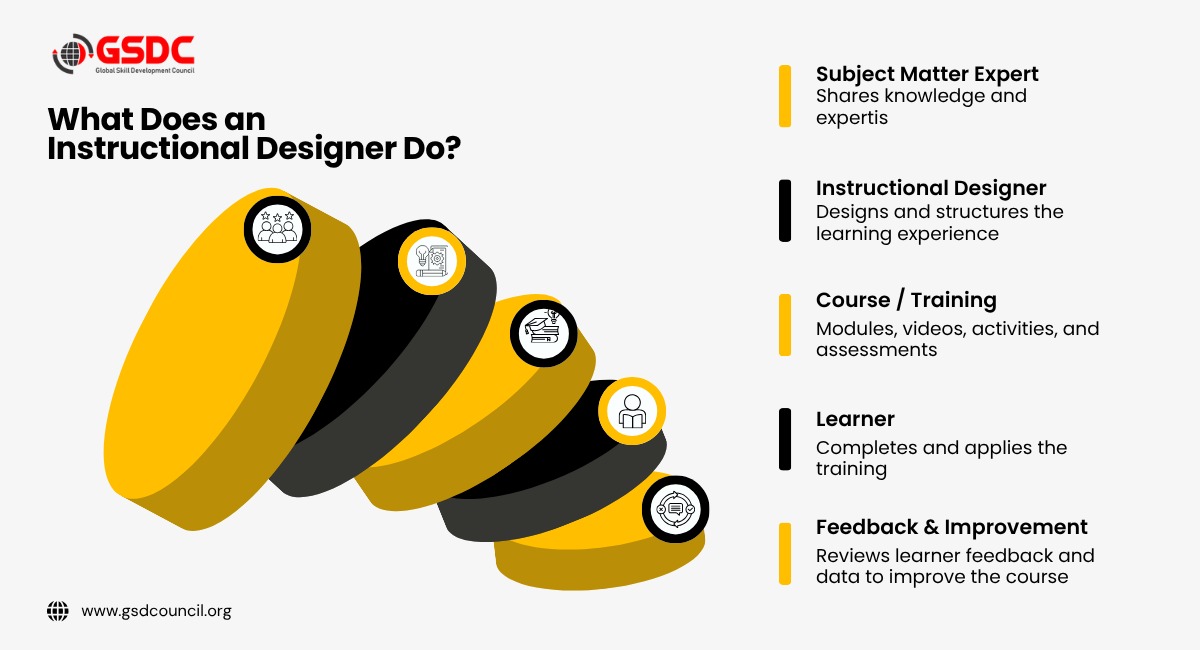
So, what does an instructional designer do all day? In short, they design the learning experiences that help people at work (or in school) actually retain what they are taught, instead of forgetting it the moment training ends.
On a typical week, an instructional designer might:
- Sit down with subject-matter experts to figure out what a training program actually needs to teach
- Turn dense, technical information into simple modules, videos, or interactive lessons
- Build courses inside a learning management system (LMS) using tools like Articulate Storyline, Camtasia, or Adobe Captivate
- Write assessments that measure whether learning happened, not just whether someone clicked "next"
- Test a course, gather feedback, and revise it based on real learner data
Teacher vs. Instructional Designer: What Actually Changes?
The job titles sound related, and the underlying skill is related too, but the day-to-day reality shifts more than most people expect going in. Here is a more concrete picture of what changes:
As a Teacher | As an Instructional Designer |
Your audience is students | Your audience is employees, customers, or adult learners |
You write lesson plans | You write learning solutions and course blueprints |
You deliver material live, in a classroom | Most content is digital and often self-paced |
Success is measured in grades and test scores | Success is measured in business or learning outcomes |
You answer to parents and school administration | You answer to subject-matter experts and stakeholders |
Your work repeats daily, in real time | Your work is organized around projects with deadlines |
That last row matters more than it looks. A lot of teachers assume instructional design will simply remove the exhausting parts of teaching. In practice, it removes some of them (classroom management, being "on" in front of a room all day) and replaces them with a different kind of pressure: stakeholder feedback loops, shifting priorities, and deadline-driven project work. It is a different job, not a quieter version of the same one, which is part of why a good instructional design certification focuses specifically on the project- and stakeholder-driven side of the role that classroom teaching does not typically prepare you for.
Why Teachers Make Natural Instructional Designers
That said, hiring managers in learning and development know something a lot of teachers do not give themselves credit for: classroom experience translates well into strong instructional designer skills.
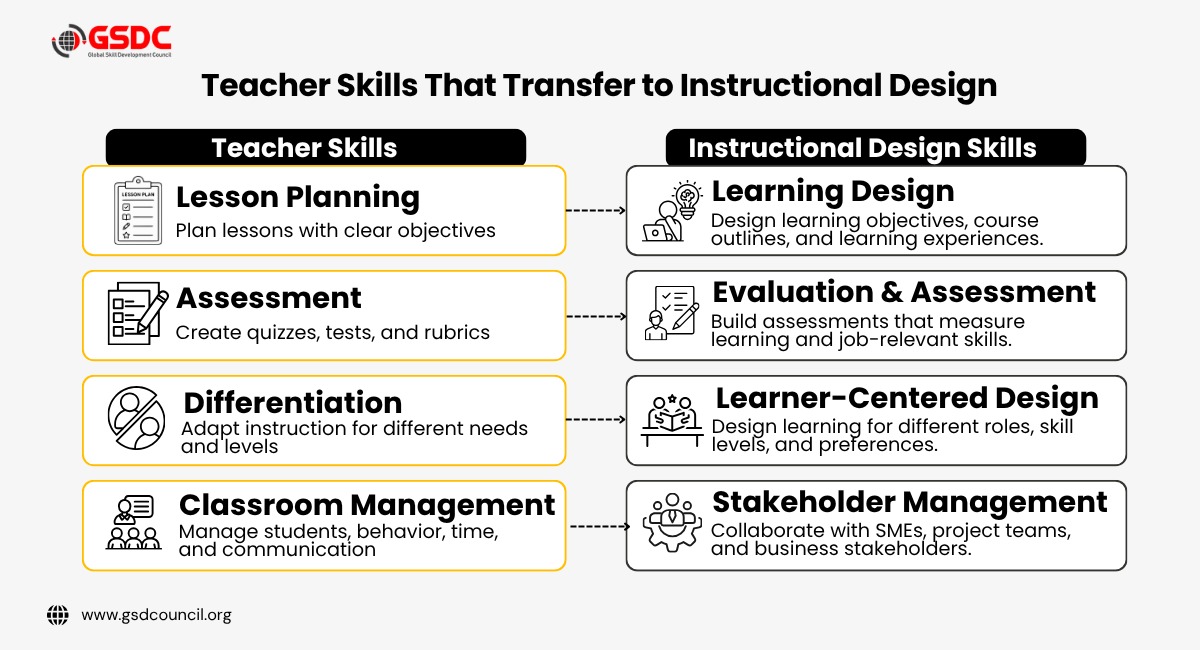
What You Did as a Teacher | What It Becomes in Instructional Design |
Writing lesson plans and unit objectives | Writing learning objectives and course outlines |
Differentiating instruction for different learners | Designing for different roles, skill levels, and learning styles |
Creating quizzes and rubrics | Building assessments that measure real competency |
Managing a classroom and stakeholders (parents, admin) | Managing stakeholders like SMEs, project leads, and clients |
Adjusting lessons based on how students respond | Revising courses based on learner analytics and feedback |
The main gap is usually technical: most instructional design roles expect familiarity with authoring tools, SCORM or xAPI standards, and instructional models like ADDIE or SAM. That gap is learnable, and it is exactly what structured programs from bodies like GSDC are built to close, without asking you to start over from scratch.
How Much Do Instructional Designers Make?
Instructional designer salary is genuinely useful to know before you commit to a career change, so let us look at the numbers, with an honest caveat up front: pay data for this role varies noticeably depending on the source, your location, your industry, and your experience level. Treat the figures below as a realistic range, not a guarantee.
According to Glassdoor, the average salary for an instructional designer in the United States is $92,431 per year, with typical total pay ranging from about $74,000 to $117,000 depending on experience and location. Senior instructional designers on the same platform report a range of roughly $98,000 to $152,000.
Level | Typical Range (Glassdoor) |
Lower end of the range | ~$74,000 |
Overall average | ~$92,000 |
Upper end of the range | ~$117,000 |
Senior Instructional Designer | ~$98,000 to $152,000 |
Source: Glassdoor, Instructional Designer Salaries.
For context, the average teacher base salary in the United States sat at roughly $73,000 in 2025, according to RAND's State of the American Teacher survey. That puts the average instructional designer salary above the average teacher salary, though industry makes a real difference: fields like pharmaceuticals, aerospace, and government tend to pay toward the higher end of the range, while nonprofit or education-sector roles often sit closer to the lower end.
If you are wondering how much do instructional designers make compared to what you earn now, the honest answer is: depending on your location, industry, and experience, the move can lead to higher earning potential, but a pay increase is not guaranteed.
How to Become an Instructional Designer
Here is the good news: you do not need to start from zero. Here is a realistic path from teacher to instructional designer.
Learn the core models.
Get comfortable with ADDIE (Analyze, Design, Develop, Implement, Evaluate) and at least one agile alternative like SAM. These frameworks structure how a course gets built.
Pick up one or two authoring tools.
Articulate 360, Adobe Captivate, or even Canva and PowerPoint for simpler projects. You do not need to master all of them, just show you can build something.
Consider a structured certification.
An instructional designer certification signals to hiring managers that you understand the discipline, not just the classroom side of teaching. It is particularly useful if your resume otherwise reads as "K to 12 teacher" with nothing else to anchor the transition. Teachers already bring strong instructional instincts to the table; the bigger gap is usually understanding instructional design frameworks, instructional design tools, and corporate learning practices, and a certification is one of the more direct ways to close that gap.
Build one small project end to end.
A short compliance module, an onboarding course, anything with a clear objective and an assessment. This becomes the seed of your portfolio.
Learn the vocabulary of corporate learning.
Terms like "stakeholder," "SME," "learning objectives," and "KPIs" carry weight in interviews.
There is no fixed timeline for this transition. Some teachers move quickly by focusing on one tool and one certification, while others take longer, building skills alongside a full teaching schedule. Give yourself room to move at a realistic pace rather than a specific number of months.
Building a Resume and Portfolio That Actually Gets You Hired
A resume for instructional designer roles needs to do one specific job: translate "teacher" into "learning professional" without losing what makes your experience valuable.
A few practical adjustments:
- Swap "lesson plan" for "curriculum design" and "learning objectives"
- Replace "classroom management" with "stakeholder engagement" where it genuinely applies
- Quantify outcomes wherever you can: test score improvements, engagement rates, program completion rates
- List any tools you have used, even informally, such as Google Slides, Canva, or your school's LMS
An instructional designer portfolio matters even more than the resume, because it is proof, not a claim. It does not need ten projects. Two or three well-documented samples, each showing the problem, your design choices, and the outcome, will outperform a long list of vague bullet points every time. If you do not have real client work yet, build a mock course based on a topic you know well from teaching. Hiring managers care about the thinking behind the design, not whether the project was "real."
Where the Jobs Actually Are
One of the more attractive parts of this shift is flexibility. Instructional design can be relatively remote-friendly because much of the work, writing, building, reviewing, and collaborating with stakeholders, happens digitally, so remote options do come up regularly for people making this switch.
Common directions include:
- In-house instructional designer at a company's L&D or training department
- Corporate training roles at consulting firms or training vendors, a common landing spot for people leaving the classroom
- E-learning developer roles focused more heavily on the technical build
- Learning experience designer (LXD), a slightly more UX-focused variation
- Freelance or contract instructional design, common for people who want flexible hours
From there, career progression generally follows a path from entry-level instructional designer to senior instructional designer, then either a specialist track (learning experience design, learning technology) or a management track (L&D manager, director of learning). Many professionals spend several years building experience at each stage before moving into a senior or specialist role, though a strong portfolio and relevant certification can help that move along faster.
Is Instructional Design a Good Career for Former Teachers?
Whether instructional design is a good career for you comes down to what specifically drained you about teaching, not just whether you want a change.
It is likely a strong fit if:
- What drained you was classroom management, discipline issues, or constant parent communication
- You enjoyed the planning and design side of teaching more than the daily delivery
- You want more predictable hours and less unpaid overtime
- You are comfortable learning new software and working independently for stretches of the day
It may not solve everything if:
- What drained you was not teaching itself, but the workload and pressure. Corporate deadlines, shifting priorities, and stakeholder feedback loops can create their own version of burnout
- You thrive on daily human interaction with students, since most instructional design work is quieter and more solitary
- You are hoping for a transition with no learning curve at all. There is real ramp-up time involved in learning the tools and frameworks before you are competitive for roles
A career change for teachers into instructional design is not a guaranteed fix, but for many people, it is a genuine improvement: pay that tends to compare favorably, more control over your schedule, and a way to keep doing work that matters without the specific pressures that made the classroom unsustainable.
If you want a more structured route in, a recognized credential like the GSDC Certified Instructional Designer program can help bridge that gap by teaching instructional design frameworks, tools, and corporate learning practices, while giving you a more structured path toward building a portfolio.

The Bottom Line
Moving from teacher to instructional designer is not a way to escape hard work, it is a way to trade one kind of hard work for a different one that may suit you better. The classroom skills you already have, planning, differentiating, assessing, managing people, carry real weight in this field. What changes is the environment: less daily performance in front of a room, more project-based work behind the scenes, and a shift from grades to business outcomes as the measure of success.
If the parts of teaching you loved were the design and the planning, and the parts that wore you down were the classroom management and the unpredictability, this career change is worth taking seriously. Start small: learn one framework, build one sample project, and see how it feels before you commit to a full transition.

Related Certifications
Frequently Asked Questions
They design and build training or learning content, from planning learning objectives to creating course materials and testing whether learners actually understood the material.
According to Glassdoor, average pay in the United States is around $92,000 a year, with a typical range of roughly $74,000 to $117,000 depending on experience, and senior instructional designers reporting $98,000 to $152,000. Figures vary by source, industry, and location, so treat any single number as a benchmark rather than a promise.
Most teachers make the shift through a combination of self-study on instructional design models, hands-on practice with authoring tools, a certification such as the GSDC Certified Instructional Designer credential, and a small portfolio of sample projects.
It is not always required, but it helps significantly if your background is entirely classroom-based, since it demonstrates familiarity with corporate learning frameworks that teaching alone does not cover.
Often, yes. Instructional design tends to be relatively remote-friendly since much of the work is digital, and many companies hire instructional designers on a fully remote basis, though this varies by employer and industry.
Stay up-to-date with the latest news, trends, and resources in GSDC
If you like this read then make sure to check out our previous blogs: Cracking Onboarding Challenges: Fresher Success Unveiled
Not sure which certification to pursue? Our advisors will help you decide!