AI Governance Certification: The Complete Guide to AI GRC
Written by Matthew Hale
- What Is AI Governance, Really?
- Why AI Governance Matters Now
- AI Governance Frameworks: NIST, ISO 42001 & the EU AI Act
- AI Governance Best Practices Worth Adopting Today
- AI Governance and Compliance: Two Sides of the Same Coin
- Understanding the AI Risk Management Framework
- AI GRC Certification: What It Is and Why It Matters
- Who Should Become a Certified AI Governance Professional?
- How to Choose an AI Governance Certification
- The Future of AI Governance
- AI GRC Certification: What a Strong Program Looks Like
- Final Thoughts
Artificial intelligence has moved from pilot projects to core business infrastructure faster than most organizations' oversight structures have kept up. McKinsey's global survey found that 88% of organizations now use AI in at least one business function, yet separate research from Economist Impact found that only 8% of organizations worldwide have an enforceable, comprehensive AI governance framework in place. That gap between how fast AI is being deployed and how well it's being governed is exactly why demand for AI governance certification has grown so sharply.
This guide breaks down what AI governance means, the frameworks organizations use, and how an AI GRC certification can help professionals build practical expertise in this growing field.
What Is AI Governance, Really?
Let's start simple. What is AI governance? In plain terms, it's the set of policies, processes, and controls that make sure an organization's AI systems are safe, fair, transparent, and compliant with the law, from the moment a model is built to the day it's retired.
Think of it as the rulebook that sits above the technology. Data scientists build the models. Engineers deploy them. But governance is what answers questions like:
- Who is accountable if the AI makes a biased decision?
- How do we know the model is doing what we think it's doing?
- What happens if a regulator asks us to prove our AI is safe?
- Where does human judgment step back in when the AI gets it wrong?
AI governance isn't a single document or a one-time checklist. It's an ongoing discipline, closer to how organizations manage financial risk or cybersecurity than a project with a start and end date.
Why AI Governance Matters Now
A few years ago, AI governance was a "nice to have" that mostly concerned large banks and pharmaceutical companies. That's no longer true. Adoption is racing ahead while oversight limps behind, and that mismatch is exactly where regulatory fines, reputational damage, and biased or unsafe AI decisions tend to happen. It's also why governments and industry bodies are pushing so hard on standards right now, from the EU AI Act's penalty structure (Article 99 sets fines of up to €35 million or 7% of worldwide annual turnover, whichever is higher, for prohibited practices under Article 5) to sector-specific rules emerging across the US, UK, and Asia-Pacific.
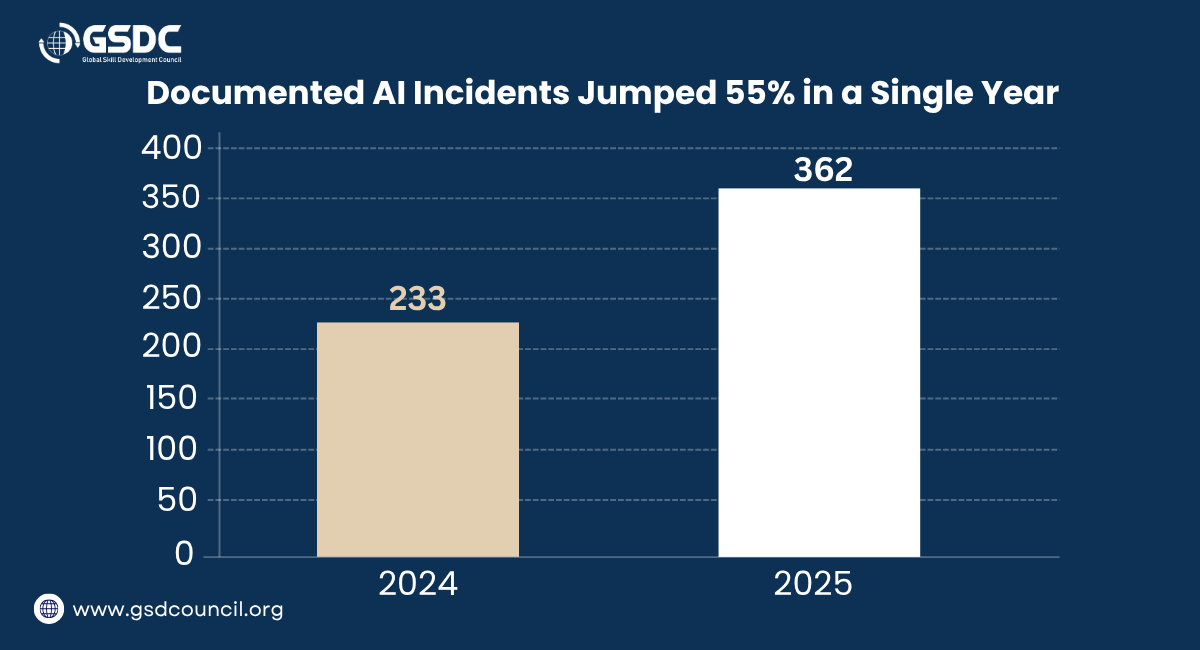
The pressure isn't hypothetical, either.Stanford HAI's AI Index found that documented AI incidents jumped to 362, up from 233 the year before, a reminder that ungoverned AI doesn't just create legal exposure, it creates real operational failures.
AI Governance Frameworks: NIST, ISO 42001 & the EU AI Act
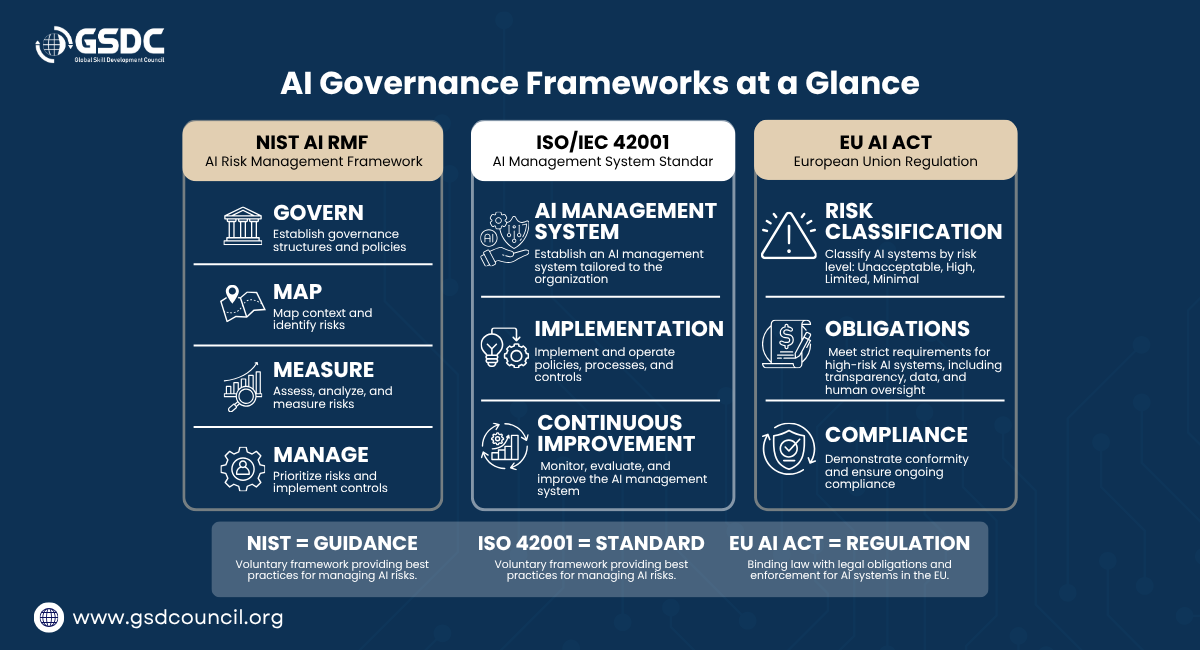
An AI governance framework is the structured approach an organization uses to actually operationalize governance, turning good intentions into repeatable practice. Rather than reinventing the wheel, most organizations build on established models. The three you'll hear about most often are:
1. NIST AI Risk Management Framework (AI RMF)
Published by the US National Institute of Standards and Technology, this voluntary framework is organized around four core functions: Govern, Map, Measure, and Manage. It's become the de facto reference point for enterprises building AI risk programs, especially in regulated industries.
2. ISO/IEC 42001
The world's first international management-system standard dedicated to AI. It gives organizations a certifiable structure, similar in spirit to ISO 27001 for information security, for establishing, implementing, and continuously improving an AI management system.
3. EU AI Act
Unlike the two frameworks above, this isn't voluntary. It's binding law across the European Union, classifying AI systems by risk level (unacceptable, high, limited, minimal) and imposing strict obligations on high-risk systems.
Framework | Type | Best For |
NIST AI RMF | Voluntary guidance | Building an internal risk-based governance program |
ISO/IEC 42001 | Certifiable standard | Demonstrating governance maturity to clients and auditors |
EU AI Act | Binding regulation | Legal compliance for AI systems used in the EU |
Most mature organizations don't pick just one. They blend NIST's risk lens, ISO's management structure, and regional regulation into a governance model that fits their actual risk profile, which is part of why GSDC built its training around all three rather than treating any single one as sufficient.
AI Governance Best Practices Worth Adopting Today
You don't need a 200-page policy manual to start governing AI responsibly. Some of the most effective AI governance best practices are surprisingly straightforward:
Set up an AI inventory.
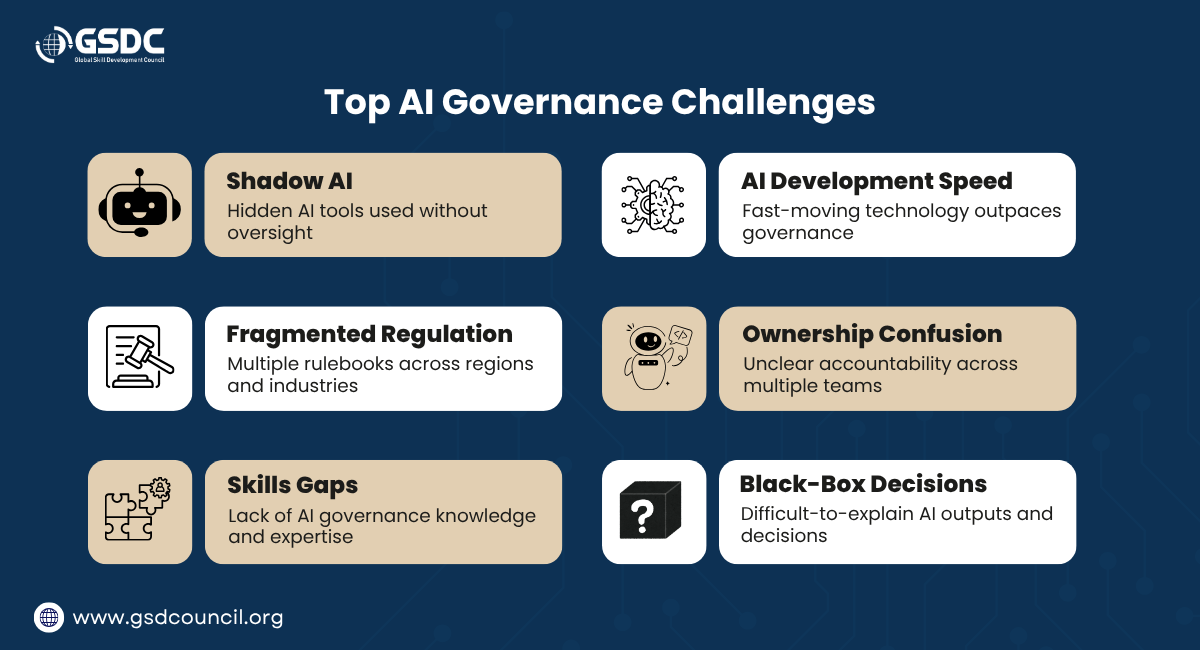
You can't govern what you can't see. Maintain a live registry of every AI system in use, including "shadow AI" tools employees adopt on their own.
Assign clear ownership.
Every AI system needs a named accountable owner, not just a team, but a person.
Build human-in-the-loop checkpoints.
High-stakes decisions (hiring, credit, healthcare, safety) should always have a human review step before final action.
Document model decisions.
Keep records of training data sources, testing results, and known limitations; this becomes essential during audits or incident investigations.
Test for bias and drift regularly.
Models degrade and behave differently over time. Schedule periodic re-evaluation, not just a one-time check at launch.
Train employees on responsible use.
Most governance failures aren't malicious; they come from people not knowing the rules exist.
Create an incident response plan specific to AI.
Traditional IT incident playbooks often don't cover model bias, hallucination, or automated decision errors.
None of these require exotic tools. They require discipline, ownership, and a framework to hang them on, which is exactly what governance training and certification programs teach in depth.
AI Governance and Compliance: Two Sides of the Same Coin
People often use AI governance and compliance interchangeably, but they're not quite the same thing.
- Governance is the internal discipline: the policies, roles, and processes an organization chooses to put in place.
- Compliance is the external obligation: meeting the laws, regulations, and industry standards that apply to your organization.
Here's the simplest way to think about it: governance is what you do because it's right and responsible. Compliance is what you must do because a regulator, client contract, or industry body requires it. Strong governance almost always makes compliance easier, because you're not scrambling to build evidence after the fact; the documentation and controls are already part of daily operations.
Understanding the AI Risk Management Framework
An AI risk management framework is the operational backbone of governance. It's how organizations identify, assess, and reduce the risks that come with building or using AI, things like biased outcomes, data privacy violations, security vulnerabilities, or simply a model that performs worse than expected in the real world.
Using the NIST model as an example, risk management typically flows through four stages:
- Govern. Establish the culture, policies, and accountability structures.
- Map. Identify where AI is used and what risks are relevant to each use case.
- Measure. Test and quantify those risks using metrics and audits.
- Manage. Prioritize and respond to risks, with ongoing monitoring.
This isn't a one-and-done exercise. Risk shifts as models are retrained, as regulations evolve, and as new use cases get added. That's why organizations increasingly look for professionals who understand risk management as a continuous cycle, not a project milestone.
AI GRC Certification: What It Is and Why It Matters
A traditional GRC certification (Governance, Risk, and Compliance) prepares professionals to manage organizational risk broadly: financial, operational, legal, and reputational. It's a well-established field with decades of practice behind it.
An Certified AI GRC Professional narrows that focus specifically to artificial intelligence: how to govern AI systems, assess AI-specific risks, and ensure compliance with AI regulation like the EU AI Act, sector-specific AI rules, and emerging global standards. It combines traditional GRC thinking with AI-specific knowledge, model risk, algorithmic bias, data lineage, and explainability, that general GRC training simply doesn't cover in depth.
As AI regulation multiplies across regions, this specialization is becoming as relevant to hiring managers as cybersecurity certifications became roughly a decade ago.
Who Should Become a Certified AI Governance Professional?
You don't need to be a data scientist to pursue this path. Professionals from compliance, legal, risk, and technical backgrounds can all build careers as certified AI governance professionals; the discipline draws on all of them. This certification tends to be a strong fit for:
- Compliance and risk officers expanding their scope to cover AI-specific regulation.
- IT and data governance leads who already manage data policy and want to extend it to AI systems.
- Legal and privacy professionals navigating AI regulation across multiple jurisdictions.
- Product and project managers overseeing AI-powered products who need to speak the governance language fluently.
- Consultants and auditors who want to offer AI governance advisory services to clients.
- Career changers looking to move into AI governance as their next specialization.
The common thread isn't a coding background. It's an interest in accountability, structure, and making sure powerful technology is used responsibly.
How to Choose an AI Governance Certification
Not all certifications are built the same way, and picking the right one matters as much as deciding to get certified in the first place. Before enrolling, weigh a program against these criteria:
Framework coverage.
Does it teach NIST AI RMF, ISO/IEC 42001, and the EU AI Act, or just one of them? Broad coverage matters more as regulation multiplies across regions.
Practical case studies.
Look for programs built around real governance scenarios (bias incidents, audit findings, model failures), not just theory.
Regulatory currency.
AI regulation changes quickly. Check when the curriculum was last updated and whether it reflects current law, not outdated draft rules.
Assessment method.
A credential built on scenario-based assessment (evaluating how you'd handle a real governance situation) tends to carry more weight than a multiple-choice-only exam.
Industry relevance.
Some programs lean heavily toward tech-sector use cases; others cover finance, healthcare, and the public sector. Match the program to where you work or want to work.
Career applicability.
Check whether the certification maps to recognizable roles, such as AI governance analyst, AI risk officer, or responsible AI lead, so the credential reads clearly on a resume.
Running any certification through this checklist will tell you quickly whether it's a serious professional credential or a surface-level course wearing a governance label.
The Future of AI Governance
A few trends are already shaping where this is headed:
- More RFPs and vendor contracts now ask for proof of AI governance maturity before a deal closes.
- Regulation will likely stay fragmented, with organizations juggling overlapping regional rules for years to come.
- Deloitte's enterprise AI survey found 74% of companies expect to use AI agents within two years, but only 21% have a mature governance model for them today.
- Employers increasingly look for candidates who can show structured framework knowledge, not just general AI familiarity.
- Titles like "AI Governance Officer" are already showing up in large enterprises, and boards will keep pushing for clearer accountability.
Organizations that build this capability now, before an incident forces the issue, end up in a much stronger position.
AI GRC Certification: What a Strong Program Looks Like
A strong AI GRC certification doesn't treat governance as something you memorize for a test. It teaches it as a skill you apply. That means real depth on NIST AI RMF and ISO/IEC 42001, case studies pulled from regulated industries instead of made-up scenarios, and risk methods you can actually use: building an AI inventory, running a bias audit, recommending controls that hold up.
It also needs to work for the different people who show up to this field. Compliance and risk officers stretching into AI. Legal and privacy specialists dealing with regulation across jurisdictions. Career changers looking for a real way in. What matters isn't the certificate on the wall. It's whether someone can look at an AI system, map it against a governance framework, find the gaps, and say what to do about them.
That's the kind of program GSDC has built. Its Certified AI GRC Professional certification is applied and framework-driven, not theoretical.
Final Thoughts
AI governance isn't a passing trend tied to a regulatory news cycle. It's becoming a permanent function inside every organization that uses AI at scale, which, increasingly, is every organization. The gap between AI adoption and AI oversight is wide right now, and that gap represents genuine opportunity for professionals willing to build the right expertise.
If you're ready to move from "aware of AI governance" to "qualified to lead it," now is a good time to start.

Related Certifications
Frequently Asked Questions
It's a credential that shows you know how to govern AI systems responsibly, not just talk about it. That covers frameworks like NIST AI RMF and ISO/IEC 42001, how to actually assess risk, and regulatory pieces like the EU AI Act.
If you're in compliance, risk, legal, or IT governance, increasingly yes. Regulation keeps expanding, and companies need people who can put governance into practice, not just nod along to the idea of it. That said, the value really comes down to the program itself: look for solid framework coverage and learning built around real scenarios, not theory.
It takes the traditional GRC playbook, governance, risk, and compliance, and applies it to AI specifically. So alongside the usual GRC practices, you're also dealing with things like model bias, data lineage, and explainability.
Compliance officers, risk managers, legal and privacy people, IT governance leads, product managers working with AI, consultants, and anyone switching careers into this space. It's a wide net.
Yes, and honestly it's a good fit. Most of the work is policy, accountability, and risk thinking, not writing code or building models, so people coming from legal, compliance, or risk backgrounds tend to pick it up fast.
NIST AI RMF, ISO/IEC 42001, and the EU AI Act come up most, plus a growing list of sector- and region-specific rules.
Governance is what you choose to do: the internal policies and controls you put around AI. Compliance is what you have to do: meeting specific laws and standards. Get governance right and compliance tends to follow.
Stay up-to-date with the latest news, trends, and resources in GSDC
If you like this read then make sure to check out our previous blogs: Cracking Onboarding Challenges: Fresher Success Unveiled
Not sure which certification to pursue? Our advisors will help you decide!