Agentic AI Roadmap: What to Learn and Use to Get Hired
Written by Matthew Hale
- What Is Agentic AI, Really?
- Agentic AI Architecture: What's Actually Under the Hood
- How Agentic AI Workflows Actually Run
- How to Create an AI Agent: A Practical Starting Path
- Agentic AI Frameworks: The Real Landscape Right Now
- Agentic AI Tools Beyond the Frameworks
- Skills You Need to Build AI Agents
- Agentic AI Learning Path: A Realistic Sequence
- Agentic AI Jobs, Roles, and What They Actually Pay
- Building Your Career in Agentic AI
- Conclusion
A year ago, "AI agent" was a slide in a vendor deck. Today it's a hiring category. Gartner expects 40% of enterprise applications to ship with task-specific AI agents by the end of 2026, up from under 5% a year earlier, roughly an eightfold jump. That's why so many people are typing "agentic AI roadmap" into Google right now.
This blog covers what agentic AI actually is, how it's architected, which frameworks and tools matter, the skills worth learning first, and what the job market and salaries genuinely look like.
What Is Agentic AI, Really?
Let's define agentic AI in plain terms, because the word gets thrown around loosely.
A regular AI chatbot answers what you ask. An agentic AI system decides what needs to be done, breaks it into steps, uses tools to carry them out, checks its own work, and adjusts course when something goes wrong, largely without a human clicking "next" at every stage.
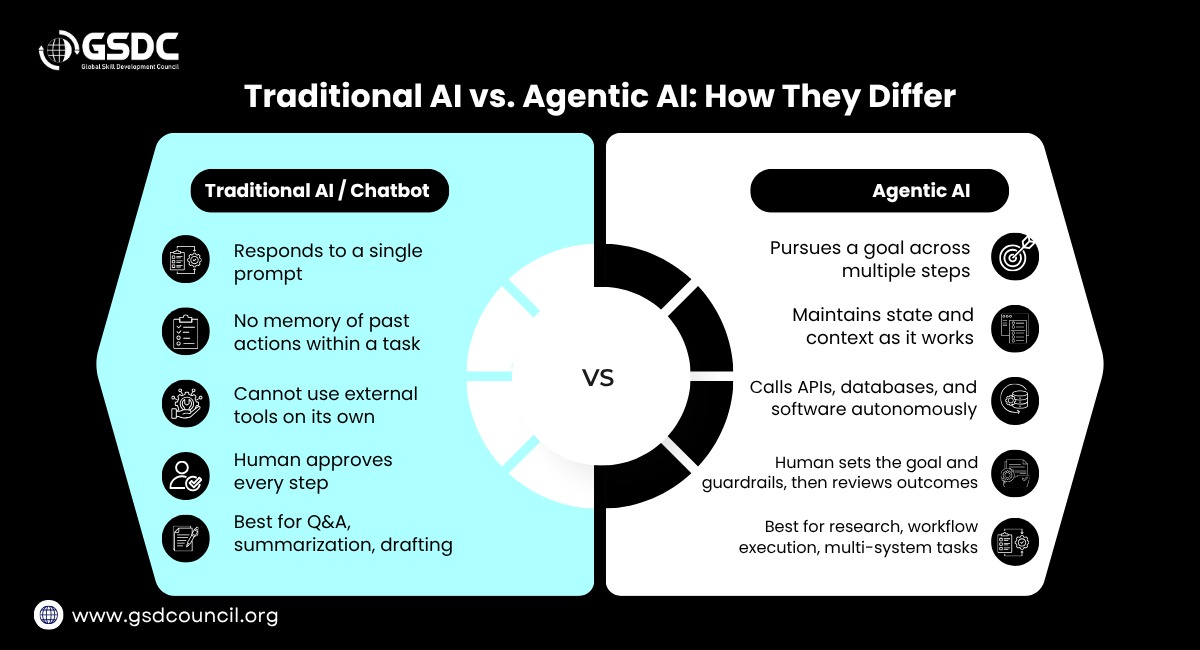
Ask a chatbot to "find flights to Delhi" and it gives general advice. Ask an AI agent, and it can search live fares, check them against your calendar, flag a conflict, and draft a booking summary.
Agentic AI Architecture: What's Actually Under the Hood
Every AI agent, regardless of the framework it's built on, tends to share the same core architecture. Understanding these building blocks matters more than memorizing any single tool, because tools change but this structure doesn't.
The simplest way to picture it: an agent is a system with a brain, a memory, a set of tools, a workflow for using them, and safety checks watching over all of it.
- Perception layer: how the agent takes in information, a user prompt, a document, an API response, or sensor data
- Reasoning and planning engine: usually a large language model that breaks a goal into steps, often using chain-of-thought or ReAct (reason, then act)
- Memory: short-term memory for the current task, long-term memory (often a vector database) for context that persists across sessions
- Tool use / action layer: how the agent calls external functions, APIs, or software, commonly standardized today via protocols like Model Context Protocol (MCP)
- Orchestration layer: the logic that manages loops, retries, and handoffs between agents in multi-agent systems
- Evaluation and guardrails: checks that catch hallucinated actions, enforce permissions, and decide when a human needs to step in
This orchestration and guardrail layer is also where most self-taught learners run into trouble, since it's rarely covered well outside a structured curriculum. It's the kind of gap that skill-development bodies like GSDC exist to close, teaching memory, tool use, and evaluation as a connected system rather than as an afterthought once the model is already picking actions.
How Agentic AI Workflows Actually Run
An agentic AI workflow is the step-by-step path a task takes once an agent picks it up:
- Goal intake: the agent receives an objective, often in natural language
- Planning: it decomposes the goal into an ordered set of sub-tasks
- Tool selection: for each sub-task, it decides which tool or knowledge source to use
- Execution: it carries out the action and captures the result
- Self-check: it evaluates whether the outcome matches intent, and re-plans if it doesn't
- Handoff or completion: it passes the task on, escalates to a human, or closes the loop
The self-check step is what separates a genuinely agentic workflow from a scripted automation. A basic script fails silently. A well-built agent notices the failure and tries a different path, and that judgment call, knowing when a result is actually good enough, is exactly the kind of skill that's hard to pick up from documentation alone. It's also a good chunk of what a structured program like the Agentic AI Professional Certification spends time on: not just how to wire up a workflow, but how to evaluate whether it's actually working.
How to Create an AI Agent: A Practical Starting Path
You don't need a research lab to build your first agent. Here's a realistic path for how to create an AI agent, whether for a portfolio or a work proof of concept.
- Pick a narrow, well-defined use case. A customer support triage agent beats "build a general assistant" every time. Scope kills more agent projects than any technical problem does.
- Choose a base model and access method. Start with an API-accessible LLM rather than fine-tuning anything at this stage.
- Define the tools it's allowed to use. List the exact APIs or functions it can call, and nothing more. Over-permissioned agents are a common source of production incidents.
- Pick a framework for orchestration rather than hand-rolling your own agent loop.
- Add memory only where it's needed. Many first agents don't need a vector database at all.
- Build in evaluation from day one. Log every decision so you can trace why it did what it did.
- Test with adversarial inputs, not just happy-path prompts, before calling it "production ready."
Agentic AI Frameworks: The Real Landscape Right Now
This is where most roadmaps get vague. Here's a straight comparison of the frameworks that actually show up in job postings and production systems.
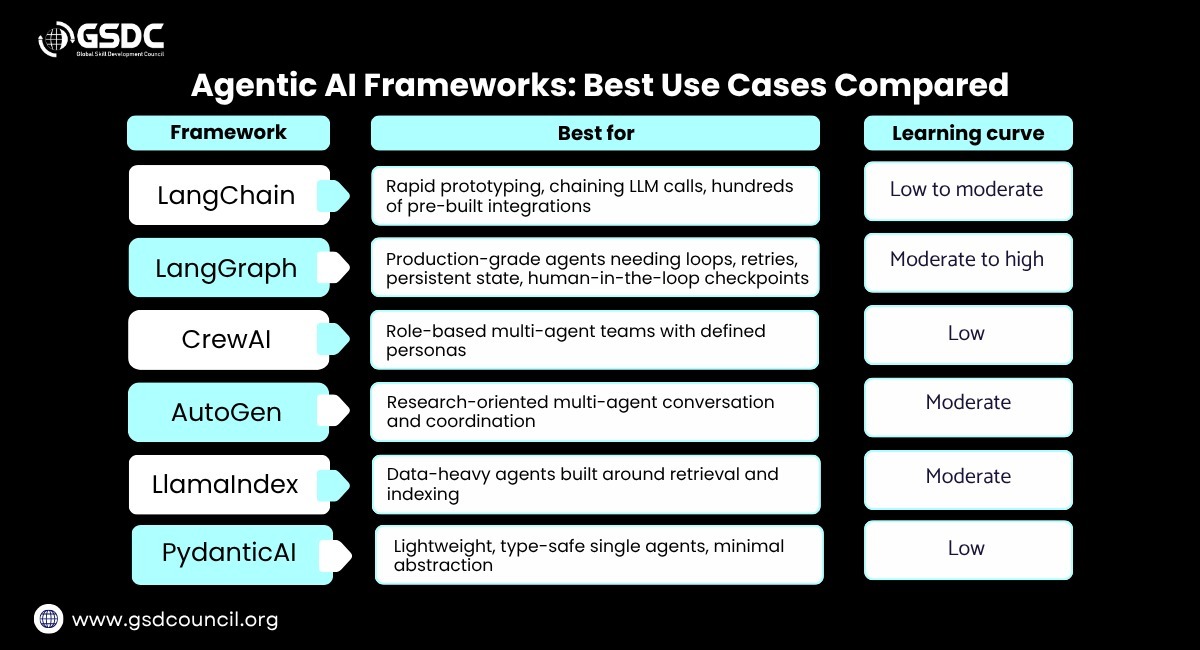
LangChain vs LangGraph: The Question Everyone Asks
The "LangChain vs LangGraph" debate is usually not an either-or choice. Both come from the same company, and LangChain 1.0's high-level create_agent function runs on LangGraph's execution engine underneath.
- LangChain is the toolkit layer: prompt templates, model wrappers, integrations, simple linear chains. It gets you to a working prototype fast.
- LangGraph is the runtime layer: it models an agent as a graph of nodes and edges, so it can loop, branch, pause for human approval, and resume exactly where it left off if a process crashes.
Rule of thumb: start with LangChain for a prototype, reach for LangGraph once your agent needs to retry a failed step, wait for sign-off, or coordinate with other agents. Many production teams end up using both.
Agentic AI Tools Beyond the Frameworks
Frameworks orchestrate the logic, but a real system also leans on a supporting stack:
- Vector databases (Pinecone, Weaviate, Chroma) for long-term memory and retrieval
- Observability and tracing tools (LangSmith, Arize, Helicone) to see what an agent actually did
- Model Context Protocol (MCP) servers to standardize how agents connect to external tools and data
- Guardrail and evaluation libraries to catch unsafe or off-policy actions before they execute
- Workflow and automation platforms (n8n, Zapier's agent tools) for teams that want agent behavior without heavy custom code
Many job postings now ask for hands-on familiarity with several of these tools, not just theoretical framework knowledge.
Skills You Need to Build AI Agents
Strip away the buzzwords, and agentic AI skills employers hire for cluster into a few honest categories.
Technical foundations
- Solid Python (still the dominant language for agent development)
- Prompt engineering and context design
- API design and integration
- At least one orchestration framework (LangChain and LangGraph appear in the largest share of framework-specific listings)
- Vector databases and retrieval-augmented generation (RAG)
- Basic MLOps: deployment, monitoring, versioning
Agent-specific skills
- Multi-agent system design and inter-agent communication
- Building and evaluating tool-use and function-calling logic
- Writing evaluation harnesses for non-deterministic outputs, genuinely one of the hardest and most valued skills right now
- Debugging agent traces and reasoning chains, not just reading final outputs
Judgment skills a tutorial won't teach
- Knowing when an agent is the wrong solution for a problem
- Scoping tasks narrowly enough that an agent can actually succeed
- Designing guardrails and human checkpoints for high-stakes actions
That gap between "impressive demo" and "trustworthy production system" is where most current hiring demand sits.
Agentic AI Learning Path: A Realistic Sequence
If you're mapping out your own agentic AI learning path, sequencing matters more than trying to learn everything at once.
Stage 1: Foundations: Python, REST APIs, and how LLMs generate text. Understand prompting before touching a framework.
Stage 2: Single-agent building: Build two or three small agents in LangChain. Focus on tool use and basic memory, and deploy one somewhere real.
Stage 3: Production patterns: Move into LangGraph, learn state management, retries, and human-in-the-loop design, plus observability and evaluations.
Stage 4: Multi-agent systems: Study how agents hand off work and negotiate roles. CrewAI or AutoGen are common starting points.
Stage 5: Structured validation: Many learners round this out with a structured, instructor-led program rather than scattered tutorials, particularly for the governance and enterprise-deployment side that's hard to self-teach.
Agentic AI Jobs, Roles, and What They Actually Pay
The agentic AI job market has moved fast enough that job titles are still settling.
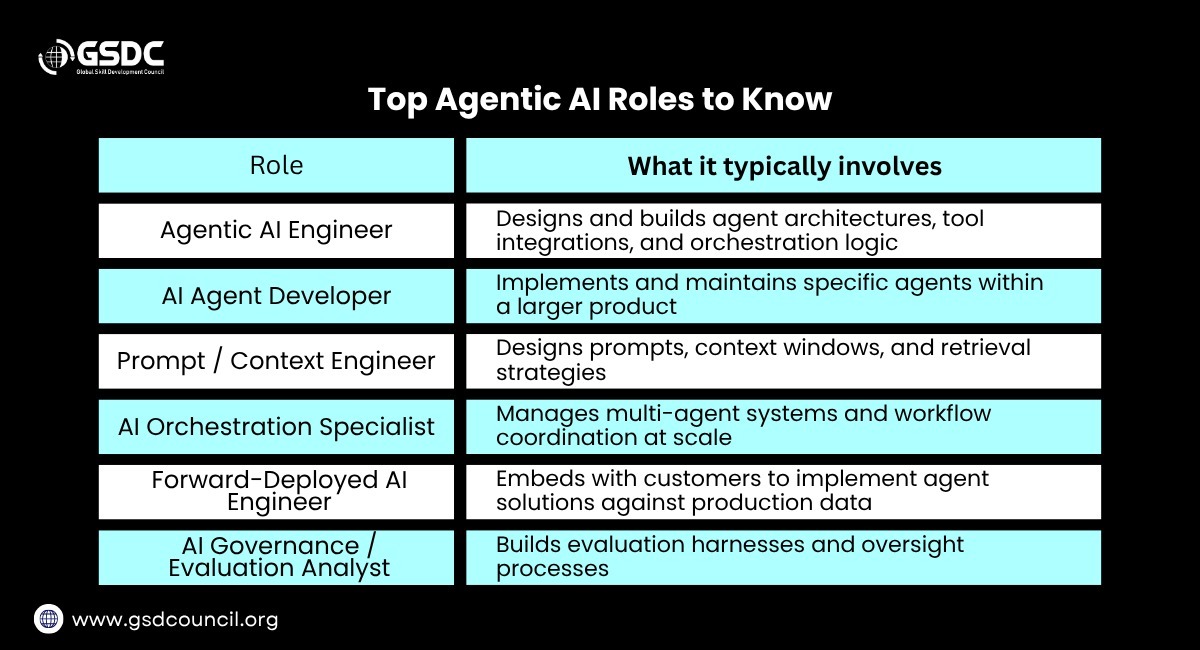
A typical agentic AI job description now asks for Python, orchestration frameworks, API integration, and increasingly, direct production experience rather than just prototyping.
On agentic AI jobs salary, "agentic AI engineer" is a new enough title that data sources land in very different places:
Source | Region | Reported range | Note |
United States | $152,427–$247,443/yr (25th–75th percentile), average $192,826/yr, top earners up to $307,216 | Small, self-reported sample; treat as directional | |
United States (varies by state) | Roughly $96,000–$135,000/yr, wider $37,000–$155,000 spread by level | Broader listings pool, skews lower than Glassdoor | |
India | ₹5–12 LPA entry-level, ₹40–80 LPA+ for senior architects and leads | Widens further at product companies and GCCs |
The roughly $100K gap between Glassdoor and ZipRecruiter isn't a data error, it's the title problem: since "agentic AI engineer" isn't standardized, it gets attached to everything from junior integration work to senior architecture. Treat any of this as a rough band, and check current listings for your market before negotiating.
- Agentic AI hiring is concentrated at companies that have already moved agents into production, so hands-on experience counts for more than certificates alone.
- Titles overlap heavily with "AI Engineer" and "ML Engineer," so searching only "agentic AI engineer jobs" will undercount the opportunity.
Building Your Career in Agentic AI
Most people don't start their agentic AI career as an agentic AI engineer. They arrive from somewhere adjacent, and that's normal.
Common entry points:
- Software engineers, especially with API and backend experience
- Data scientists and ML engineers moving toward deployment and orchestration
- QA and automation engineers, whose testing instincts map onto agent evaluation work
- Product and business analysts moving into prompt engineering and workflow design
A realistic agentic AI career path progression:
- Junior developer building single agents under supervision
- Agentic AI engineer owning agent design and integration for a product area
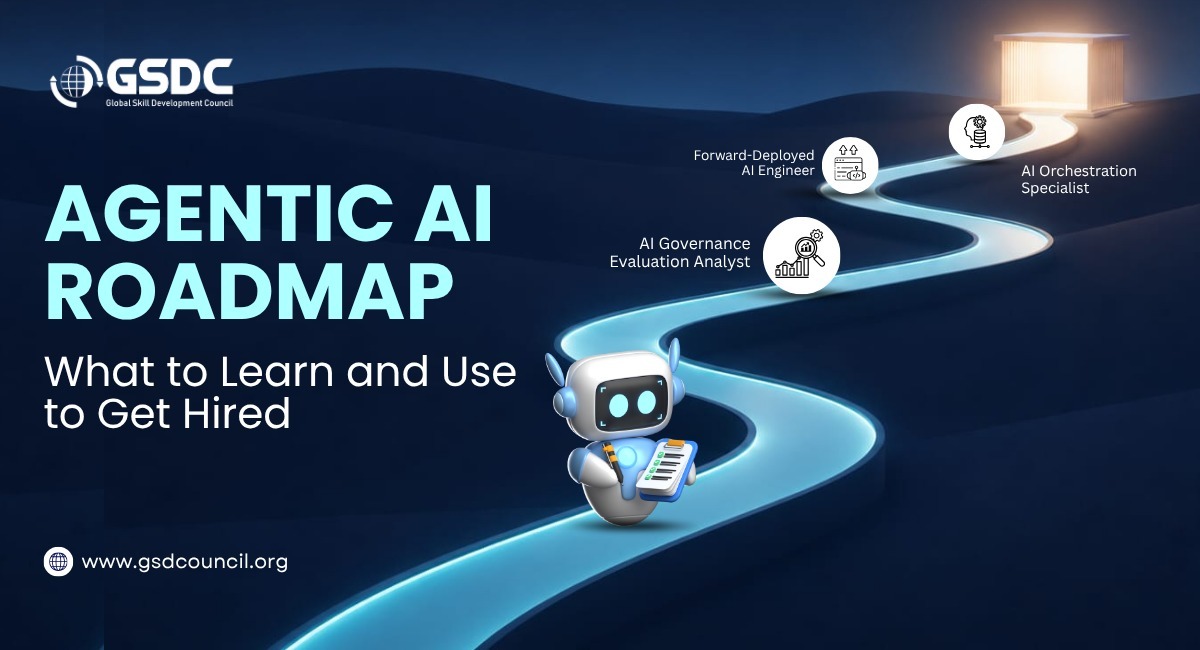
- Senior engineer or orchestration specialist handling multi-agent systems and reliability
- Staff-level architect or AI governance lead setting standards across an organization
The skill that accelerates this path fastest isn't a framework, it's demonstrated production experience: agents you've shipped, monitored, and fixed when they broke. That's harder to show when coming from an adjacent field, which is part of why career-switchers often lean on a structured credential like the Global Skill Development Council's (GSDC) Agentic AI Professional Certification, since it signals orchestration and governance knowledge that's tough to prove with side projects alone.

Conclusion
Agentic AI is still young enough that the roadmap will keep shifting, and today's "best practice" will get revised within a year. But the fundamentals here aren't going anywhere: the architecture stays the same underneath whichever framework wins, and hiring keeps rewarding people who can point to something they actually shipped over people who can only describe what they'd build.
If you take one thing away from this, let it be the order of operations: learn the architecture, build something small and real, then let the frameworks, certifications, and job titles catch up to you.

Related Certifications
Frequently Asked Questions
Python, at least one orchestration framework (LangChain or LangGraph), API integration, RAG and vector databases, and evaluation harnesses for non-deterministic outputs.
No. LangGraph runs as a runtime layer, and LangChain's own high-level agent abstraction now executes on top of it. Most teams use both.
No, though strong Python fundamentals are close to non-negotiable. Many practitioners moved in from data science, QA automation, or backend development.
For someone with existing software or data experience, three to six months of focused, project-based learning is realistic, longer if you're learning to code from scratch.
Not quite. Automation follows fixed, pre-scripted rules. Agentic AI systems reason about the goal, choose their own steps, and adapt when something unexpected happens, a meaningfully harder engineering problem.
It's positioned for learners past the basics who want structured coverage of multi-agent orchestration, governance, and deployment. You can review the full curriculum on the GSDC Agentic AI Professional Certification page.
Stay up-to-date with the latest news, trends, and resources in GSDC
If you like this read then make sure to check out our previous blogs: Cracking Onboarding Challenges: Fresher Success Unveiled
Not sure which certification to pursue? Our advisors will help you decide!