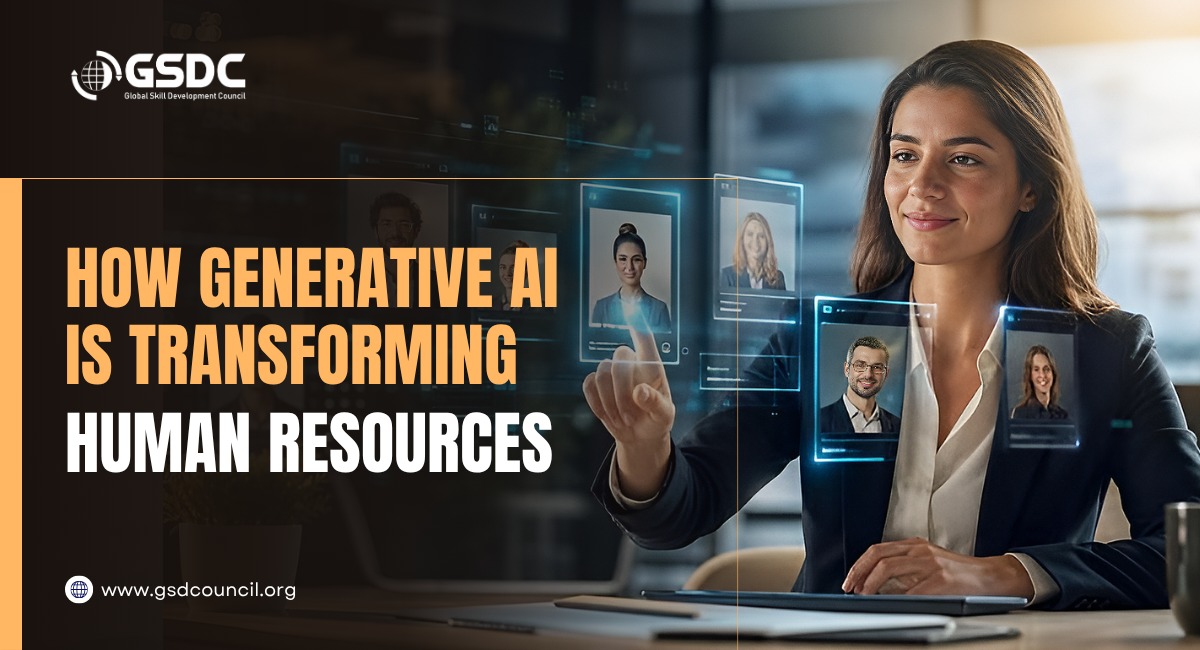
How Generative AI Is Transforming Human Resources
Written by Matthew Hale
- What Is Generative AI in HR, Exactly?
- Generative AI HR Use Cases: Where Enterprises Are Actually Using It
- AI in HR Examples: What This Looks Like in Practice
- Benefits of Generative AI in HR
- Risks and Challenges of AI in HR
- The Future of Generative AI in HR
- What HR Professionals Actually Need to Learn
- Final Thoughts
Two years ago, most HR teams' first real encounter with generative AI in human resources was a recruiter quietly using ChatGPT to draft a job posting on the side, unofficial and mostly out of curiosity. In 2026, that same task increasingly happens inside the ATS itself, sits next to a resume-matching model, and hands off to an AI agent that can screen, shortlist, and even schedule interviews, with a human stepping in only at the decision point. That's the real shift underway: HR is moving from scattered, individual AI productivity tools toward connected AI-assisted workflows and, in a growing number of enterprises, autonomous agents. And the faster that shift happens, the more governance matters, not less.
According to studies, 39% of organizations have already implemented AI in at least one HR activity, a number that's only expected to climb as the underlying tools mature.
This guide focuses on what that shift actually looks like in practice: where generative AI is doing real work in enterprise HR today, where it's really predictive or conversational AI wearing a generative-sounding label, what it delivers, what it puts at risk, and what skills HR professionals need to keep pace.
What Is Generative AI in HR, Exactly?
Generative AI is a category of artificial intelligence that creates new content, such as text, summaries, images, and even code, based on a prompt or an existing dataset, rather than just analyzing data and spitting out a score or a prediction.
That distinction matters more than most articles on this topic let on. Traditional HR AI (the kind that's been around for a decade) is mostly predictive: it scores a resume, flags flight risk, or ranks candidates. Generative AI does something different: it produces things, like a job posting, a policy FAQ, a personalized learning path, or a summary of hundreds of employee survey responses. A third category, conversational or agentic AI, handles dialogue or executes multi-step workflows.
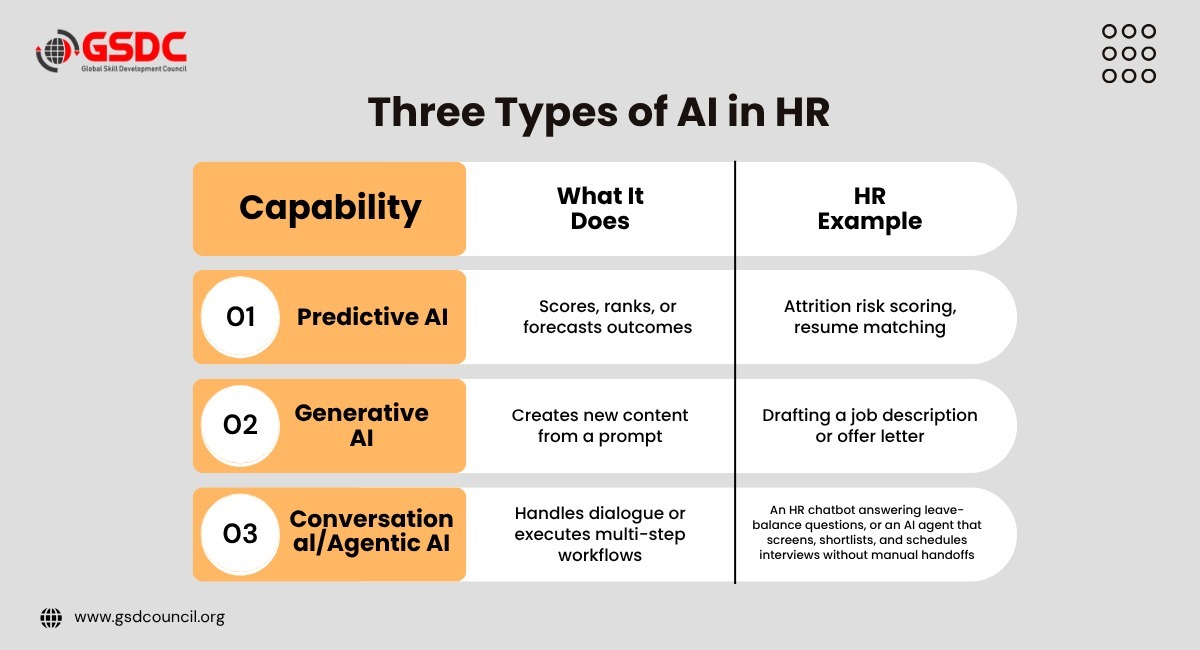
Most enterprise HR platforms in 2026 blend all three under one roof, which is exactly why "generative AI in HR" gets used loosely to describe the whole stack, even when a given feature is actually predictive or conversational. Throughout the rest of this guide, each use case is labeled by which of the three it actually is, so the terminology stays honest.
Generative AI HR Use Cases: Where Enterprises Are Actually Using It
This is the part most people actually want to know: not "can AI theoretically help HR," but "where is it working right now, in real companies." Here's a function-by-function look at the most common use cases, with the underlying AI type flagged for each.
1. AI in HR Recruitment
Recruitment is often where AI shows up first, because the workflow is repetitive, high-volume, and easy to measure.
- Job description generation (generative): drafting bias-checked, role-specific postings in seconds instead of adapting an old template
- AI-written outreach and follow-up messages (generative): personalized recruiter emails at scale
- Interview question generation (generative): role-specific, competency-based questions built from the job description itself
- Candidate FAQ chatbots (conversational): answering "what's the interview process" or "when will I hear back" instantly
- Resume screening and candidate matching (predictive): parsing applications and ranking them against role requirements. This is the piece most often mislabeled "generative AI" online; it's really a classification model, not a content generator, even though it usually ships inside the same platform
LinkedIn's 2025 Future of Recruiting report found that by automating time-consuming tasks like drafting and initial outreach, generative AI is freeing recruiters to spend more time on relationship-building and candidate experience rather than paperwork.
2. Onboarding, Engagement, and Employee Experience
- Auto-generating personalized onboarding checklists and welcome kits (generative) based on role, department, and location
- Drafting policy summaries and FAQs from dense compliance documents (generative) so new hires actually read them
- Conversational AI assistants (conversational) that answer routine questions without a helpdesk ticket
- Summarizing open-ended survey comments into digestible themes (generative), instead of a manager reading hundreds of free-text responses
- Detecting early signals of disengagement or burnout risk (predictive) from patterns in communication and workload data
This is also the category organizations like the Global Skill Development Council (GSDC) tend to spotlight first when training HR teams on AI, since onboarding and engagement are where employees form their earliest impression of how the company actually uses this technology.
3. AI in HR Learning and Development
This is one of the fastest-growing categories of generative AI HR use cases in 2026, and one where predictive and generative AI genuinely work together.
- Generating personalized learning paths (generative, built on predictive skill-gap analysis) based on an employee's role and career goals
- Creating training content, quizzes, and microlearning modules automatically from existing documentation (generative)
- Summarizing course completion and skills data into manager-ready reports (generative)
- Powering AI coaching tools that simulate difficult workplace conversations for practice (generative/conversational)
It's also worth noting that L&D is where this technology loops back on itself: a certification in generative AI in HR and L&D is, in practice, the kind of program these same personalized-learning-path tools are built to deliver, which makes L&D teams especially well positioned to pilot AI skill-building internally before rolling it out anywhere else.
4. Performance, Operations, and Compliance
- Drafting first-pass performance review summaries (generative) from check-in notes, goals, and project data, with the manager reviewing and refining, not rubber-stamping
- Summarizing 360-degree feedback into clear, actionable themes (generative)
- Flagging vague or biased language in written reviews before they're sent (predictive/classification)
- Turning benefits and policy documents into plain-language, searchable FAQs (generative)
- Auto-generating compliance reports and audit summaries, and drafting internal communications in a consistent, approved tone (generative)
AI in HR Examples: What This Looks Like in Practice
To make this concrete, here are the kinds of real-world scenarios enterprises are running today:
- A recruiter pastes a rough set of role requirements into a generative AI tool and gets three job-description drafts in different tones within a minute. She edits one instead of writing from scratch.
- An employee messages an HR chatbot at 9 p.m. asking how many personal days they have left, and gets an instant, accurate answer pulled directly from the HRIS. No ticket, no wait.
- A learning and development team feeds a new compliance policy into an AI tool and gets a five-question quiz and a two-minute microlearning script generated automatically.
- An HR business partner asks an AI assistant to summarize themes from hundreds of exit interviews conducted last quarter, and gets three clear drivers of attrition in under a minute instead of days of manual coding.
- A hiring manager receives an AI-drafted interview scorecard tailored to the specific competencies listed in the job posting.
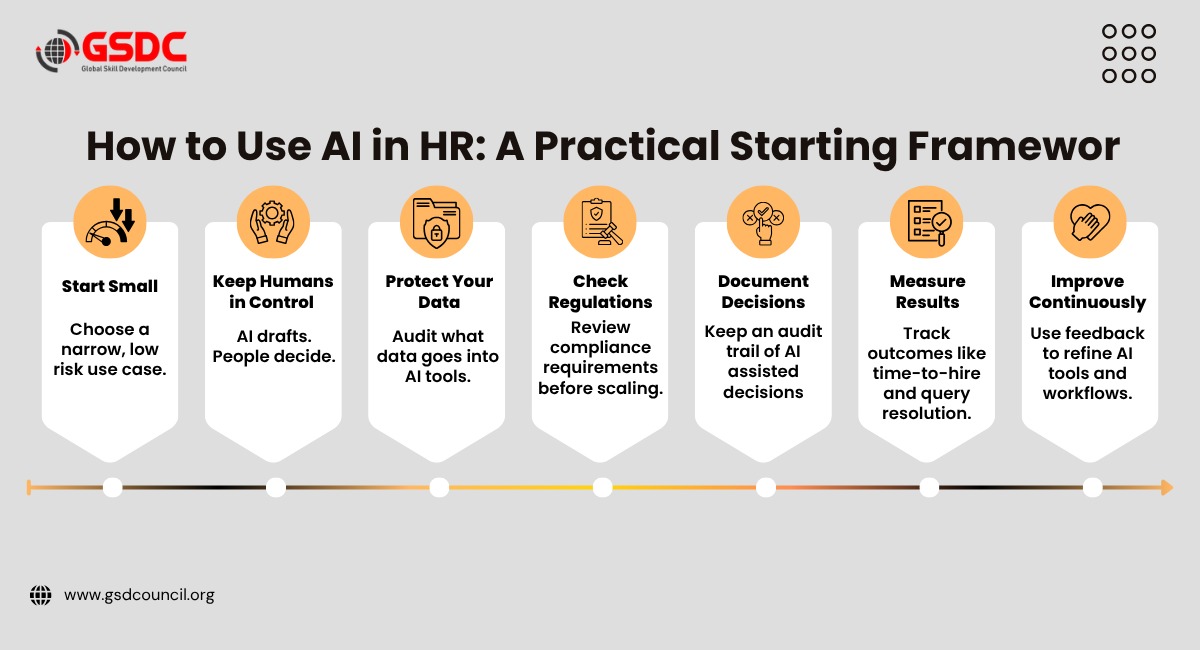
The common thread across every one of these: AI drafts, and a person still decides. That division of labor, not the technology itself, is what separates the deployments that hold up under scrutiny from the ones that don't.
Benefits of Generative AI in HR
The advantages of AI in HR tend to cluster around four themes: speed, consistency, scale, and better analysis.
- Speed: tasks that took hours, like job descriptions, policy FAQs, and review summaries, now take minutes
- Consistency: reduces variation in tone, quality, and compliance language across a large HR team
- Scale: one HR business partner can now support a meaningfully larger employee base without burning out on repetitive writing tasks
- Better analysis: generative AI helps surface patterns in employee data (survey comments, exit interviews, feedback) that would otherwise take days of manual review to find
The productivity gains tend to compound. Once recruiters aren't spending hours drafting postings, they spend more time actually talking to candidates, which is generally where hiring quality actually improves.
Risks and Challenges of AI in HR
It would be dishonest to write this without the other side. Generative AI in HR comes with genuine risks that enterprises need to plan for, not just hope around:
- Bias amplification: if training data reflects historical hiring bias, AI can quietly reproduce and even scale it
- Data privacy: HR handles some of the most sensitive personal data in any organization; feeding it into third-party AI tools without proper governance is a real exposure
- Hallucination: generative models can produce confident, well-written, and simply wrong information, which is dangerous in a compliance or policy context
- Over-automation: removing the human checkpoint entirely from decisions like hiring, promotion, or termination creates both ethical and legal risk
- Regulatory scrutiny: The EU AI Act classifies AI used for recruitment, candidate evaluation, promotion, and termination as high-risk, with key compliance obligations deferred to December 2, 2027. In the U.S., NYC Local Law 144 already requires annual independent bias audits for covered automated employment decision tools.
- Adoption friction and skills gaps: many HR teams simply haven't had the training to use these tools well yet, which slows rollout more than the technology itself does
The regulatory picture is easy to get wrong in either direction. It would be inaccurate to say HR AI is unregulated in the EU (it's formally classified as high-risk and that won't change), but it would be equally inaccurate to say the strictest EU obligations are already in force today, given the December 2027 deferral. NYC's law, by contrast, is a live, current obligation with no such delay.
The Future of Generative AI in HR
Looking ahead, a few shifts are already underway:
From tools to agents.
The next wave isn't a chatbot that answers one question. It's an AI agent that can screen resumes, shortlist candidates, and schedule interviews across several steps, handing off to a recruiter only at real decision points.
Tighter integration with core HR systems.
Generative AI is moving from a bolt-on feature to something embedded directly inside HRIS, ATS, and LMS platforms.
A real compliance deadline on the calendar.
The EU's high-risk AI obligations for employment systems now apply from December 2, 2027, not 2026 as originally planned, giving enterprises a defined window to prepare rather than an open-ended "eventually." NYC's Local Law 144 is already active today, and more U.S. states are expected to follow with similar bias-audit requirements.
Skills-based workforce planning.
Expect generative AI to play a growing role in mapping internal skill gaps to learning paths and internal mobility, rather than just external hiring.
The direction is fairly clear: the impact of generative AI on HR is moving from "helpful writing assistant" toward a genuine operating layer across the employee lifecycle, but only in organizations that pair the technology with real governance.
What HR Professionals Actually Need to Learn
HR professionals need to know how to use AI effectively, evaluate its outputs, spot bias and errors, understand governance, and handle employee data responsibly.
Global Skill Development Council (GSDC) offers the Certification in Generative AI in HR & L&D, helping HR and L&D professionals build practical skills to apply generative AI across recruitment, learning, employee experience, and HR workflows.
For professionals looking to move beyond experimenting with AI and confidently contribute to AI-driven HR initiatives, this certification offers a structured way to build those skills.
Final Thoughts
Generative AI in HR isn't a distant trend anymore. It's already drafting job descriptions, answering employee questions, and shaping learning paths inside a growing share of large enterprises, and the direction is toward workflows and agents rather than standalone tools. The organizations getting real value from it aren't the ones that adopted fastest; they're the ones that kept humans in the decision loop and treated governance as part of the rollout, not an afterthought.

Related Certifications
Frequently Asked Questions
Generative AI in HR uses AI models to create content, summarize information, answer employee questions, and support HR workflows. Common applications include job description creation, employee FAQs, personalized learning paths, performance review summaries, and training content.
Common generative AI use cases in HR include recruitment content, onboarding materials, employee communication, learning and development, performance review summaries, policy FAQs, survey analysis, and compliance reporting. Conversational and predictive AI are also often integrated into these HR workflows.
The key benefits of generative AI in HR include faster completion of repetitive tasks, greater consistency in HR communications, improved scalability, and faster analysis of employee feedback and other HR data. It can also give HR professionals more time to focus on strategic and people-focused work.
Key risks include bias, data privacy concerns, inaccurate AI-generated information, over-automation, and regulatory requirements. Organizations should use appropriate governance, protect sensitive employee data, and maintain human oversight for decisions that affect employees.
HR professionals can develop skills in prompt literacy, AI output evaluation, governance, and responsible data use through structured training. Programs such as GSDC's Certification in Generative AI in HR & L&D can help professionals build practical skills for applying generative AI across HR and learning workflows.
Stay up-to-date with the latest news, trends, and resources in GSDC
If you like this read then make sure to check out our previous blogs: Cracking Onboarding Challenges: Fresher Success Unveiled
Not sure which certification to pursue? Our advisors will help you decide!