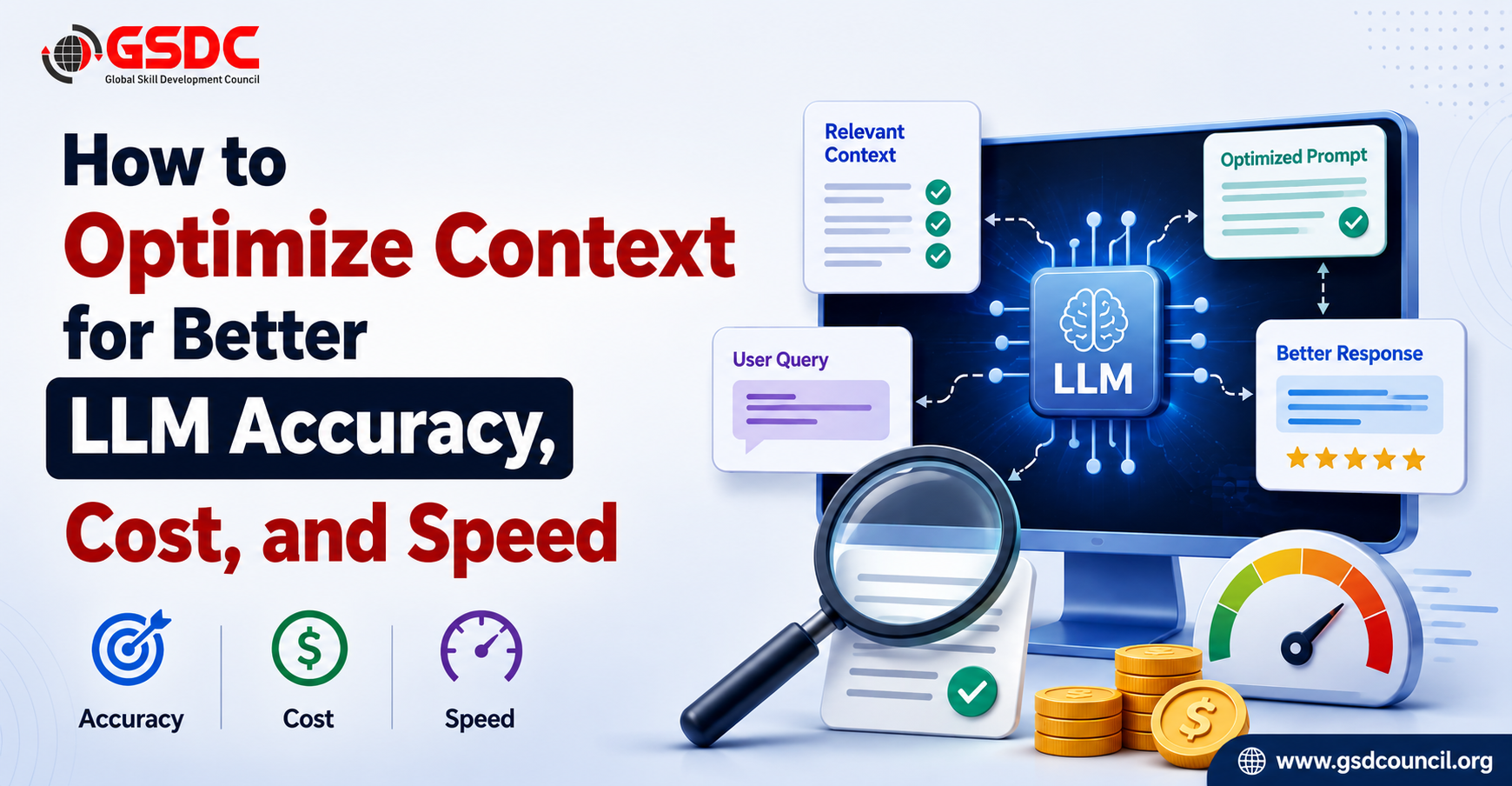
How to Optimize Context for Better LLM Accuracy, Cost, and Speed
Written by Matthew Hale
- 1. Build a Context Budget for Every Task
- 2. Retrieve Information for the Exact Question
- 3. Remove Duplicate, Outdated, and Conflicting Context
- 4. Compress Context Without Losing Important Details
- 5. Give AI Agents Different Context at Different Steps
- 6. Optimize Tool and Memory Context
- 7. Measure Context Quality Alongside LLM Accuracy and Cost
- 8. Design the Context Pipeline Before Changing the Model
- Take Your Context Engineering Skills Further
- Conclusion
A large context window does not automatically make an LLM application better. In fact, giving a model too much information can make responses slower, more expensive, and sometimes less accurate. The real challenge is deciding what information the model needs for a specific task, when it needs it, and how that information should be presented. This is where context engineering becomes important.
For teams building RAG applications, copilots, and AI agents, context optimization is becoming a core part of LLM optimization. Instead of constantly changing models or rewriting prompts, the bigger gains often come from improving the context pipeline itself.
1. Build a Context Budget for Every Task
The first step in context engineering is to stop treating the context window as unlimited storage. Every task has a different information requirement, so the amount of context sent to the model should depend on what the model actually needs to complete that task. A customer-support question may require a customer's current order, the relevant policy, and a few previous interactions, while a research task may require several documents and supporting evidence. Sending the same large context to both tasks wastes tokens and can introduce irrelevant information.
Create a context budget based on the task and divide the available context into areas such as instructions, conversation history, retrieved knowledge, memory, and tool results. Then measure how much of each category is actually being used. Metrics such as input tokens per request, repeated tokens, retrieved tokens, and irrelevant context can reveal where the system is wasting resources. This approach makes context optimization measurable instead of relying on assumptions about how much information an LLM needs.
Instead of Sending | Send This |
| Full customer history | Recent interactions relevant to the current issue |
| Entire company policy | The specific policy section that applies |
| All available product information | Information about the product being discussed |
| Every previous agent action | Decisions and actions that affect the current task |
| All tool definitions | Only the tools needed for this task |
2. Retrieve Information for the Exact Question
Retrieval should not be based only on the general topic of the user's request. A user asking about an enterprise cancellation policy does not need every document related to subscriptions, billing, pricing, and customer accounts. They need the specific policy, the conditions that apply to their account, and possibly the latest version of that policy.
A stronger retrieval pipeline first understands the intent of the question, retrieves a wider set of possible results, and then narrows them down using relevance, metadata, and reranking. Factors such as document type, product, region, customer segment, effective date, and policy version can remove irrelevant results before they reach the LLM. The goal is not to retrieve the largest possible collection of documents. It is to give the model a small set of high-confidence evidence that directly supports the task.
User Question | Weak Retrieval | Better Retrieval |
| Can I get a refund after cancellation? | All billing and subscription documents | Current cancellation and refund policy |
| Is this product available in Germany? | All product documentation | Germany availability + product inventory |
| Why did this payment fail? | General payment documentation | Customer's transaction + relevant failure reason |
| Can this employee access the system? | Complete security policy | Access policy + employee role + current permissions |
3. Remove Duplicate, Outdated, and Conflicting Context
One of the most overlooked areas of context engineering AI systems is context quality. A retrieved document may be relevant to the query but still be harmful if it is outdated, duplicated elsewhere, or contradicts a newer source. Sending five versions of the same policy to an LLM and expecting it to determine which one is correct is an unnecessary reasoning burden.
Context should therefore be cleaned before generation. Duplicate information should be removed, outdated sources should be filtered using metadata such as version and effective date, and conflicts should be identified explicitly. For example, instead of giving an agent two conflicting refund policies, the context can identify one as the current policy and the other as superseded. This makes the model's job easier and reduces the chance that it produces an answer based on an older or less authoritative source.
What Enters the Context | Problem | What Should Happen |
| 3 copies of the same document | Wasted tokens | Keep one |
| Old version of a policy | Incorrect answer risk | Remove or mark as outdated |
| Two policies with different rules | Model may choose the wrong one | Identify the current authority |
| Low-quality source | Weak evidence | Rank trusted sources higher |
| Overlapping chunks | Repeated information | Merge or remove overlap |
4. Compress Context Without Losing Important Details
Long conversations and large documents can quickly consume the available context. However, simply summarizing everything is not a reliable solution because summaries can remove details that become important later. Context compression should be based on the task rather than on document length alone.
For conversations, preserve information such as the user's objective, decisions already made, unresolved issues, important constraints, and commitments made by the system. For documents, retain the facts, conditions, exceptions, and evidence that are relevant to the current task. This creates a compact representation without forcing the model to process an entire conversation or document repeatedly. Good compression is therefore not about making text shorter; it is about preserving the information that has future value.
Original Conversation | What Should Survive Compression |
| Customer explains the problem across 8 messages | The actual problem and desired outcome |
| Agent suggests three solutions | The solution the customer accepted |
| Customer repeats the same information | One confirmed version of the information |
| Several troubleshooting steps are discussed | Steps already completed |
| Customer mentions a business constraint | The constraint that still affects the solution |
| Old issue was resolved earlier | Only the decision if it affects the current issue |
5. Give AI Agents Different Context at Different Steps
An AI agent should not carry the same context through every stage of a workflow. An agent researching a question, calling a database, validating a result, and writing a final response has different information requirements at each stage. Giving every step the complete conversation, every retrieved document, and every available tool definition increases token usage and can make the workflow harder for the model to manage.
Effective context engineering for AI agents treats context as dynamic task state. The research stage can receive the user's question and search constraints, while the reasoning stage receives only the strongest evidence. A tool-calling stage needs the relevant tool schema and required parameters, while the final response stage may only need the verified result and supporting evidence. This selective approach can significantly reduce unnecessary context while keeping each step focused on the information it actually needs.
Agent Step | What It Needs | What It Does Not Need |
| Understand the request | User's question and constraints | Full company knowledge base |
| Search for information | Search intent and relevant filters | Previous tool results |
| Compare information | Best retrieved sources | Every document found during search |
| Call a database | Required customer/account details | Unrelated documents |
| Check the result | Tool result + applicable business rule | Full conversation history |
| Write the response | Verified answer + user's requested format | Internal search process |
6. Optimize Tool and Memory Context
Tools and memory can quietly become major sources of context bloat. An agent with access to dozens of tools does not need every tool description in every request. Similarly, a memory system should not continuously send every fact it has collected about a user or every previous interaction.
Tool context should be loaded based on the current task, with irrelevant tool schemas kept outside the active context. Memory should follow a similar principle. Stable and reusable information can be retained, while temporary details and one-time interactions should be removed or summarized. This creates a cleaner separation between what the system knows and what the model needs right now, which is one of the most important principles when learning how to do context engineering at scale.
Agent Has Access To | User's Current Task | What Should Enter Context |
| CRM | Check customer's account | CRM tool + customer record |
| Payment system | Investigate failed payment | Payment tool + failed transaction |
| Send an update | Email tool + approved message | |
| HR system | Check employee information | HR tool only when required |
| Analytics system | Generate a sales report | Analytics tool + reporting requirements |
7. Measure Context Quality Alongside LLM Accuracy and Cost
Reducing token usage is not enough if the system becomes less accurate. Context optimization needs to be evaluated against several outcomes at the same time. Track answer accuracy, input-token consumption, retrieval latency, total response time, failed answers, unsupported claims, and the amount of retrieved information that actually contributes to the final response.
You can also introduce context-specific metrics such as the percentage of retrieved documents that are relevant, duplicate-token ratio, and the amount of context that is never used. These measurements can expose problems that standard LLM evaluations miss. For example, two systems may have similar answer accuracy, but one may use twice as many input tokens and take considerably longer to produce the same result. From an LLM optimization perspective, that system still has a significant efficiency problem.
What You Observe | Possible Context Problem | What to Investigate |
| Correct answer but very high token usage | Too much context | Remove repeated and irrelevant information |
| Wrong answer despite relevant documents | Conflicting or poorly ranked sources | Check source ranking and versions |
| Agent forgets earlier decisions | Important information was compressed away | Review conversation summary |
| Agent takes too long to respond | Context or retrieval is too large | Check retrieval and input-token size |
| Agent uses the wrong tool | Too many tool descriptions | Reduce available tool context |
| Similar questions produce different answers | Retrieval is inconsistent | Check ranking and context assembly |
8. Design the Context Pipeline Before Changing the Model
When an LLM application produces unreliable answers, teams often respond by switching to a larger or more expensive model. That may help in some cases, but it should not be the first optimization step. If the model is receiving irrelevant documents, conflicting information, unnecessary conversation history, or poorly selected tool results, a more powerful model is still working with a poorly designed information pipeline.
A better approach is to optimize the complete flow: understand the request, select the required context, filter and retrieve information, rerank the results, remove duplication, resolve conflicts, compress where appropriate, and assemble the final context before sending it to the model. Once this pipeline is working well, model selection becomes much easier because you can evaluate whether the remaining problem actually requires a more capable model. This is the point where context engineering and LLM optimization come together: instead of asking the model to do more with more tokens, you design the system so it can do more with better context.
If Your LLM Is Struggling With... | Don't Immediately Do This | Check This First |
| Wrong information | Move to a bigger model | Whether the right evidence was retrieved |
| Long responses | Increase output limits | Whether the instructions and context are focused |
| High costs | Switch to a cheaper model | Whether unnecessary input tokens are being sent |
| Slow responses | Increase infrastructure | Retrieval time and context size |
| Inconsistent answers | Change the model | Conflicting sources and unstable retrieval |
| Poor agent decisions | Add more instructions | Whether the agent has the right context at that step |
Take Your Context Engineering Skills Further
Optimizing context requires more than knowing how to write better prompts. You need to understand how retrieval, memory, tools, context architecture, compression, agent workflows, and evaluation work together. That is exactly where the GSDC Context Engineering Certification can help.
The program takes a production-focused approach to context engineering, covering areas such as LLM context anatomy, context architecture, RAG, advanced retrieval and reranking, memory systems, context compression, tool calling, MCP, agentic workflows, context security, and context evaluation. It also includes a capstone focused on designing a production context engineering blueprint.
With the certification, you can build skills in:
- Context Architecture: Learn how to structure instructions, user state, knowledge, tools, and other context components for different LLM applications.
- Advanced RAG & Retrieval: Understand retrieval strategies, chunking, hybrid search, reranking, query optimization, and techniques for improving the quality of information reaching an LLM.
- Context Optimization: Learn how to manage context size, token usage, compression, prioritization, and context selection without removing information that matters.
- Memory for AI Systems: Explore how short-term, long-term, semantic, and episodic memory can be designed to give AI systems useful information at the right time.
- Context Engineering for AI Agents: Learn how context can be dynamically managed across agent workflows, tool calls, sub-agents, and multi-agent systems.
- Tool Calling & MCP: Understand how tools and external systems can be connected to AI applications without unnecessarily increasing context or creating unreliable workflows.
- Context Evaluation: Learn how to evaluate retrieval quality, relevance, groundedness, context efficiency, and other factors that affect LLM performance.
- Production-Ready Context Design: Apply these concepts to real-world AI systems through practical exercises and a capstone focused on building a production context engineering blueprint.
If you want to move beyond prompt writing and learn how to design the information layer behind reliable LLM and agentic AI systems, explore the GSDC Context Engineering Certification.

Conclusion
The goal of context engineering is not to fill an LLM's context window. It is to make every piece of information entering that window useful. Better retrieval, selective memory, task-specific context, conflict handling, compression, and context measurement can improve accuracy while reducing unnecessary token usage and latency.
For modern AI applications, context should be treated as an engineered resource rather than a collection of text added to a prompt. The teams that get this right can often improve an LLM application's performance without immediately moving to a larger model or increasing infrastructure costs.

Related Certifications
Stay up-to-date with the latest news, trends, and resources in GSDC
If you like this read then make sure to check out our previous blogs: Cracking Onboarding Challenges: Fresher Success Unveiled
Not sure which certification to pursue? Our advisors will help you decide!