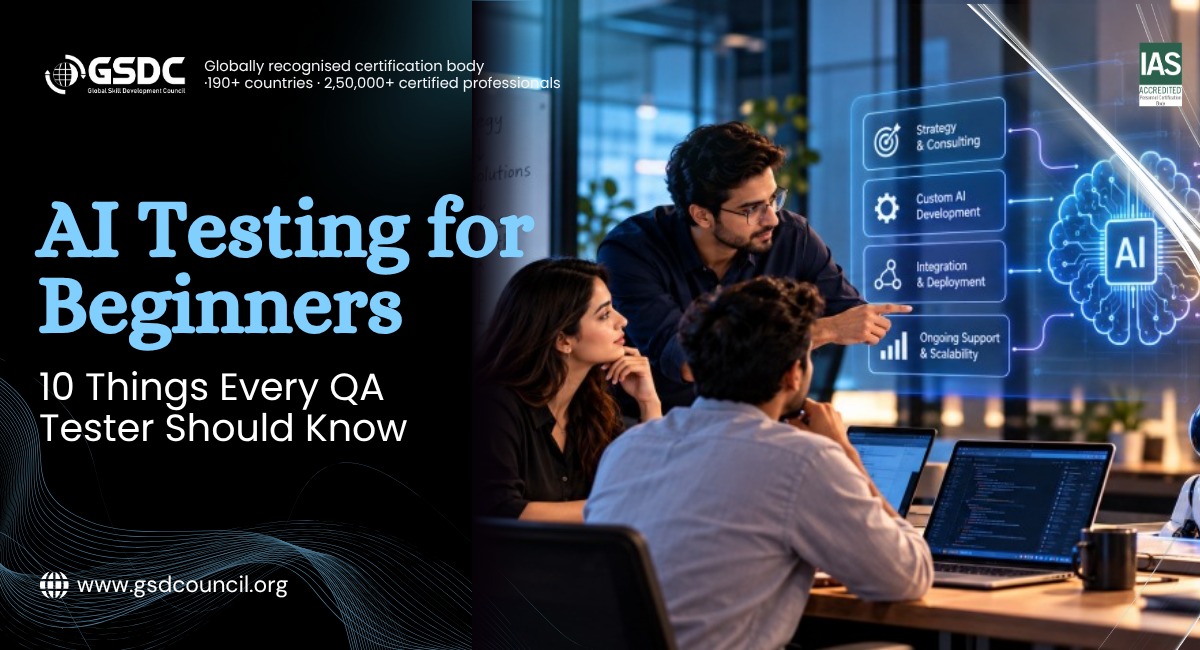
AI Testing for Beginners: 10 Things Every QA Tester Should Know
Written by Matthew Hale
- AI does not behave like normal software
- Know what kind of AI you are testing
- Learn the core metrics before you write a single test
- Use test techniques built for unpredictable output
- Test for bias, fairness and explainability
- Check robustness, safety and security
- Plan for what happens after release
- Get comfortable with AI testing tools and AI test automation
- Build your skills with an AI testing certification
- How to test AI systems: a simple step-by-step workflow
- Putting it together: testing an AI customer-support chatbot
- How to choose an AI testing certification
- Final thoughts
AI testing is quickly turning into a core part of a QA tester's job, and many teams are not ready for it. In its 2025 State of Digital Quality in Functional Testing report, Applause surveyed more than 2,100 software development and testing professionals, and about 60% said their organization already uses AI in its testing process. So the question is no longer whether you will meet AI at work, but whether you will know how to test it.
If you are about to start testing AI systems for the first time, your old playbook will only get you part of the way. Traditional testing leans on predefined expected outputs, and AI results can be much harder to pin down. This guide walks through 10 things worth knowing before you begin, in plain language, with a simple workflow, a worked example, a tools table and a certification pathway at the end.
AI does not behave like normal software
Traditional software testing often relies on predefined expected outputs. You write the expected result, run the test and see whether the two match.
AI testing is more challenging because results can be probabilistic, context-dependent or variable across repeated runs. Ask a chatbot the same question twice and you may get two different answers, and both could be perfectly fine. Some AI setups can be made more predictable, but you can't count on it. So the goal shifts from "did it match exactly" to evaluating accuracy, consistency, robustness and safety against defined acceptance criteria.
In practice, that means you will work with:
- Accuracy ranges instead of one fixed expected value
- Thresholds, such as "at least 95% correct on this test set"
- Repeated runs to see how stable the results are
Get this mindset right first. Everything else in this guide builds on it.
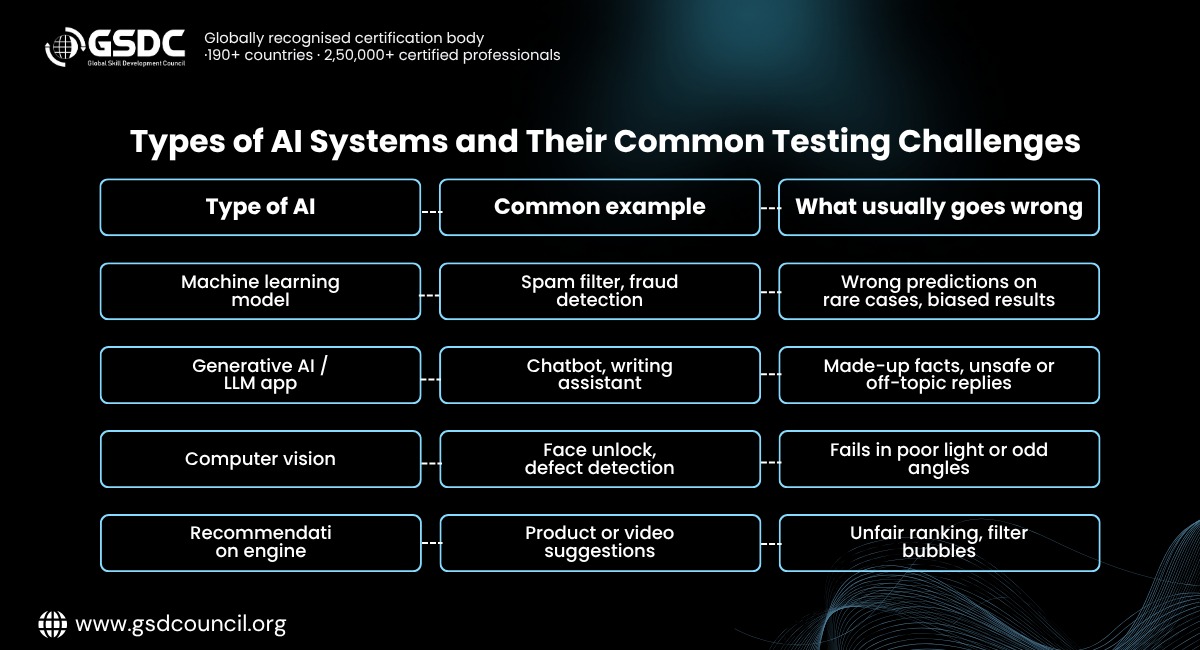
Know what kind of AI you are testing
"Testing AI" can mean two different things, and mixing them up causes confusion on day one.
- Testing AI: the AI system is the thing under test, like a fraud model or a support chatbot.
- Testing with AI: you use AI tools to help you write, run or maintain tests.
Both skills are useful. This guide focuses mostly on the first, and thing 9 covers the second. Next, check which type of AI sits in front of you, because each one fails in its own way.
Start with the data, not the model
A model is only as good as the data it learned from. Many AI bugs are really data bugs, so a smart tester looks there first.
When you review a dataset, check for:
- Missing, duplicate or outdated records
- Wrong labels, such as a cat photo tagged as a dog
- Groups that are under-represented
- Data leakage, where test data was also used for training, which makes results look better than they are
A quick habit that pays off: ask the data team for documentation on where the data came from and how it was cleaned. If nobody can answer, treat that as your first finding.
Learn the core metrics before you write a single test
When you test AI models, "it works" isn't a useful result. You need numbers. These four come up in almost every project:
Metric | What it tells you in plain words |
Accuracy | Out of all predictions, how many were right |
Precision | Out of everything the model flagged, how many were truly positive |
Recall | Out of all the real positives, how many the model found |
F1 score | A single number that balances precision and recall |
Here's why accuracy alone can fool you. Imagine a fraud model checking 1,000 transactions where only 10 are fraud. A model that says "no fraud" every time is 99% accurate, and completely useless. Recall would expose that straight away.
A confusion matrix helps here. It is a simple grid that shows true positives, false positives, true negatives and false negatives side by side, so you can see exactly where the model gets confused.
Use test techniques built for unpredictable output
Because AI doesn't give one fixed answer, you can't rely only on "input A should give output B". These approaches fill the gap:
- Metamorphic testing: change the input in a way where you know how the output should behave, then check that relationship holds. For example, a slightly rotated photo of a cat should still be labeled a cat.
- Adversarial testing: feed in tricky, odd or hostile inputs on purpose and see what breaks.
- Back-to-back testing: compare the new model against an older version or a different model on the same data.
- Exploratory testing: poke at the system with your own curiosity. Human exploratory testing remains valuable for uncovering unexpected behaviors.
If you want a first technique to try this week, start with metamorphic testing. It needs no special tools and teaches you to think about AI behavior the right way. Treat it like any new skill and practice on small, real examples. Learning-focused organizations such as the Global Skill Development Council (GSDC) build their programs around this same idea of learning by doing.
Test for bias, fairness and explainability
An AI system can score well overall and still treat certain groups unfairly. That is why overall accuracy is never enough on its own.
To check for bias:
- Split your test data by group, such as age range, gender, region or language
- Compare error rates across those groups
- Flag any group where results are noticeably worse
Explainability is the second half of this. Can someone tell why the model made a decision? This matters most in areas like lending, hiring and healthcare, where a person may need a clear reason. Rules such as the EU AI Act set documentation, transparency and human oversight duties, though which ones apply depends on how a system is classified. High-risk systems face the strictest requirements. So this is becoming a compliance topic, not only an ethics one.
Check robustness, safety and security
Real users don't behave like clean test data. They make typos, upload blurry photos, switch languages mid-sentence and sometimes try to break things on purpose. Testing AI applications means preparing for all of that.
For any AI system, try:rfdr
- Noisy or low-quality inputs, like typos, background noise or poor lighting
- Rare edge cases that barely appear in the training data
- Inputs in different languages, formats and lengths
For chatbots and other large language model (LLM) apps, add these checks:
- Hallucinations: does it state made-up facts with confidence?
- Prompt injection: can a user trick it into ignoring its rules?
- Data leaks: can it be coaxed into revealing private or internal information?
- Unsafe content: does it refuse harmful requests reliably?
Build a reusable list of tricky prompts for this. Think of it as a small red-team kit that you grow after every release.
Plan for what happens after release
With normal software, testing mostly stops at release. With AI, the real world keeps changing, and the model can slowly get worse without anyone touching the code. This is called drift.
- Data drift: the inputs users send start to look different from the training data.
- Model drift: the model's predictions become less accurate over time.
So your test plan should include monitoring in production, alerts when key metrics drop, and a fixed "golden" test set you re-run every time the model is retrained. The World Quality Report 2025 also notes that testing in production, often called shift-right, is gaining traction, although shift-left is still the dominant approach.
Get comfortable with AI testing tools and AI test automation
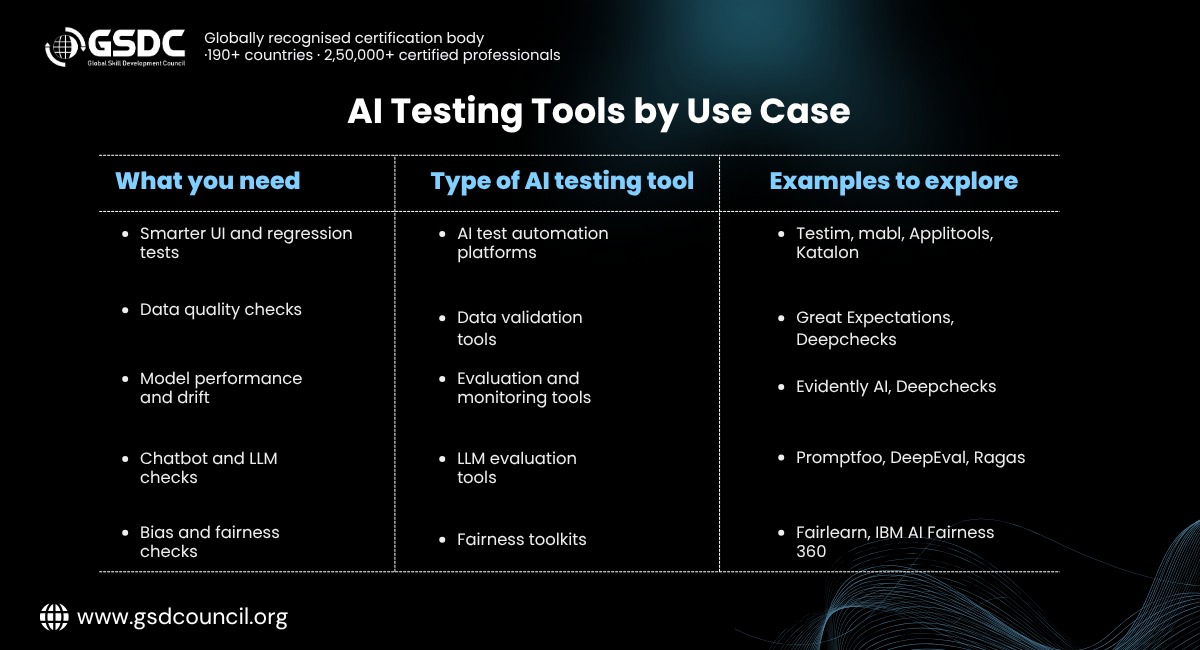
Two kinds of tools matter here: ones that help you test AI models, and AI test automation, where AI helps you generate test cases or repair broken scripts.
The tool market changes fast, so treat the names below as starting points to explore, not recommendations. Always check each tool's current documentation.
One caution before you lean on automation too hard. Lots of teams are experimenting, but the World Quality Report 2025 found that only 15% of respondents have reached enterprise-wide implementation of Gen AI in quality engineering. Tools help, yet a human still needs to review what the AI produces. AI-generated tests can look convincing and still miss the point.
Build your skills with an AI testing certification
Tools change every year. Solid fundamentals don't. That matters because the skills gap is real: in the same Applause survey, 80% of respondents said they are challenged by a lack of in-house AI testing expertise. A recognized AI testing certification gives you a structured way to learn those fundamentals and gives employers a recognized signal that you have covered the fundamentals.
The ISTQB AI Testing certification is one widely known option. According to the American Software Testing Qualifications Board (ASTQB), it covers:
- The basics of AI, including machine learning, neural networks and natural language processing
- Performance metrics such as precision, recall and confusion matrices
- Techniques like metamorphic testing for unpredictable outputs
- Testing across the full AI lifecycle, from data selection to monitoring
- Quality factors unique to AI, such as explainability, robustness and ethical behavior
- Using AI to improve your own testing work
ISTQB also offers a separate Testing with Generative AI certification, aimed at testers who use AI tools day to day.
Another option is the Certified AI Testing Professional (CAITP), a vendor-neutral certification. Its topics include AI fundamentals, bias and explainability, machine learning metrics, adversarial and metamorphic testing, and using AI to support testing, so it lines up closely with the ideas in this guide.
To prepare, you can self-study the syllabus, join a training course from an accredited provider, or mix both. Programs from the Global Skill Development Council are another option if you want guided, structured learning. Whichever route you pick, a certificate alone won't make you job-ready. Hands-on practice, like the chatbot example later in this guide, is what turns knowledge into skill.
How to test AI systems: a simple step-by-step workflow
If you want one repeatable process for how to test AI applications, start here. It works for most projects, big or small.
- Understand the goal and the risks: What is the AI meant to do, and what is the worst thing that could happen if it gets it wrong?
- Review the data: Check quality, labels, balance and leakage before you touch the model.
- Agree on metrics and thresholds: Decide up front what "good enough" means, for example 95% recall on fraud cases.
- Build your test sets: Include normal cases, edge cases and tricky cases, plus a separate set that the model has never seen.
- Run the right tests: Combine functional checks with metamorphic and adversarial testing.
- Check fairness, robustness and safety: Compare results across groups and try to break the system on purpose.
- Automate what repeats, and keep a human in the loop: Use AI test automation for routine checks and your own judgment for the rest.
- Monitor after release: Watch for drift and re-run your golden test set after every retrain.
Putting it together: testing an AI customer-support chatbot
Say your company launches a chatbot that answers billing and delivery questions. Here is how the ideas in this guide show up in a real test cycle:
- Data (thing 3): Check that the help articles it draws from are current. Outdated policy pages lead to outdated answers.
- Accuracy (thing 4): Compare its answers with a set of approved answers written by the support team, and track how many match.
- Consistency (thing 5): Ask the same question in five different ways and check that the answers agree.
- Fairness across languages (thing 6): Run the same questions in the languages your customers use and compare the results.
- Security (thing 7): Try prompt injection, and try to get it to reveal another customer's details or its own internal instructions.
- Monitoring (thing 8): Save all of this as a fixed evaluation set and rerun it after every model or content update.
One small set of checks touches most of the 10 things above, which makes it a good first project to practice on.
How to choose an AI testing certification
When you compare certifications, start with who issues the credential and whether it depends on one vendor's tools. The Global Skill Development Council (GSDC), for example, is an independent, vendor-neutral certification body. That matters in AI testing, where tools change quickly and the underlying skills last longer.
Its Certified AI Testing Professional (CAITP) maps closely to the topics in this guide, from data quality and metrics to metamorphic testing and using AI to support testing. The exam has 40 multiple-choice questions in 90 minutes, with a 65% pass mark. No prerequisites are mandatory, though some experience in testing or AI helps.
Like any certification, it is one option among several. Compare the syllabi, check which credentials employers in your market recognize, and pick the one that matches the work you actually do.

Final thoughts
Testing AI asks for a different mindset, but it is very learnable. Start with the data and the metrics, practice on a small project like the chatbot above, and build from there. A certification can give your learning structure, and it works best alongside real hands-on work.

Related Certifications
Frequently Asked Questions
AI testing is the process of checking that an AI system is accurate, fair, safe and reliable.
Start by checking the data, then measure the model with metrics like precision and recall. Add metamorphic and adversarial tests, check for bias across groups and keep monitoring after release.
It can help with things like generating test cases or spotting patterns, but it shouldn't work alone. A human tester still needs to review results, especially for high-risk systems.
Not to begin. You can learn the concepts, metrics and manual techniques first. Basic Python becomes useful once you start working with datasets and evaluation tools.
Yes. ISTQB offers an AI Testing certification and a separate Testing with Generative AI certification.
Stay up-to-date with the latest news, trends, and resources in GSDC
If you like this read then make sure to check out our previous blogs: Cracking Onboarding Challenges: Fresher Success Unveiled
Not sure which certification to pursue? Our advisors will help you decide!