Governing RAG Pipelines with ISO 42001
Written by Emily Hilton
- Understanding Retrieval-Augmented Generation and Its Risks
- How ISO 42001 AI Governance Supports RAG Systems
- Applying ISO 42001 AI Risk Management Across the RAG Pipeline
- Making RAG Systems Auditable Through Evidence
- Balancing Enterprise AI Governance with Innovation
- Building AI Governance Expertise with GSDC’s ISO 42001:2023 Lead Implementer Certification
- Conclusion
Retrieval-Augmented Generation (RAG) is becoming an important approach for organizations that want to use large language models (LLMs) with their own business documents and knowledge bases. By retrieving relevant information from approved sources before generating a response, RAG can help AI systems provide more context-specific answers. However, retrieval alone does not guarantee that the information is accurate, secure, current, or appropriate for every user.
The webinar “Governing RAG Pipelines with ISO 42001” explored how organizations can apply ISO/IEC 42001 to manage RAG-related risks, establish effective controls, and produce evidence that supports audits and investigations. The key message was clear: responsible AI governance requires more than accurate answers. Organizations must understand what their AI systems know, how they use that information, and how their decisions can be explained.
Understanding Retrieval-Augmented Generation and Its Risks
Retrieval-Augmented Generation combines information retrieval with an LLM. Instead of relying entirely on the model's existing knowledge, a RAG system searches a designated collection of documents, retrieves relevant content, and uses it to generate a response.
A typical RAG pipeline includes several stages: collecting and preparing documents, creating embeddings, storing information in a vector database, retrieving relevant content, assembling a prompt, and generating the final answer. Each stage introduces potential risks.
For example, an answer may be incorrect because the system retrieved an outdated document, failed to find the relevant information, or used a model that interpreted the retrieved content incorrectly. Other problems can arise when confidential documents are included in the knowledge base or access permissions are not properly enforced.
This is why enterprise RAG requires governance across the entire pipeline rather than focusing only on the final response. Organizations need to manage the quality, ownership, security, and lifecycle of the information their AI systems use.
How ISO 42001 AI Governance Supports RAG Systems
ISO/IEC 42001 provides requirements for establishing, implementing, maintaining, and continually improving an Artificial Intelligence Management System (AIMS). It helps organizations establish a structured approach to AI risk assessment, accountability, monitoring, and continual improvement.
For RAG systems, ISO 42001 AI governance provides a foundation for identifying risks and determining which controls are necessary for a particular use case. However, the standard should not be treated as a complete, ready-made list of technical controls for every RAG implementation.
Organizations must identify additional risks specific to their architecture and document the controls they introduce. The Statement of Applicability (SoA) is particularly important because it records which controls are applicable, which are excluded with justification, and how relevant controls are addressed.
The webinar highlighted the importance of developing custom, measurable controls for risks that are not sufficiently covered by the standard's reference controls.
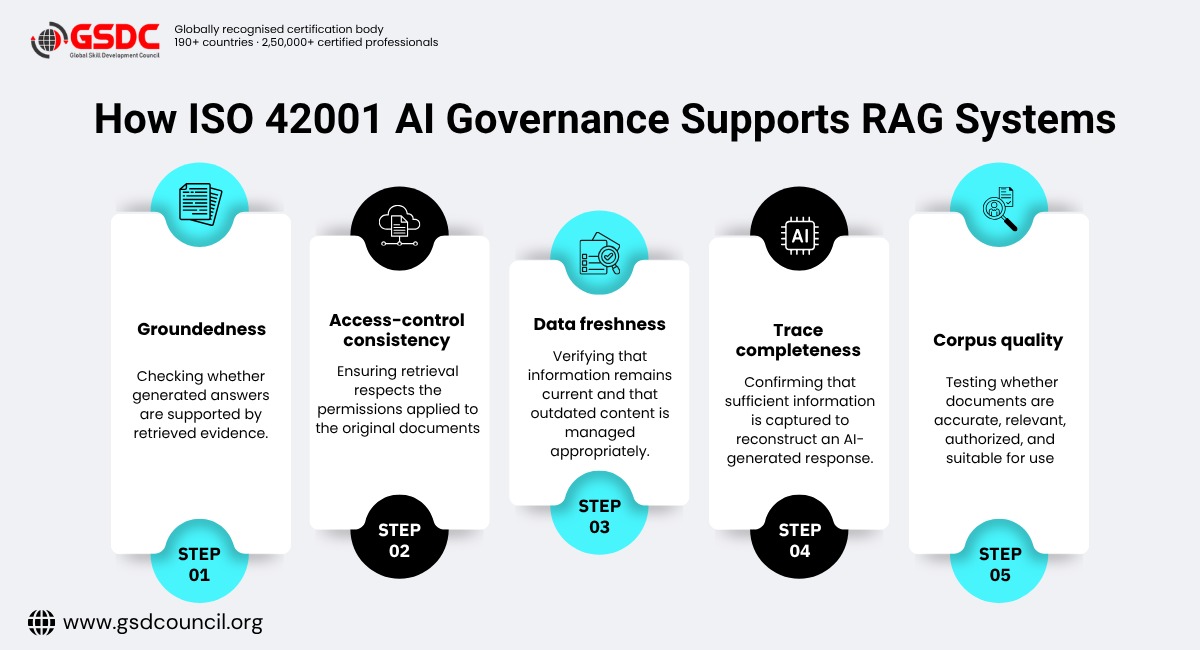
Each control should have clear acceptance criteria, a measurable threshold where appropriate, an accountable owner, and evidence that can be reviewed.
Applying ISO 42001 AI Risk Management Across the RAG Pipeline
Effective ISO 42001 AI risk management considers every stage of the system lifecycle. A useful approach is to map risks to pipeline stages and identify the corresponding controls and evidence.
1. Govern the Knowledge Base and Data Sources
The webinar emphasized that the document corpus is a governed business asset, not simply a collection of files supplied to an AI model. The quality of a RAG system depends heavily on the quality and suitability of the information it can retrieve.
Organizations should assign an owner who is responsible for the corpus's quality, access permissions, updates, and lifecycle. Before documents are added, they should be checked for accuracy, relevance, authorization, and appropriate classification. Outdated information should be updated, archived, or removed according to established rules.
Document metadata is also essential. Recording document identifiers, versions, effective dates, and other relevant details helps organizations understand which information influenced a response at a particular time.
These practices are fundamental to RAG implementation best practices because even a technically sophisticated model cannot compensate for an unreliable or poorly governed knowledge base.
2. Enforce Security and Access Controls
Enterprise RAG security requires organizations to ensure that users can retrieve only the information they are authorized to access. A system that retrieves confidential documents and includes their contents in a response can expose sensitive information even when the underlying document repository has appropriate permissions.
Access-control lists (ACLs), role-based permissions, source-system configurations, and retrieval rules must work together. Organizations should test whether the RAG pipeline preserves the original access restrictions throughout document ingestion, indexing, retrieval, and response generation.
Security requirements should also reflect how the system is exposed. An internal assistant for authorized employees generally has a different risk profile from a public-facing chatbot that accepts questions from anyone on the internet. External systems require particularly careful threat assessment, testing, and monitoring.
3. Monitor Groundedness, Quality, and Changes
RAG systems operate in changing environments. Documents are added or removed, business policies are revised, and model providers may introduce new model versions. These changes can affect responses even when users submit the same question.
Organizations should implement regular sample testing to assess corpus quality and response accuracy. Groundedness checks can help identify answers that are unsupported by retrieved sources. Where appropriate, guardrails can trigger alerts when responses fail defined thresholds, allowing teams to investigate and correct the problem.
Monitoring should cover both the knowledge base and the model. Tracking changes in retrieval quality, document freshness, model versions, and response behaviour helps organizations identify drift before it becomes a larger operational or compliance issue.
Making RAG Systems Auditable Through Evidence
A central theme of the webinar was that evidence is the product of governance, not a byproduct. A system may produce accurate answers most of the time, but organizations still need to explain individual responses when a customer complains, an incident occurs, or an auditor asks questions.
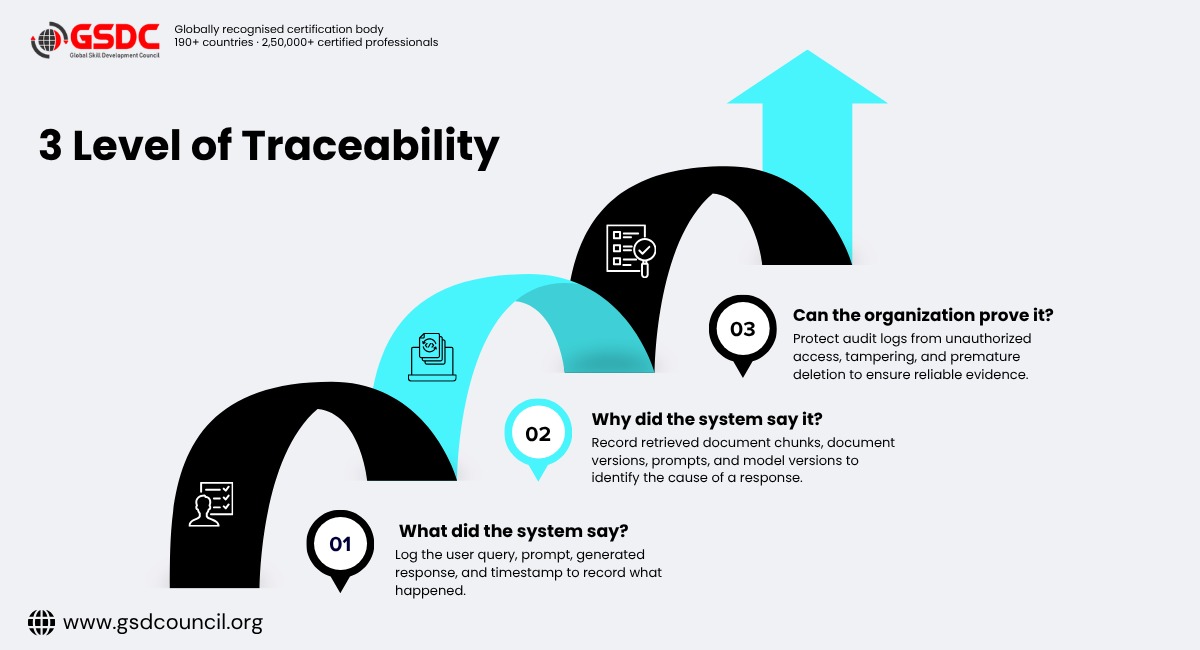
A well-designed RAG pipeline should capture relevant information at response time. Trying to reconstruct an incident months later is difficult if the documents have changed, the prompt template has been updated, or the model provider has changed the underlying model.
Organizations should define appropriate retention periods based on business needs, applicable laws, and industry requirements. Access to traces should be restricted, and records should be protected against tampering. The webinar's example of retaining traces for 24 months was specific to that implementation; it is not a universal ISO 42001 requirement.
When an issue occurs, teams can use the trace to identify the document versions involved, compare the historical corpus with the current one, locate the likely cause, implement a correction, and reevaluate the system.
Balancing Enterprise AI Governance with Innovation
Governance should enable responsible innovation rather than automatically blocking new AI capabilities. Organizations need controls that reflect the system's purpose, level of exposure, potential impact, and risk.
ISO/IEC 42001 also complements rather than replaces information security management. ISO/IEC 27001 addresses information security management, while ISO/IEC 42001 addresses the broader management of AI-related risks. Depending on the system, organizations may also need privacy controls and other applicable legal or regulatory requirements.
This distinction matters because AI systems involve more than data. They also involve models, generated outputs, and, in some cases, systems capable of taking actions. Effective enterprise AI governance coordinates these areas while preserving existing security and privacy protections.
Building AI Governance Expertise with GSDC’s ISO 42001:2023 Lead Implementer Certification
GSDC’s Certified ISO 42001:2023 Lead Implementer certification prepares professionals with practical knowledge of AI management system implementation, risk assessment, governance controls, and compliance requirements. It helps learners understand how to translate ISO/IEC 42001 principles into organizational processes, establish responsible AI practices, and support the effective management of AI systems throughout their lifecycle.
Beyond implementation knowledge, the Certified ISO 42001:2023 Lead Implementer can help professionals prepare for roles involving AI governance, regulatory compliance, risk management, and information security. It develops an understanding of policy development, cross-functional collaboration, audit preparation, and ongoing performance evaluation. These capabilities can help professionals demonstrate their expertise, support organizational accountability, and contribute to the adoption of reliable and responsible AI technologies.
Conclusion
Governing RAG pipelines requires organizations to manage the information their AI systems use, the controls applied at every pipeline stage, and the evidence needed to explain system behaviour. ISO/IEC 42001 provides a management framework for organizing this work, while custom controls address RAG-specific concerns such as groundedness, access-control consistency, corpus freshness, and traceability.
By assigning clear ownership, testing controls, monitoring changes, and maintaining reliable audit trails, organizations can build more secure, accountable, and trustworthy AI systems. Ultimately, successful RAG governance is not just about producing a useful answer. It is about being able to explain how that answer was produced and demonstrate that the system was appropriately governed.

Related Certifications
Frequently Asked Questions
Retrieval-Augmented Generation is an AI approach that retrieves relevant information from a designated knowledge source and supplies it to a language model to help generate a response. It allows organizations to use their own documents and business information to support more context-specific answers.
ISO/IEC 42001 provides a management framework for identifying AI risks, assigning responsibilities, selecting controls, monitoring performance, and improving the system over time. Organizations can use it to structure RAG governance while adding technical controls for risks specific to their implementation.
Important practices include assigning ownership of the knowledge base, validating document quality, maintaining accurate metadata, enforcing source-level access permissions, monitoring groundedness and data freshness, tracking model changes, and preserving audit evidence.
Traceability helps organizations investigate incorrect answers, information exposure, and other incidents. By recording relevant queries, retrieved document versions, prompts, model versions, and timestamps, teams can identify what information influenced a response and determine the likely cause of a problem.
No. ISO/IEC 42001 focuses on AI management, while ISO/IEC 27001 focuses on information security management. The standards address related but different needs. Organizations should maintain appropriate information security controls and integrate them with their AI governance processes.
Stay up-to-date with the latest news, trends, and resources in GSDC
If you like this read then make sure to check out our previous blogs: Cracking Onboarding Challenges: Fresher Success Unveiled
Not sure which certification to pursue? Our advisors will help you decide!