The 5 Metrics That Prove an FDE’s Value: From AI Pilot to Business Impact

Written by Emily Hilton
- 1. Time to Value: How Quickly Does AI Deliver Results?
- 2. Workflow Efficiency: Is AI Improving Productivity?
- 3. AI Accuracy and Reliability: Can the Solution Be Trusted?
- 4. User Adoption: Are People Actually Using the Solution?
- 5. Business Value and ROI: Is AI Worth the Investment?
- Conclusion: From Engineering Delivery to Measurable Business Impact
Artificial intelligence is changing how businesses operate, but adopting AI tools does not automatically translate into measurable business value. Organizations need to understand whether their AI investments are improving productivity, reducing costs, solving operational problems, and delivering sustainable results. This is where Forward Deployed Engineers (FDEs) can make a meaningful difference.
According to McKinsey’s 2025 State of AI survey, 88% of respondents reported that their organizations regularly used AI in at least one business function. However, only about one-third reported scaling AI programs across their organizations. The survey also found that 23% were scaling agentic AI systems somewhere in their enterprises, while another 39% were experimenting with AI agents. These findings highlight the gap between AI adoption and enterprise-wide implementation.
For businesses investing in AI transformation, the next question is not simply whether an AI solution works. It is whether that solution produces meaningful results.
Understanding what is a forward deployed engineer helps explain why this role matters. FDEs work closely with customers and business teams to understand operational challenges, develop tailored technical solutions, integrate them into existing systems, and improve their performance in real-world environments.
To demonstrate their contribution, organizations need clear FDE Metrics that connect engineering work with business outcomes. Five important measurement areas can help teams evaluate an FDE-led AI initiative, from its initial pilot to its long-term impact.
1. Time to Value: How Quickly Does AI Deliver Results?
The first important measure is how long it takes for an AI solution to produce a useful, measurable outcome after a business problem has been identified.
The time to value metric helps organizations assess whether an FDE can move efficiently from understanding a customer’s requirements to deploying a solution that delivers practical benefits.
For example, a customer support team may want an AI assistant that retrieves information from internal knowledge bases. The FDE must understand the workflow, connect the relevant data sources, test the assistant, address accuracy issues, and make the solution available to users.
Instead of measuring success only by development speed, the organization should track:
- Time from problem identification to the first working prototype.
- Time from prototype to production deployment.
- Time until users achieve a measurable improvement.
Number of development and testing cycles required before launch.
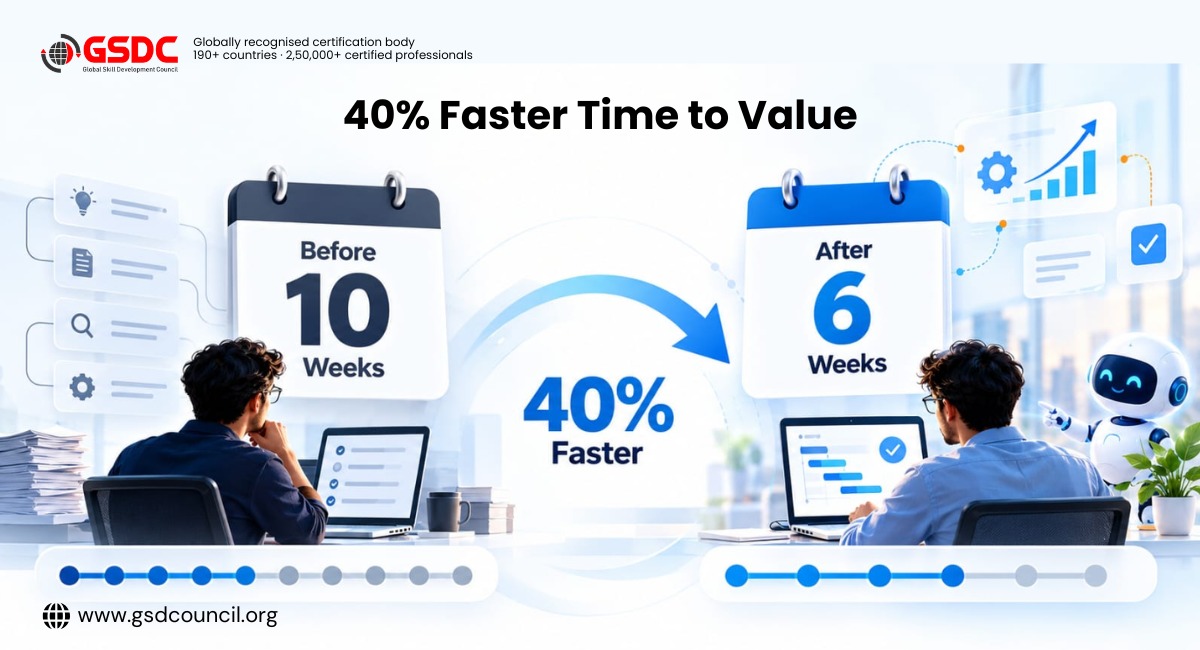
This is a hypothetical example, not a published FDE industry benchmark. The calculation demonstrates how teams can quantify improvements and establish realistic targets based on their own projects.
2. Workflow Efficiency: Is AI Improving Productivity?
Deploying an AI solution is only part of the job. Organizations must also determine whether it improves the workflow it was designed to support.
Workflow efficiency is one of the most practical AI success metrics because it connects technical performance with everyday business operations.
An FDE may build an AI agent that classifies support requests, retrieves relevant information, or prepares draft responses. The solution should then be evaluated against the original process to determine whether it reduces manual effort without compromising quality.
Useful measurements include:
- Hours spent completing a task before and after implementation.
- Average task completion time.
- Reduction in repetitive manual activities.
- Error rates and rework requirements.
Number of tasks successfully completed without intervention.
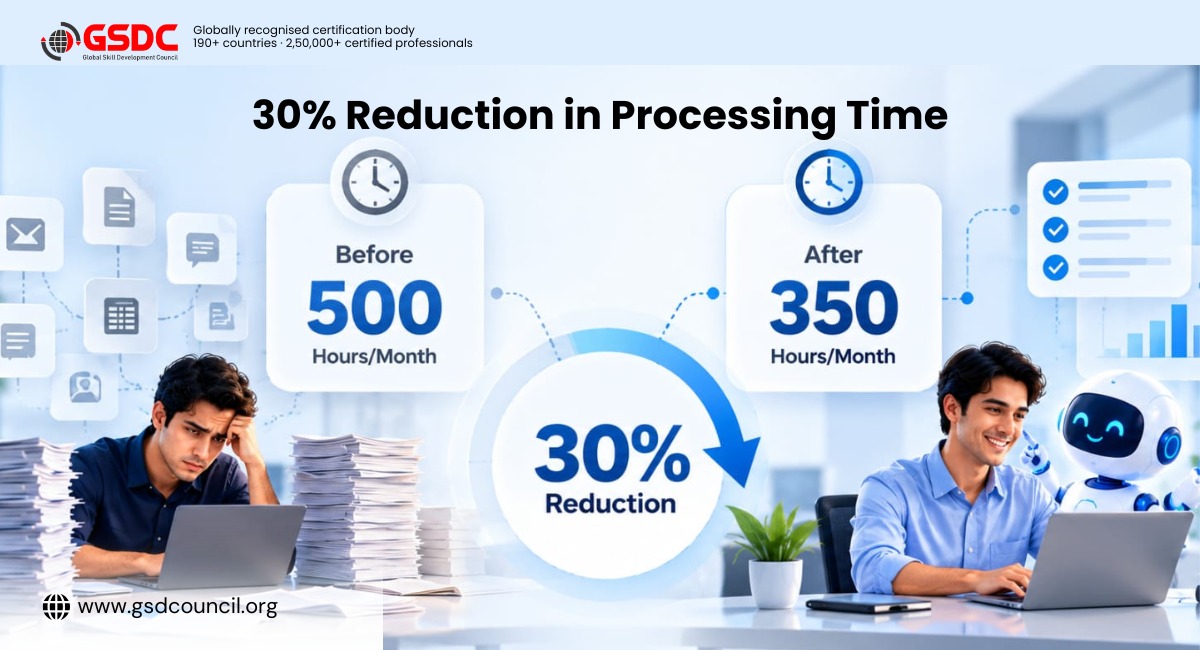
However, saved time should not automatically be treated as direct financial savings. Organizations should determine whether employees can use that time for higher-value work, increase output, or reduce operating costs.
For FDEs, the objective is to demonstrate that AI improves a real process rather than simply introducing another technology into the workflow.
3. AI Accuracy and Reliability: Can the Solution Be Trusted?
An AI solution that responds quickly but produces incorrect results may create additional work and business risks. Accuracy and reliability must therefore be included in any meaningful evaluation.
FDEs frequently work with systems that use large language models, retrieval-augmented generation (RAG), automation, and AI agents. Each approach introduces different performance considerations.
For example, an AI knowledge assistant may retrieve the wrong document, generate an unsupported answer, or fail when a connected system becomes unavailable. Measuring these problems helps teams identify where additional controls, testing, or system improvements are required.
Relevant AI KPIs include:
- Percentage of outputs meeting predefined quality standards.
- Rate of incorrect or unsupported responses.
- Successful task completion rate.
- Frequency of human corrections or escalations.
- System availability and response time.
- Frequency of failures during integrations or automated workflows.
This result must be interpreted against the task's risk level and evaluation method. A 92% pass rate might be acceptable for a low-risk internal search pilot but insufficient for a high-impact application requiring stronger accuracy and human verification.
FDEs should establish baseline measurements, test solutions against representative scenarios, and continue monitoring performance after deployment. This makes reliability a continuous engineering responsibility rather than a one-time approval step.
4. User Adoption: Are People Actually Using the Solution?
Even a technically strong AI system may fail to deliver value if employees find it difficult to use or prefer their existing processes.
That is why AI adoption metrics are essential. They help organizations understand whether the intended users are engaging with the solution and incorporating it into their work.
FDEs can support adoption by observing how users interact with the system, gathering feedback, addressing usability problems, and improving workflows based on actual behavior.
Important user adoption metrics include:
- Percentage of intended users who actively use the solution.
- Weekly or monthly active users.
- Frequency of repeat usage.
- Percentage of eligible tasks completed through the AI workflow.
- User satisfaction and feedback scores.
- Rate of users returning to the previous manual process.
However, login numbers alone do not prove successful adoption. Teams should also examine whether users complete meaningful tasks, trust the results, and achieve better outcomes.
FDEs can use these findings to identify adoption barriers and improve the solution. Strong user adoption metrics help connect the technical implementation with the people expected to benefit from it.
5. Business Value and ROI: Is AI Worth the Investment?
The final measure brings the other metrics together: business value.
AI value realization means demonstrating that an AI initiative produces tangible benefits relative to its implementation and operating costs. These benefits may include reduced processing expenses, improved productivity, faster service delivery, increased revenue, or better customer experiences.
An FDE can contribute by helping organizations define success criteria before development begins and measuring results after deployment.
Useful measurements include:
- Total implementation and operating costs.
- Verified cost savings.
- Additional revenue attributable to the solution.
- Productivity improvements translated into business outcomes.
- Reduction in service delays or customer complaints.
- Return on investment (ROI).
A commonly used ROI formula is:
ROI (%) = [(Total Benefits − Total Costs) ÷ Total Costs] × 100
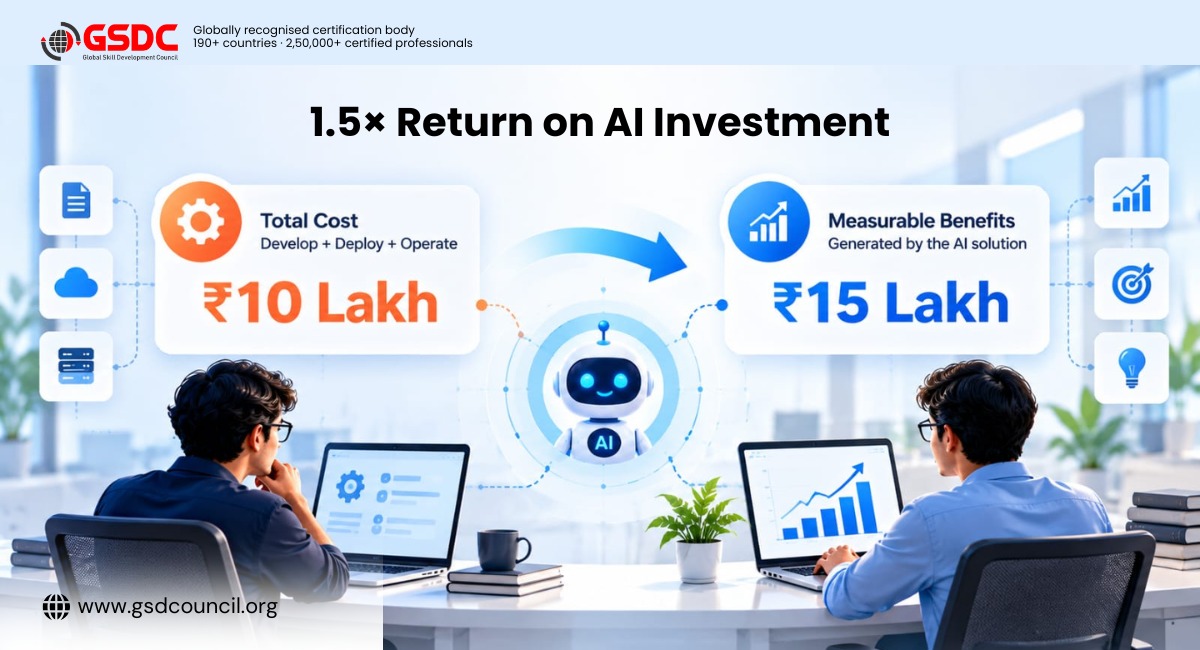
The resulting ROI is 50%.
This calculation assumes the benefits and costs are measured consistently over the same period. Organizations should also consider ongoing maintenance, infrastructure, human oversight, and other relevant expenses.
The important point is that business value must be demonstrated through evidence. An FDE should help stakeholders understand what changed, how the change was measured, and whether the outcome justifies further investment.
Conclusion: From Engineering Delivery to Measurable Business Impact
Forward Deployed Engineers operate at the intersection of engineering, business problem-solving, and customer collaboration. Their contribution extends beyond building AI applications to ensuring that solutions work within real operational environments and deliver measurable results.
The five measurement areas: time to value, workflow efficiency, accuracy and reliability, user adoption, and business ROI provide a practical framework for evaluating an FDE-led initiative.
Together, these measures help organizations establish meaningful AI success metrics, choose relevant AI KPIs, monitor user adoption metrics, and evaluate whether their AI investments are delivering value.
As AI transformation continues, businesses will need more than technical implementation. They will need engineers who can connect customer problems with reliable solutions and measurable outcomes.
Ultimately, the value of an FDE is not defined only by what gets built. It is defined by what improves, what users adopt, and what the organization can demonstrate through evidence.

Related Certifications
Stay up-to-date with the latest news, trends, and resources in GSDC
If you like this read then make sure to check out our previous blogs: Cracking Onboarding Challenges: Fresher Success Unveiled
Not sure which certification to pursue? Our advisors will help you decide!