Building an AI Legal Research Assistant: An FDE Case Study
Written by Emily Hilton
- The Challenge: Making Legal Research More Efficient
- The FDE's Role in Building the Solution
- Designing the AI Legal Research Assistant
- A Practical Use Case: Researching Contract Termination
- Choosing the Best AI for Legal Research
- Measuring Success and Scaling the Solution
- How FDE Certification Can Help Professionals
- Conclusion
Legal professionals spend hours researching case law, reviewing legislation, analyzing judgments, and preparing legal briefs. As legal information continues to grow, finding accurate and relevant information quickly has become increasingly challenging. Artificial intelligence (AI) offers a way to simplify these tasks, helping lawyers spend less time searching for documents and more time analyzing legal issues.
However, legal research requires more than generating answers. Every claim must be supported by reliable sources, citations must be accurate, and the legal context must be understood correctly. This is where a forward deployed AI engineer can make a difference by translating AI capabilities into practical solutions that address real legal challenges.
This blog explores how a Forward Deployed Engineer (FDE) could build an AI legal research assistant, the technologies involved, the challenges to consider, and how professionals can develop the skills needed to build similar solutions.
Note: The case study below is illustrative and demonstrates a potential implementation approach rather than documenting an actual client deployment.
The Challenge: Making Legal Research More Efficient
Imagine a mid-sized law firm handling corporate advisory, commercial disputes, and regulatory compliance. Its lawyers regularly search court judgments, legislation, regulatory guidance, and internal legal documents.
Despite having access to digital resources, the firm faces several challenges.
- Fragmented information: Lawyers must search multiple databases, government websites, and internal document repositories to gather relevant information.
- Time-consuming document review: Reading lengthy judgments and identifying relevant facts, legal principles, and judicial reasoning requires considerable effort.
- Difficulty finding precedents: Keyword searches may miss relevant judgments that discuss similar legal concepts using different terminology.
- Limited knowledge sharing: Previous research may remain buried in emails, folders, or individual lawyers' files, making it difficult for colleagues to reuse.
- Risk of inaccurate information: An incorrect citation, outdated statute, or fabricated case can undermine legal advice and create professional risks.
The firm needs a research assistant that can search authorized sources, summarize relevant findings, and provide verifiable citations without replacing lawyers' professional judgment.
The FDE's Role in Building the Solution
A Forward Deployed Engineer bridges the gap between technical capabilities and practical business requirements. Instead of building an AI application in isolation, an FDE works directly with users to understand their workflows and develop a solution suited to their needs.
For this project, the engineer collaborates with lawyers, research associates, knowledge management teams, and IT specialists.
The first step is to observe how legal research is performed. The FDE identifies repetitive activities, evaluates existing software, and determines where AI could reduce manual effort.
The engineer then establishes measurable objectives, such as reducing research time, improving citation traceability, and making internal legal knowledge easier to find.
These objectives guide the system's design and evaluation.
Designing the AI Legal Research Assistant
The proposed solution combines a large language model (LLM), legal document retrieval, source verification, and a user-friendly interface. Its purpose is to help lawyers discover and understand relevant information, not to make final legal decisions.
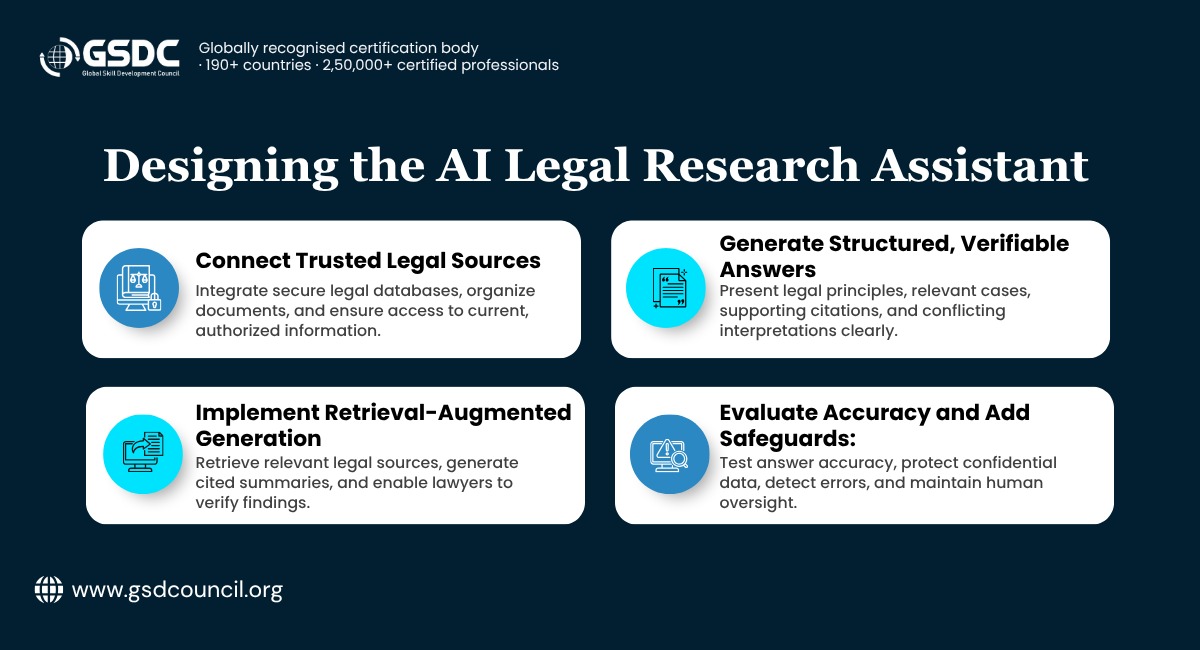
1. Connect Trusted Legal Sources
The first step is identifying the legal information the assistant can access. Sources may include licensed research databases, official court websites, legislation portals, regulatory publications, and approved internal documents.
The FDE builds appropriate integrations and organizes documents using metadata such as jurisdiction, court, publication date, case name, and legal topic.
This helps the assistant distinguish between current legislation and older judgments that may no longer reflect the applicable legal position.
Access controls are equally important. Lawyers should only be able to retrieve confidential documents they are authorized to view. The system must also respect database licensing agreements and restrictions on using legal content.
2. Implement Retrieval-Augmented Generation
Retrieval-augmented generation (RAG) is a useful technique for building reliable legal research AI applications.
Rather than relying only on information learned during model training, RAG retrieves relevant passages from an approved document collection and provides them to the language model as context.
A typical workflow involves four steps:
- Query: The lawyer asks a question and specifies the relevant jurisdiction.
- Retrieval: The system searches approved legal sources for relevant documents.
- Generation: The model summarizes the retrieved information and identifies supporting authorities.
- Verification: The lawyer reviews the cited sources and confirms their relevance.
Combining keyword search with semantic search can improve retrieval. Keyword search identifies exact case names and statutory phrases, while semantic search finds documents discussing similar legal concepts even when the wording differs.
A reranking process can then prioritize the most relevant results.
RAG helps ground responses in source material, but it does not guarantee accuracy. The quality of the source collection, retrieval process, and generated response must still be evaluated.
3. Generate Structured, Verifiable Answers
Legal professionals need more than a short summary. They need to understand the relevant authorities, the reasoning behind a decision, and whether conflicting interpretations exist.
The assistant can organize its responses into sections covering relevant cases, applicable legislation, key legal principles, judicial reasoning, contrary authorities, and questions requiring further research.
Each important claim should link to the supporting document and, where possible, the relevant passage or page.
The system should distinguish between direct quotations and summaries. It should also acknowledge uncertainty when the available sources do not support a reliable conclusion.
If the assistant cannot find adequate evidence, it should say so rather than invent a citation or present speculation as established law.
4. Evaluate Accuracy and Add Safeguards
Before deployment, the FDE tests the assistant against realistic legal research questions.
The evaluation dataset should include straightforward queries, complex legal issues, ambiguous questions, conflicting judgments, outdated documents, and questions that cannot be answered from the available sources.
Important evaluation measures include retrieval relevance, citation accuracy, factual consistency, and the system's ability to recognize uncertainty.
The engineer should also test whether the assistant confuses jurisdictions, overlooks contrary precedents, or misrepresents the status of a judgment.
Security measures may include encryption, role-based access controls, audit logs, retention limits, and safeguards against malicious instructions embedded in retrieved documents.
Lawyers must remain responsible for verifying authorities and approving any legal advice or filing based on the research.
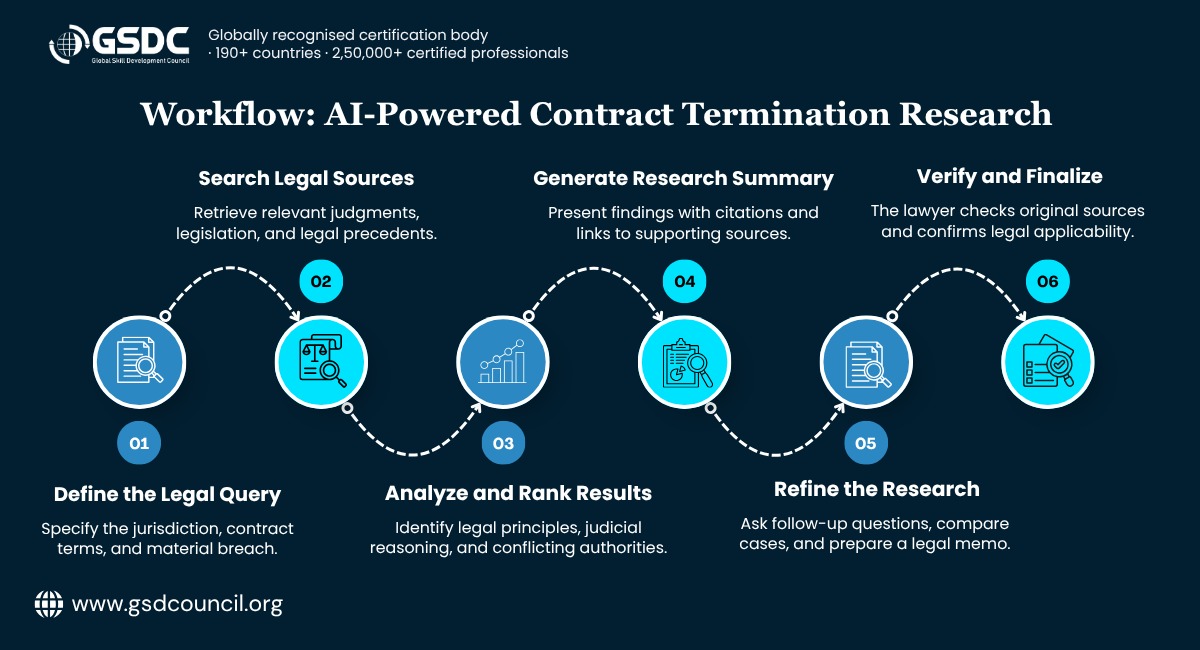
A Practical Use Case: Researching Contract Termination
Consider a lawyer investigating whether a company can terminate a commercial agreement following a material breach.
The lawyer submits a question specifying the jurisdiction and relevant contractual circumstances. The assistant searches approved sources, retrieves potentially relevant judgments and legislation, and ranks the results.
It then prepares a research summary highlighting relevant legal principles, factual distinctions, judicial reasoning, and potentially conflicting authorities. Each major claim includes links to its supporting sources.
The lawyer can ask follow-up questions, compare judgments, or request a structured research memo. Before relying on the output, the lawyer checks the original documents and confirms that the authorities remain applicable.
This workflow can reduce repetitive searching and document review while preserving professional judgment.
Choosing the Best AI for Legal Research
The best AI for legal research depends on the firm's jurisdiction, research requirements, confidentiality needs, and existing technology.
Examples of established platforms include:
- Westlaw: Provides legal research resources and AI-assisted capabilities, depending on the product and subscription.
- Lexis+ AI: Supports legal research and AI-assisted workflows using content available through its services.
- vLex: Offers legal research and AI-powered features through its legal intelligence products.
These are examples of AI legal research tools, not interchangeable solutions. Their coverage, features, source availability, and jurisdiction support differ.
An FDE should evaluate citation reliability, access to primary sources, security controls, integration capabilities, and overall cost before recommending a platform.
For organizations with specialized requirements, a custom assistant may be appropriate. For example, a firm might need to search internal legal opinions alongside licensed databases. The decision should depend on the actual workflow and risk assessment, not simply on which tool produces the most fluent answers.
Measuring Success and Scaling the Solution
The FDE should establish a baseline before deployment and compare it with the results of a controlled pilot.
Useful metrics include time spent locating relevant cases, the percentage of citations verified successfully, the frequency of unsupported answers, and lawyer satisfaction.
Improvements should be based on measured results rather than assumptions.
If the pilot performs well, the firm can expand the assistant to additional practice areas. Each expansion should be tested because different jurisdictions and legal domains have different terminology, source requirements, and risks.
Ongoing monitoring is also necessary. Changes to source databases, model versions, retrieval settings, and access permissions can affect performance and should trigger appropriate reassessment.
How FDE Certification Can Help Professionals
Building an AI legal research assistant requires skills in AI engineering, APIs, document processing, retrieval systems, evaluation, security, and production deployment.
GSDC’s FDE Certification can help professionals develop a structured understanding of these capabilities and learn how to apply AI to real-world business challenges. The certification is relevant for engineers looking to strengthen their knowledge of AI applications, system integration, and practical implementation.
When exploring Certified Forward Deployed Engineer, professionals can focus on developing practical skills in LLM applications, RAG pipelines, system integrations, model evaluation, and secure deployment. These capabilities can support the development of AI solutions for specialized domains, including legal research.
However, certification alone does not establish legal expertise or guarantee that an AI system is suitable for professional use. Engineers must collaborate with qualified legal professionals to validate outputs and address confidentiality, licensing, and jurisdiction-specific requirements.

Conclusion
Building an AI legal research assistant involves more than connecting a chatbot to legal documents. It requires reliable retrieval, verifiable citations, secure integrations, systematic testing, and human oversight.
A Forward Deployed Engineer brings these elements together by understanding lawyers' daily challenges and translating them into practical technology. With the right design, AI for legal departments can reduce repetitive research work, improve legal knowledge management, and help lawyers focus on analysis and strategy.
Ultimately, success is not about how quickly AI generates an answer. It is about how effectively it helps legal professionals find, verify, and understand the information they need.

Related Certifications
Frequently Asked Questions
An AI legal research assistant helps legal professionals search authorized sources, summarize judgments, identify relevant precedents, and organize research findings with supporting citations.
RAG retrieves relevant passages from approved sources before generating an answer. This helps ground responses in source material, although lawyers must still verify citations and interpretations.
No. AI can assist with searching, summarization, and document analysis, but lawyers remain responsible for interpreting the law, evaluating authorities, and approving legal advice.
They should assess source coverage, jurisdiction support, citation accuracy, confidentiality, licensing, access controls, integration capabilities, and the reliability of research outputs.
An FDE connects legal teams' requirements with AI engineering, integrates solutions with existing systems, evaluates performance, and helps ensure that applications are secure and useful in practice.
Stay up-to-date with the latest news, trends, and resources in GSDC
If you like this read then make sure to check out our previous blogs: Cracking Onboarding Challenges: Fresher Success Unveiled
Not sure which certification to pursue? Our advisors will help you decide!