How FDEs Help Hospitals Reduce Admin Work with AI
Written by Emily Hilton
- What Is Healthcare Workflow Automation?
- Why Do Hospitals Need AI in Administration?
- How Forward Deployed Engineers Help Hospitals Implement AI?
- Practical AI Use Cases in Hospital Administration
- How Hospitals Can Implement Healthcare Automation Safely
- Why FDE Skills and Certification Matter in Healthcare AI
- How GSDC’s FDE Certification Helps Professionals Transform Healthcare with AI?
- Conclusion
Hospitals should focus on patient care, not get buried in paperwork. From appointment scheduling and billing to medical records and staff coordination, administrative tasks consume valuable time and resources. Healthcare automation and AI offer a smarter way forward, helping hospitals streamline workflows, reduce repetitive work, and improve operational efficiency.
However, successful AI implementation requires more than technology. Hospitals must address data privacy, system integration, security, and human oversight to ensure reliable results.
This is where Forward Deployed Engineers (FDEs) make a difference. By combining technical expertise with real-world problem-solving, they help hospitals identify inefficiencies, implement AI-powered solutions, and integrate them into existing workflows.
As AI adoption grows, FDEs can help transform hospital administration from a manual, time-consuming process into a more efficient and intelligent system giving healthcare teams more time to focus on what matters most: better patient care.
What Is Healthcare Workflow Automation?
Healthcare workflow automation uses software, AI, and integrated systems to reduce manual effort across hospital operations. It can automate repetitive administrative activities, route information between departments, and help staff complete routine tasks more efficiently.
Traditional automation follows predefined rules. For example, a scheduling system may send appointment reminders automatically or flag an incomplete registration form.
AI-powered automation can handle more complex tasks, such as extracting information from documents, summarizing patient communications, categorizing support requests, or helping staff find relevant information across approved records.
With the development of AI agents in healthcare, hospitals can also explore systems that perform multiple connected steps toward a defined goal. For example, an agent could review an appointment request, check scheduling rules, identify missing information, and prepare a booking for staff confirmation.
The goal is not to replace healthcare professionals. Instead, healthcare workflow automation helps reduce repetitive administrative work while keeping important decisions under appropriate human control.
Why Do Hospitals Need AI in Administration?
Administrative teams often work across electronic health records (EHRs), hospital management systems, billing platforms, email, and spreadsheets. When these systems do not communicate effectively, employees must enter the same information multiple times, search for missing documents, and manually coordinate tasks between departments.
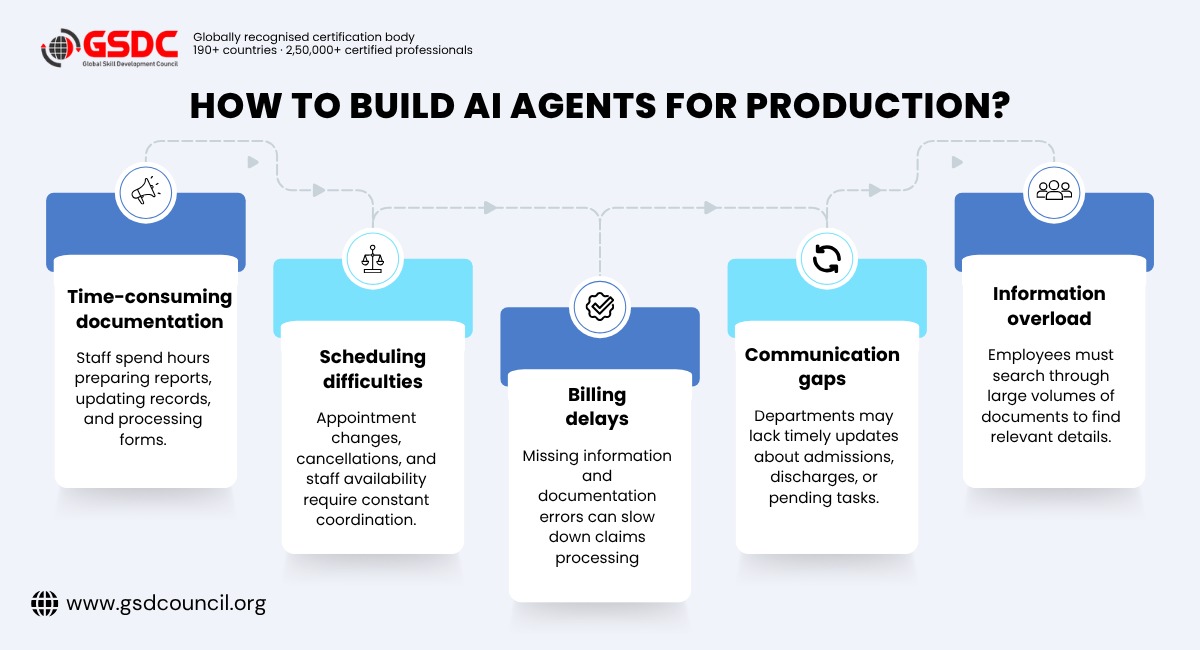
Using AI in hospital administration can help address these challenges by automating routine tasks and making information easier to access. However, automation should be designed around actual hospital needs rather than introduced simply because a new AI tool is available.
How Forward Deployed Engineers Help Hospitals Implement AI?
Forward Deployed Engineers bridge the gap between AI technology and real-world business problems. They work directly with users, understand existing processes, and develop solutions that fit the organization's technical environment.
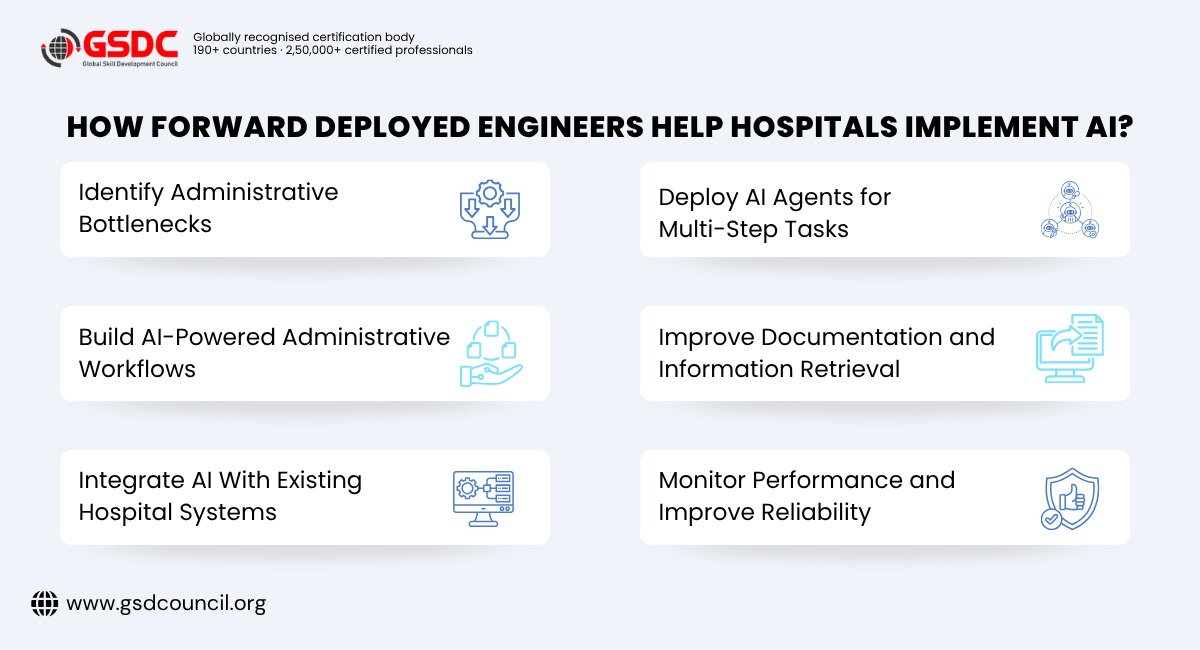
For hospitals, the role of an FDE involves much more than writing code. It includes workflow analysis, system integration, AI application development, testing, deployment, and ongoing improvement.
1. Identify Administrative Bottlenecks
Before building an AI solution, an FDE studies how administrative work is performed.
They may interview receptionists, billing teams, medical records staff, hospital administrators, and other stakeholders to identify repetitive tasks and operational delays.
For example, if staff spend significant time manually transferring information from referral letters into a hospital system, an FDE can assess whether document-processing AI could reduce that workload.
The engineer also establishes measurable success criteria, such as reduced processing time, fewer data-entry errors, faster claim preparation, or less manual intervention.
This ensures that FDE in healthcare focuses on solving practical operational problems instead of introducing unnecessary complexity.
2. Build AI-Powered Administrative Workflows
Once a problem is identified, FDEs design automation workflows that combine AI models, existing software, and business rules.
Consider patient registration. An AI-enabled workflow could extract relevant details from submitted forms, identify missing fields, and prepare the information for entry into a hospital management system.
Similarly, an automated document-processing system could classify incoming referrals, identify the relevant department, and route documents to the appropriate team.
These are practical AI use cases in healthcare because they target repetitive administrative tasks while allowing staff to review information before it becomes part of an official record.
3. Integrate AI With Existing Hospital Systems
Hospitals rarely operate on a single software platform. They may use separate systems for patient records, appointments, laboratory services, billing, pharmacy operations, and insurance claims.
An AI solution that cannot communicate with these systems may create additional work rather than reduce it.
FDEs connect AI applications with existing platforms using appropriate APIs, approved integrations, and secure data pipelines. They also ensure that information is transferred accurately and that permissions are enforced.
For instance, an AI assistant may retrieve appointment availability from a scheduling system without receiving unrestricted access to patient records.
This integration work is essential to making AI in hospitals useful, secure, and compatible with everyday operations.
4. Deploy AI Agents for Multi-Step Tasks
Traditional automation handles predefined steps, while AI agents can interpret requests, select approved tools, and coordinate multiple actions toward a goal.
Healthcare AI agents can support administrative workflows such as:
- Reviewing appointment requests and identifying missing details.
- Preparing insurance claim documents for staff review.
- Routing patient inquiries to the appropriate department.
- Tracking pending administrative tasks and notifying responsible teams.
- Summarizing approved documents for administrative use.
For example, an agent handling a billing inquiry could retrieve relevant claim information, check whether required documents are available, and prepare a summary of outstanding items.
The agent should not independently approve complex claims or make consequential clinical decisions. Actions involving financial commitments, sensitive records, or patient safety should have appropriate authorization and human review.
FDEs define these boundaries, connect agents to approved tools, and test how they behave when information is incomplete or systems fail.
This is where agentic AI healthcare applications can provide value: they coordinate connected tasks rather than simply generating text in response to a prompt.
5. Improve Documentation and Information Retrieval
Healthcare administration involves large volumes of documents, including referral letters, discharge summaries, insurance forms, internal policies, and operational reports.
AI can help extract relevant information, summarize lengthy documents, classify incoming requests, and retrieve answers from approved knowledge sources.
For example, an administrative employee could ask an internal AI assistant about the documents required for a particular billing process. The assistant could retrieve the relevant hospital policy and summarize the requirements, ideally providing links to the source material.
FDEs build these solutions using techniques such as retrieval-augmented generation (RAG), document parsing, access controls, and source-grounded responses.
They also test for hallucinations, incorrect summaries, unauthorized information disclosure, and outdated documents. Human verification remains important when the output affects official records or consequential decisions.
6. Monitor Performance and Improve Reliability
Deploying an AI system is only the beginning. Hospitals need to know whether it is reducing workloads without introducing new risks.
FDEs establish monitoring and evaluation processes to track measures such as:
- Time saved per administrative task.
- Percentage of tasks completed without correction.
- Frequency of incorrect or incomplete outputs.
- Number of cases requiring human intervention.
- System availability and cost per completed task.
They also collect feedback from hospital staff and improve workflows based on actual usage.
For instance, if an AI tool frequently misclassifies insurance documents, the FDE can investigate the underlying cause, improve document-processing rules, and test the revised workflow before deploying it.
This continuous improvement process helps healthcare AI agents remain useful as hospital requirements and systems evolve.
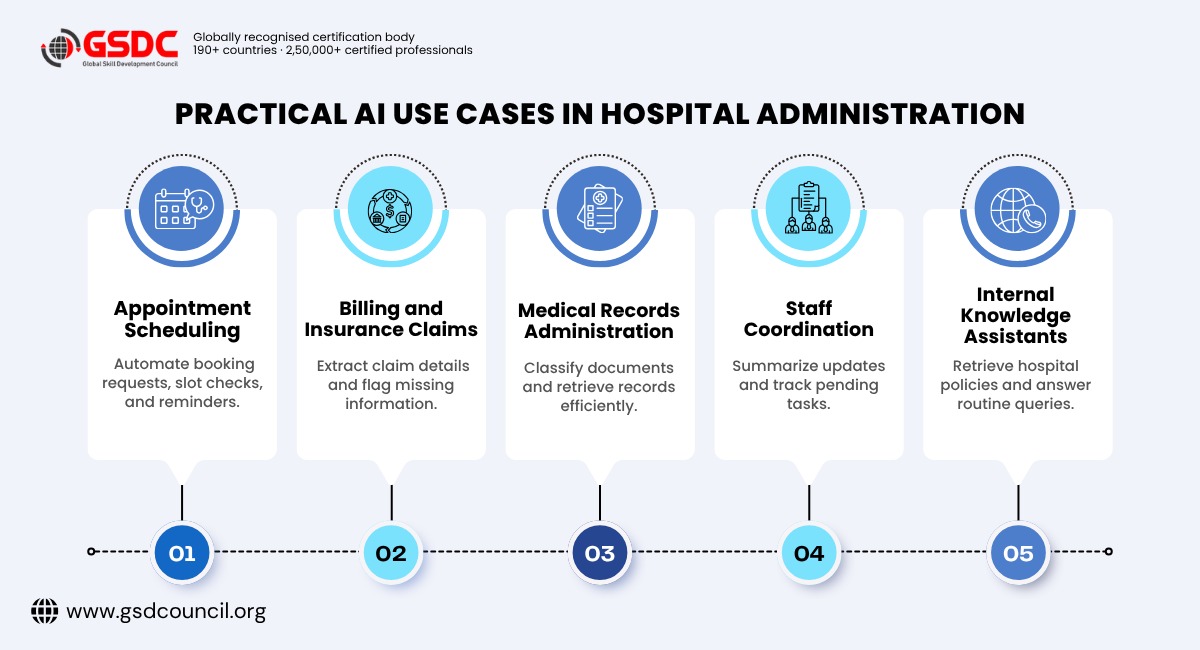
Practical AI Use Cases in Hospital Administration
Here are five areas where AI-driven administrative automation may help hospitals reduce repetitive work.
1. Appointment Scheduling
AI assistants can respond to routine scheduling inquiries, check available slots, prepare booking requests, and send reminders. Staff can handle exceptions and requests requiring additional judgment.
2. Billing and Insurance Claims
AI can extract information from claim documents, identify missing fields, and flag inconsistencies before submission. Authorized staff retain responsibility for verification and approval.
3. Medical Records Administration
Document AI can classify files, extract relevant details, and help staff locate records. Access controls and verification are essential to prevent incorrect record updates.
4. Staff Coordination
AI tools can summarize shift updates, identify pending administrative tasks, and prepare operational reports. Managers remain responsible for staffing decisions.
5. Internal Knowledge Assistants
AI assistants can retrieve hospital policies, summarize approved procedures, and answer routine administrative questions using authorized internal documents.
These examples demonstrate how AI in healthcare can support hospital operations beyond clinical applications. Actual benefits depend on the quality of the data, the existing systems, workflow design, and the level of human oversight.
How Hospitals Can Implement Healthcare Automation Safely
Successful automation requires a structured implementation approach. FDEs can guide hospitals through the following steps.
- Step 1: Start with a focused workflow. Select a repetitive administrative task with measurable delays or high manual effort. Avoid automating multiple departments simultaneously.
- Step 2: Assess data and systems. Identify where the required information resides, how it can be accessed, and whether the data is suitable for AI processing.
- Step 3: Build a controlled pilot. Test the solution using synthetic, de-identified, or otherwise appropriately authorized data. Compare its results with the existing process.
- Step 4: Establish safeguards. Apply role-based access, encryption, audit logs, data retention limits, and human approval for sensitive actions. Ensure compliance with applicable privacy laws and hospital policies.
- Step 5: Measure results before scaling. Compare processing times, error rates, staff workload, and operating costs against the baseline. Expand only when the solution demonstrates acceptable performance and risk controls.
Hospitals should also evaluate third-party AI providers carefully. Patient information should not be shared with external models unless the arrangement is authorized and appropriate contractual, security, and privacy protections are in place.
Why FDE Skills and Certification Matter in Healthcare AI
Implementing healthcare automation requires a combination of technical expertise and practical problem-solving. FDEs need to understand APIs, system integration, AI application development, workflow design, testing, deployment, and monitoring.
They must also communicate effectively with non-technical stakeholders and understand the operational constraints of healthcare environments.
A forward deployed engineer certification can help professionals structure their learning in areas such as AI engineering, agent development, system integration, and production deployment. An FDE Certification may be particularly relevant for engineers who want to demonstrate practical skills in translating business requirements into working technology solutions.
When evaluating a certification program, professionals should look for hands-on projects, real-world implementation scenarios, agent evaluation, secure deployment practices, and opportunities to build end-to-end AI applications.
Certification alone does not establish expertise in healthcare regulations or authorize someone to handle sensitive medical data. Professionals working in this sector should also develop knowledge of healthcare privacy, security, data governance, and human oversight requirements.
How GSDC’s FDE Certification Helps Professionals Transform Healthcare with AI?
GSDC’s Forward Deployed Engineer (FDE) Certification helps professionals understand how AI technologies can address real-world challenges in the healthcare industry. As hospitals and healthcare organizations increasingly adopt AI to improve operational efficiency, professionals need the skills to identify workflow problems and develop practical technology-driven solutions.
The Forward Deployed Engineer (FDE) Certification can help professionals understand how AI agents, automation, and intelligent systems can support healthcare administration, streamline processes, and improve information management.
GSDC’s FDE Certification can help professionals learn to:
- Automate Administration: Use AI to support scheduling, patient queries, and data entry.
- Improve Workflows: Identify bottlenecks and streamline hospital operations.
- Support Documentation: Use AI for documentation and information retrieval with human review.
- Integrate AI Solutions: Connect AI applications with existing healthcare systems.
- Solve Real-World Problems: Develop practical AI solutions for healthcare challenges.
- Implement Responsible AI: Understand data privacy, security, accuracy, and human oversight.
- Collaborate Effectively: Work with healthcare teams and stakeholders to develop suitable AI solutions.
Conclusion
Hospitals can use AI to reduce administrative burdens, improve information access, and streamline repetitive processes. However, successful implementation requires more than selecting a model or deploying a chatbot.
Forward Deployed Engineers help bridge the gap between AI capabilities and real hospital workflows. By identifying operational bottlenecks, integrating systems, building reliable AI agents, and monitoring outcomes, they help organizations turn promising technology into practical solutions.
The most effective approach is to start small, establish clear performance measures, protect patient information, and keep humans involved in consequential decisions.
As healthcare organizations continue exploring healthcare workflow automation, FDEs can play a valuable role in building solutions that support administrative teams, improve operational efficiency, and allow healthcare professionals to devote more time to patient care.

Related Certifications
Frequently Asked Questions
An FDE works directly with healthcare organizations to identify operational problems, develop tailored AI solutions, integrate them with existing systems, and ensure that they perform reliably in real-world environments.
AI can assist with appointment scheduling, document processing, billing preparation, insurance verification, internal knowledge retrieval, and administrative reporting. Human review remains necessary for sensitive or consequential decisions.
Healthcare AI agents are AI-powered systems that can interpret requests, use approved tools, and coordinate multiple steps to complete defined tasks. They can support administration, but clinical or high-impact actions require appropriate safeguards.
FDEs benefit from skills in AI engineering, API integration, agent development, workflow automation, testing, deployment, data security, and stakeholder communication. Knowledge of healthcare privacy and compliance requirements is also important.
An FDE certification can help professionals develop and demonstrate relevant implementation skills. However, candidates should also gain practical project experience and understand the specific security, privacy, and operational requirements of healthcare organizations.
Stay up-to-date with the latest news, trends, and resources in GSDC
If you like this read then make sure to check out our previous blogs: Cracking Onboarding Challenges: Fresher Success Unveiled
Not sure which certification to pursue? Our advisors will help you decide!