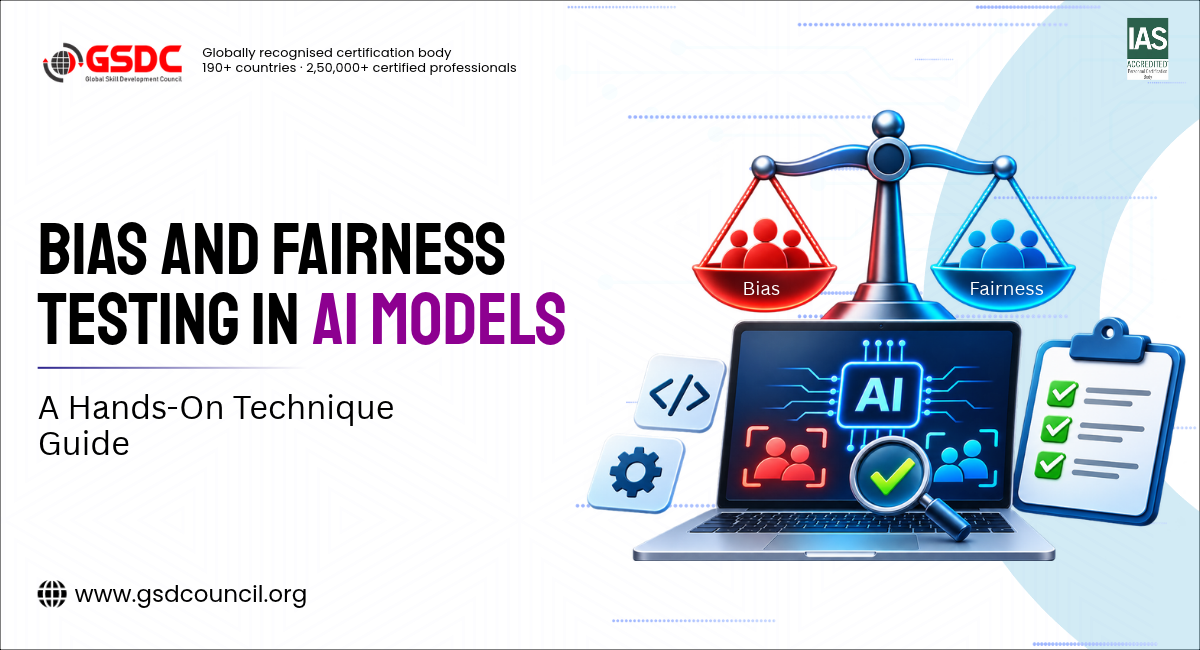
Bias and Fairness Testing in AI Models: A Hands-On Technique Guide
Written by Emily Hilton
Artificial intelligence is increasingly used to make decisions in recruitment, healthcare, banking, education, insurance, and customer services. While AI models can process large amounts of information and improve decision-making, they can also produce biased outcomes due to algorithmic bias. These biases may affect individuals based on characteristics such as gender, age, ethnicity, disability, or socioeconomic background.
For organizations deploying AI systems, accuracy alone is not enough. Models must also be evaluated for fairness in AI, consistency, and discriminatory behaviour. This makes algorithmic fairness and model fairness important considerations in the AI testing lifecycle. Understanding AI bias and fairness helps organizations identify potential risks and build more responsible AI systems.
AI testers need practical techniques for AI bias detection, bias detection, and evaluating model predictions to identify unfair patterns. Through bias testing and AI bias testing, professionals can verify whether corrective actions improve outcomes. This guide explores common sources of AI bias, important fairness metrics, and hands-on testing techniques that professionals can apply when evaluating machine learning models.
Understanding Bias and Fairness in AI Models
AI bias occurs when an AI system consistently produces outcomes that unfairly favour or disadvantage certain individuals or groups. This algorithmic bias can originate from training data, feature selection, model design, testing processes, or the environment in which the system operates. Effective AI bias detection helps identify these issues before they affect real-world decisions.
For example, consider an AI-powered recruitment system trained on historical hiring data. If previous hiring decisions favoured male candidates, the model may learn patterns that disadvantage equally qualified female applicants. This highlights why fairness in AI and algorithmic fairness are essential when developing and evaluating AI systems.
Fairness testing evaluates whether a model treats individuals and demographic groups appropriately within a particular application. AI bias testing and bias testing help testers identify unfair outcomes and assess model fairness.
Common sources of AI bias include:
- Historical Bias: Existing inequalities in historical data become part of the model's learning process.
- Data Representation Bias: Certain demographic groups are underrepresented in training datasets.
- Measurement Bias: Data collection methods measure different groups inconsistently.
- Algorithmic Bias: Model design or optimization produces unequal outcomes.
- Evaluation Bias: Testing datasets fail to represent the population that will use the system.
Identifying these sources helps testers understand why unfair predictions occur instead of focusing only on the final model output. Effective bias detection also supports responsible decision-making and reduces risks associated with AI bias and fairness.
Why Bias and Fairness Testing Matter
An AI model can achieve high overall accuracy while performing poorly for specific demographic groups. This creates risks for both organizations and individuals. Effective testing in AI models goes beyond checking accuracy and includes evaluating fairness, consistency, and potential discriminatory outcomes.
For example, a loan approval model may report 92% accuracy but consistently reject qualified applicants from a particular demographic group. Looking only at overall accuracy would not reveal this problem.
Bias and fairness testing helps organizations:
- Identify discriminatory patterns before deploying AI systems.
- Evaluate model performance across different demographic groups.
- Improve the reliability of automated decisions.
- Reduce ethical, operational, and regulatory risks.
- Build confidence among customers, employees, and stakeholders.
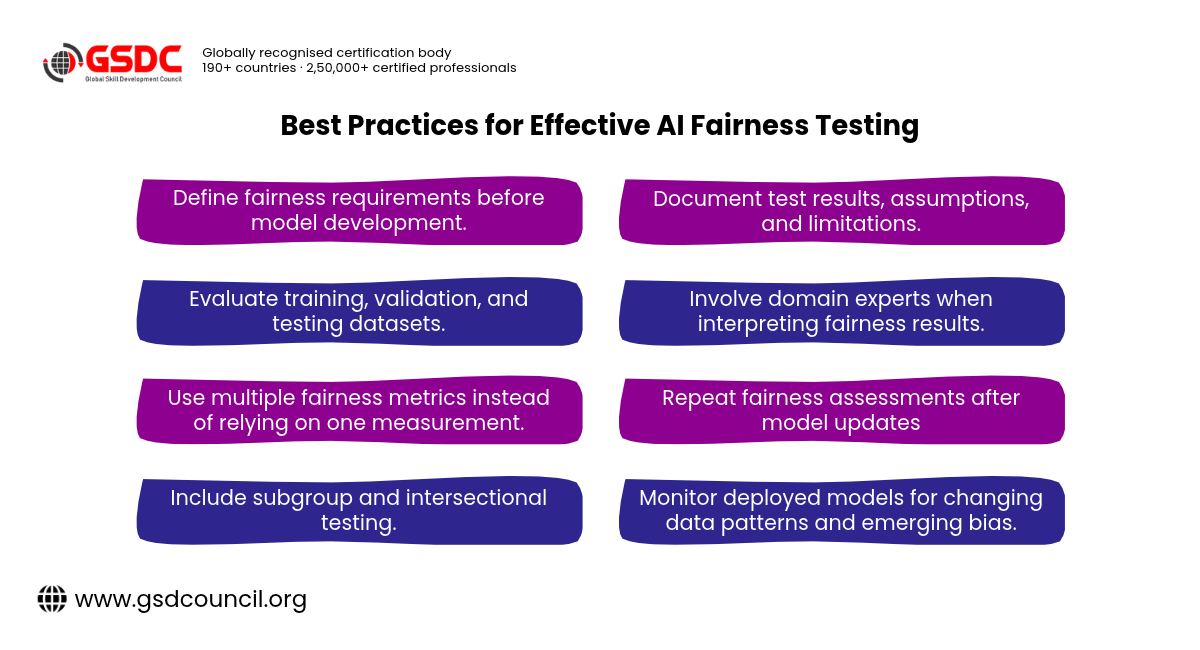
Fairness should therefore be considered throughout the AI development lifecycle rather than treated as a final testing activity. This growing need also creates a growth path for AI testers, opening opportunities to develop specialized skills in AI quality assurance, bias detection, and responsible AI evaluation.
Professionals can explore roles for AI testers such as AI Test Engineer, AI Quality Assurance Engineer, Machine Learning Test Engineer, and AI Validation Specialist. A structured CAITP career roadmap can help aspiring professionals strengthen their AI testing knowledge and prepare for evolving opportunities in the AI testing industry.
Hands-On Techniques for Bias and Fairness Testing
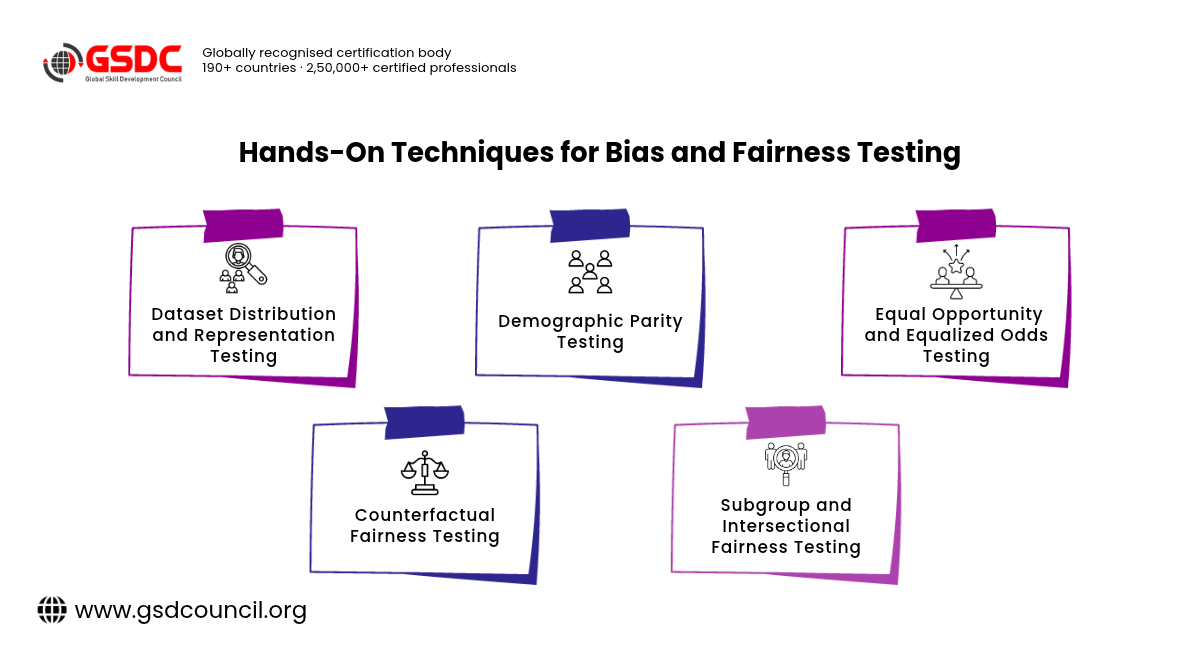
Testing AI fairness requires a combination of dataset analysis, statistical measurements, controlled experiments, and model evaluation. The following techniques provide a practical approach.
1. Dataset Distribution and Representation Testing
The first step is examining the training and testing datasets to understand whether different demographic groups are adequately represented.
For example, consider a recruitment dataset containing 10,000 applicant records. If 8,000 records represent male applicants and only 2,000 represent female applicants, the model may learn patterns that perform differently across these groups.
Testers should:
- Identify sensitive attributes such as gender, age, and ethnicity where legally and appropriately available.
- Calculate the number of records belonging to each group.
- Compare positive and negative outcome distributions.
- Identify missing values and inconsistent data collection.
- Examine intersections between demographic groups.
Hands-on example: Use Python's Pandas library to examine group representation.
import pandas as pd
data = pd.read_csv("recruitment_data.csv")
print(data["gender"].value_counts())
print(
data.groupby("gender")["hired"]
.value_counts(normalize=True)
)
This analysis helps testers identify differences in dataset representation and hiring outcomes before evaluating model predictions.
2. Demographic Parity Testing
Demographic parity evaluates whether different demographic groups receive positive predictions at similar rates.
For example, a recruitment model can be tested to determine whether male and female applicants receive interview recommendations at comparable rates.
The demographic parity difference can be calculated as:
Demographic Parity Difference = Selection Rate (Group A) − Selection Rate (Group B)
A result closer to zero indicates similar selection rates.
Hands-on example:
selection_rates = data.groupby("gender")[
"predicted_hired"
].mean()
print(selection_rates)
If the model recommends 70% of male applicants and 45% of female applicants, testers should investigate the 25-percentage-point difference.
However, equal selection rates do not automatically establish fairness. Differences in qualifications, context, and legitimate decision criteria must also be considered.
3. Equal Opportunity and Equalized Odds Testing
Demographic parity focuses on selection rates, while equal opportunity evaluates whether qualified individuals across different groups receive positive predictions at comparable rates.
Equal opportunity focuses on the true positive rate, which measures how often the model correctly identifies eligible individuals.
Equalized odds goes further by comparing both true positive rates and false positive rates across groups.
These metrics are particularly useful in recruitment, loan approvals, and healthcare applications.
Hands-on example:
Testers can calculate true positive rates for different groups using actual outcomes and model predictions.
from sklearn.metrics import confusion_matrix
for group in data["gender"].unique():
subset = data[data["gender"] == group]
tn, fp, fn, tp = confusion_matrix(
subset["actual"],
subset["prediction"]
).ravel()
tpr = tp / (tp + fn) if (tp + fn) else 0
fpr = fp / (fp + tn) if (fp + tn) else 0
print(group, "TPR:", tpr, "FPR:", fpr)
Comparing these results helps testers identify whether the model makes different types of errors across demographic groups. <Cite refs={["turn219408search16","turn219408search14"]}/>
4. Counterfactual Fairness Testing
Counterfactual testing checks whether an AI model changes its prediction when a sensitive attribute changes while other relevant characteristics remain constant.
For example, consider two job applicants with identical qualifications, experience, and skills. If changing only the gender attribute changes the model's recommendation, it may indicate gender-related bias.
Hands-on approach:
- Select a representative sample of input records.
- Create modified versions by changing one sensitive attribute.
- Keep other relevant attributes unchanged.
- Run both versions through the AI model.
- Compare predictions and confidence scores.
- Investigate unexpected differences.
This technique is useful for detecting individual-level discrimination that may not appear in group-level statistical measurements.
For generative AI systems, testers can also use paired prompts that differ only in demographic references and compare the responses for differences in tone, recommendations, or opportunities. <Cite refs={["turn219408search13","turn219408search3"]}/>
5. Subgroup and Intersectional Fairness Testing
Testing only broad demographic categories can hide important problems. A model may perform similarly for men and women overall but produce significantly different results for older women or younger applicants from underrepresented communities.
Intersectional testing evaluates combinations of demographic attributes to identify these hidden disparities.
For example, testers can compare recruitment outcomes across:
- Younger male applicants.
- Younger female applicants.
- Older male applicants.
- Older female applicants.
This approach provides a more detailed understanding of how different characteristics interact and influence model predictions.
Testers should ensure that each subgroup has enough representative data to support meaningful conclusions.
How to Improve Fairness After Identifying Bias
Detecting bias is only one part of AI testing. Organizations must also evaluate whether corrective actions reduce unfair outcomes without unnecessarily affecting model performance.
Three commonly used approaches include:
1. Pre-processing: Improve training data before model development through representative sampling, data balancing, and correction of problematic labels.
2. In-processing: Introduce fairness constraints or optimization techniques during model training to reduce disparities between groups.
3. Post-processing: Adjust model predictions or decision thresholds after training to address identified fairness issues.
After applying these techniques, testers should repeat the original fairness assessments and compare the results. They should also check whether improvements in one fairness metric create problems in another.
There is no universally suitable fairness metric for every application. The appropriate approach depends on the model's purpose, affected population, business context, and potential consequences of incorrect decisions. <Cite refs={["turn219408search2","turn219408search9"]}/>
How GSDC's Certified AI Testing Professional (CAITP) Certification Helps Professionals
GSDC's Certified AI Testing Professional (CAITP) certification provides a learning opportunity for professionals who want to strengthen their understanding of AI testing and quality assurance. As organizations increasingly depend on AI-powered applications, testing professionals need to understand how intelligent systems behave, how their outputs should be evaluated, and how potential quality issues can be identified.

The Certified AI Testing Professional (CAITP) certification helps professionals build knowledge relevant to the evolving AI testing landscape and understand the importance of evaluating AI systems beyond traditional software testing approaches.
Topics such as model validation, testing methodologies, reliability, and responsible AI evaluation are important areas for professionals developing their AI testing capabilities. Learning about AI bias detection, bias detection, and fairness in AI can also help testers approach AI quality challenges with greater awareness. Understanding algorithmic bias, algorithmic fairness, and model fairness further supports the evaluation of AI systems for potentially discriminatory outcomes.
Conclusion
Bias and fairness testing are essential for building AI systems that produce reliable and responsible outcomes. Techniques such as dataset distribution analysis, demographic parity, equal opportunity, counterfactual testing, and intersectional evaluation help testers identify unfair model behaviour. These approaches play an important role in AI bias testing and evaluating AI bias and fairness across different applications.
However, fairness cannot be established through a single metric or testing exercise. Organizations need continuous evaluation, appropriate mitigation strategies, and clear documentation throughout the AI lifecycle.
As AI applications continue to influence important decisions, professionals with practical AI testing knowledge will play an important role in ensuring that intelligent systems are not only accurate but also fair and trustworthy.

Related Certifications
Stay up-to-date with the latest news, trends, and resources in GSDC
If you like this read then make sure to check out our previous blogs: Cracking Onboarding Challenges: Fresher Success Unveiled
Not sure which certification to pursue? Our advisors will help you decide!