AI in Software Testing: Skills to Move From QA to AI Tester
Written by Matthew Hale
- What does an AI tester actually do?
- Why QA testers are moving toward AI now
- AI tester skills you actually need
- How to become an AI tester: a 7-step QA engineer roadmap
- QA career path: where AI testing fits
- AI testing jobs: titles, roles and where to look
- Three small projects that prove your skills
- Common mistakes to avoid
- The future of software testing
- Certifications and learning resources
- Your next step
Nearly 90% of organizations are pursuing generative AI in their quality engineering work, but only 15% have reached enterprise-scale deployment, according to the World Quality Report 2025. That gap between trying AI and making it work is where QA professionals can step in.
AI in software testing doesn't mean starting your career over. Your skills in test design, exploratory testing and bug reporting still matter. What changes is how you apply them, plus the extra skills you need to check systems that don't always give the same answer twice. This guide covers what an AI tester does, which skills to add, and a step-by-step roadmap from QA tester to AI tester.
In short:
- An AI tester either tests with AI tools, tests AI systems, or does both.
- Your current QA skills still count. Test design, curiosity and clear bug reports are the base.
- Add Python, basic machine learning ideas, data skills and ways to evaluate AI output.
- Plan on several months of steady practice, not a weekend crash course.
What does an AI tester actually do?
The job title sounds new, but the idea is simple. An AI tester is a QA professional who works with artificial intelligence in one of two ways. Many roles mix both.
- Testing with AI: You use AI tools to write test cases, create test data, spot flaky tests, predict risky areas and repair broken scripts.
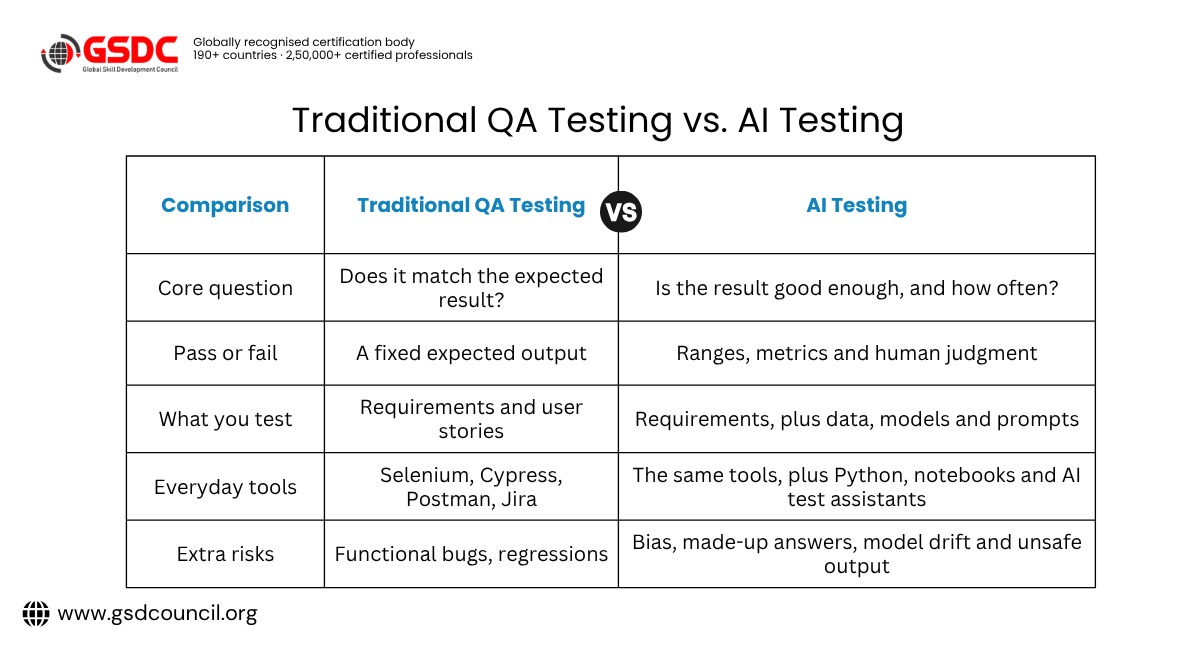
- Testing AI: You check products that contain AI, like chatbots, recommendation engines and fraud detection models, where the same input can give different answers.
That second part surprises most people. A classic test says: given input A, expect output B. An AI system might give you B, something close to B, or something nobody planned for. So the work shifts from checking exact answers to judging whether the behavior is accurate, fair, safe and consistent enough.
Why QA testers are moving toward AI now
The shift is simple to describe. Almost every team is trying AI in its quality work, and very few have made it work at scale. Testers sit right in the middle of that.
Many companies have bought the tools, but someone still has to check AI output, set quality standards and keep humans in the loop. That someone is increasingly a tester who understands AI.
AI tester skills you actually need
Good news first. You are not starting from zero. Most of what makes a strong tester today still matters tomorrow.
Start with the software testing skills you already have
These QA tester skills are the base of everything else. AI does not replace them. It raises the bar, because someone has to decide whether an AI-generated test is any good.
- Test design and risk thinking
- Exploratory testing and a nose for edge cases
- Clear, reproducible bug reports
- API testing and SQL basics
- Test automation fundamentals
- Agile and CI/CD awareness

Structured training programs usually cover much of this list. The Global Skill Development Council's AI testing program, for example, includes machine learning basics, performance metrics like confusion matrices, and techniques like metamorphic testing for outputs that change from run to run.
Soft skills that quietly matter
- Critical thinking: Confident-sounding answers can still be wrong.
- Communication: You'll often explain model risk to people who don't write code.
- Curiosity: The best AI testers enjoy poking at things to see what breaks.
- Ethical judgment: Fairness and safety problems rarely show up as error messages.
What you can skip for now
You don't need a math degree, and you don't need to build neural networks from scratch. You need to understand AI well enough to test it, not well enough to invent it.
How to become an AI tester: a 7-step QA engineer roadmap
If you're wondering how to become an AI tester, think of it as a QA engineer roadmap with a few new stops. Take the steps in order, but don't wait to feel "ready" before starting the next one.
- Audit what you already know.
Use the skills table above and mark what you can do today. Be honest. This tells you where to spend your time.
- Get comfortable with Python.
Start small. Write scripts that read a file, call an API or compare two outputs.
- Learn the core AI ideas.
Focus on how models learn, why data quality matters and what can go wrong. Skip the heavy math at first.
- Practice testing AI output.
Start with the practice projects below. Write down what "correct" means and how you'll measure it.
- Bring AI tools into your daily work.
Use them for test ideas, test data and failure triage, and always review the results yourself.
- Earn a credential.
A certification such as the Certified AI Testing Professional (CAITP) gives employers a quick signal. More on options in the next sections.
- Build a small portfolio.
Two or three documented projects beat a long list of course names.
Where to start depends on your background. This is a practical suggestion, not a fixed rule.
Your background | Learn first | Learn next | Learn later or as needed |
Manual QA tester | API testing basics, Python basics | Data literacy, evaluation metrics | Prompt writing for testing |
Automation engineer or SDET | Evaluation metrics, machine learning basics | Testing unpredictable output, AI quality factors | Monitoring and MLOps |
Essential for everyone: Python basics, evaluation metrics and the habit of reviewing AI output yourself. Everything else can follow the job you're aiming for.
QA career path: where AI testing fits
The QA career path used to be fairly linear. It's now a bit more branched, and AI testing is a natural next branch for people already in automation or quality engineering. Titles vary a lot by company, so treat this as a guide and not a rulebook.
Stage | Typical focus | What to add next |
Manual QA tester | Test cases, exploratory testing, bug reports | Automation and API testing |
Automation QA or SDET | Frameworks, CI/CD, regression suites | Python depth, data skills, AI-assisted testing |
Senior QA engineer | Test strategy, quality ownership | Machine learning basics, AI evaluation methods |
AI QA engineer or AI test engineer | Testing AI features and using AI inside QA work | Risk, governance and monitoring |
QA architect or AI quality lead | Standards, tooling, team direction | Leadership and AI risk policy |
For a sense of the baseline, the US Bureau of Labor Statistics reports a median US pay of $104,300 for software QA analysts and testers (May 2025). Reliable pay data for AI-specific testing roles is still thin, so be careful with any big salary promise.
AI testing jobs: titles, roles and where to look
Job titles are messy right now. One company posts an AI QA engineer role, another asks for an SDET with generative AI experience, a third calls it AI assurance. If you're searching for AI testing jobs or AI tester jobs, search by skills as well as titles.
The wider field is still large. The BLS counts about 187,600 software QA analyst and tester jobs in the US (2025), so these new titles are appearing inside an existing market, not a brand new one.
Title you may see | What it usually involves | Skills often asked for |
AI tester | Hands-on checking of AI output, often with human review | Exploratory testing, domain knowledge, clear reporting |
AI QA engineer | Testing AI-powered features and using AI in QA workflows | Python, API testing, evaluation basics |
AI test engineer | Designing tests for models, data pipelines and prompts | Machine learning basics, automation, data validation |
Test automation engineer (AI focus) | Building automation that uses AI tools | Frameworks, CI/CD, AI-assisted testing |
These are common patterns, not official definitions. Read the job description closely, because two companies can use the same title for very different work.
Try searching phrases like "AI QA engineer", "AI test engineer", "LLM testing", "model evaluation" and "AI assurance". Also check your own company first. Many testers make the move by volunteering for the first AI feature their team ships.
Three small projects that prove your skills
Hiring managers love evidence. These projects are small enough to finish and specific enough to talk about in an interview.
- Test a chatbot: Write 30 prompts, including tricky ones. Record where it makes things up, contradicts itself or ignores instructions. Summarize your findings in a one-page report.
- Evaluate a simple classifier: Use a public dataset and a basic model. Build a confusion matrix, calculate precision and recall, and explain in plain words what the numbers mean.
- Build an AI-assisted test workflow: Use an AI tool to draft test cases for a feature, then review and fix them. Track how many were useful, how many were wrong and what you learned.
Common mistakes to avoid
- Chasing tools instead of fundamentals: Tools change every few months. Test thinking lasts.
- Trusting AI-generated tests without review: A test that looks right can still miss the real risk.
- Skipping data basics: Many AI problems start with the data, not the model.
- Calling it done because it looked fine: Define what "good" means before you test.
- Waiting until you feel ready: Start with one small project this week.
The future of software testing
Nobody can predict the future of software testing exactly, but the direction is fairly clear. Routine work like writing scripts and sorting failures is moving to AI, while deciding what matters and what's risky still needs a person.
The World Quality Report 2025 points the same way. It describes the way forward as people and AI working together, which it calls collaborative intelligence, and it stresses that scaling AI takes strong quality engineering fundamentals.
So the future of QA testing looks less like clicking through scripts and more like designing smart checks, reading data and making risk calls. Testers who learn to work effectively with AI will be better prepared for how quality engineering evolves.
Certifications and learning resources
A certificate won't replace hands-on practice, but it gives you a structured path and a quick signal to employers. When you compare options, look for these things:
- Coverage that matches the role. AI fundamentals, evaluation metrics, testing unpredictable output and AI quality factors.
- Hands-on work. Projects and exercises, not only theory.
- Employer recognition. A credential that hiring teams know and can verify.
- A fair starting point. Clear prerequisites that fit your current QA experience.
Whatever route you choose, pair it with real exercises so the learning sticks.
One option built around these skills is the Global Skill Development Council's Certified AI Testing Professional (CAITP) certification. It is designed for people who test or validate AI systems, including QA professionals, test automation engineers and software testers. The program covers machine learning basics, AI quality characteristics such as bias and explainability, performance metrics like confusion matrices, test methods like metamorphic testing, and using AI for tasks like test case generation and defect prediction. No extensive AI background is needed, although testing experience helps.

Your next step
Moving from QA tester to AI tester isn't one big leap. It's a series of small, practical steps built on skills you already use. This week, pick one: write a Python script, test a chatbot or draft a short quality checklist for one AI feature.
Finish that one task before you move to the next. A few small, finished projects will teach you more than a long list of half-read courses, and they give you real examples to talk about in your next interview.

Related Certifications
Frequently Asked Questions
An AI tester is a QA professional who uses AI tools to test software, tests products that contain AI, or does both. The role builds on classic testing skills and adds data, evaluation and AI knowledge.
Basic Python helps a lot, and it opens more roles. You don't need to be a full-time developer. Many testers start with small scripts and build from there.
The data doesn't point that way. The US Bureau of Labor Statistics projects 6% growth from 2025 to 2035 for software QA analysts and testers. A 10% figure on the same page covers developers, QA analysts and testers as one group, so it doesn't describe testers alone. Tasks will change, though, so testers who learn to work with AI are in a stronger position.
It depends on your starting point and how many hours you can give each week. Most working testers can cover the basics in a few months. Deeper skills take longer and come mostly from practice.
If you're new to formal testing credentials, begin with ISTQB Foundation Level, which both AI certifications require. Then choose CT-AI to test AI systems or CT-GenAI to use generative AI in your testing.
Often, yes. Companies use the titles in different ways, so check the job description for the actual duties.
Stay up-to-date with the latest news, trends, and resources in GSDC
If you like this read then make sure to check out our previous blogs: Cracking Onboarding Challenges: Fresher Success Unveiled
Not sure which certification to pursue? Our advisors will help you decide!