Multi-Agent Orchestration in Project Delivery: What PMPs Need to Know
Written by Emily Hilton
- What Is Multi-Agent Orchestration?
- How Multi-Agent Systems Work in Project Delivery
- Key Applications of Multi-Agent Orchestration in Project Management
- Understanding AI Agent Orchestration in Real Project Workflows
- How AI Orchestration Improves Project Delivery
- Challenges PMPs Should Consider Before Implementing Multi-Agent Systems
- Practical Steps for PMPs to Implement Multi-Agent Orchestration
- How AI in Project Management Will Change the Role of PMPs
- Conclusion
Artificial intelligence is changing how organizations plan projects, coordinate teams, manage resources, and track delivery outcomes. While traditional project management software helps professionals organize tasks and monitor progress, the next stage of AI adoption is introducing systems that can independently handle different parts of a project workflow.
One important development is multi-agent orchestration, an approach that allows multiple AI agents to work together toward a shared objective. Instead of relying on a single AI assistant, organizations can use specialized agents to manage scheduling, analyze risks, monitor budgets, prepare reports, and support decision-making.
For Project Management Professionals (PMPs), this development creates new opportunities to improve project efficiency and reduce repetitive administrative work. However, coordinating multiple AI agents also introduces challenges involving communication, accountability, data accuracy, and human oversight.
Understanding how multi-agent systems operate and how they fit into project delivery can help project managers prepare for increasingly AI-driven work environments.
What Is Multi-Agent Orchestration?
Multi-agent orchestration refers to the process of coordinating multiple AI agents so they can collaborate, exchange information, and complete tasks within a larger workflow.
Each agent is assigned a specific responsibility based on its capabilities. An orchestration layer manages how these agents communicate, share information, execute tasks, and deliver results.
For example, consider a software development project involving several activities:
- A planning agent breaks project requirements into tasks.
- A scheduling agent recommends timelines and resource allocation.
- A risk analysis agent identifies potential project delays.
- A reporting agent prepares progress summaries.
- A quality assurance agent reviews deliverables against project requirements.
Instead of performing every activity manually, project managers can use AI agents to handle individual responsibilities while maintaining control over the overall project.
The main objective of multi-agent orchestration is not to replace project managers but to coordinate specialized AI capabilities more effectively.
How Multi-Agent Systems Work in Project Delivery
Multi-agent systems consist of multiple independent or semi-independent agents that communicate and collaborate to achieve a shared goal.
These systems generally include three important elements:
1. Specialized agents: Each agent performs a defined task, such as scheduling, reporting, resource planning, or risk identification.
2. Communication mechanisms: Agents exchange information through shared memory, messages, APIs, or other communication methods.
3. Orchestration layer: This layer coordinates task distribution, manages execution sequences, monitors progress, and handles failures.
Depending on the project requirements, orchestration can follow different approaches.
- Centralized orchestration: A central controller assigns tasks and coordinates agent activities.
- Decentralized orchestration: Agents communicate and coordinate with one another without relying entirely on a central controller.
- Hierarchical orchestration: A lead agent manages specialized agents responsible for individual project activities.
For most enterprise project environments, centralized or hierarchical approaches can provide better visibility and control because responsibilities and approval processes are easier to define.
Key Applications of Multi-Agent Orchestration in Project Management
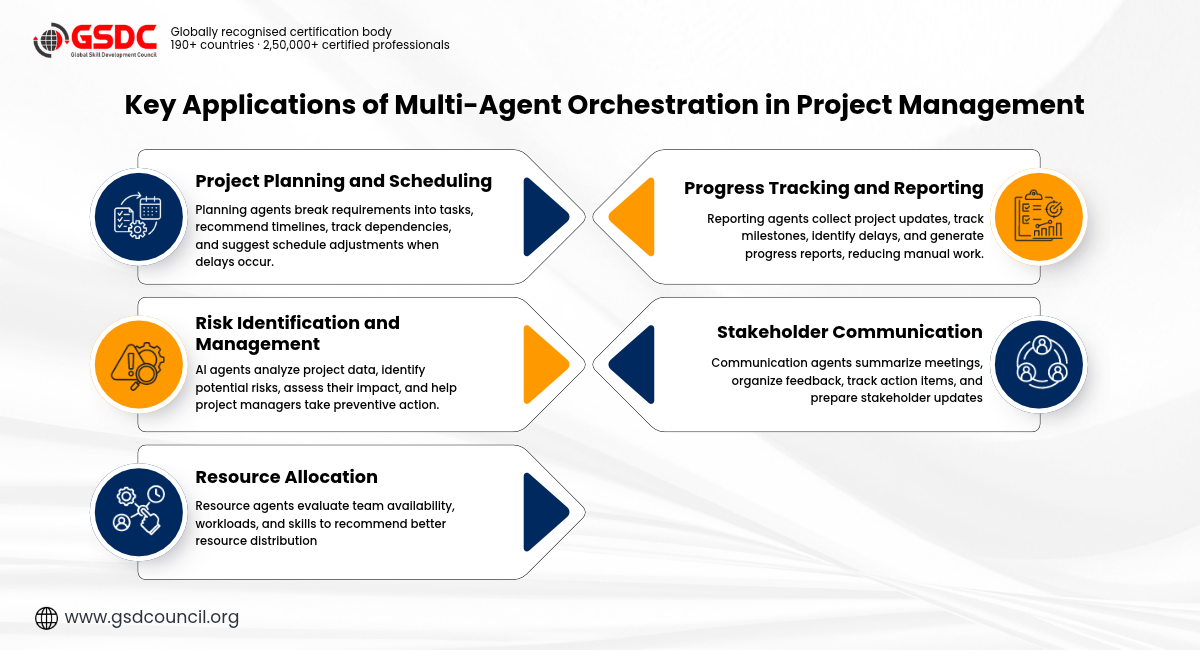
Multi-agent orchestration can support several project management activities, particularly when projects involve multiple teams, dependencies, and changing requirements.
1. Project Planning and Scheduling
Planning agents can analyze project requirements, break large deliverables into smaller tasks, and recommend timelines. Scheduling agents can identify dependencies, track milestones, and suggest adjustments when deadlines change.
For example, if a development task is delayed, the scheduling agent can identify affected activities and recommend an updated timeline for the project manager's review.
2. Risk Identification and Management
Risk management requires continuous monitoring of project activities. AI agents can analyze project reports, historical data, resource availability, and task dependencies to identify potential risks.
A risk monitoring agent can flag possible delays, while another agent evaluates their impact on project objectives. This allows project managers to address problems before they affect delivery.
3. Resource Allocation
Managing resources across multiple projects can become complicated, especially when employees have competing priorities.
Resource management agents can analyze team workloads, availability, skills, and upcoming deadlines. They can recommend resource adjustments and highlight situations where additional support may be required.
However, final resource allocation decisions should remain with project managers.
4. Progress Tracking and Reporting
Reporting is one of the most time-consuming project management activities. Reporting agents can collect updates from project management platforms, summarize completed tasks, identify pending activities, and prepare progress reports.
Other agents can compare actual progress with planned milestones and highlight deviations.
This reduces manual reporting work and gives project managers more time to focus on stakeholder communication and decision-making.
5. Stakeholder Communication
Communication agents can help prepare meeting summaries, organize stakeholder feedback, track action items, and draft project updates.
For example, after a project meeting, an agent can extract important decisions, identify assigned responsibilities, and prepare a follow-up summary for review.
These applications demonstrate how AI for project management can move beyond basic automation and support coordinated project delivery.
Understanding AI Agent Orchestration in Real Project Workflows
To understand how AI agent orchestration works in practice, consider a company implementing a new customer relationship management (CRM) platform.
The project involves software developers, business analysts, quality assurance teams, and external stakeholders.
A coordinated workflow could look like this:
- Planning agent: Reviews project requirements and prepares an initial task breakdown.
- Scheduling agent: Creates a proposed timeline based on task dependencies and resource availability.
- Risk agent: Identifies potential integration issues and delivery risks.
- Execution monitoring agent: Tracks task updates and identifies delays.
- Reporting agent: Combines information from other agents into a project status report.
The orchestration layer ensures that information moves between these agents in the correct sequence.
For example, when the execution monitoring agent identifies a delay, it can notify the risk agent. The risk agent then evaluates the impact, and the scheduling agent recommends timeline adjustments.
The project manager reviews these recommendations and approves the necessary changes.
This is how agentic workflows can make project delivery more connected, responsive, and efficient.
How AI Orchestration Improves Project Delivery
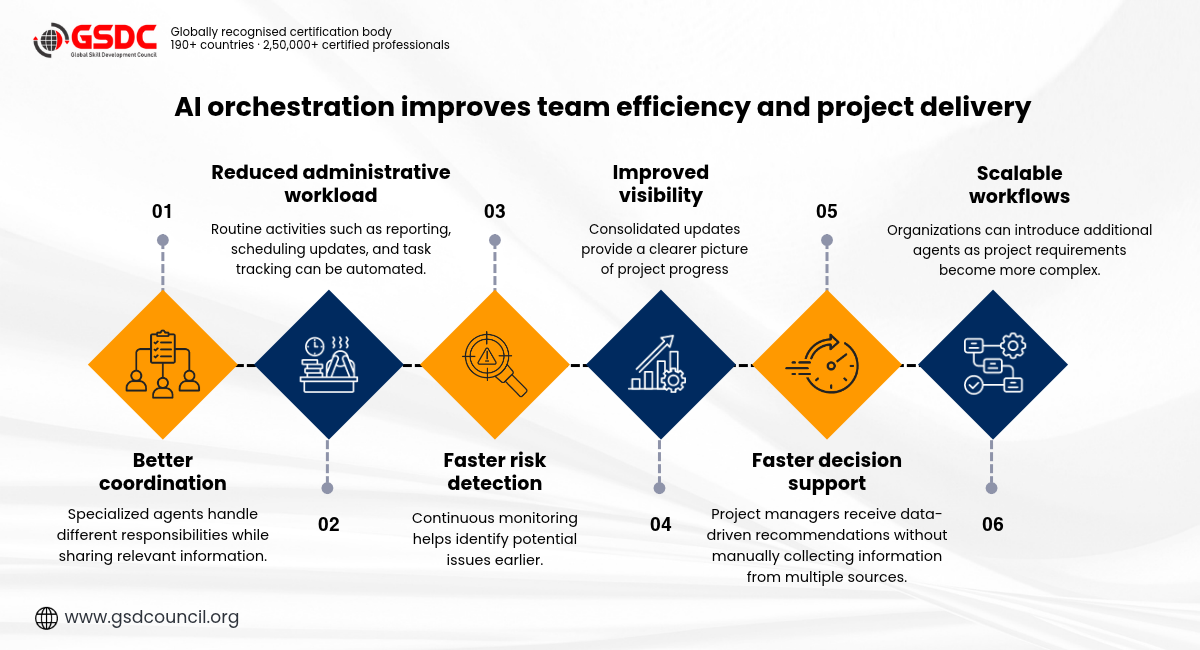
Challenges PMPs Should Consider Before Implementing Multi-Agent Systems
Although multi-agent systems offer several advantages, their implementation requires careful planning and governance.
- 1. Communication failures: Agents may exchange incomplete, outdated, or incorrect information, affecting subsequent decisions.
- 2. Conflicting recommendations: Different agents may produce recommendations that do not align. A clear decision-making structure is necessary to resolve conflicts.
- 3. Data security and privacy: Agents may access sensitive project information. Organizations must establish permissions and data access controls.
- 4. Integration complexity: Connecting multiple agents with existing project management platforms, databases, and enterprise applications can require significant technical effort.
- 5. Uncontrolled execution: Agents may repeat tasks, trigger unnecessary actions, or continue workflows without appropriate approval mechanisms.
- 6. Accountability: Project managers must establish who is responsible for reviewing AI-generated recommendations and approving important decisions.
To address these challenges, organizations should define clear agent responsibilities, establish communication protocols, introduce approval checkpoints, and maintain execution logs.
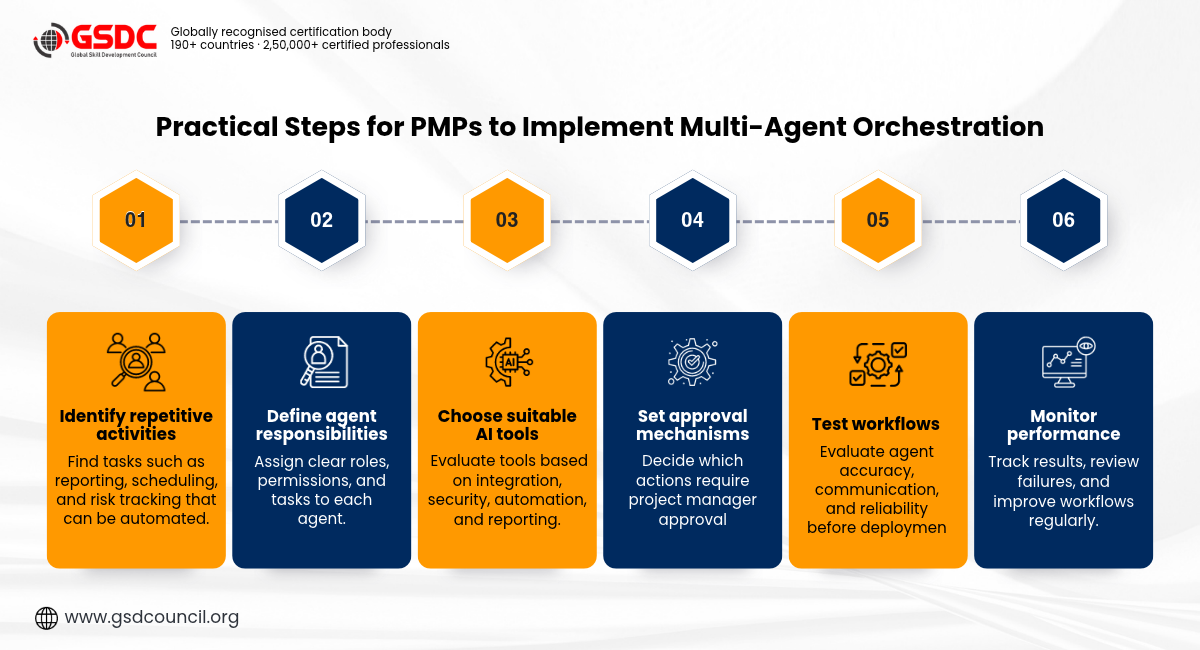
Practical Steps for PMPs to Implement Multi-Agent Orchestration
Project managers do not need to become AI developers to work effectively with orchestrated AI systems. However, they should understand how these systems operate and how to introduce them into existing project environments.
Here are some practical steps:
1. Identify repetitive project activities: Start by identifying tasks such as progress reporting, meeting summaries, risk tracking, and schedule updates that could benefit from automation.
2. Define clear agent responsibilities: Assign each agent a specific role and establish what information it can access and what actions it can perform.
3. Select suitable AI project management tools: Evaluate platforms based on their integration capabilities, workflow automation, security, reporting, and support for AI agents.
4. Establish approval mechanisms: Define which activities agents can complete independently and which require project manager approval.
5. Test workflows before deployment: Run pilot projects to evaluate agent accuracy, communication, task completion, and reliability.
6. Monitor and improve performance: Track automation results, review failures, collect team feedback, and update workflows as project requirements change.
A gradual implementation approach helps organizations understand the value of AI orchestration without introducing unnecessary complexity.
How AI in Project Management Will Change the Role of PMPs
GSDC's Generative AI in Project Management Certification helps professionals understand how generative AI can support different stages of project delivery, including planning, risk identification, stakeholder communication, scheduling, and reporting. It explores how AI tools can improve productivity, automate repetitive tasks, and support data-driven decision-making.
For PMPs looking to stay relevant in an AI-driven environment, this Generative AI in Project Management Certification helps strengthen their understanding of practical AI applications in project management. It prepares professionals to integrate generative AI into project workflows while maintaining human oversight, accountability, and effective project governance.
Conclusion
Multi-agent orchestration represents an important development in project delivery. By coordinating specialized AI agents, organizations can improve planning, automate repetitive activities, monitor risks, and gain better visibility into project performance.
However, successful implementation requires more than connecting multiple AI agents. Organizations must establish clear responsibilities, reliable communication, security controls, and appropriate human oversight.
For PMPs, understanding multi-agent systems and agentic workflows is an opportunity to prepare for the future of project management. The goal is not to hand over project ownership to AI but to use intelligent systems to make project delivery more efficient, informed, and responsive.

Related Certifications
Stay up-to-date with the latest news, trends, and resources in GSDC
If you like this read then make sure to check out our previous blogs: Cracking Onboarding Challenges: Fresher Success Unveiled
Not sure which certification to pursue? Our advisors will help you decide!